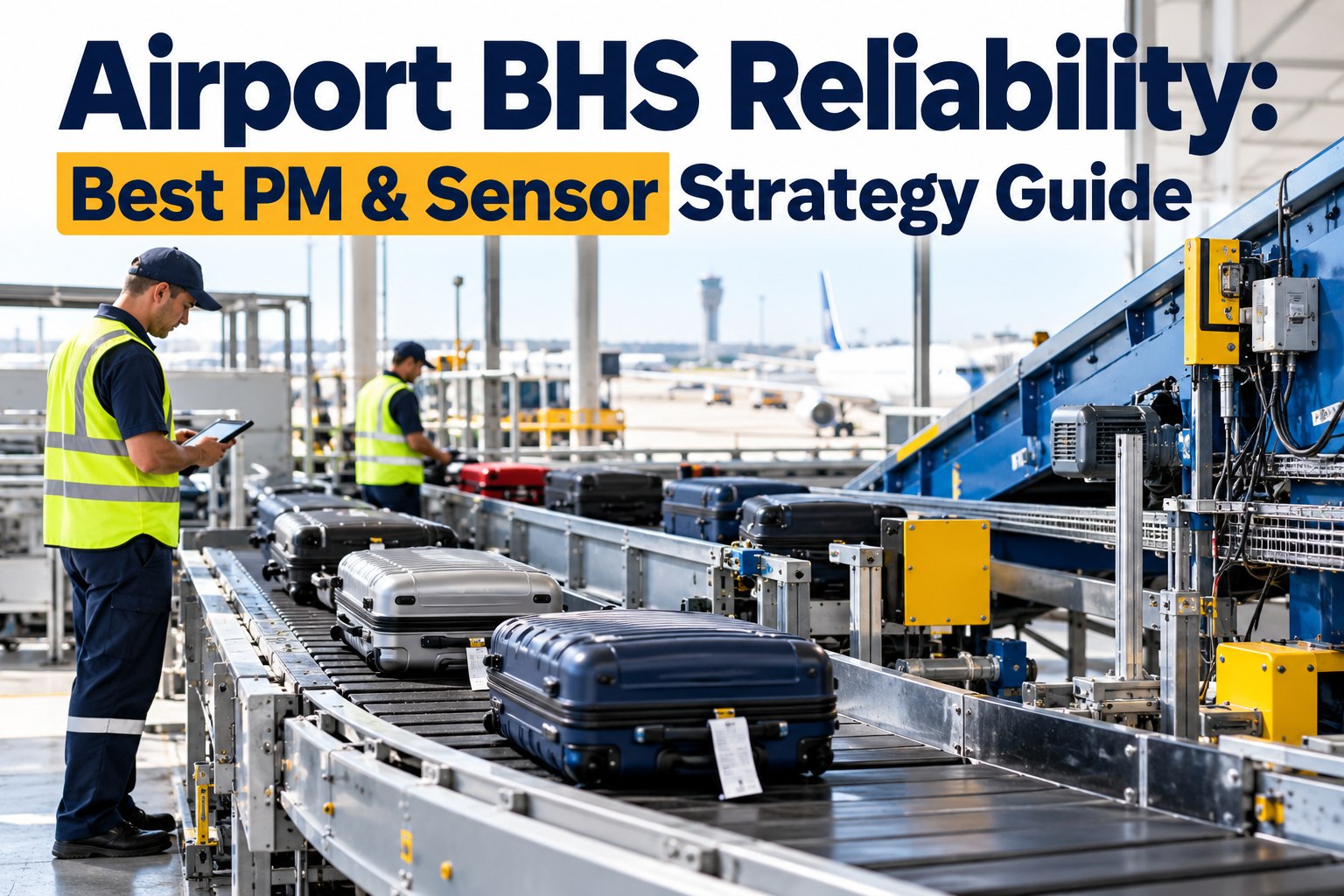
A conveyor motor draws a little more current every week, a gearbox runs a few degrees hotter, a belt drifts off track — and none of it shows up until a jam backs up an outbound bank and bags start missing their flights. That's the gap between a scheduled PM and a bag that made the plane. OXMAINT AI is AI-powered maintenance management software (CMMS) that watches the signals your baggage handling system already gives off — motor current, vibration, gearbox temperature, belt tracking — and turns a drifting reading into a ranked work order before it becomes a jam. Book a demo to see condition data drive your PM.
Airport BHS · PM & Sensor Strategy
Catch the Jam Before It Costs a Bag Its Flight
Baggage systems rarely fail without warning — the warning just isn't being read. OXMAINT AI pairs condition sensors with a maintenance workflow: it reads motor current, vibration, gearbox oil and belt wear, flags the component that's trending toward failure, and issues a work order timed for an operational lull — so a slow drift never becomes a peak-bank jam.
- 1Sensor reads signal
- 2Trend crosses threshold
- 3Work order raised
- 4Fixed in a quiet window
Mishandled baggage, 2024
6.3per 1,000 pax
down from 6.9 in 2023
~$5Bindustry cost of mishandling
41%of incidents transfer-related
Source: SITA Baggage IT Insights 2024
Every BHS Failure Sends a Signal First
A conveyor doesn't seize out of nowhere. Each failure mode has a measurable precursor — the trick is having something read it. This is the map from component to the signal that betrays it. Start a free trial to monitor these signals.
BHS component to failure signal to sensor mapping
| Component | How it fails | The signal that warns you |
| Drive motor |
Winding stress, bearing wear, micro-stops |
Rising current draw & anomaly patterns |
| Gearbox |
Oil degradation, tooth wear, overheating |
Temperature rise & oil-analysis particles |
| Bearings |
Lubrication loss, spalling |
Vibration signature & acoustic change |
| Belt |
Mistracking, tension loss, wear |
Tracking variance & surface condition |
| Rollers |
Seizing, flat spots, heat build-up |
Thermal hotspots & noise |
| Diverters & PLC |
Actuator lag, control faults |
Acoustic pattern & micro-stop latency |
Component-to-signal mapping reflects published BHS condition-monitoring practice (GEMS; SITA). Which signals you act on depends on the sensors fitted to your lines.
The Four Signals Worth Wiring to a Work Order
You don't need to instrument everything — you need the handful of parameters that predict the failures that stop a line. Start here. Book a demo to see thresholds on your equipment.
Motor current
A creeping amperage draw flags load, friction or a failing bearing long before the motor trips.
Vibration
A shifting vibration signature is the earliest tell of bearing wear, imbalance or misalignment.
Gearbox temp & oil
Rising temperature and oil-particle counts catch tooth wear and lubrication loss before seizure.
Belt tracking & wear
Tracking drift and surface wear predict the mistracks and jams that back up an entire loop.
Turn a Drifting Reading Into a Timed Repair
See how OXMAINT AI takes a sensor trend, raises a work order with the part and the window attached, and closes the loop before the line stops.
From Reading to Repair: The Condition-to-Work-Order Loop
Condition monitoring only pays off when the reading becomes an action. This is the loop OXMAINT AI runs so a signal doesn't just sit on a dashboard. Start a free trial to run the loop on your lines.
1
Read
Sensors stream current, vibration, temperature and tracking data from each drive and belt section.
2
Trend
Readings are baselined so a slow drift stands out from normal noise — not just a hard alarm.
3
Trigger
Crossing a threshold raises a ranked work order with the suspected component, part and tools.
4
Time it
The job is scheduled into an operational valley, not forced during a peak outbound bank.
5
Close & learn
The fix is logged against the asset, and repeat offenders surface for deeper overhaul.
The Reliability Numbers Worth Watching
Availability is the outcome; these are the levers beneath it. Track them per line and the weak sections show themselves. Book a demo to track them across your BHS.
Line availability
The share of scheduled time each conveyor loop is actually running bags.
MTBF by section
Mean time between failures per loop — where reliability is thin and effort should go.
MTTR
Mean time to repair — how fast a stopped line comes back, before the queue snowballs.
PM vs reactive
The ratio of planned to breakdown work — the clearest sign the strategy is shifting left.
How OXMAINT AI Runs BHS Reliability
OXMAINT AI is maintenance management software that connects condition data, PM schedules and work orders for every conveyor, drive and diverter — so reliability is managed by signal, not by surprise. Start a free trial to connect your first line.
-
1
Monitor
Ingest current, vibration, temperature and tracking data alongside time-based PM schedules.
-
2
Predict
Baseline each signal so drift toward failure is flagged early, not at the alarm point.
-
3
Dispatch
Raise a ranked work order with the part and a low-traffic window, then track it to closeout.
-
4
Improve
Surface repeat-failure sections and MTBF trends to target overhaul and spares.
Frequently Asked Questions
Which BHS components fail most and how are they monitored?
Motors, gearboxes, bearings and belts are the usual culprits — monitored through current draw, vibration, temperature, oil analysis and belt tracking. A CMMS ties those signals to action.
Start a free trial to monitor them.
How does sensor data reduce mishandled bags?
By catching a failing conveyor before it jams, it keeps outbound and transfer lines moving during peak banks — the moments when a stopped line turns into missed connections.
Book a demo to see the link.
Do I need to replace time-based PM entirely?
No — condition monitoring layers on top of PM. Routine tasks stay scheduled; sensor triggers add the early warnings that time-based cycles miss.
Start a free trial to run both.
What does a condition-triggered work order include?
The suspected component, the likely part and tools, the expected downtime and a suggested low-traffic window — so the fix is planned, not scrambled.
Book a demo to see one built.
Can OXMAINT AI show which lines fail most?
Yes — because every failure is logged to a section, MTBF and repeat-callback data surface the weakest loops so you can target overhaul and spares.
Start a free trial to find them.
Keep the Belts Moving and the Bags on Their Flights
Read the signals, trigger the work order, fix in the quiet window — reliability for every conveyor, drive and diverter on one platform.