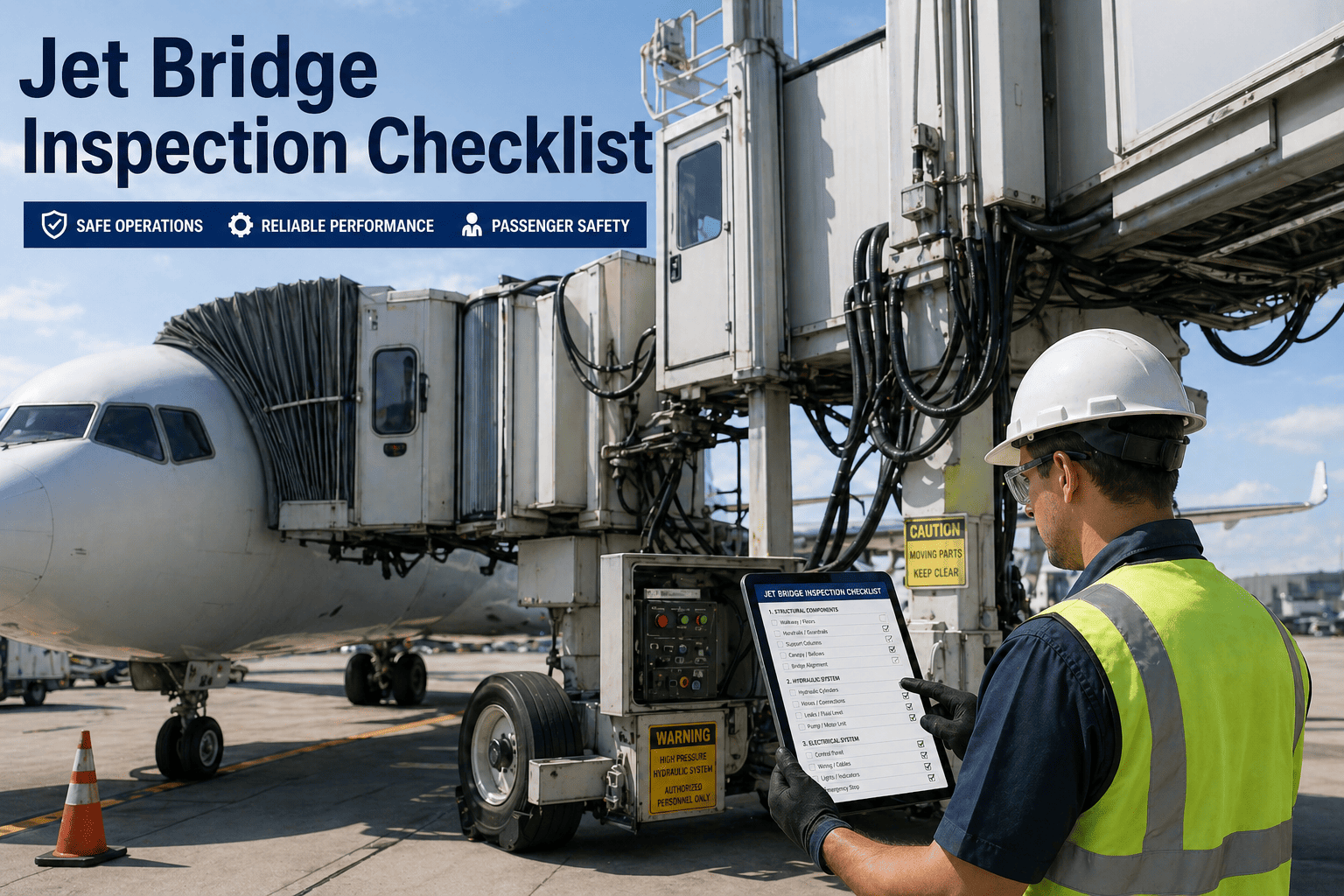
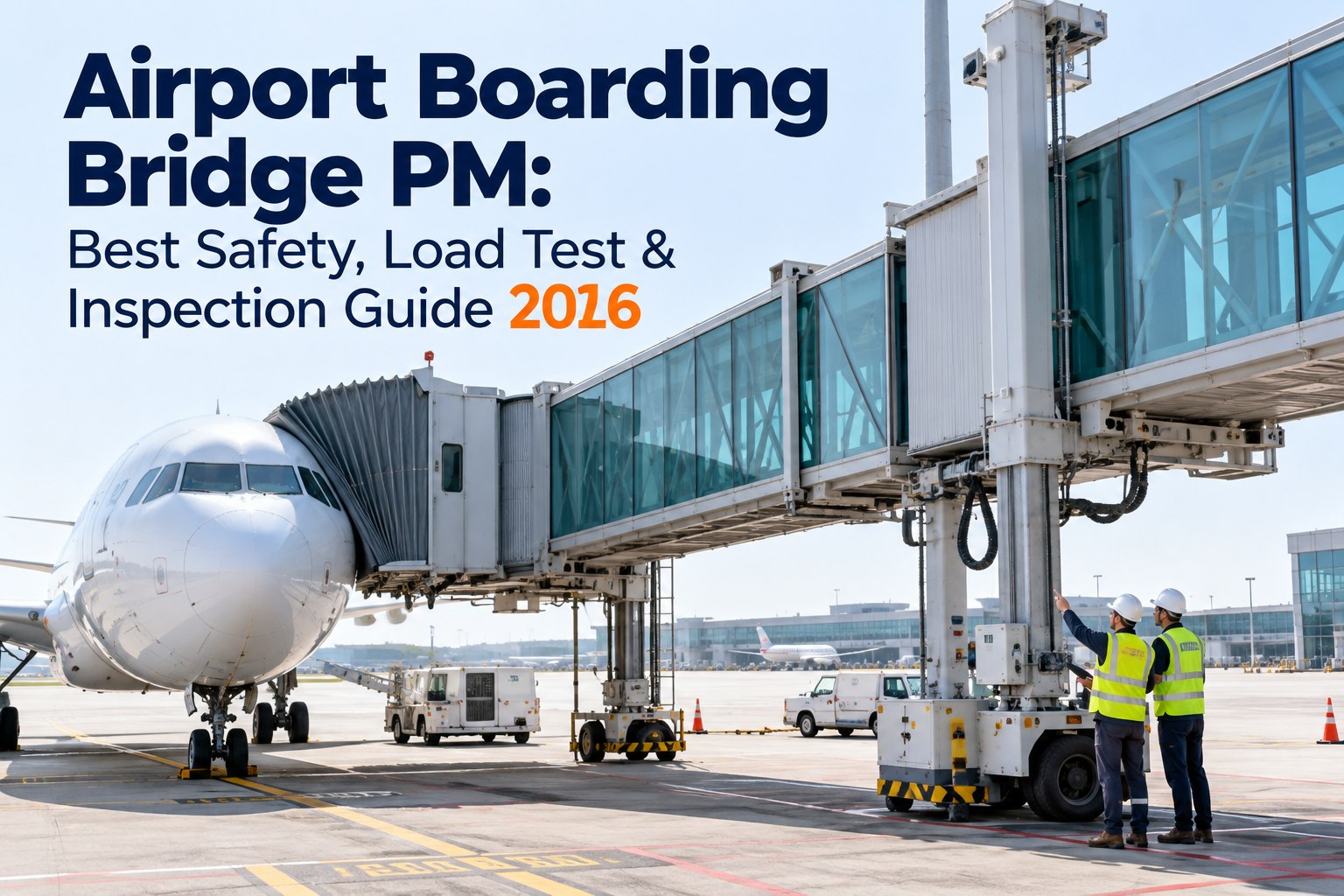
A single jet bridge failure during peak operations does not just delay one flight — it cascades across the gate schedule, forces remote stand operations, and creates passenger experience failures that no airline forgets at contract renewal. Passenger Boarding Bridges handle 150 to 400 docking cycles per month at busy gates, and every cycle stresses hydraulics, drive systems, sensors, and structural joints. Airports that rely on reactive repairs spend 4.8x more per incident than those running structured preventive programs. This checklist converts PBB maintenance from paper-based guesswork into a digital, audit-ready workflow. Book a demo to see how Oxmaint automates jet bridge inspection scheduling across your entire terminal.
400+
docking cycles per month at high-traffic gates — each one stressing hydraulics and drive systems
4.8x
cost multiplier for emergency PBB repairs vs. planned preventive maintenance
5-7 yr
typical rebuild cycle for hydraulic cylinders based on cycle count and climate exposure
98%
gate availability target — achievable only with structured PM programs
The Four-Tier PBB Inspection Framework
Industry best practice structures jet bridge maintenance into four tiers, each with defined scope, frequency, and documentation requirements. Airports running all four tiers consistently report 98%+ gate availability and 60% fewer unplanned outages. Want to deploy this framework digitally across your terminal? Start a free trial and configure tiered PM schedules for every bridge in your fleet.
Tier 1 — Daily
Operator Walk-Around
Pre-use visual safety check. Walkway clear of FOD, no oil or water contamination, proper positioning within starburst lines, all controls and indicator lights operational. Duration: 5-10 minutes per bridge.
Tier 2 — Monthly
Functional Inspection
Full operational cycle testing. Hydraulic system integrity, drive wheel condition, tire pressure, tunnel alignment, canopy weatherproofing, and sensor calibration verification. Duration: 45-90 minutes.
Tier 3 — Annual
Comprehensive Audit
Full system teardown and inspection. Structural integrity assessment, electrical safety testing, load testing of critical mechanical systems, and complete documentation review. Requires specialist technicians.
Tier 4 — 5-Year
NDT & Structural Survey
Long-term fatigue and material degradation analysis. Ultrasonic testing, corrosion mapping of structural members, fatigue analysis of joints and lifting columns. Determines remaining useful life.
Automate All Four Inspection Tiers From One Dashboard
Oxmaint schedules daily walk-arounds, monthly functionals, annual audits, and 5-year NDT cycles automatically — with digital checklists, photo capture, and timestamped completion records your compliance team can audit instantly.
System-by-System Inspection Checklist
Each PBB subsystem has specific failure modes and inspection criteria. The checklist below covers the six critical systems that account for 92% of all jet bridge failures and unplanned gate closures.
Hydraulic System
Cylinder seal integrity — check for external leaks at rod and piston seals
Hydraulic fluid level and condition — sample for contamination quarterly
Pressure test against OEM specifications — record and trend readings
Hose and fitting condition — replace cracked or bulging hoses immediately
Drive System
Drive wheel tread depth and condition — replace at 50% wear threshold
Wheel bearing play and lubrication — repack per OEM schedule
Drive chain tension and sprocket wear — adjust or replace at limits
Motor brush length and commutator condition — document measurements
Safety Sensors
Auto-leveling system — test response to simulated aircraft height change
Anti-collision sensors — verify trigger distance and response time
Safety shoes — test contact detection and emergency stop activation
Limit switches and encoders — verify positioning accuracy and calibration
Cab & Electrical
Operator control panel — test all buttons, joysticks, and indicator lights
Emergency stop circuits — verify all E-stop stations activate correctly
Lighting — walkway, exterior, and cab illumination functional and adequate
Wiring and connections — inspect for chafing, corrosion, and loose terminals
Structural & Tunnel
Weld joints — inspect for fatigue cracks especially at lifting column connections
Tunnel segments — check alignment, weatherseal condition, and floor integrity
Canopy and bumper — verify aircraft interface seal and bumper compression
Corrosion — document and treat any surface corrosion before structural impact
Aircraft Interface
Rotunda floor — check for warping, loose panels, and trip hazards
Preconditioned air connection — verify coupling integrity and seal condition
Ground power cable — inspect for damage, test voltage output stability
Handrail and closure panels — ensure passenger safety barriers are secure
Paper Checklists vs. CMMS-Managed PBB Maintenance
| Dimension | Paper-Based | With Oxmaint CMMS |
|---|
| Inspection records | Filed in binders, often incomplete | Timestamped digital records with photos and signatures |
| PM scheduling | Calendar reminders, manually tracked | Auto-scheduled by tier with overdue escalation alerts |
| Failure trending | No data aggregation across fleet | Fleet-wide failure pattern analysis and prediction |
| Parts inventory | Stockouts discovered at repair time | Auto-reorder triggers tied to PM schedules |
| Compliance audit | Days of manual document assembly | Instant retrieval — all records searchable on demand |
| Gate availability | 85-90% with reactive approach | 98%+ with structured preventive maintenance |
ROI of Structured PBB Maintenance
60%
Fewer Unplanned Outages
Tiered inspections catch degradation before failure — converting emergency repairs into scheduled interventions.
98%
Gate Availability
Structured PM programs maintain bridge readiness at levels that eliminate remote stand operations from equipment failure.
35%
Lower Maintenance Cost
Planned repairs cost a fraction of emergency callouts — and extend equipment life by 30-40% beyond reactive baselines.
100%
Audit Readiness
Every inspection, every work order, every part replacement permanently recorded with digital signatures for FAA compliance.
These results are typical for airports that transition from paper-based PBB maintenance to structured CMMS workflows. The cost of a single gate closure during peak operations — passenger rebooking, airline penalties, and operational disruption — exceeds the annual cost of a comprehensive digital maintenance program. Protect your gate availability and prove your compliance — book a demo to see PBB inspection workflows in Oxmaint, or start a free trial to deploy digital checklists across your terminal fleet today.
How often should jet bridge hydraulic systems be fully inspected?
Daily visual checks for leaks, monthly pressure testing and seal verification, and full hydraulic system rebuild every 5-7 years based on cycle count and environmental conditions. Oxmaint tracks cycle counts per bridge and triggers rebuild work orders automatically when thresholds are reached.
Start a free trial to set up cycle-based maintenance triggers.What happens if an auto-leveling sensor fails during operations?
Auto-leveling failure requires immediate bridge removal from service per FAA guidance. The anti-collision sensors and safety shoes provide backup protection, but the bridge cannot be used for passenger operations until the auto-leveler is repaired and tested. Oxmaint flags sensor failures as priority-1 work orders with automatic gate status updates.
Book a demo to see priority-based work order routing.Can CMMS track maintenance across different PBB manufacturers?
Yes. Oxmaint supports multi-manufacturer fleets with model-specific inspection templates, OEM-aligned PM schedules, and separate parts catalogs per manufacturer. Each bridge carries its own asset record with full service history regardless of make or model.
What documentation does FAA expect for PBB maintenance compliance?
FAA expects documented inspection records aligned with AC 150/5220-21C, complete maintenance histories per bridge, technician qualification records, and evidence of OEM-recommended maintenance intervals being followed. Oxmaint stores all of this digitally with timestamps and signatures — retrievable in seconds during an audit.
Start a free trial to see audit-ready documentation.
Every Gate Closure Is a Revenue Event You Cannot Reverse.
Oxmaint automates four-tier PBB inspections, tracks hydraulic cycle counts, enforces sensor verification, and stores every maintenance record with digital signatures — so your bridges are available when the aircraft arrives and your compliance is proven when the auditor arrives.
4-Tier PM SchedulingCycle-Based TriggersDigital Safety ChecklistsFleet-Wide Analytics