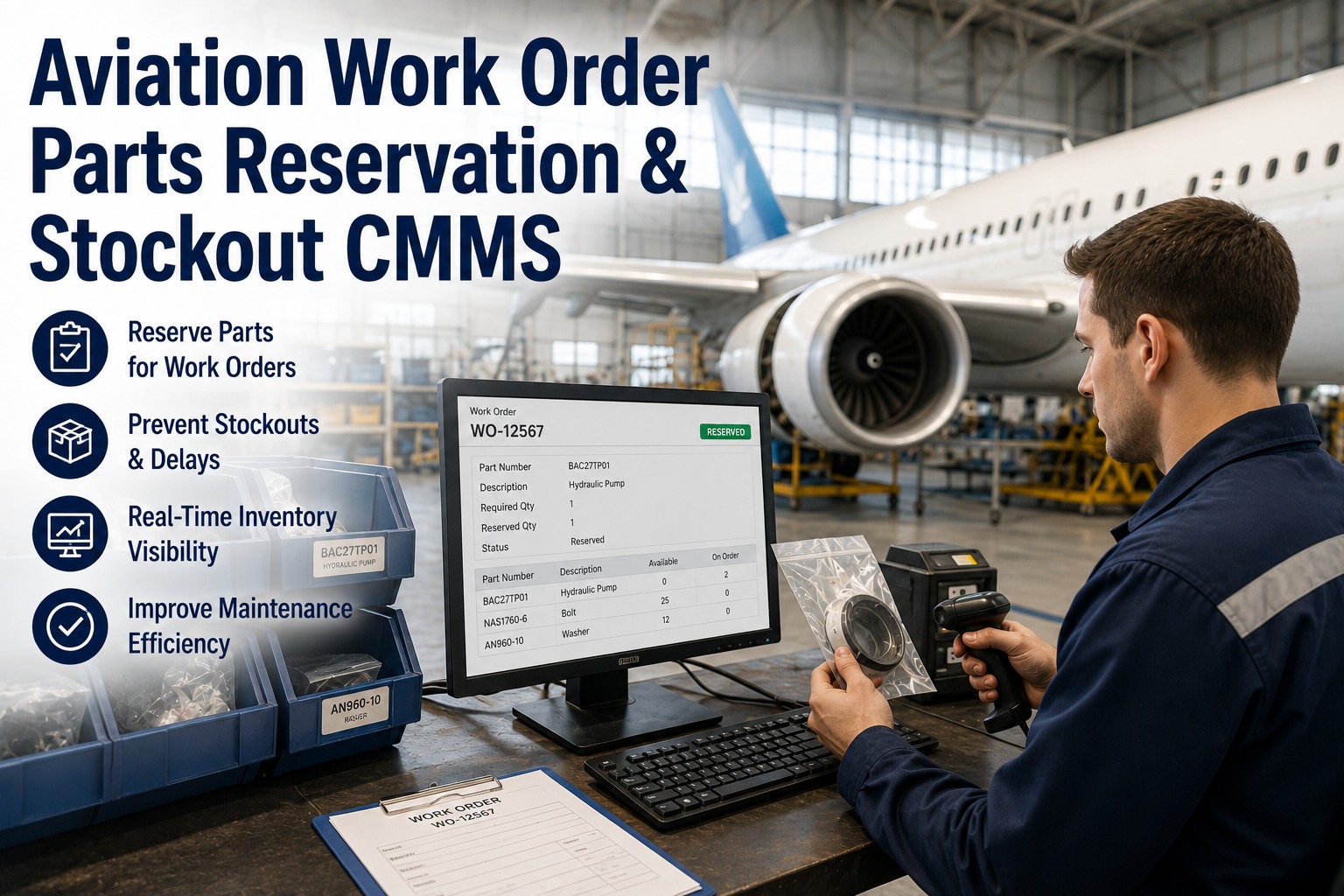
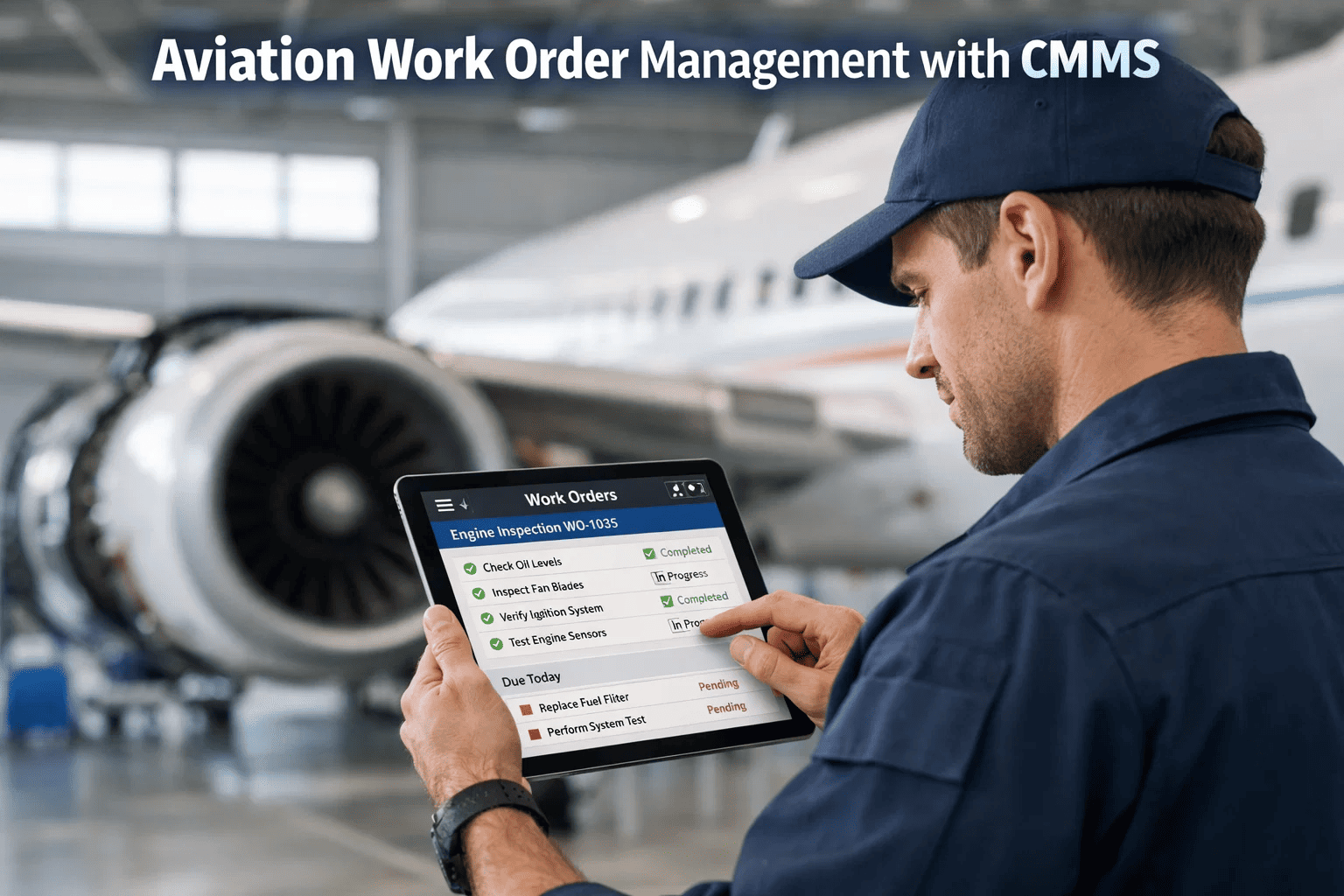
A Part 145 repair station does not just need a CMMS — it needs a production system. Work packages move through induction, disassembly, inspection, repair, reassembly, test and certification. Stamps must be tied to authorized signatories. Capability lists must match the work being released. Billing must reconcile labor hours, parts consumed, and outside-vendor charges back to the work order. And every aircraft sitting in the hangar is generating roughly $10,000 to $80,000 per flight hour of lost revenue for its operator while it is grounded — meaning every day of unnecessary turnaround time has a customer cost measured in six figures. Bain & Company's analysis shows engine shop turnaround times are up 35% on legacy engines and over 150% on new-generation engines since pre-pandemic — and most of that delay traces back to fragmented production systems, manual paperwork and capability bottlenecks rather than wrench time. A purpose-built MRO software platform replaces the fragmented stack with one production-and-compliance system that handles every workflow inside a Part 145 facility, from work pack import to invoice release. Start a free trial and see how OxMaint runs a Part 145 floor, or book a demo and we will walk through a real component repair workflow.
150%+
increase in engine shop turnaround time on new-generation engines vs. pre-pandemic (Bain & Company)
35%
increase in legacy engine shop turnaround times — driving capacity shortfall across the industry
17%
projected MRO capacity shortfall by end of decade if shop efficiency does not improve (Bain analysis)
$2.8M
global average MRO cost per aircraft tail per year — variance heavily tied to shop efficiency
What Is an MRO Software Platform?
An MRO software platform is the operating system of a Part 145 repair station. It manages every workflow from work-pack induction to certified release: shop scheduling, capability-list verification, parts pick and consumption, labor capture, NDT and inspection results, stamps and certifying staff, outside-vendor subcontracting, and final billing. Every action is timestamped and traceable to a named individual — because FAA and EASA Part 145 audits demand exactly that level of evidence.
Where a generic ERP fails, an MRO platform is built around the realities of repair-station operations: serial-number-driven components, mandatory data approvals (SRM, OEM, DER), Form 8130-3 and EASA Form 1 release tags, and the constant pressure to compress turnaround time without compromising airworthiness. Start a free trial and stand up a sample work pack, or book a demo and we will model your capability list live.
Core Workflows in a Part 145 MRO Platform
01
Work Pack Induction
Customer work scope, task cards and component arrival logged at induction. Capability check confirms the work is within scope before the job opens.
02
Capability List Management
Live capability list maps every approved component, repair scheme and limitation. Scope creep blocked at induction — no out-of-scope work accepted.
03
Shop Routing & Scheduling
Work-package tasks routed through disassembly, inspection, repair, reassembly and test cells with man-hours and tooling allocated against capacity.
04
Parts & Materials Control
Serialized rotables and consumables issued against the work order with 8130-3, Form 1 and shelf-life records linked. USM parts traced back-to-birth.
05
Stamps & Certification
Each task signed off by authorized certifying staff with stamp number, scope of authorization and two-factor verification. Forged signatures impossible.
06
Billing & Release
Labor hours, parts consumed and subcontracted work auto-reconcile to the work order. Release tag issued and invoice generated in one workflow.
Why Most Repair Stations Lose Margin on Every Job
Untracked TAT Slippage
Quoted turnaround time slips by 20–40% on most jobs because shop status lives in supervisor heads and whiteboards. By the time slip is reported, recovery is impossible.
Labor Hour Leakage
Technicians log time at end of day from memory. Hours that should bill to the customer instead get absorbed into overhead — every job under-bills by 8–15%.
Out-of-Scope Acceptance
Work accepted that the station is not capability-listed for. Discovered late in the job — too late to subcontract — forcing slip, customer credit, or quiet release of non-compliant work.
Stamp & Sign Gaps
Tasks closed without proper certifying staff sign-off. Audit findings against the certificate. In the worst case — surrender or suspension of Part 145 approval.
Every day of unnecessary turnaround time costs a Part 145 customer over $200K in lost aircraft revenue.
How OxMaint Runs a Modern Part 145 Operation
OxMaint replaces the fragmented MRO stack — work-order software here, parts system there, capability list in a spreadsheet, billing in QuickBooks — with one cloud platform. Every event in the shop ties back to a single work order, a single technician, and a single certificate of approval. The result is faster turnaround, complete margin capture and audit confidence on demand. Book a demo and we will walk through a component induction-to-release on your capability list.
Capability-Verified Induction
Every incoming work request checked against the live capability list before acceptance. Out-of-scope work blocked at the door — or routed to a pre-approved subcontractor with traceability intact.
Real-Time Shop Floor Status
Every work order, task and component visible by cell, by technician and by stage. Supervisors see slip before it happens — and reallocate capacity before customer TAT is missed.
Mobile Labor & Stamp Capture
Technicians clock on and off tasks from their device. Certifying staff stamp tasks with two-factor verification. Every labor hour and every signature timestamped and tied to a named individual.
Serialized Parts & USM
Every part — new, repaired, USM — tracked by serial with 8130-3, Form 1, back-to-birth and shelf-life records. Audit-ready traceability on every component released.
Subcontractor Control
Outside-vendor work tracked against the same work order. Subcontractor capability verified, paperwork captured, and charges auto-reconciled to the customer invoice.
One-Click Release & Billing
Final inspection passed, certifying signature applied, 8130-3 issued, and invoice generated against the closed work order — all in one workflow. Labor, parts and subcontract charges fully captured.
Fragmented MRO Stack vs. OxMaint Unified Part 145 Platform
| Function | Fragmented MRO Stack | OxMaint MRO Platform |
|---|
| Capability list check | Manual reference at induction — often skipped | Live check before any work order opens |
| Shop floor visibility | Whiteboards, supervisor memory, end-of-day reports | Real-time by cell, technician and task stage |
| Labor capture | End-of-day timesheets from memory | Mobile clock-on / off, task-level accuracy |
| Parts traceability | Multiple systems, paper Form 1s in folders | One serial record, audit-exportable on click |
| Stamp & sign-off | Physical stamps, signature can be forged | Two-factor digital stamp tied to certifying staff |
| Subcontractor reconciliation | Manual matching of vendor invoices to jobs | Auto-matched to work order before customer billing |
| Billing accuracy | 8–15% under-bill on labor + missed sub charges | Full margin capture — every hour and part billed |
| Audit pack preparation | Days of manual document assembly | One-click export per work order or certificate |
ROI of a Unified MRO Software Platform
25%
reduction in shop turnaround time achievable through unified scheduling, real-time status and capability-verified induction
12%
margin recovery from accurate labor capture, full subcontractor reconciliation and zero missed billable hours
100%
traceability on every released part — 8130-3, Form 1 and back-to-birth records linked to the asset record
60s
to generate a complete audit dossier per work order — versus days of paper assembly
Frequently Asked Questions
Is OxMaint MRO designed for FAA Part 145 and EASA Part 145 certificate holders?
Yes. OxMaint is built around the regulatory structure of FAA Part 145 and EASA Part 145 repair stations. Capability list management, certifying staff roles, stamp control, 8130-3 and Form 1 issuance, and audit dossier generation are all native to the platform. Operators holding dual FAA / EASA certificates manage both within one tenant.
Can OxMaint manage component, line, base and engine MRO in the same tenant?
Yes. Component repair shops, line maintenance stations, base maintenance hangars and engine shops can all operate within a single OxMaint deployment. Each unit carries its own capability list, certifying staff and workflow, while management gets a consolidated view of TAT, labor utilization, parts consumption and margin across all sites.
How does the platform handle USM (used serviceable material) traceability?
Every USM part is tracked by serial number with full back-to-birth records — original manufacture, every installation, every removal, every overhaul, every release certificate. The dossier exports as a single audit-ready document on demand, which is critical given that some MRO shops cover up to 30% of total parts demand via USM.
How fast can a Part 145 repair station deploy OxMaint MRO?
Typical deployment runs 6–12 weeks. Phase 1 (week 1–4) covers capability-list import, work-order migration and parts master setup. Phase 2 (week 5–8) covers user training, mobile rollout and pilot work-pack validation. Phase 3 (week 9–12) covers full cutover and billing-system integration. No 18-month ERP-style implementation required.
Compress Turnaround. Capture Every Margin Hour.
Run Your Part 145 Repair Station on One Cloud Platform
Stop running an MRO operation on disconnected work-order software, paper Form 1s and end-of-day timesheets. OxMaint unifies capability verification, shop routing, stamps, parts, subcontract control and billing into one auditable workflow. Used by repair stations managing thousands of components per month — live in 6–12 weeks, not 18 months.