Right now, somewhere on your airfield, a baggage tug is idling with no load. A belt loader is parked at Gate 14 while a crew at Gate 27 is radioing around trying to find one. A pushback tractor just hit 3,000 engine hours with no service record in sight. If you're managing ground support equipment without telematics, you're managing blind—and that blindness costs you in fuel waste, equipment failures, delayed turnarounds, and safety incidents. Telematics-powered fleet management gives you real-time eyes on every GSE asset across your entire airside operation. Schedule a demo to see how OXmaint brings visibility to your GSE fleet.
The Scale of the GSE Challenge
A mid-size airport operates hundreds of ground support vehicles—tugs, tractors, belt loaders, cargo loaders, ground power units, de-icing trucks, fuel bowsers, and passenger buses—spread across miles of ramp, taxiway, and apron. Each piece of equipment represents a capital investment, an ongoing maintenance liability, and a critical link in the aircraft turnaround chain. When even one unit goes missing or breaks down at the wrong moment, the ripple effect hits departure schedules across the terminal.
$6.1B
Global GSE Market Value (2024)
→
40%
Of Apron Incidents Involve GSE (IATA)
→
15%
Industry Avg. Equipment Downtime Rate
Polaris Market Research, IATA Safety Report & Industry Benchmarks
The Five Blind Spots Killing GSE Efficiency
Without telematics, fleet managers rely on radio calls, manual logs, and walk-arounds to keep track of equipment that's constantly moving across a dynamic, high-stakes environment. These five blind spots are where most airports lose money, time, and safety margin.
01
Location Unknown
Where is Tug #47 right now? Without GPS tracking, the answer is "probably somewhere on the south ramp." Crews spend 15-30 minutes per shift just locating equipment that has been moved, borrowed, or left in the wrong staging area.
02
Utilization Invisible
You own 12 baggage tugs but have no idea if 4 of them sit idle most of the day. Without utilization data, you can't right-size your fleet, justify new purchases, or identify equipment that's being overworked while others collect dust.
03
Idle Time Burning Fuel
Diesel-powered GSE sitting idle wastes fuel and shortens engine life. Most airports have no visibility into how many hours their fleet spends running but not working—a cost that compounds silently across hundreds of units.
04
Maintenance by Calendar, Not Condition
Servicing a tug every 90 days regardless of whether it has run 200 hours or 800 hours means you're either maintaining too early (wasting labor) or too late (risking breakdown). Without engine hour and condition data, maintenance is a guess.
05
Safety Gaps
Speed violations in restricted zones, unauthorized operators, and equipment entering geo-fenced areas go undetected without telematics. When 40% of apron incidents involve GSE, visibility into vehicle behavior isn't optional—it's a safety imperative.
How many of these blind spots exist in your operation? OXmaint's GSE fleet management gives you real-time location, utilization, and condition data for every vehicle on your ramp.
Start Free
How Telematics Transforms GSE Fleet Management
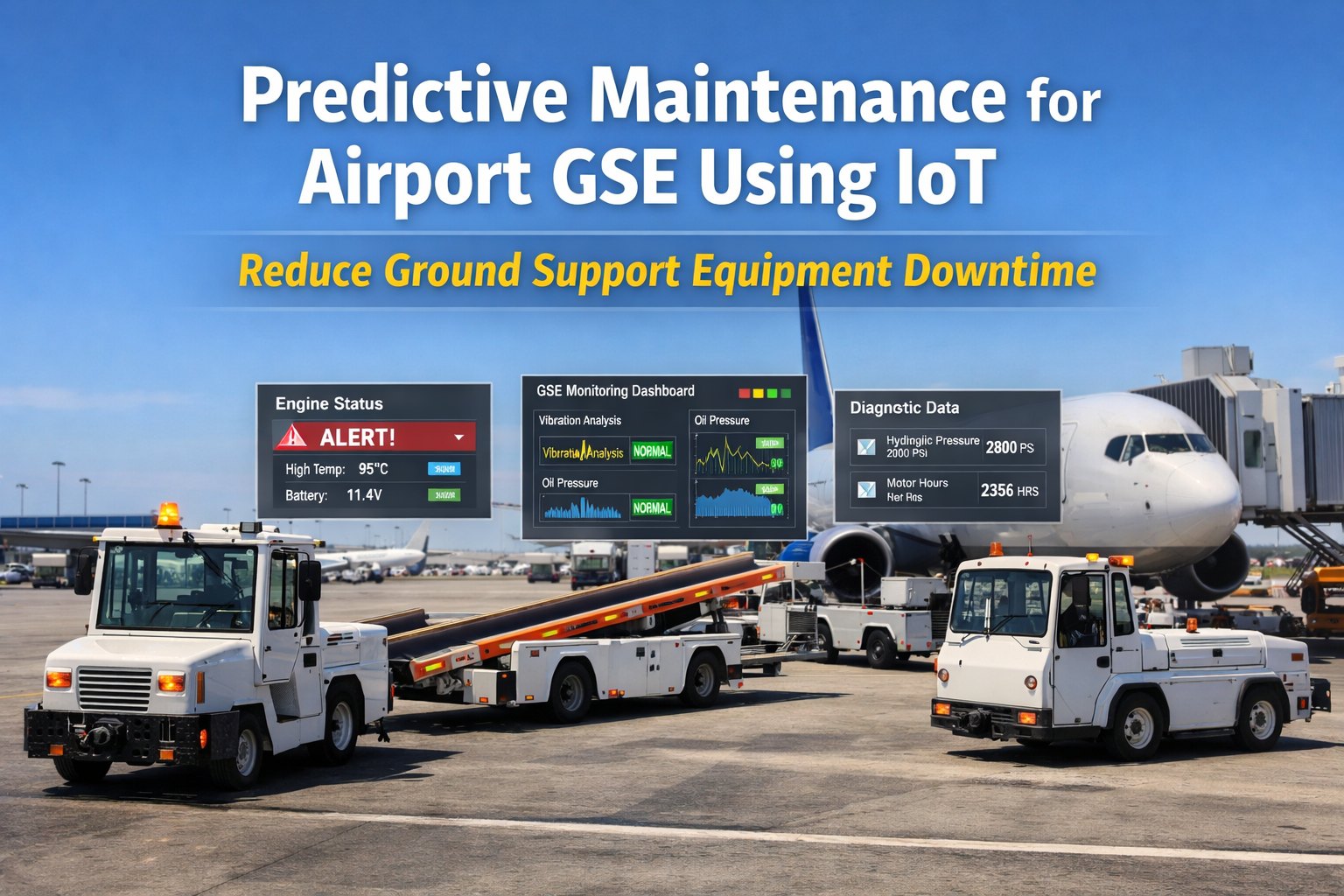
Telematics turns every piece of ground support equipment into a connected, data-generating asset. GPS sensors track location. On-board data loggers capture engine hours, idle time, fuel consumption, speed, and operator behavior. This data transmits wirelessly to a cloud platform where it's organized into dashboards, alerts, and automated maintenance triggers—giving fleet managers a live operational picture they've never had before.
Telematics Data Flow: Ramp to Dashboard
Data Collection
GPS Position
Engine Hours
Idle Time
Fuel Level
Speed
Battery SOC
↓
Wireless Transmission
Cellular / Wi-Fi
GPS Antenna
Cloud Server
↓
OXmaint Platform Actions
Live Map View
Utilization Reports
Auto Maintenance Triggers
Geo-Fence Alerts
Operator Scorecards
Six Capabilities That Change Ground Operations
Once telematics data flows into OXmaint's fleet management platform, it unlocks six capabilities that directly address the pain points every airside equipment supervisor deals with daily.
Real-Time Tracking
Know Where Every Unit Is, Right Now
Live GPS map shows the position of every tug, loader, GPU, and bus across your ramp. No more radio calls asking "who has the belt loader?" Dispatchers see availability at a glance and assign the nearest unit to the next flight.
Utilization Analytics
See What's Working and What's Sitting
Usage dashboards show engine hours, trips, and active time per unit per day. Identify underutilized assets you can redistribute or retire. Spot overworked units before they break. Make data-backed decisions on fleet sizing.
Condition-Based Maintenance
Maintain by Hours, Not by Calendar
Trigger preventive maintenance based on actual engine hours, mileage, or sensor thresholds—not arbitrary time intervals. A tug running 16 hours a day gets serviced before one running 4 hours a day. Downtime drops. Asset life extends.
Geo-Fencing & Alerts
Enforce Boundaries Automatically
Define restricted zones, speed limits, and authorized operating areas. The system alerts supervisors instantly when a vehicle enters a prohibited zone, exceeds speed limits, or leaves the airside boundary. Safety enforcement without surveillance cameras.
Idle Time Reduction
Stop Burning Fuel for Nothing
Telematics distinguishes between productive run time and idle time. Reports highlight which units idle excessively, which operators leave equipment running, and where staging changes could reduce dead time. Direct fuel savings, reduced emissions.
Operator Accountability
Link Every Action to a Driver
Driver ID systems ensure only authorized personnel operate equipment. Every trip, every speed event, every idle session is linked to a specific operator. Performance scorecards drive accountability and enable targeted training.
See Your Fleet Like Never Before
Book a demo and we'll show you how OXmaint transforms raw telematics data into actionable fleet intelligence—from live tracking to automated maintenance triggers.
Before & After: Telematics Impact on Daily Operations
The difference between a fleet managed by radio and clipboard versus one managed by telematics and data shows up in every shift, every turnaround, and every maintenance decision.
Finding Equipment at Gate
Without Telematics
Dispatcher radios three crews asking who has the available belt loader. Two don't respond. One says "try the south ramp." Supervisor drives around looking. 22 minutes lost. Flight departure delayed.
With OXmaint
Dispatcher sees three available belt loaders on the live map. The nearest is 400 meters from the gate. Assigned with one click. On-site in 3 minutes. Turnaround stays on schedule.
Scheduling Tug Maintenance
Without Telematics
All 30 tugs scheduled for service every 90 days regardless of usage. Night shift's busiest tug breaks down at 2 AM—three weeks before its scheduled PM. Emergency repair costs 3x the planned service.
With OXmaint
Maintenance auto-triggered at 500 engine hours. The night shift's heavy-use tug gets serviced at week 6. Light-use tugs at week 14. Zero emergency breakdowns. Labor and parts costs optimized.
Fleet Right-Sizing Decision
Without Telematics
Operations requests 4 additional cargo tugs for summer peak. No utilization data to evaluate. Finance approves based on gut feel. Post-summer audit reveals 3 existing tugs averaged under 2 hours of daily use.
With OXmaint
Utilization reports show 5 tugs averaging under 3 hours daily. Redistribution plan moves 2 underused units to the cargo area. Peak demand met with zero new purchases. $180K saved.
GSE Types and Their Telematics Priorities
Different GSE types generate different data priorities. A pushback tractor's critical metrics aren't the same as a ground power unit's. Here's how telematics monitoring maps to the equipment categories across your ramp.
Aircraft Tugs & Pushback Tractors
Engine Hours
Towing Cycles
Hydraulic Pressure
Location
High-value assets with the most complex maintenance profiles. Engine hour tracking drives PM scheduling. Location tracking prevents the "lost tug" problem that delays pushbacks.
Belt Loaders & Cargo Loaders
Conveyor Cycles
Idle Time
Fuel / Battery
Location
High-demand during peak departures, often sitting idle during off-peak. Utilization data reveals optimal fleet size. Idle time monitoring cuts fuel waste on diesel units.
Ground Power Units (GPUs)
Run Hours
Output Voltage
Fuel Level
Position
Critical for aircraft electrical supply at gates. Run-hour tracking ensures generators are serviced before they fail mid-turnaround. Fuel monitoring prevents empty units at remote stands.
Baggage Carts & Dollies
GPS Location
Trip Count
Zone Dwell Time
Non-motorized but frequently lost or pooled across terminals. GPS trackers prevent the "missing dolly" problem. Trip count data informs rebalancing across gates.
De-Icing Trucks
Fluid Level
Spray Cycles
Location
Engine Temp
Seasonal but mission-critical. Telematics ensures units are pre-positioned, fluid tanks are full, and engines are warm before winter operations begin. One missing de-icer can delay an entire bank of departures.
Passenger Buses & Transport
Speed
Route Tracking
Passenger Load
Mileage
Passenger-facing vehicles where safety and service quality are visible. Speed monitoring enforces airside limits. Route tracking optimizes remote stand shuttle operations.
The Business Case: Telematics by the Numbers
Telematics delivers ROI through multiple channels simultaneously—reduced fuel costs, fewer emergency repairs, optimized fleet size, faster turnarounds, and lower insurance exposure from improved safety records.
30%
Reduction in unplanned downtime with IoT-enabled predictive maintenance on GSE fleets
414 hrs
Annual downtime saved through automated service dispatching on a 50-vehicle fleet
96%+
Fleet availability target achievable with comprehensive telematics-driven maintenance
$22,768
Average annual savings from reduced downtime alone per fleet with telematics
Frequently Asked Questions
What GSE types can be tracked with telematics?
Virtually all ground support equipment can be tracked. Motorized units like tugs, tractors, loaders, GPUs, fuel bowsers, and de-icing trucks use on-board data loggers that capture engine hours, fuel, speed, and GPS position. Non-motorized assets like baggage dollies, towbars, and wheelchairs use battery-powered GPS trackers that report location at set intervals. OXmaint's platform handles both motorized and non-motorized assets in a single unified dashboard.
Book a demo to see the full equipment view.
How does condition-based maintenance work for GSE?
Instead of scheduling maintenance every 90 days regardless of usage, OXmaint triggers work orders based on actual operating data—engine hours, mileage, fuel consumption patterns, or sensor thresholds. When a pushback tractor hits 500 engine hours, the system automatically generates a PM work order, assigns a technician, and reserves the required parts. Equipment that runs less frequently gets serviced less often. Equipment under heavy use gets serviced before it breaks.
Can telematics help us reduce our GSE fleet size?
Absolutely—and this is one of the highest-ROI outcomes. Utilization analytics reveal which units are genuinely needed during peak operations and which sit idle for most of the day. Many airports discover that 15-25% of their fleet is underutilized. By redistributing those assets or retiring them, you reduce capital tied up in equipment, cut maintenance costs, and free up ramp space—all without impacting turnaround performance.
Start your free trial to begin measuring utilization.
What about electric GSE? Does telematics work differently?
Electric GSE generates additional data points that make telematics even more valuable—battery state of charge, charging cycles, energy consumption per trip, and charging station utilization. OXmaint tracks these alongside traditional metrics, helping you optimize charging schedules, prevent range-related service interruptions, and plan charging infrastructure as your electric fleet grows. With JFK's Terminal 6 and other major airports moving to pooled electric fleets, this capability is becoming essential.
How quickly can we deploy telematics across our GSE fleet?
Hardware installation on motorized GSE typically takes 1-2 hours per unit. Battery-powered trackers for non-motorized assets are attach-and-go. Most airports complete a pilot deployment on 20-30 priority units within the first week and see actionable data within 48 hours of installation. Full fleet rollout, including dashboard configuration and team training, is typically completed within 4-6 weeks.
Schedule a consultation to plan your deployment.
Stop Managing Your Fleet Blind
Real-time location, utilization analytics, condition-based maintenance, and safety monitoring for every GSE asset on your ramp—all from one platform. See what telematics-powered fleet management looks like.