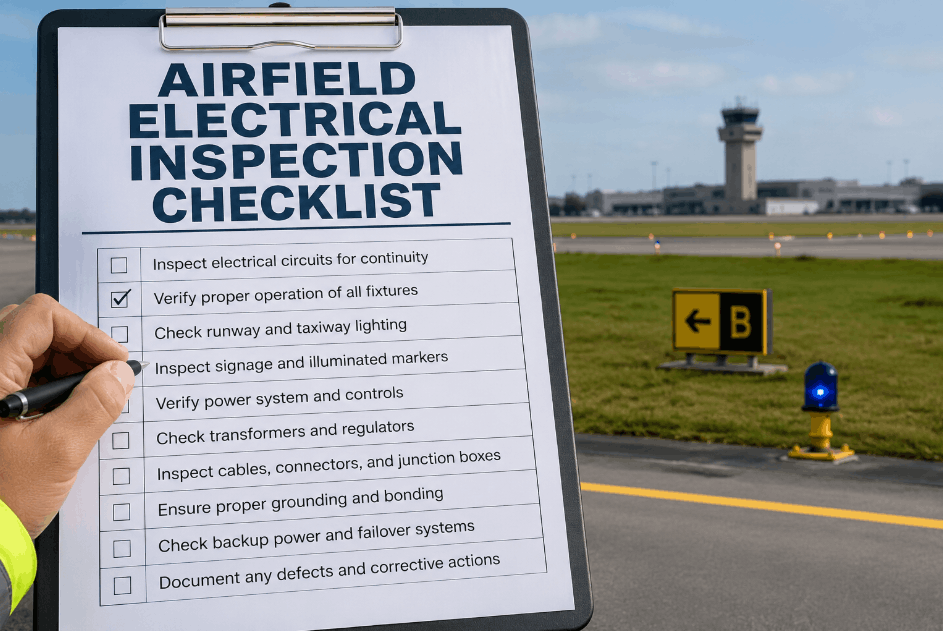
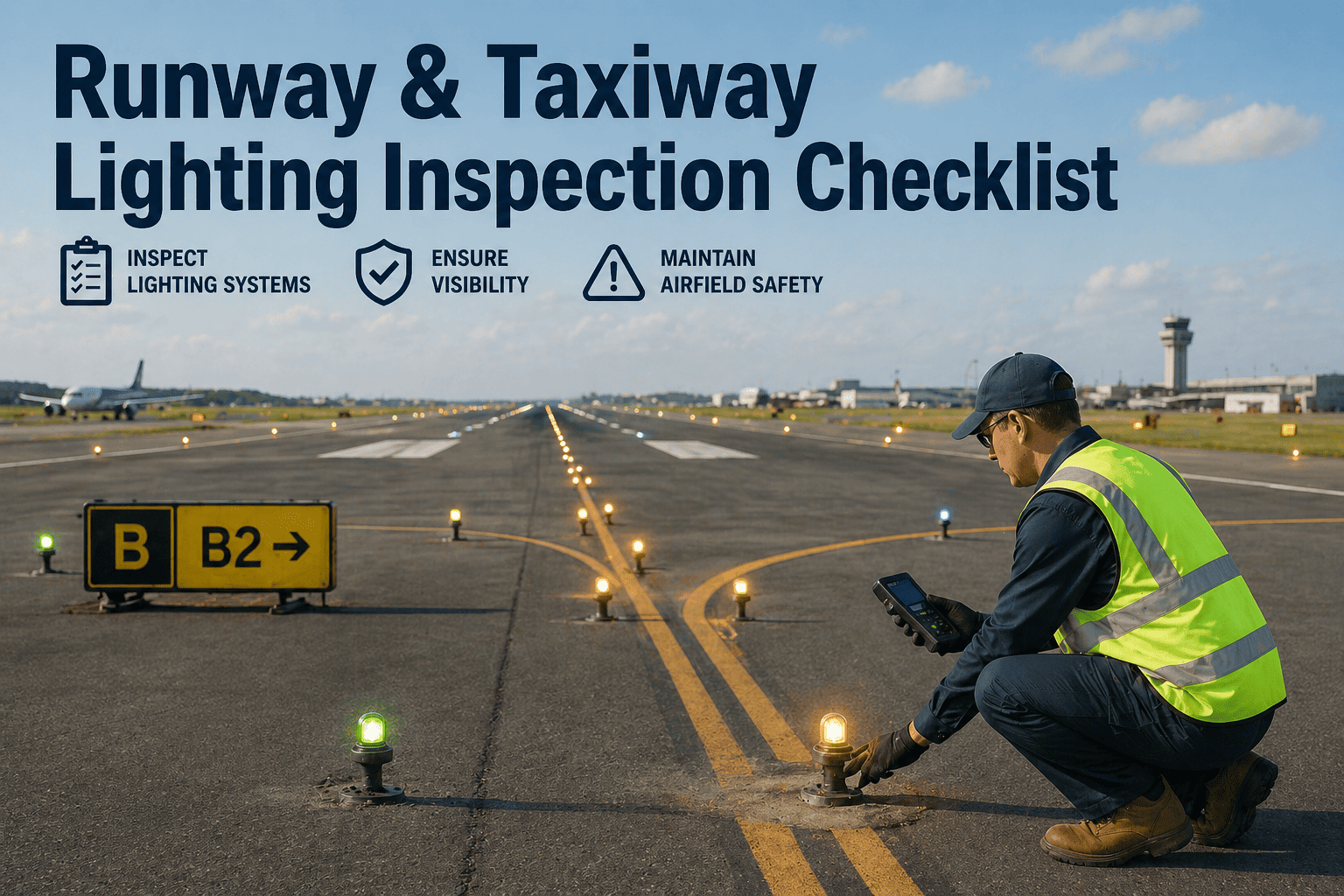
Taxiway sign visibility during night flight operations is not a lighting amenity — it is a safety-critical navigation system that flight crews depend on for every surface movement between runway and gate after dark. A sign that passes a daytime visual check may fall below the minimum brightness standard for night operations within the same inspection cycle, and the only indicator is a quantified luminance measurement, not a supervisor walk-around. The combination of lamp degradation, retroreflective film loss, electrical feed variance, and enclosure contamination creates a visibility decay profile that is entirely predictable — and entirely preventable when tracked against structured inspection metrics in a CMMS. Sign Up Free to build your taxiway sign visibility inspection programme in OxMaint — linking brightness records, reflectivity measurements, and electrical continuity checks to each sign cluster across your airfield night operations schedule.
Airfield Safety · Article · Night Operations
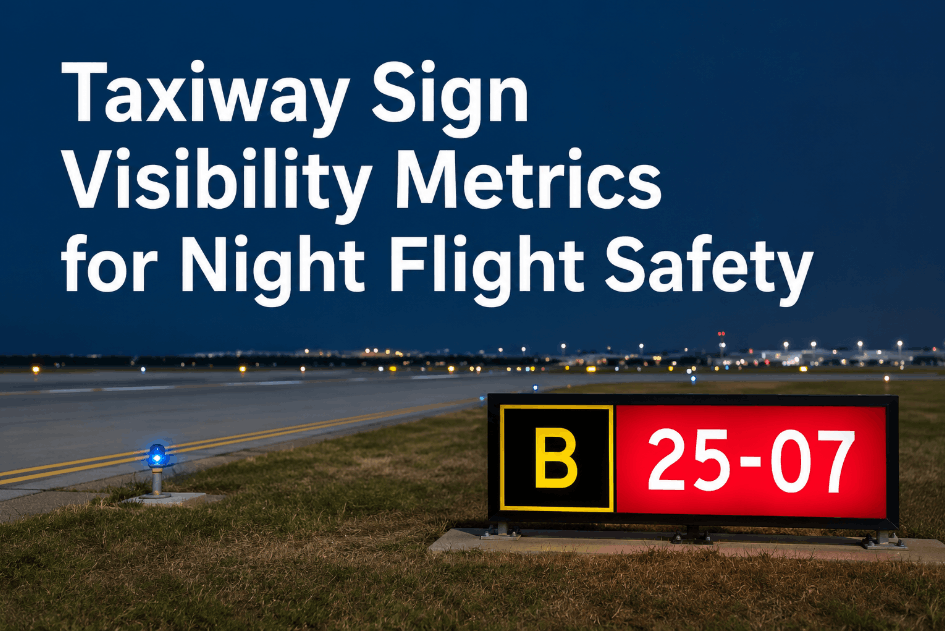
Taxiway Sign Visibility Metrics for Night Flight Safety
Brightness measurement, retroreflectivity trending, electrical continuity verification, and visibility range assessment — structured taxiway sign inspection metrics for airfield operations teams protecting night flight crew guidance across complex taxiway systems.
88%Of taxiway sign visibility deficiencies at night are undetectable by visual daytime inspection alone — instrument measurement is required
2.8×Higher surface incident risk on routes where taxiway sign brightness falls below the 150 cd/m² night minimum without a CMMS-triggered replacement work order
−52%Reduction in sign-related surface movement deviation reports when CMMS-scheduled brightness inspections replace reactive replacement programmes
14 daysRecommended maximum inspection interval for mandatory instruction signs on runways used for night low-visibility operations at international airports
Six Taxiway Sign Visibility Metrics for Night Flight Safety Assurance
Taxiway sign visibility for night operations is governed by a set of quantified performance parameters that must be measured, recorded, and trended against established standards — not assessed by visual walk. The six metrics below represent the highest-frequency failure points in night taxiway sign performance across complex airfield systems: the specific measurement requirements that distinguish a compliant night operations sign programme from one that relies on visual inspection confidence rather than instrument data. Book a Demo to see how OxMaint structures taxiway sign inspection work orders by sign type, criticality zone, and night operations schedule — triggering brightness and electrical checks at intervals matched to your airfield's night traffic profile.
Metric 1
Luminance Measurement Against Night Standard
Quantified luminance reading in candelas per square metre measured against the ICAO Annex 14 minimum for each sign type and step setting. Night standard for mandatory instruction signs is typically 150–300 cd/m² depending on approach category and visibility minima in use.
Safety Critical
Metric 2
Retroreflective Film Condition
Retroreflective film degradation assessment on externally illuminated sign faces. Film loss or delamination reduces effective visibility range significantly before lamp failure — condition measurement is required, not visual estimation.
High Degradation Risk
Metric 3
Electrical Feed and Voltage Verification
Supply voltage and circuit continuity verification at the sign base. Voltage drop across series circuits produces brightness reduction that is not visible from the airfield surface but measurable at the supply point — a leading indicator of network-level visibility failure.
High Failure Risk
Metric 4
Visibility Range Assessment at Night
Operational visibility range verification at the specified viewing angle and approach distance for each sign type. Range assessment under night conditions must be performed with the airfield lighting system at the step setting used for night low-visibility operations, not daytime full power.
Safety Critical
Metric 5
Enclosure Cleanliness and Light Leakage
Sign enclosure internal contamination — dust, insect accumulation, moisture — reduces luminance output by up to 30% without any lamp degradation. External light leakage from failed seals reduces contrast and effective read distance at night.
Reliability Risk
Metric 6
Character Legibility and Colour Accuracy
Character panel integrity — no cracking, discolouration, or partial obscuration — and colour accuracy against the standard for each sign type. Yellow-on-black location signs and red-on-white mandatory signs have specific colour temperature requirements that degrade with lamp age.
Guidance Risk
Taxiway Sign Visibility Failure Cascade — How a Brightness Deficiency Becomes a Surface Safety Event
Taxiway sign visibility failures during night operations follow a predictable deterioration path from first brightness deficiency to surface movement deviation. Each stage in the cascade represents a point where structured inspection metrics would have identified the deficiency before it reached crew-visible failure — but only if the measurement programme was CMMS-scheduled and instrument-based rather than reactive. The cascade below maps the progression and the cost of each intercept point. Sign Up Free to build the visibility measurement programme that intercepts the cascade at Stage 1 — before a brightness deficiency reaches the departure gate crew.
Taxiway Sign Visibility Cascade — 5 Stages from Brightness Deficiency to Surface Event
Stage 1
Brightness Below Night Standard — Undetected
Sign luminance falls below the 150 cd/m² minimum. No inspection scheduled. Daytime visual walk shows no visible deficiency. Night operations continue on a sign that no longer meets standard.
↓
Stage 2
Reduced Visibility Range — Crew Navigation Margin Reduced
Effective read distance at night falls below the design range for the approach speed used on the taxiway. Crew must position closer to read the sign correctly. Situational awareness margin reduced in complex intersection zones.
$380
Lamp and film replacement cost
↓
Stage 3
Crew Misread or Delay at Intersection — ATC Query
Crew slows or holds at intersection due to reduced sign legibility. ATC queries position. Surface movement delay recorded. Incident report initiated. Sign deficiency identified as contributing factor.
$1,400
Incident investigation + urgent repair
↓
Stage 4
Wrong Taxiway Entry — Surface Movement Deviation
Reduced sign legibility contributes to incorrect taxiway entry. ATC corrective instruction required. In low-visibility conditions, deviation carries incursion risk. Full airfield safety occurrence report initiated.
$6,800
Safety occurrence report + programme review
↓
Stage 5
Regulatory Investigation — Inspection Programme Finding
Regulator audit identifies absence of structured sign visibility inspection records. Corrective action plan required against maintenance programme. Night operations review pending programme remediation.
$16,000+
Regulatory finding + operational review
Taxiway Sign Visibility Programme Maturity Score
Airfield operations teams vary significantly in the maturity of their taxiway sign visibility inspection programmes. A team that conducts instrument-based luminance measurements at scheduled intervals, logs electrical continuity data per sign, and triggers replacement work orders from condition evidence carries fundamentally lower night operations safety exposure than a team relying on visual patrols and reactive lamp replacement. The assessment below gives airfield engineering managers a rapid tool to identify where their night sign programme sits and what immediate actions are required. Book a Demo to configure OxMaint's taxiway sign inspection scheduling for your airfield's night operations profile and sign criticality tiers.
Taxiway Sign Visibility Programme Maturity Score
Score 5 = night-standard compliant · Score 1 = active surface safety risk · Assess per sign type or taxiway zone
5
Night-Standard Compliant — CMMS-Scheduled Instrument Checks
Luminance and retroreflectivity measurements scheduled in CMMS at benchmark intervals per sign type. Electrical continuity verified at each check. Zero signs below night standard. Complete visibility record available for regulatory review.
Action: Maintain programme. Review luminance trend data quarterly. Verify step setting compliance records are current against low-visibility operations schedule.
4
Mostly Compliant — Some Signs Without Current Measurement
Structured checks performed on mandatory instruction signs but location signs and secondary taxiway signs not measured at benchmark intervals. Electrical continuity not formally logged at all check points.
Action: Extend CMMS inspection schedule to cover all sign types within 30 days. Add electrical continuity check to each brightness inspection work order.
3
Visual Only — No Instrument Measurement Programme
Regular visual patrols completed but no luminance measurement, retroreflectivity check, or electrical verification. Night performance assumed from daytime visual assessment. No condition trend data available for any sign group.
Action: Implement instrument-based measurement for all mandatory instruction signs within 3 weeks. Build CMMS inspection work orders at 14-day intervals for night-critical routes.
2
Reactive — Lamp Replacement Only After Report
Sign maintenance occurs only after a crew report, ATC query, or visible lamp failure. No proactive measurement. Multiple signs are likely operating below night standard between reactive interventions. No programme record for regulatory review.
Action: Immediate luminance survey of all mandatory instruction signs. Initiate CMMS-scheduled inspection programme before next night low-visibility operations period.
1
No Programme — Active Night Safety Risk
No structured visibility inspection programme. Sign performance records do not exist. Night standard compliance is unverified across the sign network. Safety occurrence and regulatory finding risk is high.
Action: Emergency luminance survey across all night-operation taxiway signs within 7 days. Engage safety regulator liaison and halt low-visibility operations on non-compliant routes pending remediation.
Technology Integration: CMMS Sign Inspection Scheduling, Brightness Records, and Visibility Trend Analysis
A taxiway sign inspection programme that relies on shift supervisors to initiate luminance measurements as a discretionary activity is not a safety assurance programme — it is a gap in the maintenance record. Effective night taxiway sign visibility management requires the measurement schedule to be owned by the CMMS, each luminance result to be logged against the sign asset and the night operations standard, and replacement work orders to be triggered automatically when brightness falls below the threshold rather than when a crew report or visual observation provides the prompt. OxMaint connects all three: sign inspection work orders auto-generated per sign type at benchmark intervals, luminance and reflectivity records linked to the sign asset and the applicable standard, and replacement triggers generated when condition data identifies pre-failure brightness decay. Sign Up Free to move your taxiway sign programme from reactive lamp replacement to CMMS-driven night visibility assurance.
Sign Inspection Scheduling
100%
Night-standard coverage when CMMS-scheduled vs supervisor-initiated
Inspection work orders auto-generated per sign type at benchmark intervals. No sign group can exceed its night-standard verification window without a CMMS overdue record — coverage is complete and audit-ready.
Brightness Records
−52%
Reduction in night sign deficiency reports with proactive measurement
Each inspection generates a luminance record linked to the sign, the sign type, and the applicable night standard. Brightness deficiencies trigger replacement work orders before they produce crew-visible visibility failure.
Visibility Trend Analysis
2.8×
Earlier deficiency identification vs reactive crew-report-triggered replacement
Luminance trend across inspection cycles surfaces in OxMaint's airfield sign dashboard — identifying signs approaching the night standard threshold weeks before they produce a safety occurrence or regulatory finding.
Compliance Records
98%
Regulatory record completeness when CMMS-managed vs paper-based
Luminance measurements, film condition assessments, electrical checks, and replacement records linked to every sign inspection work order. Audit requests answered directly from CMMS — no separate documentation management required.
"
We had a surface movement deviation report that identified a mandatory instruction sign with inadequate brightness at the runway holding point. The sign had passed our last visual patrol. When we measured it with a luminance meter it was at 68 cd/m² — less than half the night standard. There was no alarm, no visible failure, nothing to flag it on a visual check. We implemented OxMaint's luminance inspection scheduling across all mandatory signs. In the next six months we identified and replaced 11 signs below standard before any crew report. No surface safety occurrences attributable to sign visibility in that period.
Airfield Operations Engineer — International gateway airport, Category II/III low-visibility operations, Western Europe
Taxiway Sign Night Visibility Failure Root Cause Distribution
Night taxiway sign visibility deficiencies originate from root causes that are measurable in advance of operational failure — but only when structured instrument-based inspection metrics are included in the maintenance programme. The distribution below reflects airfield sign maintenance programme analysis across airports with regular night low-visibility operations. Book a Demo to map your airfield sign risk profile against this distribution and configure OxMaint's inspection scheduling to address the highest-frequency visibility failure origins first.
Taxiway Sign Night Visibility Failure Root Cause Distribution — Airfield Operations (%)
Lamp degradation below night standard — no measurement programme
72%
Retroreflective film loss — condition not assessed
64%
Enclosure contamination reducing luminance output
55%
Voltage drop in series circuit — not verified at sign base
46%
Wrong step setting used for low-visibility operations
37%
Character panel decolouration — colour standard not verified
28%
Protect Night Taxiway Guidance — CMMS-Scheduled Luminance Checks, Brightness-Tracked, Replacement-Triggered.
OxMaint schedules taxiway sign visibility inspection per sign type, per criticality zone — instrument-verified, regulatory record-ready, and free to start.
Frequently Asked Questions
What luminance standard applies to mandatory instruction signs for night low-visibility operations?
ICAO Annex 14 specifies a minimum of 150 cd/m² for mandatory instruction signs under night operations at the step setting used for low-visibility procedures. Specific national aviation authority requirements may be higher. Measurements must be taken at the operational step setting, not at full power, to verify actual night performance.
Why is visual inspection insufficient for taxiway sign night visibility compliance?
Lamp degradation, retroreflective film loss, and enclosure contamination all reduce night luminance significantly before producing a visible daytime deficiency. A sign that appears serviceable on a daytime visual walk may be operating at less than half the night standard — only instrument measurement identifies the gap.
Sign Up Free to build instrument-based scheduling in OxMaint.
How often should taxiway sign luminance be measured at airports with night low-visibility operations?
Every 14 days for mandatory instruction signs on runway holding points and runway crossing routes with Cat II/III operations. Location signs on primary taxiway routes require 30-day measurement intervals. All intervals should be scheduled in CMMS and completed with instrument records, not estimated from lamp age or installation date.
Book a Demo to configure this in OxMaint.
How does a CMMS improve taxiway sign visibility compliance for night operations?
A CMMS schedules luminance inspection work orders at benchmark intervals per sign type, logs measurement results against the applicable standard, triggers replacement work orders automatically when brightness falls below threshold, and provides a complete compliance record set for regulatory audits — replacing visual patrol reliance with an instrument-evidence programme.
What records are required to demonstrate taxiway sign visibility compliance for night operations audits?
Dated luminance measurement records per sign showing the instrument used, calibration reference, measured value against the applicable standard, step setting used, and any replacement or corrective action work orders raised. CMMS-generated timestamped records provide the most defensible audit trail for national aviation authority review of night operations compliance.
Zero Night Visibility Gaps — Luminance-Measured, Instrument-Logged, Compliance Record-Ready.
OxMaint builds taxiway sign night visibility assurance into your airfield maintenance programme — automated luminance scheduling, brightness trend records, and low-visibility compliance management.