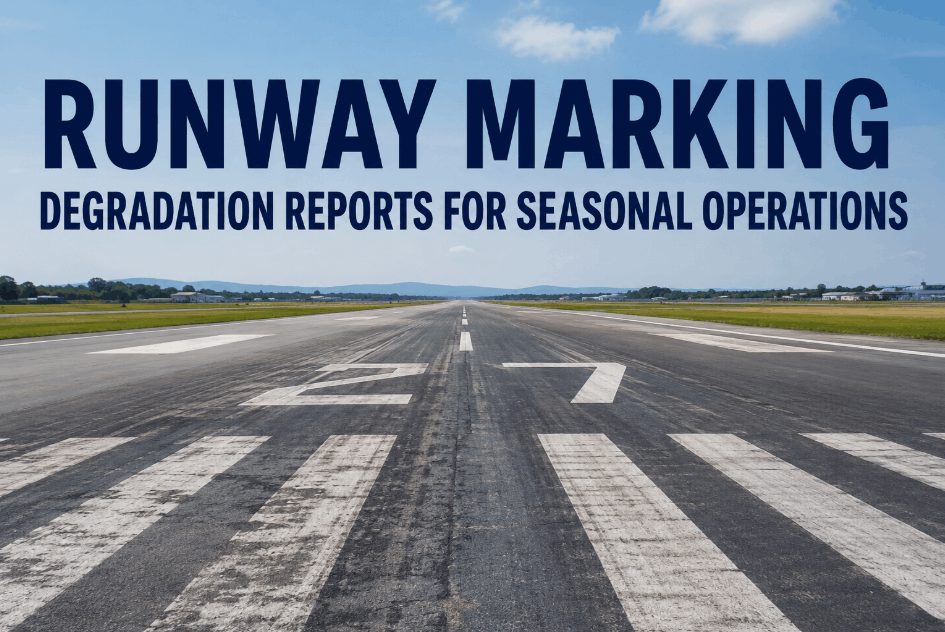
Runway marking degradation during seasonal traffic transitions is one of the most predictable and consistently undermanaged compliance risks in airfield operations. Threshold markings, centreline paint, and touchdown zone indicators that met the minimum retroreflectivity standard at the end of summer operations may fall below the regulatory threshold within six to eight weeks under winter de-icing chemical exposure — and there is no alarm, no automatic notification, and no ATC-visible indication when they do. The gap between scheduled repaint cycles and actual surface degradation is where crew guidance fails progressively until a friction test, a safety walk, or an audit reveals that the markings no longer meet the standard they were certified to. Sign Up Free to build your runway marking degradation tracking programme in OxMaint — linking friction measurement records, retroreflectivity readings, and repaint work orders to each marking zone across your airfield seasonal maintenance schedule.
Airfield Pavement · Article · Seasonal Maintenance
Runway Marking Degradation Reports for Seasonal Operations
Surface wear mapping, retroreflectivity trending, repaint interval management, and seasonal degradation reporting — structured frameworks for airfield pavement teams maintaining marking compliance through seasonal traffic changes and weather transitions.
6–8 wkTypical window for runway marking retroreflectivity to fall below regulatory minimum following winter de-icing chemical exposure
63%Of seasonal marking deficiency findings occur within 45 days of a seasonal traffic change that was not accompanied by a marking condition survey
−49%Reduction in unplanned repaint events when CMMS-linked degradation tracking replaces fixed-interval repaint scheduling
2.4×Higher likelihood of regulatory marking deficiency finding when seasonal condition surveys are not linked to the CMMS maintenance record
Six Runway Marking Degradation Parameters for Seasonal Operations Management
Runway marking degradation management during seasonal transitions requires a structured set of measurement parameters that go beyond visual inspection. The six degradation indicators below represent the highest-frequency compliance failure points in seasonal airfield operations — the specific measurement and recording requirements that distinguish a compliant marking programme from one that relies on repaint scheduling alone without condition-based evidence. Book a Demo to see how OxMaint structures runway marking degradation work orders by zone and season — scheduling measurement surveys against the specific wear profile of your runway pavement and seasonal chemical exposure calendar.
Parameter 1
Retroreflectivity Measurement
Quantified retroreflectivity reading in millicandelas per lux per square metre, measured against the regulatory minimum for each marking type. Post-winter and post-summer season surveys are non-negotiable at Category I and above airports.
Regulatory Required
Parameter 2
Threshold and Designation Marking Condition
Visual and photometric assessment of threshold marking integrity. Threshold markings are the first visual reference for landing crews — fading or contamination in this zone carries higher operational consequence than most other marking areas.
Safety Critical
Parameter 3
Touchdown Zone Indicator Wear
Touchdown zone bars wear fastest due to rubber deposit accumulation combined with tyre impact abrasion. Seasonal condition surveys must measure the actual remaining paint thickness and retroreflectivity, not estimate from age or cycle count.
High Wear Zone
Parameter 4
Centreline Paint Continuity
Centreline marking gaps, fading, or off-alignment conditions must be surveyed across the full runway length, not spot-checked. Gap lengths exceeding 15% of any 50m section typically trigger a repaint requirement under ICAO Annex 14 standards.
High Failure Risk
Parameter 5
De-Icing Chemical Contamination
Post-winter survey must include a chemical contamination assessment for glycol and acetate residue penetration into paint layers. Contaminated markings can show acceptable visual appearance while providing significantly reduced retroreflectivity.
Seasonal Risk
Parameter 6
Rubber Deposit and Surface Friction
Rubber accumulation over marking zones reduces both retroreflectivity and pavement friction simultaneously. Friction measurement must be recorded against the marking condition survey to ensure marking repaint timing accounts for the combined effect on surface performance.
Surface Risk
Seasonal Marking Degradation Cascade — How a Missed Post-Season Survey Becomes a Compliance Finding
Runway marking non-compliance during seasonal transitions follows a predictable path. A marking that passes a pre-season survey degrades through the season under traffic, chemical, and weather exposure — but the post-season survey is delayed or not formally scheduled. Degradation continues. The first formal verification occurs when an auditor walks the runway and measures the retroreflectivity. The cascade below maps the cost at each stage from missed survey to regulatory finding — and shows the intercept points that a CMMS-scheduled degradation programme provides. Sign Up Free to build the measurement schedule that intercepts seasonal degradation before it reaches the audit finding stage.
Seasonal Marking Degradation Cascade — 5 Stages from Missed Survey to Regulatory Finding
Stage 1
Post-Season Survey Not Scheduled — Degradation Untracked
Season transition occurs without a CMMS-scheduled marking condition survey. Degradation continues untracked. No retroreflectivity data recorded. Visual compliance assumed from previous survey.
↓
Stage 2
Retroreflectivity Falls Below Minimum Threshold
Marking output drops below regulatory minimum. No alarm, no ATC indication. Crews continue using markings that no longer meet the certification standard under which they were last assessed.
$480
Survey + targeted repaint cost
↓
Stage 3
Pilot or Safety Walk Report — Marking Deficiency Noted
Deficiency identified through pilot report or unscheduled safety walk. Reactive assessment initiated. NOTAM consideration required pending formal survey. Maintenance team dispatched without prepared specification.
$2,600
Reactive survey + emergency repaint
↓
Stage 4
Full Runway Survey — Multiple Zone Deficiencies Found
Formal survey reveals that deficiency extends across multiple zones. Full repaint required rather than targeted patching. Repaint duration requires temporary runway restrictions during application and curing.
$7,200
Full repaint + operational restriction
↓
Stage 5
Regulatory Audit — Inspection Record Gap Finding
Auditor identifies absence of post-season marking survey records. Corrective action plan required against inspection programme. All operations during the unverified period potentially in scope for review.
$12,000+
Regulatory finding + programme remediation
Seasonal Marking Degradation Programme Maturity Score
Airfield operations teams managing runway markings across seasonal transitions carry different compliance risk profiles depending on the maturity of their degradation survey and repaint scheduling programme. A team that conducts instrument-based retroreflectivity surveys at each seasonal transition, logs results in the CMMS, and triggers repaint work orders against actual condition data carries fundamentally lower regulatory exposure than a team that repaints on fixed annual intervals without condition-based evidence. The scoring framework below helps airfield engineering managers assess where their seasonal marking programme sits today. Book a Demo to configure OxMaint's seasonal marking survey schedule for your runway pavement zones and seasonal transition calendar.
Seasonal Marking Degradation Programme Maturity Score
Score 5 = condition-based programme · Score 1 = reactive repainting · Assess per runway or seasonal period
5
Condition-Based — CMMS-Scheduled Seasonal Surveys
Retroreflectivity surveys scheduled at each seasonal transition in CMMS. Repaint work orders triggered by condition measurement against threshold, not fixed calendar. Full zone-level degradation data available for regulatory review.
Action: Maintain programme. Review friction-marking correlation data post-winter season. No programme gaps at current maturity.
4
Mostly Controlled — Surveys Performed but Not All Logged
Seasonal surveys conducted but results recorded on paper or informally. Retroreflectivity data not systematically entered into CMMS. Repaint triggers based on measurement but without formal work order linkage.
Action: Migrate all survey records to CMMS within 30 days. Establish formal repaint work order trigger against retroreflectivity threshold data.
3
Fixed Calendar — Repaint Scheduled, Condition Not Measured
Repaint carried out on fixed annual or biannual schedule without pre-repaint condition survey. No retroreflectivity data recorded between repaints. Actual marking condition between scheduled repaints is unknown.
Action: Add pre- and post-season measurement surveys to CMMS schedule. Begin condition-based repaint programme within current season cycle.
2
Reactive — Repaint Triggered by Report or Audit Observation
Repainting occurs only after a deficiency is reported or identified during an audit. No condition data. No seasonal survey programme. Multiple marking zones are likely below minimum standard between reactive interventions.
Action: Immediate full-runway marking condition survey. Initiate CMMS-scheduled seasonal survey programme before next seasonal transition.
1
No Programme — Active Compliance Risk
No marking degradation programme. Repaint history not formally recorded. Seasonal condition transitions not assessed. Retroreflectivity compliance is unverified. Regulatory finding risk at next audit is high.
Action: Emergency retroreflectivity survey across all runway and taxiway markings within 14 days. Engage regulator liaison ahead of next scheduled audit.
Technology Integration: CMMS Survey Scheduling, Degradation Records, and Repaint Trigger Management
A runway marking programme that operates on fixed calendar repaints without condition measurement produces either over-specification (repainting compliant markings ahead of schedule) or under-specification (allowing degraded markings to persist past their actual threshold breach). Effective seasonal marking management requires the survey schedule to be owned by the CMMS, each measurement result to be logged against the zone and the seasonal transition, and repaint work orders to be generated automatically when a measurement falls below the threshold — not when the calendar says so. OxMaint connects all three: seasonal survey work orders generated at each transition, zone-level retroreflectivity records linked to the runway asset and the regulatory standard, and repaint triggers generated automatically when condition data falls below the minimum threshold. Sign Up Free to move your marking programme from calendar-based repainting to condition-based seasonal management.
Survey Scheduling
100%
Seasonal transition coverage when CMMS-scheduled vs calendar-based
Survey work orders generated at each seasonal transition per runway zone. No transition can pass without a CMMS survey record — coverage is complete and audit-ready at each regulatory cycle.
Degradation Records
−49%
Reduction in unplanned repaints with condition-based trigger management
Each survey generates a zone-level retroreflectivity record linked to the runway, the marking type, and the seasonal transition. Threshold breaches trigger repaint work orders automatically — no manual review required.
Repaint Trend Analysis
2.4×
Earlier deficiency detection vs reactive post-report survey
Retroreflectivity trend across seasonal surveys surfaces in OxMaint's pavement dashboard — identifying zones approaching threshold breach weeks before they produce a reportable deficiency or regulatory exposure.
Regulatory Records
98%
Compliance record completeness when CMMS-managed vs paper-based
Survey results, retroreflectivity readings, repaint specifications, and work order records linked to every seasonal transition. Audit requests are answered directly from the CMMS — no separate document management required.
"
We had been repainting on a 12-month calendar cycle for years. After implementing OxMaint's seasonal survey programme we found that our touchdown zone markings were falling below the retroreflectivity minimum within 7 months of application — and our threshold markings were lasting 16 months. We were repainting the wrong zones at the wrong times. Condition-based scheduling cut our total repaint spend by 31% in the first year and we had our first clean regulatory marking audit in five years.
Airfield Pavement Engineer — International airport, dual-runway operation, Northern Europe seasonal operations
Runway Marking Degradation Root Cause Distribution in Seasonal Operations
Runway marking non-compliance during seasonal transitions originates from a consistent set of root causes that are measurable and predictable when a structured degradation tracking programme is in place. The distribution below reflects airfield pavement maintenance analysis across airports with significant seasonal traffic and weather variation. Book a Demo to map your runway marking degradation risk profile against this distribution and configure OxMaint's survey scheduling to address the highest-frequency compliance failure origins first.
Runway Marking Degradation Root Cause Distribution — Seasonal Operations (%)
Post-season retroreflectivity survey not conducted
63%
De-icing chemical penetration not assessed post-winter
57%
Fixed-calendar repaint without condition measurement
51%
Rubber deposit accumulation over marking zones untracked
44%
Touchdown zone wear rate underestimated between seasons
38%
Survey records not entered into CMMS for regulatory review
29%
Protect Seasonal Marking Compliance — Condition-Surveyed, CMMS-Scheduled, Repaint-Triggered.
OxMaint schedules runway marking surveys at each seasonal transition — retroreflectivity-logged, repaint work order-linked, and free to start.
Frequently Asked Questions
How often should runway marking retroreflectivity be measured for seasonal operations compliance?
At minimum, at each seasonal transition — post-winter and post-summer. High-traffic runways and airports with heavy de-icing chemical use should add a mid-season measurement. Results must be recorded in the CMMS and compared against the regulatory threshold for each marking type.
What causes runway marking retroreflectivity to degrade faster in winter operations?
De-icing chemical penetration into paint layers, combined with snowplough abrasion and increased tyre impact under cold-contracted pavement, accelerates retroreflectivity loss significantly faster than summer conditions. Post-winter surveys must include chemical contamination assessment as well as optical measurement.
Sign Up Free to schedule these in OxMaint.
How does a CMMS support runway marking degradation compliance for seasonal airports?
A CMMS schedules condition surveys at each seasonal transition, logs zone-level retroreflectivity data against the regulatory minimum, triggers repaint work orders when measurement falls below threshold, and provides the complete inspection record set for audits — replacing fixed-calendar repainting with condition-based evidence.
Book a Demo to see OxMaint's programme.
Which runway marking zones degrade fastest in seasonal operations?
Touchdown zone bars and centreline markings between the threshold and the 300m point experience the highest combined wear from tyre impact, rubber deposit accumulation, and de-icing chemical exposure. These zones typically require condition assessment at shorter intervals than the balance of the runway marking system during winter operations.
What regulatory records are required for runway marking seasonal inspection compliance?
Dated survey records per zone showing measurement date, equipment calibration reference, retroreflectivity values against the published standard, and any repaint work orders raised. CMMS-generated records with timestamped results are preferred by most national aviation authorities over paper-based survey sheets for programme compliance demonstration.
Condition-Based Marking Management — Survey-Scheduled, Threshold-Triggered, Regulatory Record-Ready.
OxMaint builds seasonal runway marking degradation tracking into your airfield maintenance programme — automated survey scheduling, zone-level condition records, and compliance-ready repaint management.