Airports are among the most complex operational environments on the planet — running 24/7, managing thousands of critical assets, and serving millions of passengers who expect everything to work flawlessly. Yet many airport maintenance teams still operate blind, relying on spreadsheets and gut instincts instead of real-time performance data. A single baggage system failure can cascade into flight delays affecting thousands. An untracked HVAC breakdown in a terminal can trigger safety violations. The solution? A KPI dashboard that turns maintenance chaos into actionable intelligence. Book a free consultation to see how real-time KPI tracking can transform your airport maintenance operations.
Why KPI Dashboards Are Critical for Airport Operations
An airport isn't just one facility — it's a network of interconnected systems where a single failure can trigger a domino effect. Baggage handling, runway lighting, HVAC, fire suppression, elevators, jet bridges, fuel systems — each demands its own maintenance cadence, and each has a different tolerance for downtime.
Without centralized KPI visibility, maintenance teams are forced into reactive mode — fixing what's already broken rather than preventing failures before they happen. The result? Higher costs, more disruptions, and increased safety risk. A well-designed KPI dashboard provides the single source of truth that connects your maintenance strategy to actual operational outcomes.
The 8 KPIs Every Airport Maintenance Team Must Track
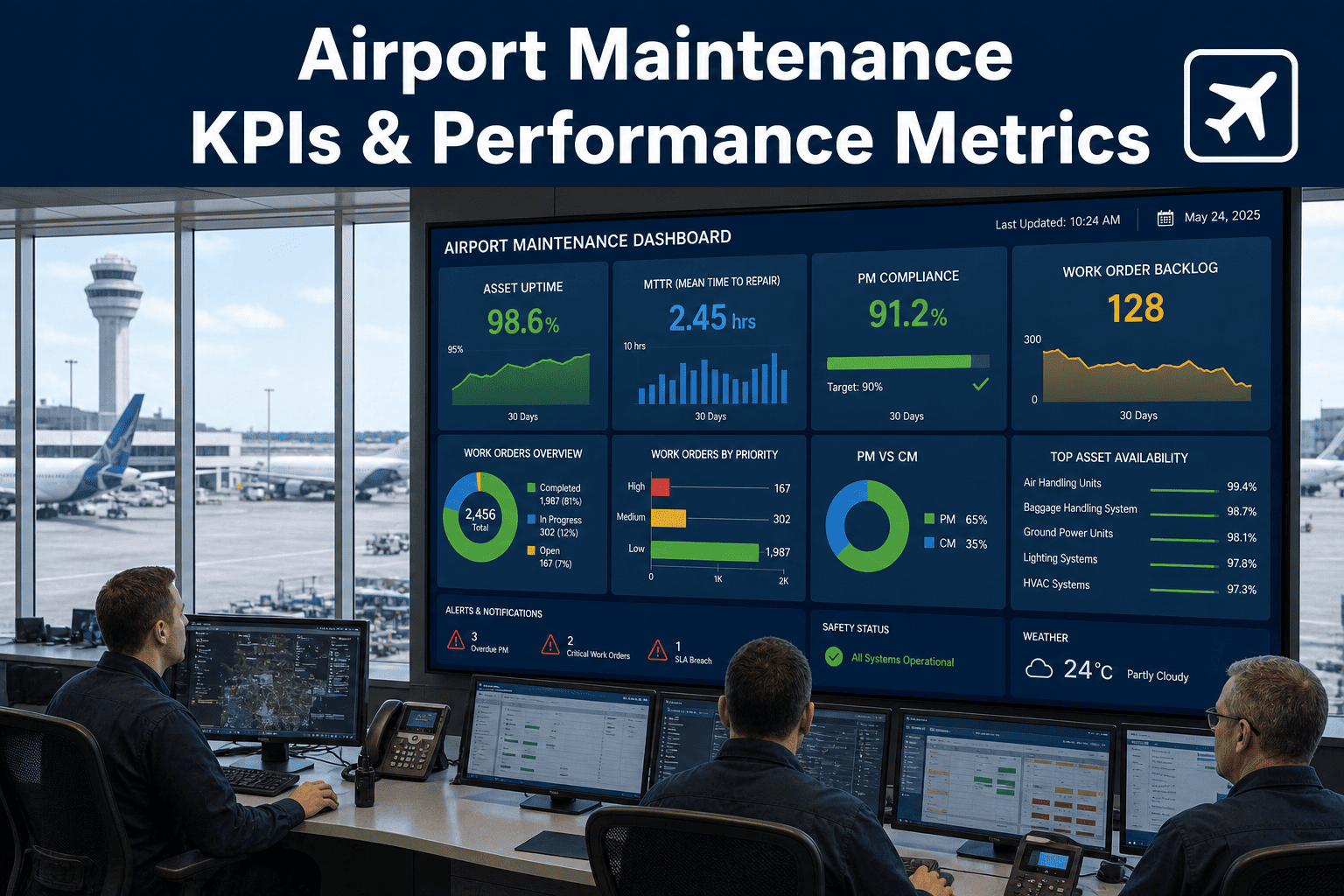
Not all metrics are created equal. These eight KPIs give airport maintenance managers the clearest view of equipment health, team efficiency, and budget performance — the three pillars that determine whether your airport runs smoothly or stumbles into costly disruptions.
Asset availability measures the percentage of time your equipment is operational and ready to perform. For airports, this is the backbone of reliability — a 1% drop in availability across critical systems like baggage handling or jet bridges can mean hundreds of delayed flights per month.
MTTR tracks how quickly your team restores failed equipment. In aviation, every minute of unplanned downtime carries significant cost — research shows organizations with MTTR under 4 hours achieve 28% higher asset availability. For critical airport systems like runway lighting or fire suppression, speed of repair isn't just about efficiency — it's about safety.
Preventive maintenance compliance measures how many scheduled maintenance tasks are completed on time. For airports regulated by FAA, EASA, and ICAO, missed PMs don't just lead to breakdowns — they can trigger regulatory penalties up to $37,377 per violation per day. A PM compliance rate below 80% is a red flag that your maintenance program needs immediate attention.
Tracking total maintenance expenditure helps balance cost optimization with safety and uptime. The global aviation industry faces $3.1 billion in additional maintenance costs annually due to aging fleets. World-class facilities maintain an MC/ERV ratio of 2-3%. When this number starts climbing, it signals that repair-versus-replace decisions need to be evaluated.
Knowing exactly how many assets you manage — and their current condition — is the foundation of every maintenance strategy. Airports typically manage hundreds to thousands of assets across terminals, runways, and support facilities. Without accurate asset tracking, work orders fall through the cracks, warranty claims get missed, and replacement planning becomes guesswork.
Tracking total failures over time reveals which asset categories are consuming the most resources and causing the most disruptions. When your electrical systems account for 87 failures while mechanical systems show 62, you know exactly where to focus root-cause analysis and capital investment. Failure trending is what separates proactive maintenance teams from firefighters.
Downtime is the metric that hits the bottom line hardest. Research indicates that unplanned downtime costs industrial operations an average of $260 per minute — and for airport-critical systems, the cascading impact on flights, passenger experience, and safety makes the true cost far higher. Tracking downtime by asset category exposes your most expensive reliability gaps.
The ratio of emergency to planned work orders is a direct measure of maintenance maturity. World-class operations target 85%+ proactive work — meaning only 15% or less should be emergency repairs. An emergency WO ratio above 40% signals that your team is stuck in reactive mode, constantly fighting fires instead of preventing them. Reducing this ratio is the single fastest path to lower costs and higher reliability.
How KPIs Work Together: The Performance Picture
Individual KPIs tell you what's happening. But the real power comes from understanding how they connect. Here's how these eight metrics create a complete performance picture for airport maintenance teams.
From Spreadsheets to Smart Dashboards
Manual KPI tracking using spreadsheets and paper logs is not only time-consuming — it's error-prone and always outdated. Modern CMMS platforms powered by IoT sensors and AI analytics transform raw maintenance data into real-time, actionable intelligence that your entire team can access from anywhere.
Getting Started: Your 4-Step KPI Implementation Plan
You don't need to track everything at once. The most successful airport maintenance teams start focused and expand over time. Here's the proven approach.