Here's a frustrating reality: your maintenance team works hard every day, but you can't prove it with numbers. When leadership asks "How efficient are we?"—you're stuck guessing. When equipment fails repeatedly—you don't have data showing the pattern. When budget season arrives—you can't demonstrate ROI on maintenance investments. Sound familiar? You're not alone. Most airport maintenance teams fly blind, reacting to problems instead of preventing them.
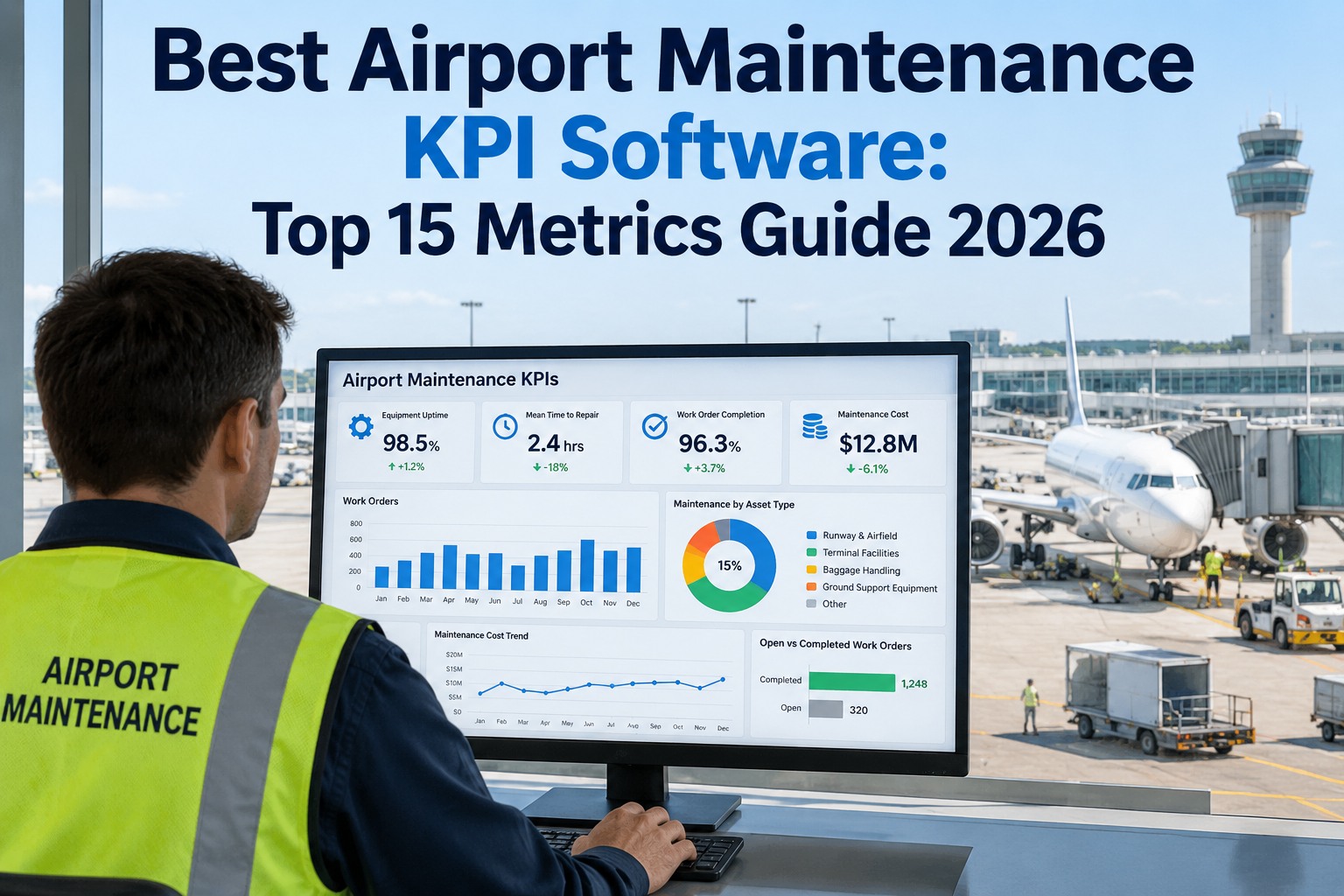
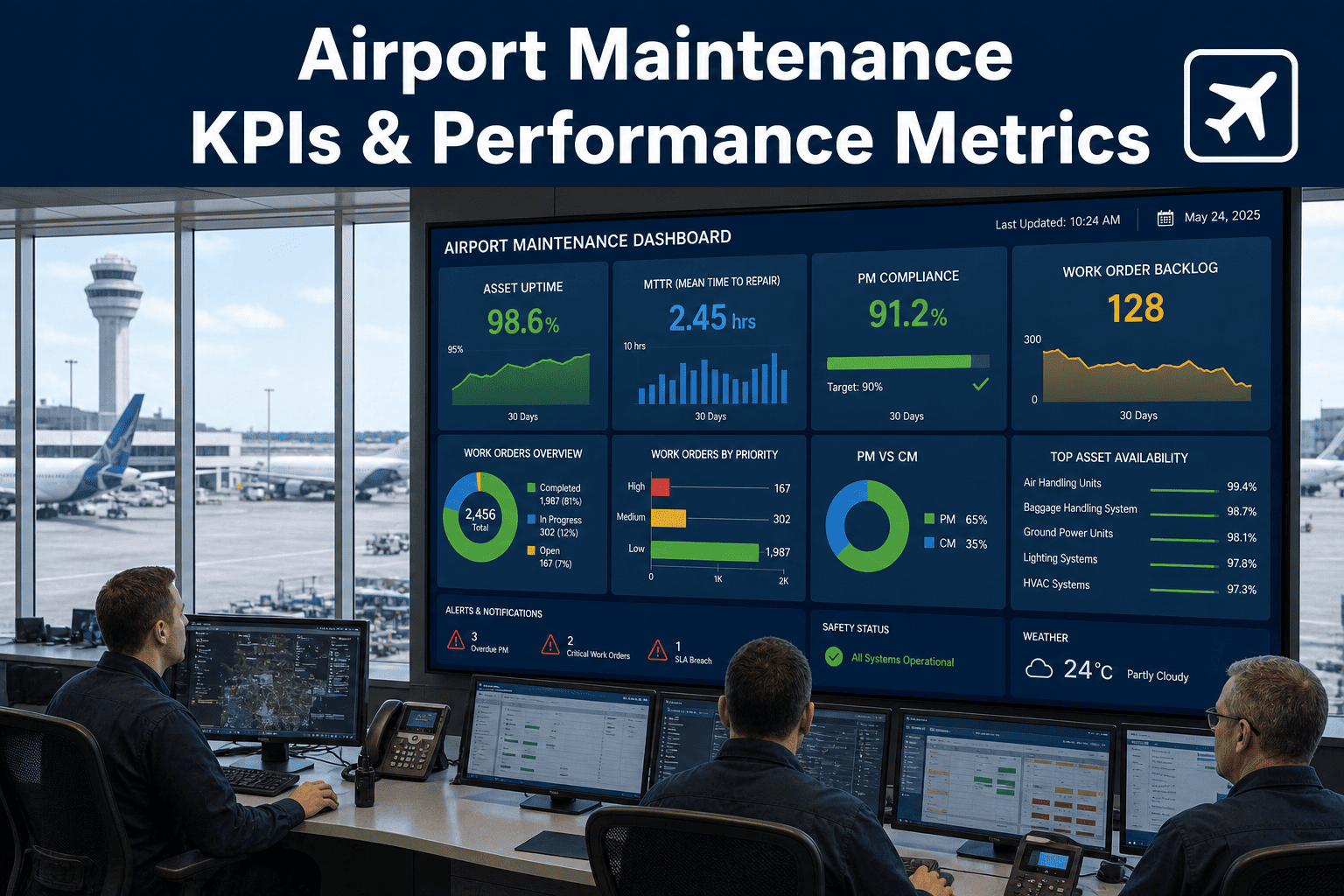
But here's the good news: the airports achieving 35% less downtime and 25-40% lower maintenance costs aren't working harder—they're tracking smarter. They measure what matters: how long equipment runs before failing, how fast technicians complete repairs, and whether preventive maintenance actually gets done. These KPIs transform maintenance from a cost center into a competitive advantage. Ready to see what's possible? Book a free consultation and we'll show you exactly which metrics will move the needle for your airport.
METRICS GUIDE
Airport Maintenance KPIs
25 Essential Metrics That Drive Operational Excellence
<5 hrs
World-Class MTTR Target
90%+
PM Compliance Benchmark
85%
World-Class OEE Score
Why Airport Maintenance KPIs Matter
Airports operate 24/7 with zero tolerance for critical system failures. A broken jet bridge delays flights. A failed baggage carousel creates passenger chaos. An HVAC outage in summer makes terminals unbearable. Without KPIs, maintenance teams react to crises rather than prevent them. With the right metrics, patterns emerge—equipment showing early warning signs, technicians needing training, processes creating bottlenecks.
Data-Driven Decisions
Replace gut feelings with measurable insights. Know exactly where to invest time and resources for maximum impact.
Benchmark Progress
Compare performance against industry standards and track improvement over time with objective measurements.
Justify Investments
Build business cases for equipment upgrades, staffing changes, and technology investments with hard data.
Predict Problems
Identify failing equipment before breakdowns occur. Shift from reactive firefighting to proactive prevention.
The 25 Essential Airport Maintenance KPIs
Not all metrics deserve equal attention. We've organized these 25 KPIs into five categories based on what they measure: equipment reliability, team efficiency, cost management, work order performance, and compliance. Focus on 5-7 KPIs that align with your current priorities rather than tracking everything at once.
1
Mean Time Between Failures (MTBF)
Total Uptime ÷ Number of Failures
Target: Higher is better—varies by equipment type
Measures average operating time between equipment failures. Higher MTBF indicates more reliable equipment and effective preventive maintenance.
2
Mean Time To Repair (MTTR)
Total Repair Time ÷ Number of Repairs
Target: <5 hours for world-class performance
Average time to restore equipment after failure. Lower MTTR means faster recovery and less operational disruption.
3
Overall Equipment Effectiveness (OEE)
Availability × Performance × Quality
Target: 85%+ is world-class; 60% is average
Gold standard metric combining uptime, speed, and output quality into single comprehensive score.
4
Equipment Uptime Percentage
(Operating Hours ÷ Scheduled Hours) × 100
Target: 90%+ availability for critical assets
Percentage of time equipment is operational and available. Direct indicator of maintenance program effectiveness.
5
Unplanned Downtime Rate
(Unplanned Downtime ÷ Total Operating Time) × 100
Target: <10% for world-class operations
Measures unexpected equipment failures. High rates signal weak preventive maintenance practices.
6
Wrench Time
(Hands-On Work Hours ÷ Total Work Hours) × 100
Target: 55%+ (industry average is 25-35%)
Time technicians spend actually working on equipment vs. waiting, traveling, or finding parts. Key indicator of operational efficiency.
7
Technician Productivity
(Completed Tasks ÷ Total Work Hours) × 100
Target: Varies by task complexity
Measures individual and team output. Helps identify training needs and resource allocation issues.
8
Schedule Compliance
(Completed Scheduled Tasks ÷ Total Scheduled Tasks) × 100
Target: 90%+ is world-class
Percentage of planned maintenance completed on schedule. Low scores indicate planning or resource problems.
9
Overtime Percentage
(Overtime Hours ÷ Total Hours) × 100
Target: <5% for world-class operations
Excessive overtime indicates understaffing or poor planning. Leads to technician burnout and higher costs.
10
First-Time Fix Rate
(Repairs Fixed First Visit ÷ Total Repairs) × 100
Target: 85%+ for skilled teams
Percentage of repairs completed without return visits. Reflects technician skill and parts availability.
Track These KPIs Automatically
Oxmaint CMMS calculates MTBF, MTTR, OEE, and all critical maintenance metrics in real-time dashboards.
11
Maintenance Cost per Square Foot
Total Maintenance Cost ÷ Facility Square Footage
Target: Benchmark against similar facilities
Standard metric for comparing maintenance spending across terminals and airport facilities.
12
Maintenance Cost as % of RAV
(Annual Maintenance Cost ÷ Replacement Asset Value) × 100
Target: 1-3% for world-class operations
Measures cost-effectiveness of maintenance program relative to total asset value.
13
Labor Cost per Work Order
Total Labor Costs ÷ Number of Work Orders
Target: Track trends over time
Helps identify inefficiencies in work order execution and resource allocation.
14
Emergency Repair Cost Ratio
(Emergency Repair Costs ÷ Total Maintenance Costs) × 100
Target: <5% (industry average is 15%)
Emergency repairs cost 3-5x more than planned maintenance. Lower ratios indicate proactive programs.
15
Spare Parts Turnover
Parts Used ÷ Average Inventory Value
Target: Balance availability vs. carrying costs
Measures inventory efficiency. Too low means excess stock; too high risks stockouts.
16
Planned Maintenance Percentage (PMP)
(Planned Hours ÷ Total Maintenance Hours) × 100
Target: 80-90% is world-class
Ratio of planned vs. reactive maintenance. Higher PMP indicates proactive maintenance culture.
17
Preventive Maintenance Compliance
(Completed PM Tasks ÷ Scheduled PM Tasks) × 100
Target: 90%+ (top quartile is 95%)
Percentage of scheduled preventive maintenance completed on time. Critical leading indicator.
18
Work Order Completion Rate
(Completed WOs ÷ Total WOs Created) × 100
Target: 95%+ monthly completion
Tracks overall work order throughput. Declining rates signal resource or process issues.
19
Maintenance Backlog
Total Pending Work Orders (in hours or count)
Target: 2 weeks of work per technician
Accumulation of incomplete work. Too high signals understaffing; too low may indicate overstaffing.
20
Reactive Maintenance Ratio
(Reactive Hours ÷ Total Hours) × 100
Target: <20% of total maintenance
Inverse of PMP. Organizations relying on reactive maintenance experience 3.3x more downtime.
21
FAA Compliance Rate
(Compliant Inspections ÷ Required Inspections) × 100
Target: 100% compliance required
Tracks completion of federally mandated maintenance inspections and documentation.
22
Safety Incident Rate
Incidents per 200,000 Work Hours
Target: Zero incidents; track declining trends
Frequency of workplace accidents related to maintenance activities. Critical for worker protection.
23
Audit Finding Resolution Time
Average Days to Resolve Audit Findings
Target: <30 days for non-critical findings
Speed of addressing compliance gaps identified during audits. Faster resolution reduces regulatory risk.
24
Documentation Completeness
(Complete Records ÷ Total Records Required) × 100
Target: 100% for audit readiness
Measures maintenance record accuracy and completeness for regulatory compliance.
25
Critical Work Order Age
Average Age of Open Critical/Emergency WOs
Target: <24 hours for safety-related items
Tracks how long high-priority work orders remain open. Extended ages indicate serious process failures.
KPI Benchmarks at a Glance
Knowing what to measure is only half the battle. You need benchmarks to understand whether your performance is acceptable, good, or world-class. This quick-reference chart shows target ranges for the most critical maintenance KPIs.
MTTR
>8 hours
5-8 hours
<5 hours
PM Compliance
<80%
80-89%
90%+
Wrench Time
<25%
25-45%
55%+
Planned Maintenance %
<60%
60-79%
80-90%
Schedule Compliance
<80%
80-89%
90%+
Unplanned Downtime
>20%
10-20%
<10%
Overtime %
>15%
5-15%
<5%
How to Start Tracking KPIs
Implementing KPI tracking doesn't require perfection on day one. Start with the metrics most relevant to your current challenges, establish baselines, and improve incrementally. Here's a practical approach that works for airports of any size.
1
Select 5-7 Priority KPIs
Choose metrics aligned with your biggest challenges. If downtime is killing operations, start with MTBF, MTTR, and equipment uptime. If costs are spiraling, focus on PMP and emergency repair ratio.
2
Establish Baselines
Measure current performance before setting targets. You can't improve what you haven't measured. Run 30-60 days of data collection to understand your starting point.
3
Implement CMMS Tracking
Manual tracking is error-prone and unsustainable. A CMMS automates data collection, calculates metrics in real-time, and generates dashboards for instant visibility.
4
Review Weekly, Act Monthly
Check KPIs weekly to spot trends. Make process changes monthly based on patterns. Avoid knee-jerk reactions to single data points—look for sustained patterns.
Build Your KPI Dashboard Today
Stop guessing about maintenance performance. Oxmaint provides real-time KPI tracking, automated calculations, and executive dashboards built for airport operations.
Frequently Asked Questions
What are the most important KPIs for airport maintenance?
The five most critical KPIs are MTBF (Mean Time Between Failures), MTTR (Mean Time To Repair), OEE (Overall Equipment Effectiveness), Planned Maintenance Percentage, and PM Compliance. These metrics cover equipment reliability, repair efficiency, and maintenance strategy effectiveness—the core drivers of operational excellence.
What is a good MTTR benchmark for airport equipment?
World-class MTTR is under 5 hours for most equipment categories. However, targets vary by asset criticality—jet bridges and baggage systems may require faster response than non-critical equipment. The key is establishing baselines for your specific assets and improving consistently over time.
How do I calculate wrench time for maintenance technicians?
Wrench time equals hands-on work hours divided by total work hours, multiplied by 100. Industry average is just 25-35%, meaning technicians spend most of their time on non-productive activities like finding parts, waiting for equipment, or traveling. World-class operations achieve 55%+ wrench time through better planning and parts availability.
What PM compliance rate should airports target?
Target 90% or higher PM compliance. Below 80% is considered critical and indicates assets are at risk of failure. Top quartile performance is 95%+ compliance. Low compliance rates directly correlate with more breakdowns, higher emergency repair costs, and increased downtime.
How can a CMMS help track maintenance KPIs?
A CMMS automates KPI tracking by capturing data from every work order, equipment interaction, and maintenance activity. It calculates metrics like MTBF, MTTR, and OEE automatically, generates real-time dashboards, and produces reports for management review—eliminating manual spreadsheets and ensuring data accuracy.