Your airport runs on 12 disconnected systems. Flight ops uses one platform, ground handling another, maintenance a third. Security data sits in separate silos. When a gate change happens, five people make five manual updates—and passengers still see outdated information. This isn't rare. This is how most airports operate. An Airport Operations Management System (AOMS) eliminates the chaos: one unified platform controlling every operation in real-time—from airside to terminal, ground handling to compliance, all synchronized automatically.
Fragmented Systems
⚠
Manual Data Entry
2,400+ staff hours monthly wasted
⚠
Delayed Information
Gate changes take 8-12 minutes to propagate
⚠
Data Inconsistencies
15-20% of operational data conflicts
⚠
System Integration Costs
$200K-$500K annual custom integrations
$2.8M - $4.2M Annual Loss
Unified AOMS Platform
✓
Automated Data Sync
Single-entry, instant propagation
✓
Real-Time Updates
Changes visible in 2-3 seconds system-wide
✓
Single Source of Truth
Zero data conflicts, 100% accuracy
✓
Native Integration
All modules built-in, no custom code
$1.6M - $2.8M Annual Savings
The AOMS market reached $10.5B in 2024, growing at 7.6% CAGR toward $19.9B by 2033. Airports implementing unified systems report 20% lower operational costs, 15% reduction in baggage mishandling, and elimination of data synchronization errors. Schedule a consultation to see how OXmaint consolidates your fragmented operations into one intelligent platform. Start your free 30-day trial and experience unified airport operations management firsthand.
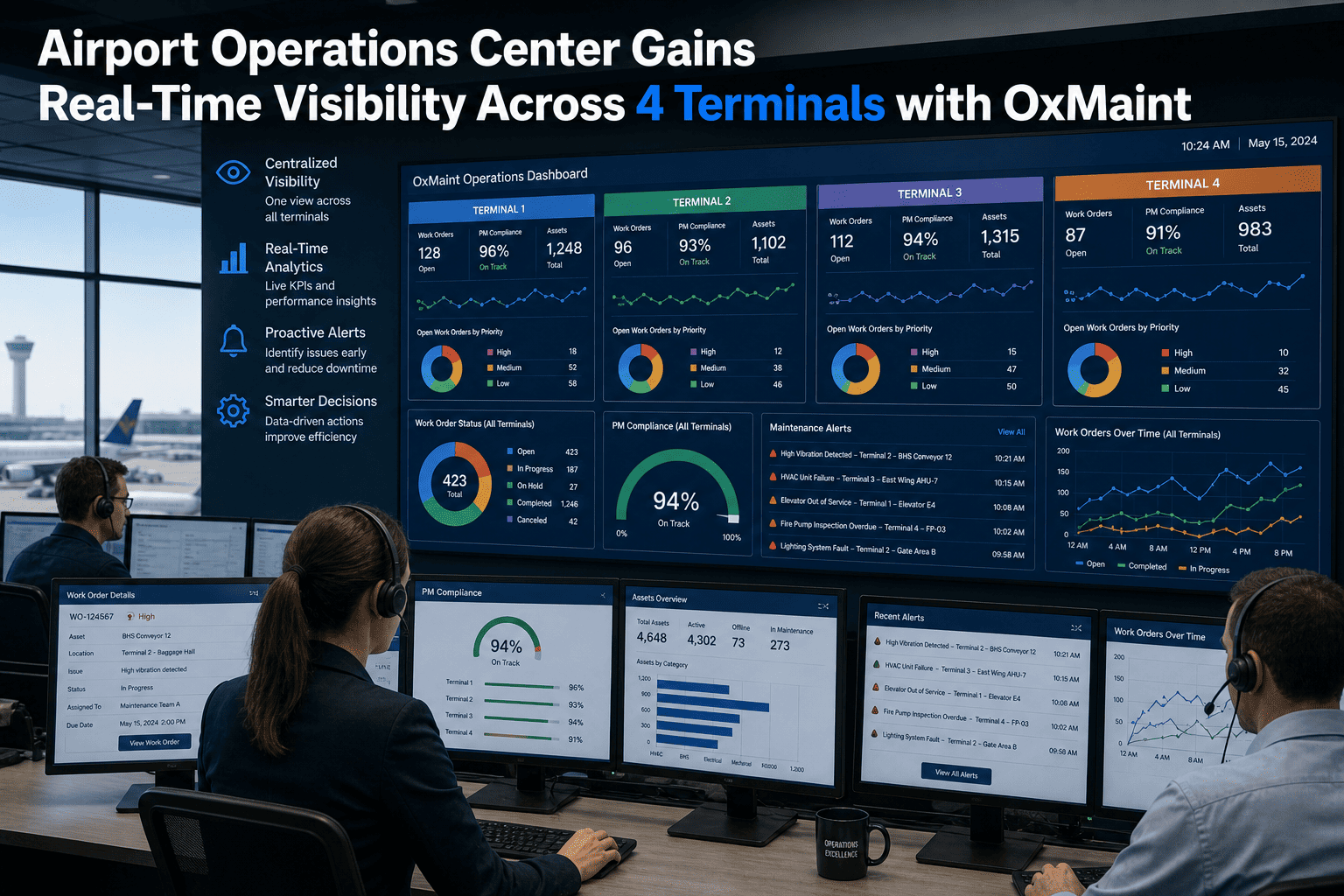
The AOMS Control Room: Your Airport's Command Center
An AOMS transforms operations from reactive chaos to proactive control. The system provides a unified dashboard where every airport operation appears in real-time: flight status, gate assignments, baggage flow, ground equipment locations, maintenance alerts, security incidents. When weather delays an inbound flight, the AOMS automatically adjusts gate assignments, notifies ground crews, updates passenger information, and reschedules connecting flights—all without human intervention. OXmaint delivers this control center functionality, giving airport operators the visibility they've never had.
Flight Operations
147 Active Flights
3 Delays (12 min avg)
92% On-Time
Gate Management
42/45 Gates Occupied
3 Available Now
Auto-Optimized
Baggage Handling
1,847 Bags Tracked
99.2% On Schedule
2 Alerts Active
Personnel Tracking
284 Staff On-Duty
All Certified
Real-Time Locations
Asset Management
156 GSE Units
8 Maintenance Due
87% Utilization
Safety & Compliance
12 Inspections Today
100% Completed
0 Violations
Real-Time Integration: How AOMS Connects Everything
The power of AOMS isn't individual modules—it's how they communicate instantly. When a flight lands early, the system cascades updates: gate availability refreshes, baggage handlers receive new timing, customs gets passenger counts, cleaners adjust schedules, catering trucks reroute. All automatic. All synchronized. All documented. Traditional systems require 8-12 manual notifications for a single gate change. AOMS completes the entire cascade in 2-3 seconds with zero human input. Book a live demo to watch this automation in action with real airport scenarios.
Flight AA1247 Status Update
Landing 15 minutes early
0.5 sec
Gate assignment updated to A12 (available earlier)
1.0 sec
Ground crew notified via mobile alert
1.5 sec
Passenger information displays updated
2.0 sec
Baggage handlers adjust loading schedule
2.5 sec
Connecting flights notified of earlier arrival
3.0 sec
Cleaning crew timing adjusted automatically
Total Cascade Time
3 Seconds
vs. 8-12 minutes with manual updates
See the Complete AOMS in Action
Watch a live demo showing how OXmaint synchronizes flight ops, ground handling, asset management, and compliance in real-time. See the control dashboard managing your entire airport from one screen.
Core AOMS Modules: What's Included
OXmaint AOMS integrates eight core operational modules, each designed for airport-specific workflows. Flight operations manages scheduling, gate assignments, and delay management. Resource management optimizes gate utilization, equipment deployment, and staff allocation. Baggage handling tracks every bag from check-in to claim. Asset management monitors all ground equipment, vehicles, and infrastructure. Safety & compliance automates inspections, incident reporting, and regulatory documentation. Passenger services manages check-in, boarding, and information displays. The modules share one database—changes in any module instantly update all others.
• Real-time flight tracking
• Automated gate assignments
• Delay management & reporting
• Stand allocation optimization
92-95% on-time performance
• Gate utilization analytics
• Equipment deployment
• Staff scheduling & tracking
• Capacity planning tools
15-20% efficiency gains
• RFID bag tracking
• Automated routing
• Mishandling alerts
• Real-time status updates
15% fewer mishandling incidents
• GSE location tracking
• Predictive maintenance
• Utilization monitoring
• Lifecycle management
40% better equipment utilization
• Digital inspection checklists
• Incident reporting system
• Regulatory documentation
• Audit trail automation
65% faster compliance reporting
• Check-in management
• Boarding coordination
• Information displays
• Queue monitoring
30% reduced wait times
The ROI Equation: What AOMS Actually Delivers
AOMS implementation costs vary ($500K-$2M depending on airport size), but ROI timelines are consistent: 12-18 months. The returns compound across multiple areas simultaneously. Operational cost reduction (20% average) combines with increased gate utilization (15-20% more daily operations), reduced baggage mishandling (15% fewer incidents at $100-$300 per case), and lower compliance costs (50-65% reduction). Sign up for OXmaint's free trial and calculate exact ROI based on your current operational metrics—most airports identify $2-5M annual value within the assessment.
Months 1-3
Implementation & Training
System deployment complete
Staff training finished
First modules live
-$500K to -$2M (Investment)
Months 4-6
Initial Benefits
10% operational cost reduction
8% fewer delays
First compliance time savings
+$400K - $800K (Cumulative)
Months 7-12
Full Optimization
20% operational cost reduction
15% increased gate utilization
Full automation benefits realized
+$1.2M - $2.8M (Cumulative)
Months 13-18
ROI Positive
Investment fully recovered
Sustained operational gains
Additional capacity unlocked
+$2.4M - $5.2M (Net Positive)
Average Breakeven Period
12-18 Months
Then $2M-$4M annual recurring value
Cloud vs. On-Premise: Deployment Options
OXmaint offers both cloud-based and on-premise AOMS deployment. Cloud solutions provide faster implementation (4-8 weeks vs. 12-16 weeks), lower upfront costs, automatic updates, and scalability. On-premise systems offer complete data control, customization flexibility, and work in low-connectivity environments. Most airports choose hybrid: core operations in cloud for reliability and scalability, sensitive security data on-premise for control. Book a technical consultation to determine optimal architecture for your airport's specific requirements and constraints.
Feature
Cloud-Based
On-Premise
Hybrid
Implementation Time
4-8 weeks
12-16 weeks
8-12 weeks
Upfront Cost
$200K-$500K
$800K-$2M
$400K-$1.2M
Scalability
Instant
Hardware-dependent
Flexible
Data Control
Provider-managed
Complete
Selective
Updates
Automatic
Manual
Mixed
Best For
Growing airports
Security-critical
Most airports
Unify Your Airport Operations Today
Stop coordinating across 12 disconnected systems. OXmaint AOMS provides one platform for flight ops, ground handling, asset management, compliance, and passenger services—all synchronized in real-time.
Frequently Asked Questions
What's the difference between AOMS and individual airport management software tools?
Individual tools handle specific functions (flight ops, baggage, maintenance) but operate in silos, requiring manual data transfer and creating synchronization delays. AOMS integrates all functions into one platform with a shared database. When flight status changes in OXmaint, the update propagates automatically to gates, baggage, ground crews, and displays in 2-3 seconds—versus 8-12 minutes with manual coordination across separate systems.
How long does AOMS implementation take?
Cloud-based AOMS like OXmaint deploy in 4-8 weeks: Week 1-2 system configuration and data migration, Week 3-4 staff training and pilot testing, Week 5-6 phased rollout by module, Week 7-8 full operation with monitoring. On-premise implementations take 12-16 weeks due to hardware installation. Most airports go live with core modules (flight ops, gates, baggage) first, then add asset management and compliance modules over 2-3 months.
Can AOMS integrate with our existing systems?
Yes. OXmaint connects with legacy flight information systems, baggage handling equipment, access control platforms, and airline departure control systems via API integration. The AOMS doesn't replace existing hardware—it unifies software control and data flow. Integration typically covers: flight data feeds, baggage tracking systems, gate management hardware, security access systems, and airline reservation platforms. Full integration validates during pilot phase before complete deployment.
What ROI can we expect from AOMS implementation?
Mid-sized airports (50-100 daily operations) achieve breakeven in 12-18 months, then realize $2-4M annual recurring value. Returns come from: 20% operational cost reduction ($800K-$1.6M), 15-20% increased gate utilization enabling more flights ($600K-$1.2M), 15% fewer baggage mishandling incidents ($200K-$400K), and 50-65% compliance cost reduction ($150K-$300K). Larger airports see proportionally higher returns.
Is cloud-based AOMS secure enough for airport operations?
Modern cloud AOMS platforms use enterprise-grade security: encrypted data transmission (TLS 1.3), encrypted storage (AES-256), role-based access control, multi-factor authentication, and SOC 2 compliance. OXmaint provides hybrid deployment where sensitive security data stays on-premise while operational data benefits from cloud scalability. Cloud platforms often exceed on-premise security because providers employ dedicated security teams, automatic patching, and 24/7 monitoring that most airports can't maintain internally.