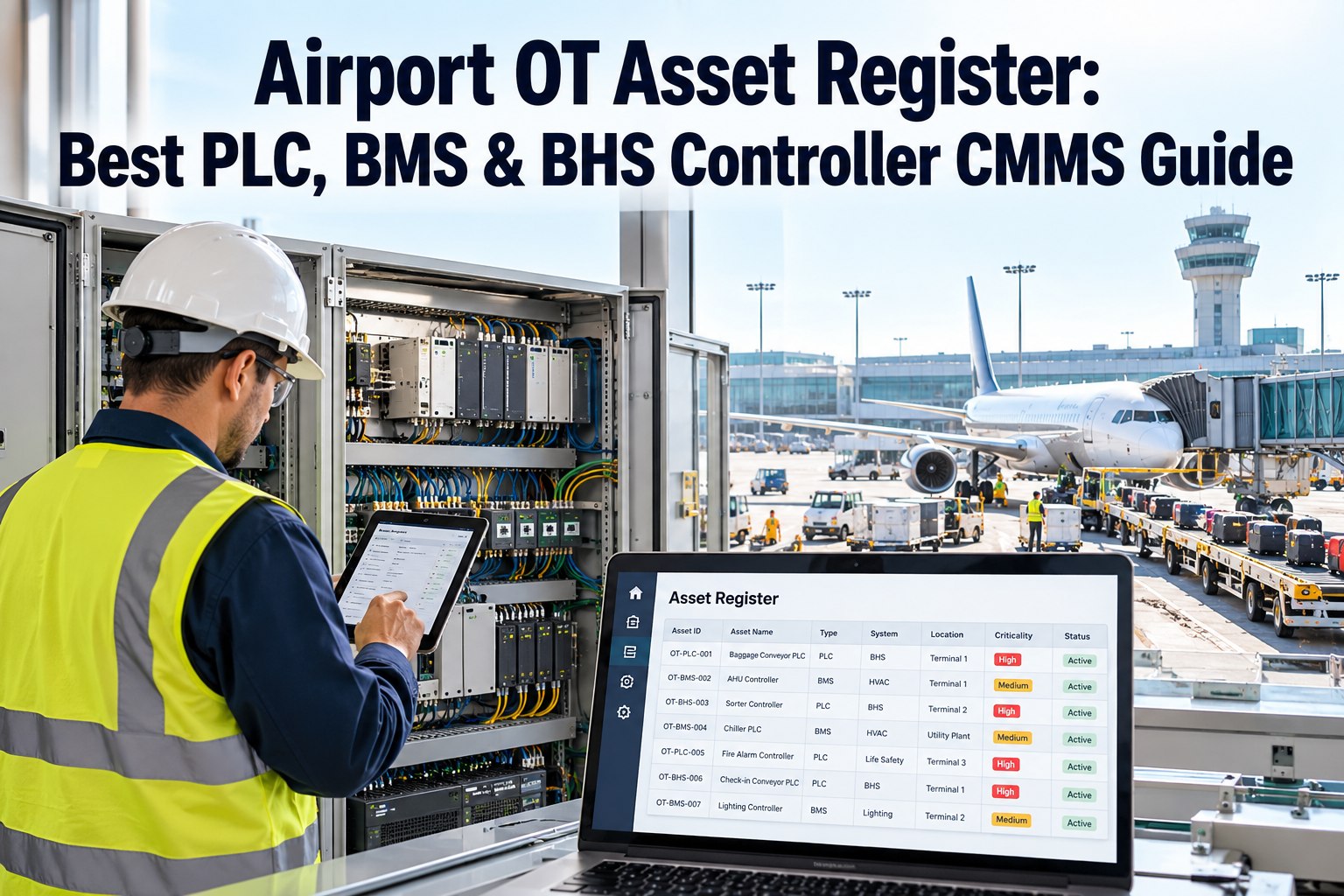
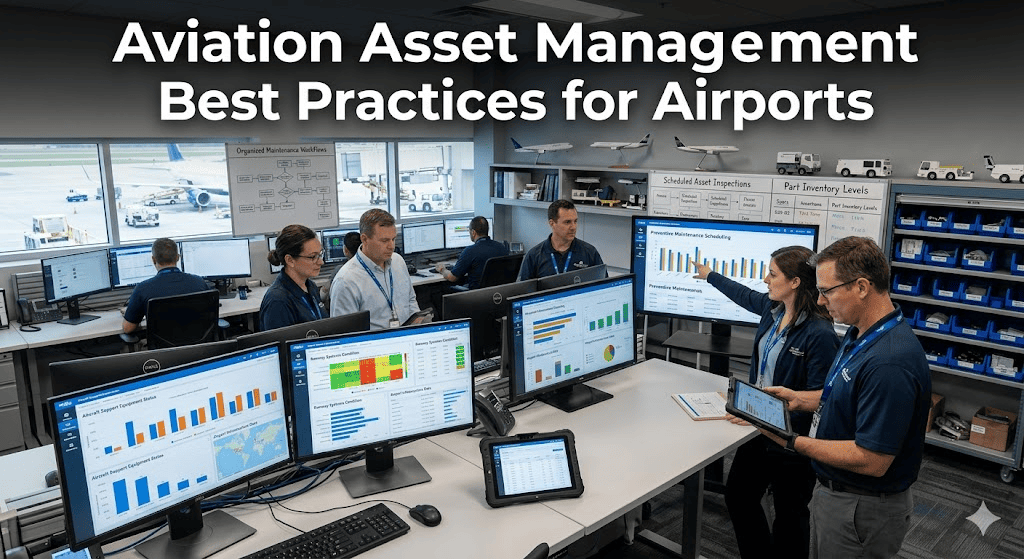
The PLC running the baggage sortation loop, the BMS controller managing terminal HVAC, the panel driving the jet bridge — every one is a computer, and most airports can't say what firmware they run, whether they're patched, or who owns them. That blind spot is where an OT outage or a cyber-physical incident begins. Biomed-style maintenance tracks some of it; security tracks some of it; nobody has the whole register. OXMAINT AI is AI-powered maintenance management software (CMMS) that holds every OT asset — PLC, BMS, BHS controller — with its firmware, patch level, criticality and PM cadence on one record. Book a demo to see a defensible OT register.
Airport · OT Asset Register
You Can't Patch, Protect or Maintain What You Haven't Listed
Airport operational technology — the controllers behind baggage, HVAC, jet bridges and lighting — is invisible until it fails. OXMAINT AI turns that scattered hardware into one OT asset register: firmware version, patch level, criticality tier and PM schedule per device, so maintenance and security finally work from the same defensible list.
- 1Discover the OT assets
- 2Record firmware & patch
- 3Tier by criticality
- 4Schedule & prove
OT under one register
BHSsortation PLCs, conveyor drives, scanners
BMSHVAC controllers on BACnet / Modbus
Gatesjet bridges, de-icing, apron systems
Airfieldlighting controllers, people movers
Different vendors, different protocols, one register — the only way to see the whole estate.
What a Defensible OT Record Contains
An OT asset register isn't a spreadsheet of names — it's the fields that let you patch, prioritize and prove. Miss these and the register can't do its job. Start a free trial to capture them per device.
Make, model & serialThe unique identity every other field hangs on.
Firmware / OS versionWhat's actually running — the basis for any vulnerability check.
Patch level & EOLWhether it's current, and when the vendor stops supporting it.
Network zoneWhich segment it sits in — the flat-network risk lives here.
Criticality tierWhat an outage costs operations — the priority driver.
PM & ownerThe maintenance cadence and the accountable name.
Tier by Criticality, Not by Convenience
A display board and a baggage-sortation PLC are not equal risks. Ranking OT assets by what their failure does to operations tells you where to patch and protect first. Book a demo to see criticality tiering.
Tier 1 · Safety / flight-critical
Failure grounds operations or affects safety — airfield lighting controllers, primary BHS sortation. Highest patch and segmentation priority.
Tier 2 · Operationally critical
Failure degrades throughput — jet bridges, terminal HVAC, people movers. Prioritized maintenance and monitored closely.
Tier 3 · Supporting
Failure is an inconvenience — display boards, non-critical sensors. Scheduled work, standard controls.
Tiering reflects OT-security practice: rank by operational and safety impact so limited patch windows go to the assets that matter most. Align tiers to your own risk assessment (e.g. IEC 62443, NIST SP 800-82). Sources: Nozomi Networks connected-airport analysis; IEC 62443 / NIST SP 800-82.
Give Maintenance and Security the Same OT List
See how OXMAINT AI keeps firmware, patch state, criticality and PM history on one OT record — so a patch gap and a service need surface in the same place.
Why OT Isn't Just IT With Different Boxes
The instinct is to patch OT like a laptop. It doesn't work that way — and the differences are exactly why the register has to be maintenance-grade, not just an IT scan. Start a free trial built for OT reality.
IT assets
- Patch on a routine cycle
- Reboot with little consequence
- Short, well-known lifespans
- Modern, secured protocols
OT controllers
- Patch windows are rare — uptime is everything
- A reboot can halt a terminal
- Run for 15–20 years, often past vendor support
- BACnet / Modbus — built for reliability, not security
OT protocols like BACnet and Modbus were designed for reliability, often with no encryption or authentication and default credentials — so on a flat network, lateral movement to higher-value systems is the easy part. The register plus segmentation is the defense. Source: Nozomi Networks.
The Register Serves Maintenance and Security at Once
One list, two audiences. The same OT record that schedules a controller's PM also tells security whether it's patched and where it sits — so neither team works blind. Book a demo to see the shared view.
For maintenance
PM cadence, service history, spares and the owner — so controllers stay maintained and outages get fixed fast.
For security
Firmware, patch state, EOL and network zone — so a vulnerable or unsupported device is visible and prioritized.
For compliance
A complete, current inventory — the foundation regulators such as EASA Part-IS and NIS2-style regimes expect.
For the audit
Timestamped records of patches, PMs and controls — defensible evidence instead of a reconstructed guess.
How OXMAINT AI Builds the OT Register
OXMAINT AI is maintenance management software that holds each OT controller's identity, security state and maintenance history on one record — so the register is live, tiered and provable. Start a free trial to register your first system.
-
1
Discover
Capture every PLC, BMS and BHS controller with make, model, serial, location and network zone.
-
2
Record
Log firmware, patch level and end-of-life alongside the PM schedule on the same asset.
-
3
Tier
Rank by operational and safety criticality so patch windows and controls go where they matter.
-
4
Prove
Keep an audit-ready history of maintenance, patches and controls for safety and security review.
Frequently Asked Questions
What counts as an airport OT asset?
The controllers behind physical operations — baggage-handling PLCs, building-management and HVAC controllers, jet bridges, de-icing, airfield lighting controllers and people movers.
Start a free trial to register them.
Why is an OT asset register the security foundation?
You can't patch, segment or prioritize a device you haven't listed. A complete register with firmware and patch state is the base every other OT control builds on.
Book a demo to see it.
Why is patching OT harder than IT?
OT controllers run continuously, a reboot can halt operations, and they often run 15–20 years past vendor support — so patch windows are rare and compensating controls matter.
Start a free trial to track EOL.
How does criticality tiering help?
Patch windows are limited, so ranking assets by operational and safety impact sends effort to the flight-critical controllers first, not the display boards.
Book a demo to see tiers.
Can OXMAINT AI serve both biomed-style maintenance and security?
Yes — one OT record carries PM history for maintenance and firmware, patch and zone data for security, so both teams work from the same list.
Start a free trial to unify them.
Turn Scattered Controllers Into One Defensible Register
List every OT asset with its firmware, patch, criticality and PM — a register maintenance, security and auditors can all trust, on one platform.