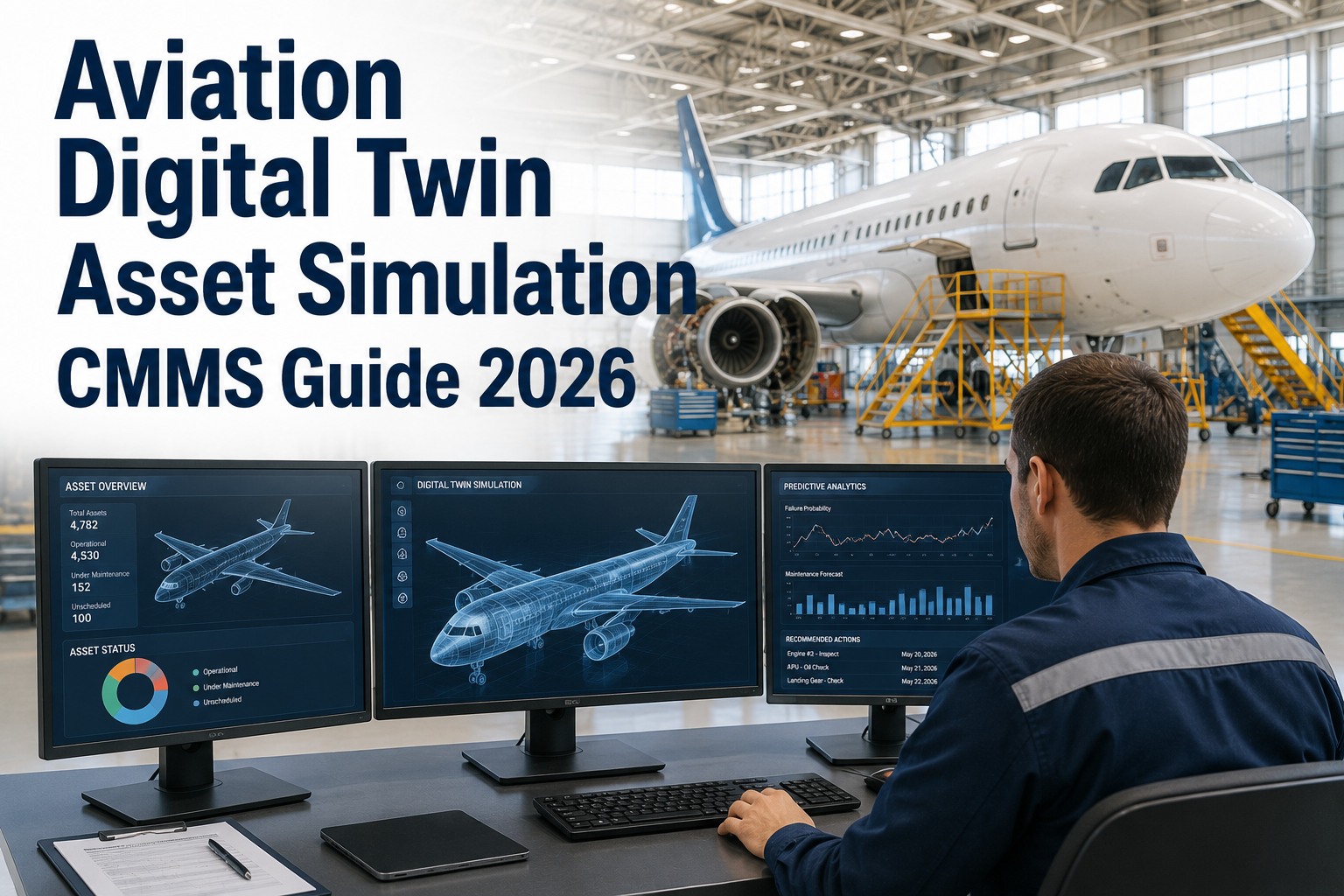
An airport digital twin is the industry's most-hyped 2026 investment — a virtual replica of runways, terminals, jet bridges, baggage systems and airside vehicles, running in parallel with the real thing. The problem: a twin without live CMMS data is a very expensive 3D model of what the airport looked like at go-live. The global airport digital twin market is projected to grow from USD 1.6B in 2026 to USD 4.88B by 2034 at 14.9% CAGR — and every high-performing deployment traces back to the same foundation: structured asset attributes, live work-order streams, sensor telemetry and event streams flowing from a modern CMMS. Or as the field puts it: "the twin sees the future, the CMMS makes it happen." This guide walks the four data feeds an airport twin actually needs, the reference architecture, and how OXMAINT AI — the CMMS software — supplies that foundation.
Airport Digital Twin · CMMS Data Feed · Reference Architecture · 2026
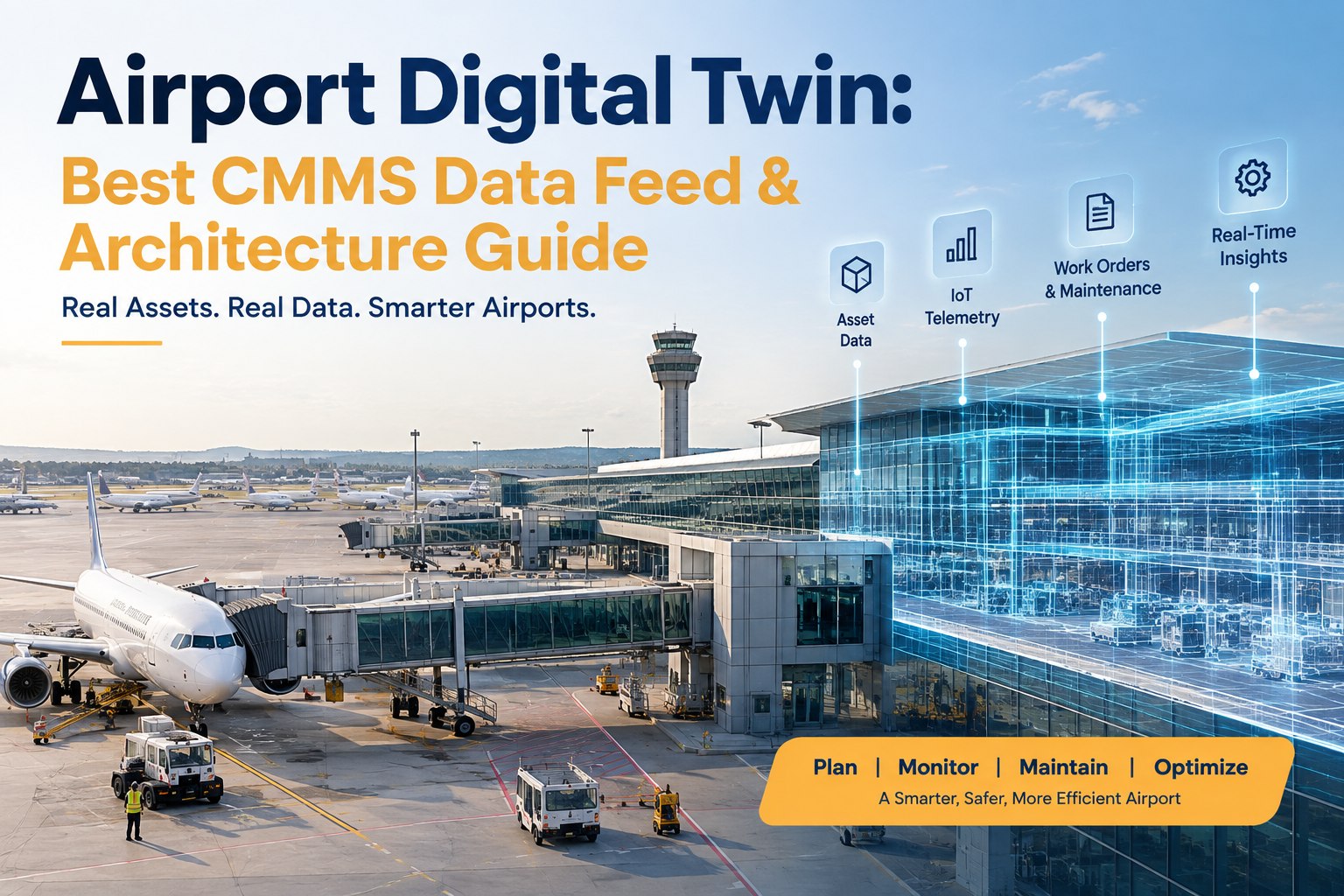
Airport Digital Twin: Best CMMS Data Feed & Architecture Guide
A digital twin is only as smart as the data feeding it. OXMAINT AI, an AI-powered CMMS, supplies the four data feeds every airport twin needs — asset attributes, live work orders, sensor telemetry & event streams — so your twin stays honest and every prediction turns into a real inspection, defect, work order or PM.
$1.6B → $4.88B
airport DT market 2026 → 2034 at 14.9% CAGR
80,000+
critical assets a large hub airport manages
20–30%
gain in prediction accuracy w/ historical WO data
4 feeds
the minimum data streams a working twin needs
Why a Twin Without CMMS Data Is Just an Expensive 3D Model
Every airport digital twin fails the same way when it fails: the 3D model went live, the executive demo went well, and then nobody could tell you whether the highlighted jet bridge was actually the one under repair, or when it was last serviced, or who owned the open work order. The twin looked alive. The data behind it wasn't. The fix isn't more visualization — it's the CMMS layer underneath. Start free and give your twin the CMMS foundation it needs.
Twin Without CMMS
Static 3D Museum Piece
Beautiful BIM model — frozen at go-live
Asset attributes hand-maintained & drifting
No live work-order state
No maintenance history to train predictions
Twin says "asset OK" while it's actually in bay 4
Executive demo → operations shelf-ware
Twin + OXMAINT AI
Living Operational Mirror
3D model tied to live asset register
Every asset attribute pulled from the CMMS record
Work-order state live on the twin overlay
Historical WO data lifts prediction accuracy 20–30%
Predictions become real work orders in one click
Twin & CMMS share one source of truth
The 4 Data Feeds Every Airport Twin Needs
A working airport digital twin needs four data streams flowing in, and OXMAINT AI is the source-of-record for all four. Miss any one and the twin drifts out of sync with reality — usually fast enough that operations teams stop trusting it within a quarter. Here's what each feed does and how OXMAINT AI supplies it. Book a demo to see the 4-feed pipeline live.
Feed 1
Asset Attributes
Every asset in the twin has a matching CMMS record — asset ID, model, install date, warranty status, criticality tag, spare-parts BOM, geospatial coordinates. This is the identity layer.
Source: OXMAINT AI asset register
Feed 2
Live Work Orders
Every open, in-progress & closed WO streamed in real time. Status changes on the twin the moment a technician updates it in the field — no batch export delay.
Source: OXMAINT AI work-order stream
Feed 3
Sensor Telemetry
Vibration, temperature, current-draw, pressure, acoustic — IoT & LoRaWAN sensor data time-series fed into the twin for anomaly detection & predictive alerts.
Source: OXMAINT AI IoT ingestion layer
Feed 4
Event Streams
Alarms, inspections completed, contractor sign-ins, PM triggers, shift-handover events — every non-WO event with a timestamp & asset attribution.
Source: OXMAINT AI event log
The Reference Architecture — CMMS to Twin, End to End
Here's the data pipeline that makes a live airport twin work — from the physical asset on the airside apron to the twin's decision layer and back. OXMAINT AI sits at the bottom of the stack as the source of truth & the destination of predictions, closing the loop. Sign up free and wire this architecture on your assets.
L6
Decision & Simulation
Scenario planning, capacity forecasting, failure predictions. Every predicted action lands as a work order back in OXMAINT AI.
L5
Visualization & UI
BIM/GIS-based 3D UI, dashboards, operational overlays. The screen the ops director walks up to.
L4
Analytics & AI
Anomaly detection, degradation modelling, remaining-useful-life. Trained on historical CMMS + telemetry data.
L3
Data Fabric
Common Data Environment (CDE) unifying BIM, GIS, CMMS, BMS, SCADA & ERP. Schema alignment happens here.
L2
OXMAINT AI — CMMS & Ingestion
Asset register, work-order stream, IoT ingestion, event log — the source of truth for the 4 data feeds.
L1
Physical Assets & Sensors
Runways, terminals, jet bridges, baggage systems, GSE, HVAC — plus LoRaWAN/BMS/SCADA sensors on every asset.
The Twin Sees the Future — OXMAINT AI Makes It Happen.
A prediction that never becomes a work order is a slide, not an outcome. OXMAINT AI closes the loop — the twin's degradation forecast lands as a scheduled inspection, its anomaly alert becomes a routed WO with parts & ETA, and the closure feedback trains the next prediction cycle.
Asset Attribute Payload — What Actually Flows Per Asset
Every asset on the twin needs a full attribute payload from OXMAINT AI — the fields that turn a 3D geometry into an operational object. Here's the minimum field set per asset, and the higher-value fields that separate a good twin from a great one. Book a demo to see the payload on a live asset record.
The 5-Phase Airport Twin Rollout
Digital twin programs fail when airports try to model everything at once. The teams that succeed pick one operational problem, build a focused twin around it, and expand once value is proven — this is the "System of Systems" incremental approach airports like Schiphol have used to build their Common Data Environment. Here's the 5-phase rollout that pairs with OXMAINT AI. Sign up free and start Phase 1 on a single asset class.
01
CMMS Foundation
Stand up OXMAINT AI as the source of truth — asset register, WO stream, event log. Nothing meaningful on the twin until this is in place.
02
Pilot Asset Class
Pick one class — jet bridges, GSE, baggage belts — and connect the 4 data feeds. Prove value on a bounded problem.
03
Sensor Layer
Deploy IoT sensors on the pilot assets. LoRaWAN, BMS, SCADA — feed telemetry into OXMAINT AI & up to the twin.
04
Predictive Analytics
Train degradation & anomaly models on historical WO + telemetry data. Predictions land back as OXMAINT AI work orders.
05
Scale & Integrate
Expand to additional asset classes, integrate BMS/SCADA/ERP at the CDE layer, open the twin to more stakeholders.
The 5 Governance Rules That Keep the Twin Honest
A digital twin gets untrusted fast when its data drifts from reality — a jet bridge shown "in service" while it's actually in bay 4 is game over for operations trust. These are the governance rules OXMAINT AI enforces so the twin stays true. Book a demo to see the governance layer live.
01
CMMS is the single source of truth for asset attributes — no hand-edits on the twin allowed.
02
WO state changes flow twin-wards in seconds, not batch overnight — live parity is non-negotiable.
03
Every asset in the twin has a matching OXMAINT AI record — orphan geometries removed monthly.
04
Every twin prediction has a defined path back into OXMAINT AI as a WO — no orphaned insights.
05
Data quality KPIs (completeness, freshness, orphan rate) tracked shift-over-shift, not annually.
What OXMAINT AI Gives an Airport Digital Twin Program
OXMAINT AI is the CMMS layer that makes the twin worth building — the source of the 4 data feeds and the destination of every prediction. Here's what airport digital twin leads actually get on day one. Sign up free and start supplying the twin's foundation.
Structured Asset Register
Every asset with a full attribute payload — identity, nameplate, criticality, location, sensor mapping — ready to feed the twin's identity layer.
Live Work-Order Stream
Real-time WO state via webhook / API — open, in-progress, closed statuses reflect on the twin the moment field techs update.
IoT / Sensor Ingestion
Vibration, temperature, pressure & acoustic streams from LoRaWAN, BMS & SCADA sources — all landing in one CMMS event log.
Historical WO Archive
Years of structured maintenance history — the training data that lifts twin prediction accuracy by 20–30% over sensor-only models.
Prediction-to-WO Bridge
Every twin anomaly alert or degradation forecast routes back into OXMAINT AI as a scheduled WO with parts & owner.
Data-Quality Governance
Orphan-rate, completeness & freshness KPIs tracked live — so the twin never drifts silently out of sync with reality.
"
We spent the first year of our digital twin program building a beautiful 3D model that nobody in operations trusted. The asset attributes were hand-maintained and 30% wrong, and the twin said things about work-order status that nobody in the field could verify. When we moved the source of truth to OXMAINT AI, the whole thing came alive — every asset in the twin had a live CMMS record behind it, every WO state change reflected in seconds, and the anomaly alerts from the analytics layer started landing as real scheduled work. The twin didn't get smarter; it just started telling the truth.
Digital Twin Program Lead · International Airport
Frequently Asked Questions
What data does an airport digital twin need from a CMMS?
Four feeds: asset attributes (identity, criticality, location, nameplate), live work-order state, sensor telemetry (vibration, temperature, current), and event streams (alarms, inspections, contractor sign-ins). OXMAINT AI supplies all four from a single platform.
Can we build a digital twin without a CMMS?
You can — but the twin becomes a static 3D model within a quarter. Without live CMMS data, asset attributes drift, work-order state isn't reflected, and predictions have no operational path back to reality. Every serious 2026 airport twin program starts with a CMMS foundation.
How much does an airport digital twin cost to deploy?
A pilot on a single asset class typically ranges from tens to a few hundred thousand dollars depending on sensor coverage & integration complexity. Airports with structured OXMAINT AI data already in place reduce cost significantly by eliminating the data-reconstruction step.
Which airport assets benefit most from a digital twin?
Jet bridges, baggage handling systems, HVAC plants, airfield lighting circuits & GSE fleets — assets with high failure impact, sensor-friendly failure modes, and rich CMMS history. OXMAINT AI's asset-class templates make each one straightforward to bring online.
How fast can OXMAINT AI be wired into a digital twin platform?
Most airports connect the 4 data feeds — asset attributes, WO stream, telemetry, events — via OXMAINT AI's open API in a few weeks. Import the asset list, wire the webhooks, and the twin starts receiving live CMMS data from day one.
A Living Twin Starts With a Living CMMS.
Give your airport digital twin the four data feeds it needs — asset attributes, live work orders, sensor telemetry & event streams — from OXMAINT AI, and turn every prediction into a real work order, PM or inspection.