Airport parking is not a passive infrastructure asset — it is the single largest non-aeronautical revenue source for most commercial airports, and every square foot of it depends on equipment that must function without interruption. A malfunctioning gate barrier during a morning departure rush does not just inconvenience drivers — it creates a revenue leak that compounds across hundreds of transactions per hour. A failed pay-on-foot kiosk redirects queuing pressure to exit lanes, stacking vehicles into the structure and generating the kind of passenger frustration that drives travelers toward off-airport competitors. A burned-out lighting section in a parking garage creates a security concern that liability insurers notice and passengers remember. For the airport operations teams responsible for parking revenue performance, the reality is that revenue protection is maintenance — and maintenance that is not tracked, scheduled, and documented through a centralized system leaks money as invisibly as a slow plumbing drain. With 64% of U.S. hub airports now offering EV charging infrastructure and PARCS systems growing more complex with LPR cameras, dynamic pricing, and mobile payment integration, the maintenance burden on parking facilities has expanded significantly beyond traditional structural and lighting upkeep. Managing this expanded asset portfolio without a CMMS creates operational blind spots that directly erode the revenue the facility exists to generate. See how OxMaint centralizes parking facility maintenance across structures, lots, equipment, and technology systems — start a free trial to explore the platform.
Is Deferred Maintenance Quietly Eroding Your Parking Revenue?
OxMaint helps airport parking teams track every gate, kiosk, camera, charger, and structural asset in one platform — so nothing falls through the cracks.
The Seven Asset Categories That Define Airport Parking Maintenance
Airport parking facilities are far more complex than the concrete-and-steel structures they appear to be from the outside. A comprehensive maintenance program must address seven distinct asset categories — each with different failure modes, inspection requirements, and revenue impact profiles. Neglecting any one category creates a weak link that can cascade into revenue loss, safety incidents, or regulatory exposure.
PARCS Equipment
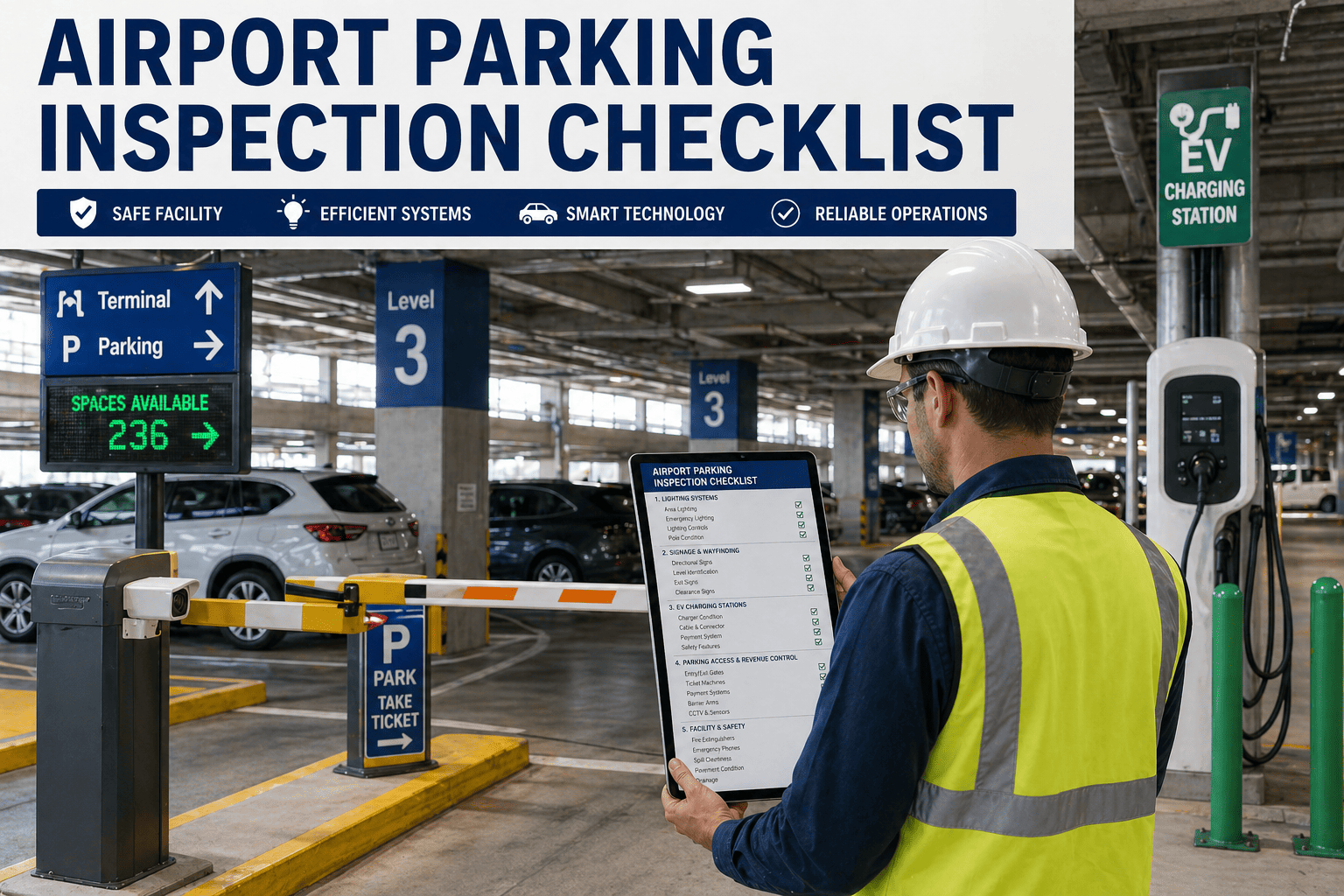
Gate barriers, ticket dispensers, pay-on-foot kiosks, LPR cameras, credit card readers, and exit lane controllers. A single barrier arm failure at a high-volume exit can lose $2,000–$5,000 in uncollected revenue per hour. Mechanical failures, vehicle collisions, and software glitches are the top three maintenance drivers. Modern PARCS kiosks require both physical hardware maintenance and software/firmware updates managed on separate schedules.
Lighting Systems
Garage interior lighting, lot pole lights, stairwell illumination, and wayfinding signage backlighting. Burned-out sections create security liability and passenger perception problems. LED conversion reduces maintenance frequency from 2x/year re-lamping to 10+ year intervals while freeing electrical capacity for EV charger deployment.
EV Charging Infrastructure
Level 1, Level 2, and DC fast chargers with associated electrical panels, cable management, bollard protection, and payment integration. Currently 64% of hub airports offer charging, but maintenance protocols are still developing. Trip hazards from charging cables and accidental vehicle damage to stations are the most reported operational concerns.
Structural Systems
Post-tensioned concrete decks, expansion joints, waterproofing membranes, column protection, and ramp surfaces. Water infiltration is the primary structural degradation driver — corroding reinforcing steel and compromising load capacity. Annual structural condition surveys and bi-annual joint sealant inspections form the minimum maintenance baseline.
Drainage and Waterproofing
Floor drains, trench drains, stormwater management, sump pumps, and deck waterproofing coatings. Clogged drains during heavy rain events create ponding that damages vehicles, creates slip hazards, and accelerates structural deterioration. Drain clearing and sump pump testing are high-frequency maintenance tasks that prevent high-cost consequences.
Elevators, Stairwells, and Pedestrian Bridges
Parking structure elevators require the same ADA compliance maintenance rigor as terminal elevators — every outage is a documented accessibility gap. Stairwell lighting, handrail condition, and pedestrian bridge surface maintenance affect both safety and the passenger's first impression of the airport experience. Coordinate parking elevator PM schedules with terminal vertical transportation programs for operational efficiency.
Signage, Wayfinding, and Guidance Systems
Space count sensors, dynamic availability displays, directional signage, and parking guidance systems (PGS). Ultrasonic vehicle detectors require periodic calibration and daily physical count reconciliation. Digital signage controllers need software updates and network connectivity monitoring. When guidance systems display incorrect availability, drivers circle the structure — burning time, creating congestion, and generating complaints.
Revenue at Risk: How Maintenance Gaps Translate to Financial Impact
Every maintenance failure in an airport parking facility has a direct or indirect revenue consequence. The challenge for parking operations managers is that most of these revenue impacts are invisible in standard financial reporting — they show up as slightly lower transaction counts, marginally reduced average duration, or gradually declining customer satisfaction scores rather than as clearly labeled maintenance-caused losses. A CMMS that tracks equipment uptime alongside revenue data makes these connections visible — transforming maintenance from a cost center into a revenue protection function. Explore how OxMaint links asset performance to operational KPIs — book a demo to see parking-specific dashboard configurations.
Uncollected fees from manual override, free exits during repair, or vehicles waved through to clear queues
Vehicle stacking into structure, blocking entry lanes, and diverting drivers to competitor parking
Transaction processing delays, manual cashier deployment costs, and missed dynamic pricing opportunities
Extended exit times create congestion that passengers associate with poor airport experience
Liability exposure from slip/trip incidents, vehicle break-in claims, and insurance premium increases
Passenger perception of unsafe facility drives shift to off-airport parking and ride-share alternatives
Lost charging session fees, wasted premium parking space allocation, and reduced EV driver attraction
EV drivers choose off-airport lots with reliable charging — a growing segment representing 10%+ of new vehicle sales
How OxMaint Manages Airport Parking Facility Maintenance
Full Parking Portfolio Mapping
Register every asset across garages, surface lots, and remote facilities — from structural elements and lighting circuits to individual PARCS kiosks, LPR cameras, and EV chargers. Location-tagged records link each asset to its structure, level, and zone for precise maintenance routing.
Priority-Based Dispatch
Revenue-impacting equipment failures (gates, kiosks, payment systems) auto-escalate to highest priority. Structural and drainage tasks schedule during low-occupancy windows. Mobile work orders route to the nearest available technician with the right skill set for the asset type.
Multi-System Preventive Programs
Configure distinct PM frequencies for each asset category — daily PARCS inspections, weekly drain checks, monthly lighting audits, quarterly structural surveys, semi-annual waterproofing assessments. Each schedule auto-generates work orders with category-specific checklists and parts requirements.
Charger Fleet Tracking
Monitor charger operational status, session counts, energy consumption, and maintenance history per unit. Track cable condition, bollard integrity, and payment system functionality as separate inspection items. Support phased deployment by linking charger installations to electrical capacity planning and LED conversion timelines.
Safety and Structural Documentation
Build auditable records for structural inspection results, fire suppression system testing, elevator certification, ADA compliance verification, and insurance documentation requirements. Generate compliance reports that satisfy building code inspectors, insurance auditors, and airport authority oversight.
Cost-Per-Space Performance Metrics
Calculate total maintenance cost per parking space across the portfolio — normalized by structure age, technology density, and utilization rate. Identify high-cost structures, underperforming equipment types, and capital replacement candidates with data that supports budget requests and CapEx planning.
The EV Charging Maintenance Challenge Most Airports Are Not Ready For
EV charging infrastructure is the fastest-growing asset category in airport parking facilities — and the one with the least established maintenance framework. Most airports deployed initial chargers under manufacturer warranty programs that covered maintenance for the first 2–3 years. As those warranties expire, operations teams are discovering that EV charger maintenance introduces requirements they have not previously managed: cable management and trip hazard inspection, payment system software updates, network connectivity monitoring, load balancing calibration, and coordination with electrical infrastructure that may be shared with garage lighting circuits.
The emerging best practice — already adopted by airports like Phoenix Sky Harbor — is to integrate EV charger maintenance into the same CMMS platform that manages all other parking facility assets. This creates a unified maintenance record that tracks charger uptime, session counts, energy consumption, and repair history alongside the structural, lighting, and PARCS data that parking operations teams already depend on. Airports that manage EV charging as a standalone program disconnected from their facility maintenance system will find it increasingly difficult to optimize charger placement, justify expansion capital, and maintain the uptime rates that EV drivers expect. Build your EV charging maintenance program inside the same platform that manages your entire parking portfolio — start a free trial to configure your first charger asset records today.
Parking Maintenance Frequency Guide
| Asset Category | Daily | Weekly | Monthly | Quarterly | Annual |
|---|---|---|---|---|---|
| Gate barriers and arm mechanisms | Yes | — | — | — | — |
| Pay-on-foot kiosks and card readers | Yes | — | — | — | — |
| LPR cameras and PGS sensors | — | Yes | — | — | — |
| Drainage and sump pump systems | — | Yes | — | — | — |
| EV charger condition and cable inspection | — | Yes | — | — | — |
| Lighting audit (garage and lot) | — | — | Yes | — | — |
| Signage and wayfinding calibration | — | — | Yes | — | — |
| Expansion joint and sealant inspection | — | — | — | Yes | — |
| Waterproofing membrane assessment | — | — | — | — | Yes |
| Full structural condition survey | — | — | — | — | Yes |
Frequently Asked Questions
What are the biggest maintenance challenges for airport parking PARCS systems?
The top three challenges are mechanical barrier arm failures (often caused by vehicle collisions), payment kiosk reliability (card reader jams, receipt printer failures, network connectivity drops), and software integration issues between PARCS, LPR, payment processing, and parking guidance components. Modern PARCS systems are increasingly software-dependent, requiring both physical hardware maintenance and regular firmware and software updates managed on separate schedules — a complexity that traditional parking maintenance programs were not designed to handle.
How should airports approach EV charger maintenance as warranties expire?
As manufacturer warranties expire (typically after 2–3 years), airports should integrate EV charger maintenance into their existing CMMS platform rather than managing it as a standalone program. Key maintenance tasks include weekly cable condition and trip hazard inspection, monthly payment system and network connectivity verification, quarterly electrical load balancing calibration, and annual comprehensive equipment testing. Tracking charger uptime and session data in the same system that manages parking revenue equipment provides the performance visibility needed to justify expansion investment.
How does proactive parking maintenance protect non-aeronautical revenue?
Parking is typically the largest single source of non-aeronautical revenue for commercial airports. Every equipment failure that causes uncollected transactions (gate failures), diverts drivers to competitors (kiosk outages, lighting concerns), or reduces the facility's ability to attract EV drivers (charger downtime) directly erodes this revenue stream. A CMMS that tracks equipment uptime, maintenance response times, and repair costs per asset enables parking managers to quantify the revenue protection value of their maintenance program — transforming maintenance budgets from cost line items into documented revenue protection investments.
What structural maintenance is most critical for multi-level parking garages?
Water infiltration management is the single most critical structural maintenance priority. Water penetrating through expansion joints, failed waterproofing membranes, or clogged drains corrodes reinforcing steel, degrades post-tensioned concrete tendons, and can compromise structural load capacity over time. The maintenance program should include weekly drain clearing, quarterly expansion joint and sealant inspection, annual waterproofing membrane assessment, and annual comprehensive structural condition surveys — all documented with photo evidence that supports long-term capital planning for deck resurfacing and membrane replacement projects.
Every Gate. Every Kiosk. Every Charger. Every Level. One Platform.
OxMaint gives airport parking operations teams a single maintenance platform for PARCS equipment, lighting, EV charging, structural assets, and drainage systems — protecting the revenue your facility was built to generate.