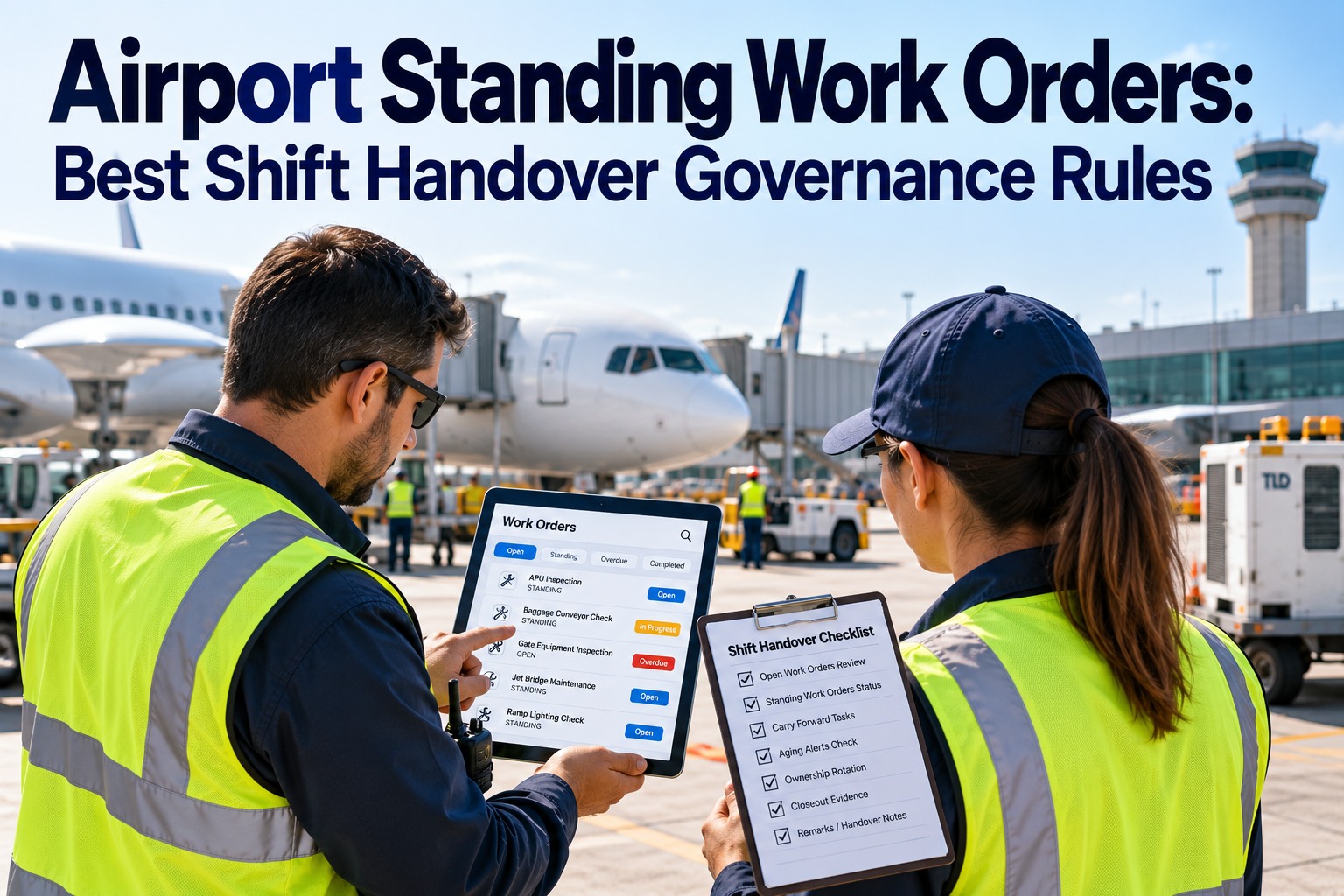
Airport Standing Work Orders: Best Shift Handover Governance Rules

By William Jerry on September 29, 2026

airport-standing-work-orders-shift-handover-governance

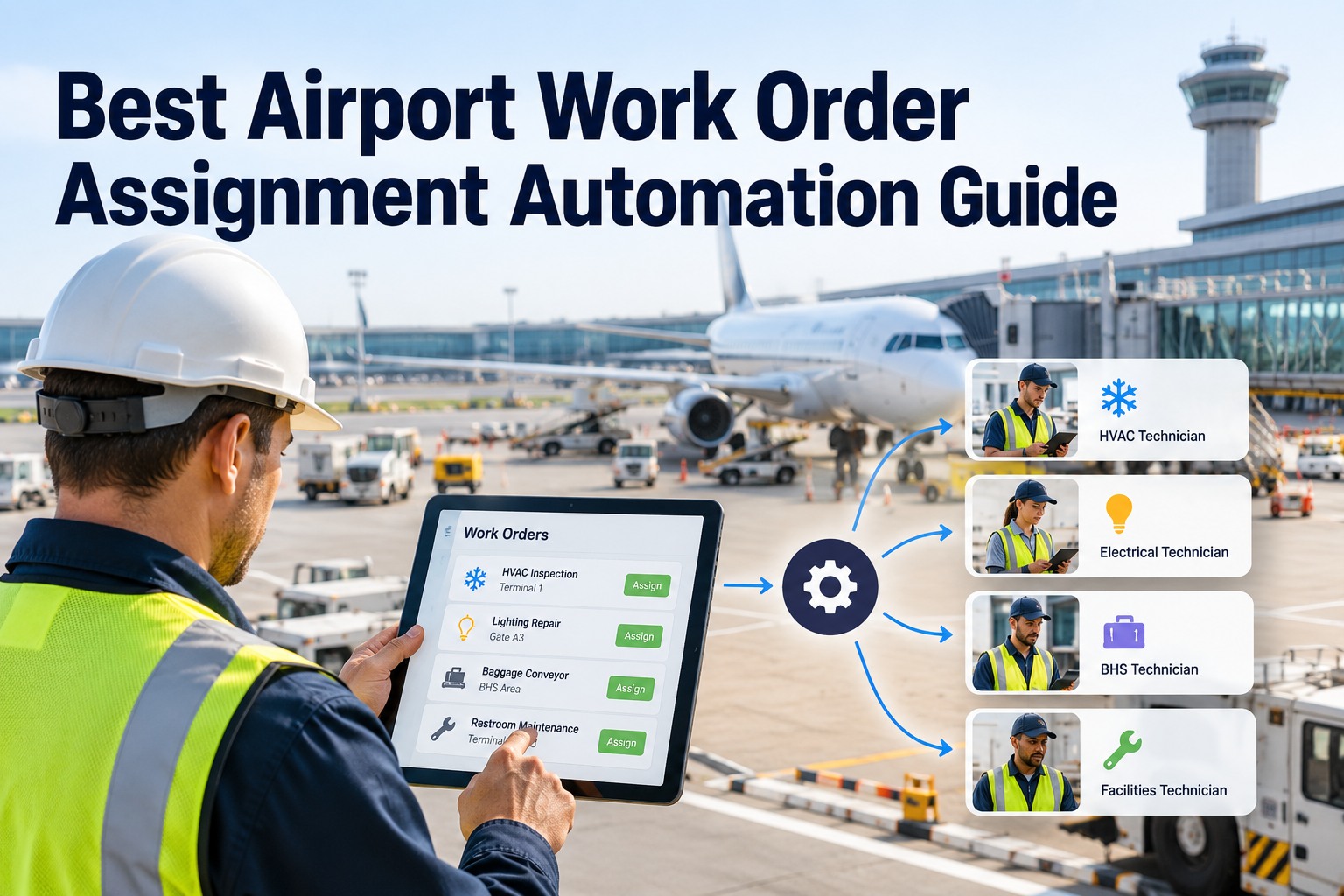
At an airport, work never stops and neither do the open work orders — they cross every shift change. The night crew logs a jet-bridge fault; by morning nobody owns it, by afternoon it's buried under newer tickets, and three weeks later it surfaces as an AOG or an audit finding. The task didn't fail; the governance did. Standing and open work orders need rules that survive the handover. This page lays out those rules — and how OXMAINT AI, the AI-powered airport CMMS, carries every open item forward with an owner, an age and a closeout.

Airport Ops · Work-Order Governance · Shift Handover · 2026

Airport Standing Work Orders: Shift-Handover Governance Rules

Open tickets that lose their owner at 06:00. Aging findings nobody re-diagnoses. Backlogs that only surface at audit. OXMAINT AI, the AI-powered CMMS and maintenance management software, runs the governance on one platform: every open work order carries forward with its notes, gets an owner and an age, escalates when it sits too long, and can't close without evidence — so nothing falls into the gap between shifts.

1Open WO → 2Carry Forward → 3Owner & Age → 4Close w/ Evidence
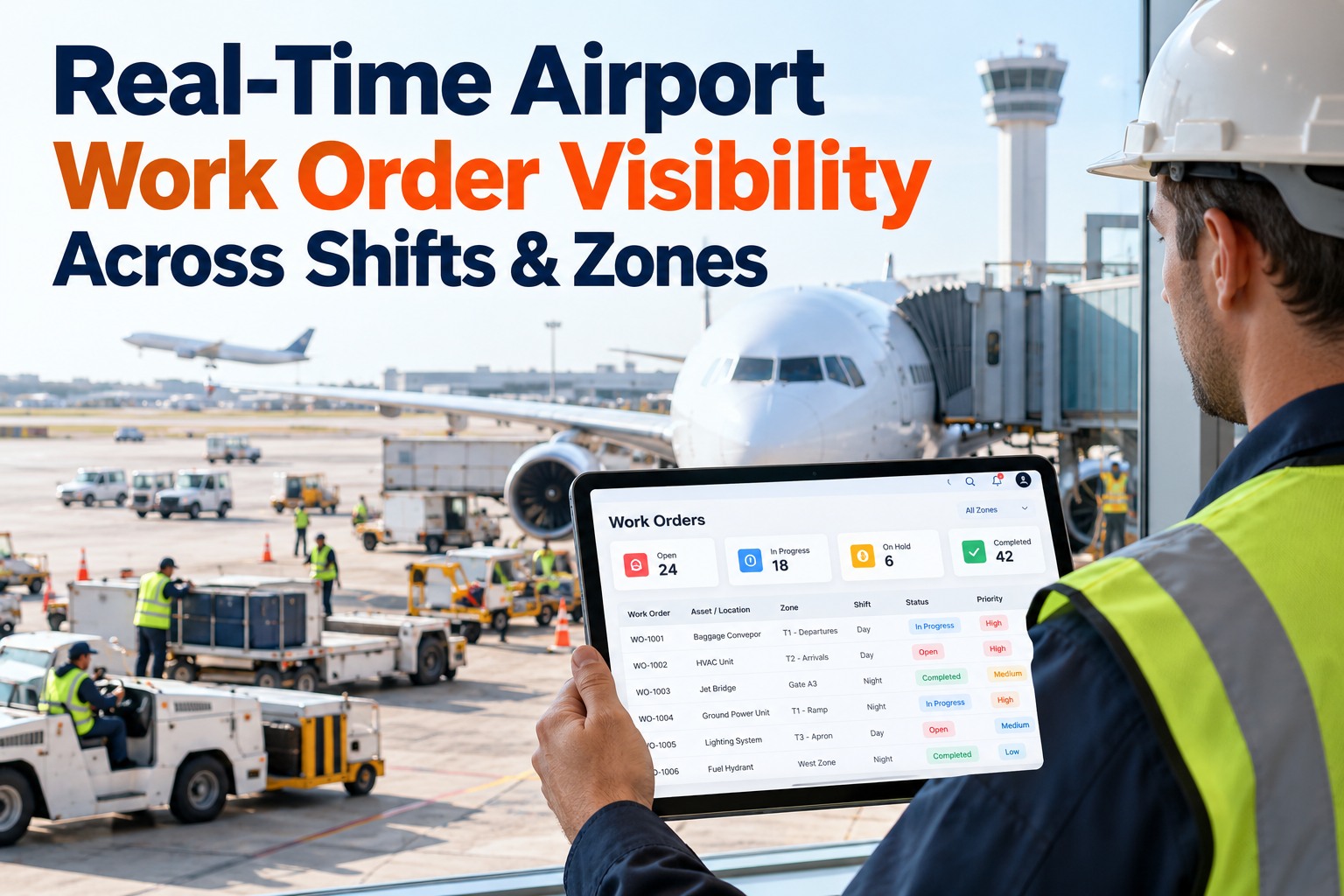
SHIFT HANDOVER · OPEN QUEUE
Jet Bridge B12 · sensor2d · owned
Belt Loader 7 · hydraulics5d · owned
Taxiway Sign L4 · lamp31d · aging
Baggage Carousel 358d · ESCALATED
Read & acknowledgeincoming lead ✓
1 aged item escalated → owner assigned, handover signed
2–4 wk
healthy backlog of known work per technician
74%
of breakdowns linked to poor shift communication
~45 min
average time re-diagnosing issues lost per shift
90 days
age at which an un-scheduled finding auto-escalates

The Gap Between Shifts Is Where Work Orders Go to Die

A single shift can run a tight queue. The failure is at the seam — the verbal pass-down that never happens because the next crew was late, the paper log nobody reads, the open item that quietly loses its owner. Most breakdowns trace back to that seam, not to the wrench work. OXMAINT AI closes it by making every open work order carry forward with its full context and a named owner. Start free and put your open queue on a governed handover in OXMAINT AI.

Rule 1 — Know How Old Your Backlog Is

Governance starts with age. A backlog isn't a number of tickets — it's how long the oldest one has been sitting. These bands tell you whether your queue is healthy or heading for crisis, and OXMAINT AI colors every open work order by where it falls. Book a demo to see your queue aged automatically in OXMAINT AI.

HEALTHY
Oldest open under 45 days
Queue under control; hold to plan
MANAGEABLE
2–4 weeks of backlog
Acceptable working range per tech
STRESSED
4–8 weeks of backlog
Concerning; triage and add capacity
CRITICAL
8+ weeks of backlog
Crisis mode; escalate to management

A zero backlog is its own warning — it usually means inspections have stopped, not that everything's done. The goal is a healthy, aging-controlled queue, not an empty one.

The Five Governance Rules for Open Work Orders

Rules only work if the system enforces them. These five keep a standing work order accountable from the shift it opens to the shift it closes — and OXMAINT AI builds each one into the queue rather than leaving it to memory. Start free and enforce these rules automatically in OXMAINT AI.

R1Carry Forward with Context
Every incomplete work order moves to the incoming crew with its diagnostic notes, parts used and current status intact — zero data loss, no re-diagnosis from scratch.
R2Age & Auto-Escalate
Configurable aging thresholds flag stale items and escalate them to supervisor, then manager. A finding sitting 90 days un-scheduled escalates on its own.
R3Every Item Has an Owner
No open work order is ownerless across a handover. Assignment transfers with the ticket, so accountability rotates with the shift instead of evaporating at change-over.
R4Separate Ready from Waiting
Only work with parts on hand, permits cleared and a window open is schedulable now. Waiting-on-parts items are tracked apart so they don't clog the active queue.
R5Read-and-Acknowledge Closeout
The incoming shift digitally signs off on the outgoing log before taking the queue, and no work order closes without its evidence — creating an auditable chain from open to close that a Part 139 or internal review can read in seconds.

Who Owns What — the Escalation Tiers

Governance also means an open item reaches the right level fast. A routine anomaly stays with the technician; a line-down repair running past shift end climbs to a manager. OXMAINT AI routes each escalation by these tiers automatically instead of hoping someone makes the call. Book a demo to map these tiers to your operation in OXMAINT AI.

TierOwnerTriggerTimeline
L5 Airport Ops / Duty Manager Total shutdown, severe safety or security incident Immediate alert
L4 Maintenance Manager Critical utility or system down, repair over 4 hours Escalate if unresolved by shift end
L3 Maintenance Supervisor Imminent failure, missing critical parts, safety bypass Within 1 hour of diagnosis
L2 Shift Lead Abnormal condition, cross-team coordination needed During shift overlap
L1 Technician Routine anomaly, minor issue, standard finding Document in shift log

An Open Work Order Without an Owner Is Just a Rumor.

The queue doesn't fail because the work is hard — it fails because accountability drops at the shift line. OXMAINT AI keeps every open item owned, aged and escalating, so the ticket that crosses three shifts still has someone answerable for it.

The Handover Protocol, Step by Step

Rules need a ritual to run through. A structured handover moves the open queue cleanly from one crew to the next, and OXMAINT AI anchors each step to the live work-order list instead of a whiteboard and a hallway conversation. Start free and run this protocol on your shifts in OXMAINT AI.

01
Stand-Up Briefing
A short review of the CMMS dashboard — open breakdowns, safety alerts and the day's priorities — before the shift starts.
↓
02
Structured Pass-Down
Each open item handed over with situation, background, assessment and recommendation — not a vague "watch the carousel."
↓
03
Walk the Critical Ones
For high-severity repairs, the outgoing tech physically shows the incoming tech the asset and its current state.
↓
04
Digital Log Entry
A mandatory end-of-shift summary in the CMMS — completed tasks, pending work, abnormal conditions — searchable, not scribbled.
↓
05
Read & Acknowledge
The incoming shift digitally signs off on the log before taking the queue — an auditable transfer of ownership.

What Governance Gives the Airport

Governed work orders aren't about more paperwork — they're about nothing slipping through the seam and everything being provable after the fact. OXMAINT AI builds all of it into the queue itself. Book a demo to see governed handovers in OXMAINT AI.

CARRY
Zero-Loss Carry-Over
Open work orders move shift to shift with notes, parts and status intact — no re-diagnosis, no lost context.
AGE
Aging Alerts & Escalation
Configurable thresholds flag stale items and route them up the chain before they become an incident.
OWN
Rotating Ownership
Every open item stays owned across change-over, so accountability follows the ticket, not the person leaving.
TRIAGE
Ready-vs-Waiting Split
Schedulable work is separated from parts-and-permit blocked work, keeping the active queue honest.
SIGN
Acknowledged Handovers
Mandatory read-and-acknowledge sign-off makes each shift transfer an auditable, timestamped event.
CLOSE
Evidence-Backed Closeout
No work order closes without its record — a clean chain from open to close for any Part 139 or internal review.
“

Our worst findings were never the hard repairs — they were the small ones that crossed a shift and lost their owner. A taxiway sign lamp logged on nights, still open six weeks later because every crew assumed the last one had it. Once open work orders carried forward with an owner and an age, that stopped. The aged-item list is short now, and when an auditor asks who had a ticket and when, we can show the whole chain, signature by signature.

Airport Maintenance Operations Manager · Regional Airport

Frequently Asked Questions

What is a standing or open work order in airport ops?
It's a work order that isn't closed at the end of a shift — an in-progress repair or an unresolved finding that has to carry into the next crew. Governance rules keep it owned, aged and tracked until closeout. OXMAINT AI enforces that carry-forward automatically. Start free and govern your open queue.
How big should our work-order backlog be?
A healthy backlog is roughly 2–4 weeks of known work per technician. Zero is a warning sign that inspections have stopped, and beyond 6–8 weeks it compounds into crisis. The point is a controlled, aging-aware queue, not an empty one. Book a demo to see your backlog aged.
How do we stop work orders getting lost at shift change?
Make the handover structured and signed: carry each open item forward with its context, assign an owner, and require the incoming shift to read and acknowledge the log before taking the queue. OXMAINT AI builds that into every change-over. Start free and close the handover gap.
When should an aging work order escalate?
On configurable thresholds — a stale item routes to a supervisor, then a manager, and a finding sitting around 90 days un-scheduled escalates on its own. Severity tiers also route line-down or safety items up immediately. Book a demo to set your escalation rules.
How does this help at audit time?
Every handover is a timestamped, acknowledged event and no work order closes without evidence, so the chain from open to close is auditable. When a Part 139 or internal review asks who owned a ticket and when, it's on screen. Start free and keep an audit-ready trail.

Let No Work Order Cross a Shift Without an Owner.

Govern airport standing work orders with the OXMAINT AI maintenance management software — context-preserving carry-forward, automatic aging and escalation, rotating ownership, and read-and-acknowledge handovers with evidence-backed closeout. Close the gap between shifts before it closes a runway.
Share This Story, Choose Your Platform!