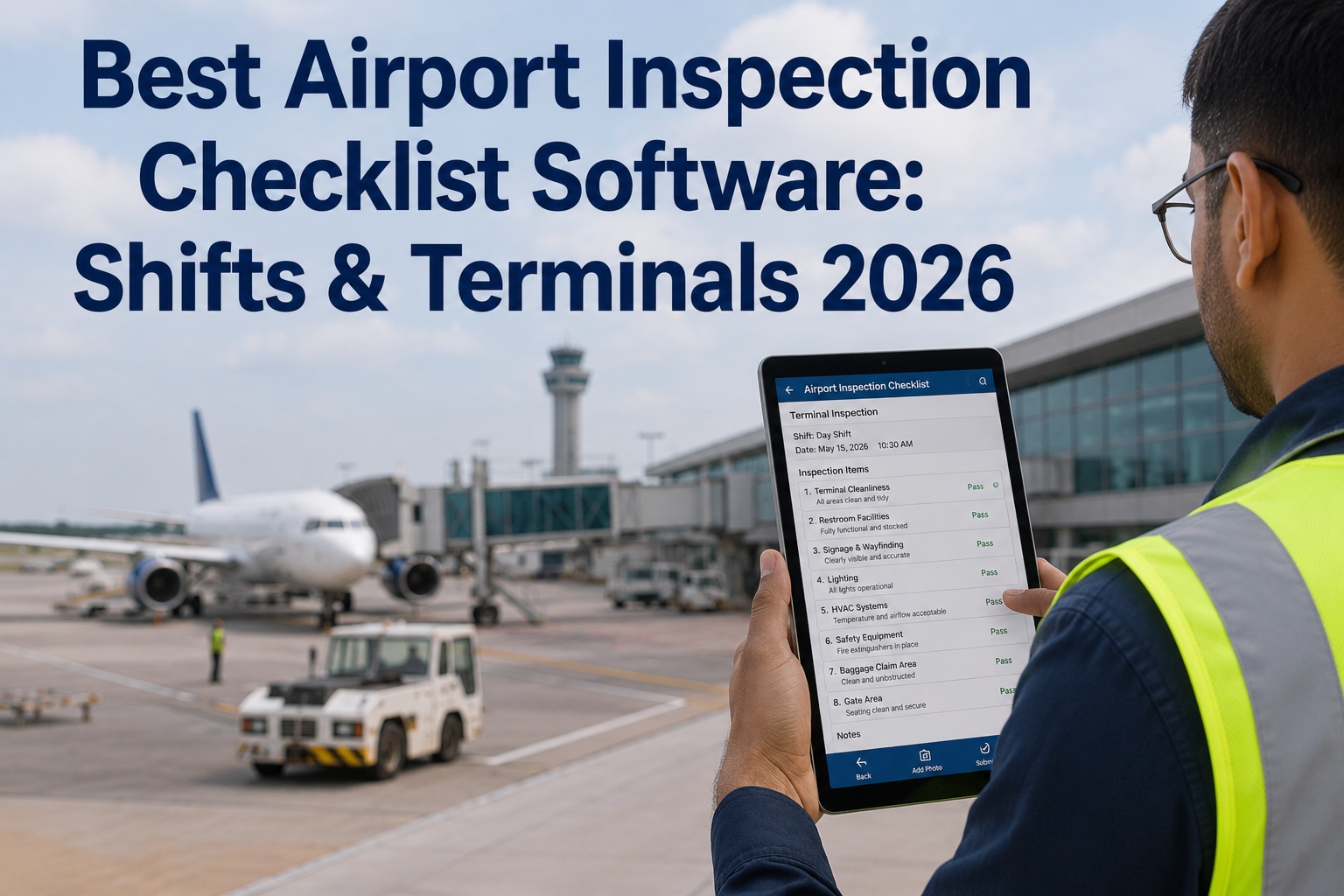
The paper checklist has one fundamental design flaw that no amount of process improvement can fix: it is a static instrument used inconsistently by a rotating cast of inspectors across three or more shifts, across two or more terminals, against an Airport Certification Manual that revises on its own schedule — and nothing in the paper structure enforces consistency across any of those axes. A finding on the day shift at Terminal 2 uses one wording; the same finding on the night shift at Terminal 3 uses another. Terminal 1's checklist got updated last quarter; Terminal 4's is still on last year's version because nobody reprinted it. The night shift inspector was trained on the 2023 defect classification; the day shift supervisor uses the 2025 one. Every one of these misalignments produces the same FAA finding pattern — inconsistent inspection execution, undocumented deviations, and audit records that surface variation the certificated airport is supposed to eliminate. The best 2026 airport inspection checklist software solves this at the architectural level: one master template library, terminal-specific variants derived from it with structured differences tracked, shift-context awareness so the app knows which checklist to serve, and version control that propagates ACM revisions to every relevant checklist automatically. Standardisation stops being a supervisor's ongoing battle and becomes a structural property of the platform. Oxmaint's inspection checklist software runs this architecture end-to-end — master templates, terminal variants, shift-aware routing, version-controlled propagation, and shift handoff workflows that ensure nothing is lost between one inspector's route close and the next inspector's route open. Start a free Oxmaint trial to run standardised airport inspection checklists on the CMMS, or book a demo to see the checklist architecture mapped to your airport's terminals and shifts.
Aviation · Airport · Inspection Checklist CMMS
Best Airport Inspection Checklist Software: Shifts & Terminals — 2026 Guide
Master templates with terminal variants, shift-aware routing, version-controlled propagation, and shift handoff workflow — standardised inspection execution across every shift, every terminal, every route.
-
5-Layer
checklist architecture — master template through inspector overlay, structured at every level
-
3–5 Shifts
day, evening, night, weekend, weather-triggered — one platform serving all shift contexts
-
Multi-Terminal
domestic, international, cargo, general aviation, heliport — terminal-specific variants derived from one master
-
Version-Controlled
ACM revisions propagate to every relevant checklist automatically — no stale paper forms
The Standardisation Problem
Four Conditions Paper and Spreadsheet Checklists Cannot Resolve
Standardised inspection execution across shifts and terminals is the single hardest operational discipline at any multi-terminal certificated airport. Four conditions produce systematic variation that no supervisor can eliminate through training alone — they need to be resolved structurally in the tool the inspector uses.
-
01
Rotating Inspector Population
Three shifts, weekends, weather cover, holiday cover. Different inspectors, different training vintages, different personal shorthand. Each brings their own interpretation of the checklist item.
-
02
Terminal-Specific Variation
Terminal 1's apron layout differs from Terminal 3's. International terminals have CBP requirements. Cargo terminals have HAZMAT. GA terminals have self-service fuel. One master checklist cannot fit every terminal.
-
03
ACM Revision Drift
Airport Certification Manual revises. The revised checklist prints in some binders and not others. Some inspectors carry last year's version. Variation across the operation becomes structural.
-
04
Shift Handoff Blind Spots
Day shift closes routes at 15:00. Evening shift opens at 15:00. Findings still open at handoff either slip through the transition or get duplicated. Paper cannot enforce continuity.
The 5-Layer Checklist Architecture
One Master Template, Five Layers of Structured Adaptation
A production airport inspection checklist is not a single document — it is a five-layer architecture with the master template at the top and inspector overlay at the bottom. Each layer adds context without breaking consistency with the layer above. Below is the model Oxmaint enforces on every airfield checklist.
Master Template
Airport-wide inspection standard for a given inspection type. Every checklist item mapped to its Part 139 reference. Owned by the compliance officer. Single source of truth.
Owner: Compliance Officer
Terminal Variant
Terminal-specific derivative of the master. Domestic, international, cargo, GA, heliport variants. Structured differences tracked — added items, removed items, modified thresholds.
Owner: Terminal Ops Manager
Shift Context
Day, evening, night, weekend, weather-triggered. Certain items only apply on certain shifts — night lighting checks, weather-condition additions. Context-aware routing.
Owner: Operations Supervisor
Zone Specifics
Runway 09L versus 09R. Apron A versus Apron D. Zone-level configuration data — dimensions, lighting fixtures, holding position identifiers. Referenced from the checklist.
Owner: Airfield Engineer
Inspector Overlay
Inspector-added notes, photos, GPS traces on the specific route instance. Never modifies the checklist structure — layered on top as evidence. Complete traceability.
Owner: Field Inspector
The Shift Coverage Matrix
Five Shift Types With Different Checklist Requirements
A 24/7 airport operation runs five distinct shift contexts — each with slightly different inspection scope and cadence. The best inspection checklist software auto-serves the right checklist to the inspector based on shift context, so no one has to remember which items apply now versus only on the night shift.
-
S1
Day Shift
Daylight visibility. Full pavement condition assessment, marking wear evaluation, drainage inspection. Reference-grade lighting condition where visible.
-
S2
Evening Shift
Transition to dusk. First lighting check of the operating cycle. Combined pavement and lighting assessment. Handoff of open findings from day shift.
-
S3
Night Shift
Full darkness. Comprehensive lighting inspection, PAPI/VASI function, edge lighting continuity, obstruction lighting verification. Reduced pavement visibility.
-
S4
Weekend Shift
Reduced staffing patterns. Consolidated route coverage. Extended handoff protocols. Full weekday requirements still apply — no reduced scope permitted.
-
S5
Weather-Triggered
Off-cycle inspection following weather events — precipitation, high wind, lightning, snow. Additional items on drainage, contamination, damage assessment.
Multi-Terminal Coverage
Five Terminal Types With Structured Checklist Variants
A multi-terminal airport is really several airports co-located on one certificate — each terminal with its own operational profile, its own regulatory overlay, and its own checklist variant derived from the master. Below is the standard variant structure the checklist software must support.
T1
Domestic Terminal
Standard passenger operations. Baseline Part 139 checklist applies without significant modification. Highest inspection volume — most routes per shift.
T2
International Terminal
CBP secure zones, jet bridge international configurations, expanded security area requirements. Additional coordination with TSA and CBP on any findings in secure zones.
T3
Cargo Terminal
Freighter operations, ULD staging areas, HAZMAT handling zones, cargo dolly transit lanes. Additional pavement wear inspection items from heavy equipment traffic.
T4
General Aviation
GA ramps, self-service fuel islands, tie-down areas, FBO ramp configuration. Different pavement duty rating and lighting requirements from commercial terminals.
T5
Heliport / Helipad
Rotor wash exposure, TLOF and FATO area requirements, helicopter-specific marking and lighting standards. Distinct inspection cadence and checklist items entirely.
The Version Control Reality
When the ACM Revises, Every Relevant Checklist Must Update — Automatically
Airport Certification Manuals revise. New Part 139 subparts amend. Local operating procedures change. In a paper world, that means reprinting binders across every terminal and hoping every one gets replaced. In a version-controlled digital checklist system, the master template revises once and the change propagates to every derivative variant that inherits from it — with a delta review the terminal manager can approve or reject. Standardisation becomes structural, not effortful — and the "we were on the old checklist" excuse disappears from every FAA finding response.
Template Management
Six Capabilities the Checklist Template Engine Must Provide
The template management engine is the heart of the checklist software. Six capabilities separate a real template engine from a generic form builder — and the difference is decisive for multi-terminal airport operations under continuous ACM revision.
-
C1
Version Control
Every template revision timestamped, authored, and archived. Prior versions retrievable. Historical audit of what inspection was in force on any past date.
-
C2
Change Propagation
Master template revision propagates to derivative terminal variants. Terminal manager reviews the delta and approves or rejects for the specific variant.
-
C3
Regulatory Linking
Every checklist item carries its Part 139 or ACM section reference. When the reg changes, the checklist item flags for review automatically.
-
C4
Override Tracking
When a terminal variant deviates from the master, the deviation is logged with author, date, and reason. No silent drift from standard.
-
C5
Expiry & Review Cadence
Every template carries a mandatory review date. Approaching expiry triggers compliance officer notification. No stale templates in production.
-
C6
Delta Review
Side-by-side comparison of the old and new template version. Compliance officer approves the change with authenticated sign-off. Full audit trail on every revision.
Shift Handoff Workflow
Four-Stage Handoff Protocol That Ensures Nothing Is Lost Between Shifts
The transition between two shifts is where most inspection continuity is lost in a paper program. Digital checklist software converts the handoff into a structured protocol — four stages executed in the app that the outgoing and incoming supervisors both sign off on.
-
01
Outgoing Shift Route Close
Every open route from the outgoing shift is closed or explicitly flagged as continuing. Findings raised in the shift closed if completed, or handed forward with explicit context.
-
02
Open Findings Digest
Every open finding across the airport summarised in a structured handoff view. Severity, location, age, next required action. Incoming supervisor reviews before shift start.
-
03
Authenticated Handoff Sign-Off
Outgoing and incoming supervisors both sign off on the handoff in the app. Timestamped record. No verbal handoff. No transferred responsibility without acknowledgment.
-
04
Incoming Shift Route Assignment
Incoming shift routes assigned with awareness of open findings. Follow-up inspection scheduled where prior finding requires verification. Continuity is structural.
Standardisation Metrics
Four Metrics That Prove Inspection Execution Is Actually Standardised
Standardisation is not a slogan — it is a set of measurable properties. Four metrics inside the checklist software prove standardisation is real. Compliance officers should be watching all four monthly as leading indicators for the next FAA cycle.
| Metric | What It Measures | Target |
|---|---|---|
| Template Version Currency | Percentage of active checklists on the current master version | 100% |
| Cross-Shift Finding Consistency | Standard deviation of findings raised per shift across the same zone | Low variance |
| Handoff Continuity Rate | Open findings at shift boundary carried cleanly to incoming shift | 100% |
| Terminal Variant Deviation | Number of terminal variants with tracked deviations from the master | All logged |
Built for Airport Standardisation
How Oxmaint Runs Standardised Inspection Across Shifts and Terminals
-
Master Template Library
Single Source of Truth for Every Inspection Type
Daily self-inspection, weekly, monthly, weather-triggered, event-triggered. Each type has one master template maintained by the compliance officer.
-
Terminal Variants
Derived From the Master With Tracked Differences
Terminal 1 domestic, Terminal 2 international, Terminal 3 cargo, GA ramp, heliport. Each variant tracks its added, removed, and modified items relative to the master.
-
Shift-Aware Routing
Correct Checklist Served on Shift Context
The mobile app knows what shift the inspector is on. Correct checklist variant loads automatically. Night-only items surface on night shift and not day.
-
Version Propagation
ACM Revision Flows to Every Variant Automatically
Master template updates propagate to all derivative terminal variants. Terminal manager reviews the delta and approves. No terminal falls behind the current standard.
-
Handoff Protocol
Structured Shift Boundary Sign-Off
Outgoing shift closes routes and hands forward open findings. Incoming supervisor reviews and signs off. No verbal handoff, no dropped findings.
-
Standardisation Dashboards
Version Currency, Cross-Shift Consistency, Deviation Tracking
Four live metrics on the compliance officer dashboard. Standardisation is measured continuously, not asserted. Leading indicator of FAA readiness.
Measured Outcomes
What Airports Gain From Standardised Checklist Execution
-
Uniform
Execution Across Shifts
Day, evening, night, weekend, weather — every shift running the correct checklist for its context. Inspector interpretation variance disappears at the structural level.
-
Consistent
Across All Terminals
Every terminal running its correct variant, every variant traced back to the master, every deviation logged. No terminal stuck on last year's version.
-
Zero
Handoff Loss
Structured handoff protocol carries every open finding cleanly between shifts. No verbal handoff. No findings falling through the shift boundary.
-
Current
ACM Alignment
Version propagation keeps every checklist aligned to the current ACM. Regulatory linking flags items on reg change. Standardisation as structural property.
Frequently Asked
Airport Inspection Checklist Software Questions
How does the software handle checklist differences between terminals?
Through the terminal variant layer — the second of the five architectural layers. Each terminal has its own derivative of the master template, with structured differences tracked: added items, removed items, modified thresholds. The terminal ops manager owns the variant, but changes to the master template propagate to every variant automatically with a delta review. No terminal is ever silently out of alignment with the airport-wide standard. Sign up for Oxmaint to run terminal-variant checklists on the CMMS.
How is the correct checklist selected for a given shift?
Automatically through shift context awareness — the third architectural layer. The mobile app knows which shift the inspector is logged into. The correct checklist variant loads with items appropriate to the shift context. Night-shift-only lighting items surface on the night shift; weather-triggered additional items surface when a weather event has fired the off-cycle inspection. The inspector never chooses the checklist — the platform serves the correct one.
What happens when the Airport Certification Manual updates?
The compliance officer updates the master template through a delta review workflow. The change is timestamped, authored, and archived — the prior version remains retrievable for historical audit. The revision propagates to every derivative terminal variant automatically. Each terminal manager reviews the propagated delta and approves it into that variant. No terminal runs an outdated version, and every change carries an authenticated audit trail. Book a demo to see checklist version propagation in Oxmaint.
How does the software prevent findings from being lost at shift handoffs?
Through the four-stage handoff protocol built into the platform. Outgoing shift explicitly closes routes or flags them as continuing. All open findings across the airport are summarised in a structured handoff digest with severity, location, age, and next required action. Outgoing and incoming supervisors both authenticate the handoff with a sign-off. Incoming shift routes are then assigned with awareness of the open findings. There is no verbal handoff, no dropped findings, and no transferred responsibility without explicit acknowledgment. Sign up for Oxmaint to run structured shift handoff on the CMMS.
Standardise · Propagate · Prove It
Standardisation Is a Structural Property of the Right Checklist Software — Not an Ongoing Battle
Five layers of checklist architecture. Five shift contexts served correctly. Five terminal variants derived from one master. Six template management capabilities. Four handoff stages. Four standardisation metrics on the compliance dashboard. Every inspection route across every shift across every terminal running the correct current version — with the audit trail proving it. Oxmaint is the airport inspection checklist software built for exactly this. Standardisation becomes what the platform enforces, not what supervisors have to fight for every day.