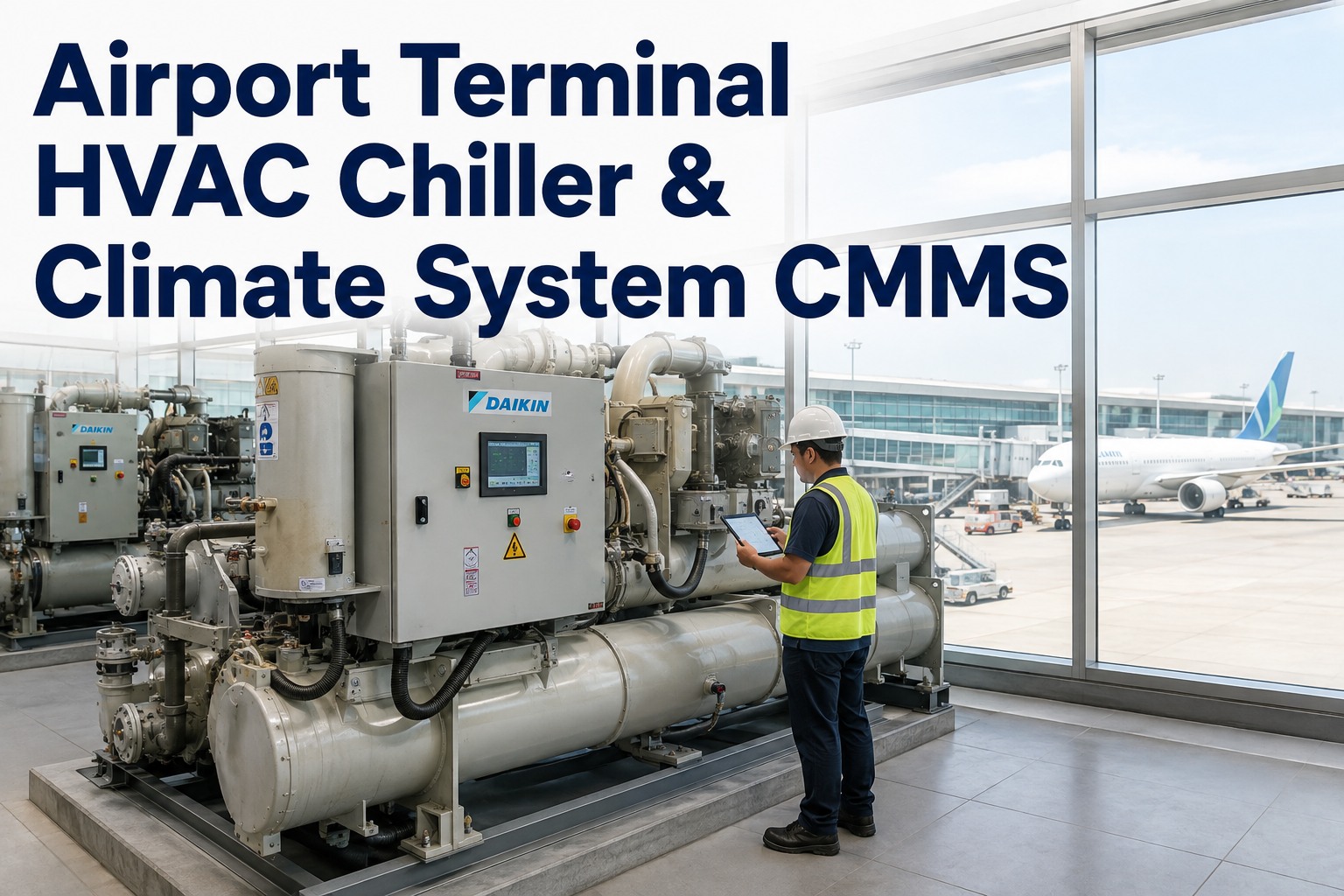
An airport terminal is one of the hardest buildings on earth to keep comfortable. A gate area can jump from 20 people to 180 in half an hour as a flight boards, glass facades pour in solar heat, jet exhaust drifts through jetways, and not a single window can open. Meanwhile HVAC quietly burns 40–50% of the terminal's entire energy budget — and the central chiller plant alone is a third to half of that. This playbook covers the reliability moves that hold comfort steady and energy down: chiller sequencing, AHU monitoring, comfort surveys, and CMMS-linked PMs. It also shows how OXMAINT AI ties BMS signals to scheduled work. See it on your terminal with a live demo.
Airport Facilities · Terminal HVAC · Comfort & Energy · 2026
Airport Terminal HVAC Reliability: Comfort & Energy Playbook
Comfort complaints and energy overspend usually trace to the same root: HVAC faults that the BMS can see but no one acts on. OXMAINT AI is the AI-powered CMMS that turns those signals — a drifting chiller, a stuck economizer, an AHU running against an empty gate — into scheduled work orders, so the terminal stays comfortable and the energy curve stays flat.
BMS signals & rounds
→
Faults & drift
→
Work orders
→
Condition-based PMs
One platform, sensor to PM
Chiller & AHU faults become work orders
Condition-based PM scheduling
Comfort complaints tied to assets
Energy baseline per unit
40–50%
of terminal energy is HVAC
35–50%
of HVAC energy is the chiller plant
20 → 180
people at a gate in ~30 min
15–35%
energy cut from well-run HVAC
Why the Terminal Is a Uniquely Hard Building to Condition
Office-building HVAC playbooks don't survive contact with a terminal. Four conditions make it a different problem — and each one is a reliability trap if the equipment isn't watched. Start free and get your terminal HVAC under one calendar in OXMAINT AI.
Violent Occupancy Swings
A gate goes from near-empty to a packed boarding surge in minutes. Fixed-rate ventilation either overcools an empty hall or starves a full one.
Massive Solar Gain
Glass facades built for daylight and views pour heat into the space, loading the chiller plant hard through the cooling season.
No Windows, Sealed Envelope
Security means spaces can never open a window. All fresh air is mechanical, so ventilation faults have nowhere to self-correct.
Diverse Zones, One System
Food courts, check-in, holdrooms and offices all pull on the same plant with different loads — a sequencing and balancing headache.
Chiller Sequencing: The Biggest Energy Lever You Have
The chiller plant is the single largest HVAC load, so how it stages against demand is where the energy is won or lost. The classic fault is invisible on a walk-round but obvious in the BMS log: two chillers loafing at 40% each when one running at 80% would be far more efficient. Left alone, that logic error compounds over an entire cooling season. Book a demo to see sequencing faults surfaced from your BMS.
Inefficient Staging
Chiller 1 · 40%
Chiller 2 · 40%
Two machines part-loaded off their efficiency sweet spot — more kW for the same cooling.
Efficient Staging
Chiller 1 · 80%
Chiller 2 · off
One machine near its best part-load efficiency, the other resting — same cooling, less energy.
Optimal staging depends on each machine's part-load efficiency curve, cooling-tower approach and current load — the point is to run the most efficient combination for the demand, not simply "share the load."
AHU Monitoring: Catching Waste the Walk-Round Misses
Air handling units fail quietly. An economizer that won't open on a cool morning, a schedule running against an empty concourse at 2am, a setpoint drifting out of its commissioning band — none of these trip an alarm, and all of them burn money. These are the BMS-visible faults OXMAINT AI turns into work orders. Sign up free and put AHU fault detection to work in OXMAINT AI.
Economizer Stuck Closed
Free cooling never engages when outdoor air is cool enough, so the chiller does work the weather could have done for free. Visible in BAS logs, invisible on rounds.
Runtime vs. Occupancy Mismatch
Equipment running full-tilt during unoccupied hours. Comparing BAS schedules to the occupancy calendar flags it — and auto-generates the correction.
Setpoint & Sequence Drift
Supply-air temp, chilled-water and zone setpoints wandering outside commissioning tolerances. Small drifts, big cumulative energy and comfort cost.
Dirty Filters & Coils
Clogged filters make fans work harder and starve airflow; fouled coils cut heat transfer. Both raise energy and drop comfort until a PM clears them.
The BMS Already Sees the Fault. Nobody's Acting on It.
A stuck economizer, a chiller sequencing error, a filter loading up — your building management system logs every one of these. The failure isn't detection; it's the gap between the alarm and the work order. OXMAINT AI pulls live data from BACnet, Modbus and MQTT, then turns a flagged deviation into a scheduled, assigned task before it shows up on the utility bill or in a complaint.
Comfort Is Data, Not a Guess: Surveys + Sensors
"It feels warm at Gate 22" is a complaint; a comfort program turns it into a signal. Pairing occupant feedback with sensor data — temperature, humidity, CO₂ as a ventilation proxy — tells you whether a zone has a real problem and which asset owns it. Note that passengers tolerate a wider comfort band than staff, and ASHRAE 55 gives useful guidance but no terminal-specific setpoint, so local feedback matters. Book a demo to link comfort complaints to the asset behind them.
ASHRAE 55
Thermal comfort
Guides the temperature/humidity comfort zone via PMV/PPD — but terminals need local feedback because occupant tolerance varies widely.
ASHRAE 62.1
Ventilation (IAQ)
Sets outdoor-air rates via the Ventilation Rate Procedure or the performance-based IAQ Procedure that rewards continuous monitoring.
~1,000 ppm
CO₂ as a proxy
Not a hard limit, but a widely used ventilation-adequacy signal — CO₂ climbing in a boarding surge flags under-ventilation in that zone.
DCV
Demand-controlled ventilation
Ramps outdoor air to real-time occupancy and CO₂ — comfort where it's needed, energy saved where it isn't.
The PM Program That Actually Prevents Failures
A generic calendar PM misses the terminal's real operating pattern. Condition-based scheduling — triggered by runtime hours, temperature deviation or an energy threshold — matches the work to how the equipment is actually running. These are the recurring PMs that keep comfort and efficiency intact, all held in OXMAINT AI. Sign up free and build condition-based HVAC PMs in OXMAINT AI.
Filter Replacement
Trigger: pressure drop / runtime
Restores airflow, cuts fan energy
Coil Cleaning
Trigger: approach temp / season
Recovers heat-transfer efficiency
Damper Calibration
Trigger: drift / schedule
Keeps economizer & fresh-air accurate
Refrigerant Charge Check
Trigger: post-leak / season
Protects capacity & Scope 1 accuracy
Cooling-Tower Service
Trigger: runtime / water quality
Holds condenser-side efficiency
Chiller Log & COP Review
Trigger: monthly / energy flag
Catches efficiency drift early
The KPIs That Prove the Playbook Is Working
A reliability program you can't measure is just a to-do list. These four numbers, tracked in OXMAINT AI, tell you whether comfort and energy are actually improving — and give facilities leaders something concrete to report upward. Book a demo to see these KPIs on a live terminal.
Chiller Plant Efficiency (kW/ton)
The headline energy metric. A rising trend means the plant is doing more work per unit of cooling — catch it before the season compounds it.
PM Compliance
Share of scheduled HVAC PMs completed on time. The leading indicator — deferred filter and coil work is where comfort failures begin.
Comfort Complaint Rate
Complaints per zone over time. When it clusters, it points at a specific asset — not a vague "the terminal's too warm."
Reactive vs. Planned Ratio
How much HVAC work is emergency vs. scheduled. Shifting toward planned is the clearest sign the playbook is taking hold.
Where OXMAINT AI Fits: BMS Signal to Scheduled Work
The whole playbook depends on one thing: closing the gap between what the building already knows and what the team actually does. OXMAINT AI connects the two, so terminal HVAC runs on data instead of walk-rounds and firefighting. Here's what it gives the facilities team. Sign up free and connect your first AHU and chiller.
Direct BMS Integration
Live data from BACnet, Modbus and MQTT endpoints straight into OXMAINT AI— no middleware, connect the BMS in hours not months.
Single HVAC PM Calendar
Every AHU, chiller, cooling tower and ventilation zone on one calendar with mobile inspections, so nothing slips between shifts.
Fault-Triggered Work Orders
A stuck economizer, a sequencing error or a compressor drawing above baseline auto-generates a work order with the fault context attached.
Per-Asset Energy Baseline
Each unit carries an energy baseline; PM completion logs its impact, so a 20%-above-baseline draw raises a flag before the utility bill does.
Comfort Complaint Capture
Tenant and passenger comfort reports logged against the zone and asset, alongside sensor data — full traceability for every decision.
Audit-Ready Records
Timestamped, technician-attributed HVAC records — the evidence airport-authority audits, insurance reviews and warranty claims ask for.
"
Our biggest energy leaks weren't dramatic failures — they were an economizer that hadn't opened in months and chillers that split the load instead of staging properly. The BMS had been logging both the whole time; we just weren't turning those logs into work. Once OXMAINT AI started raising them as work orders, the comfort complaints at our west-facing gates dropped and the cooling-season energy curve finally flattened.
Facilities & Engineering Manager · International Terminal
Frequently Asked Questions
Why is airport terminal HVAC so energy-intensive?
HVAC is typically 40–50% of a terminal's total energy, and the central chiller plant is 35–50% of that. Sealed envelopes, large glass facades, 24/7 operation and violent occupancy swings all drive heavy, constantly changing cooling loads that office-building systems never face.
What's the single highest-value HVAC efficiency move?
Correct chiller sequencing. Because the plant is the largest load, running the most efficient machine combination for the current demand — rather than part-loading several chillers off their efficiency curves — saves energy every hour of the cooling season without touching comfort.
Is 1,000 ppm CO₂ an official airport limit?
No — ASHRAE 62.1 hasn't set an indoor CO₂ limit for decades. The ~1,000 ppm figure is a widely used proxy for ventilation adequacy, not a hard standard. Rising CO₂ during a boarding surge is a useful signal that a zone is under-ventilated for its occupancy.
How does OXMAINT AI connect to our existing BMS?
It pulls live data directly from BACnet, Modbus and MQTT endpoints — no middleware layer. That lets it validate sequences, flag deviations and auto-generate work orders from the same telemetry your BMS already collects, usually connected in hours rather than months.
Does OXMAINT AI replace our building management system?
No — it works alongside it. The BMS controls and monitors the equipment; OXMAINT AI turns its signals into scheduled maintenance, ties comfort complaints to assets, and keeps the audit-ready record. You keep your controls; OXMAINT AI makes the data actionable.
Keep the Terminal Comfortable and the Energy Curve Flat.
Every comfort complaint and every unit of wasted energy started as a fault your BMS already saw. Route those signals into OXMAINT AI and turn them into scheduled work before passengers or the utility bill notice.