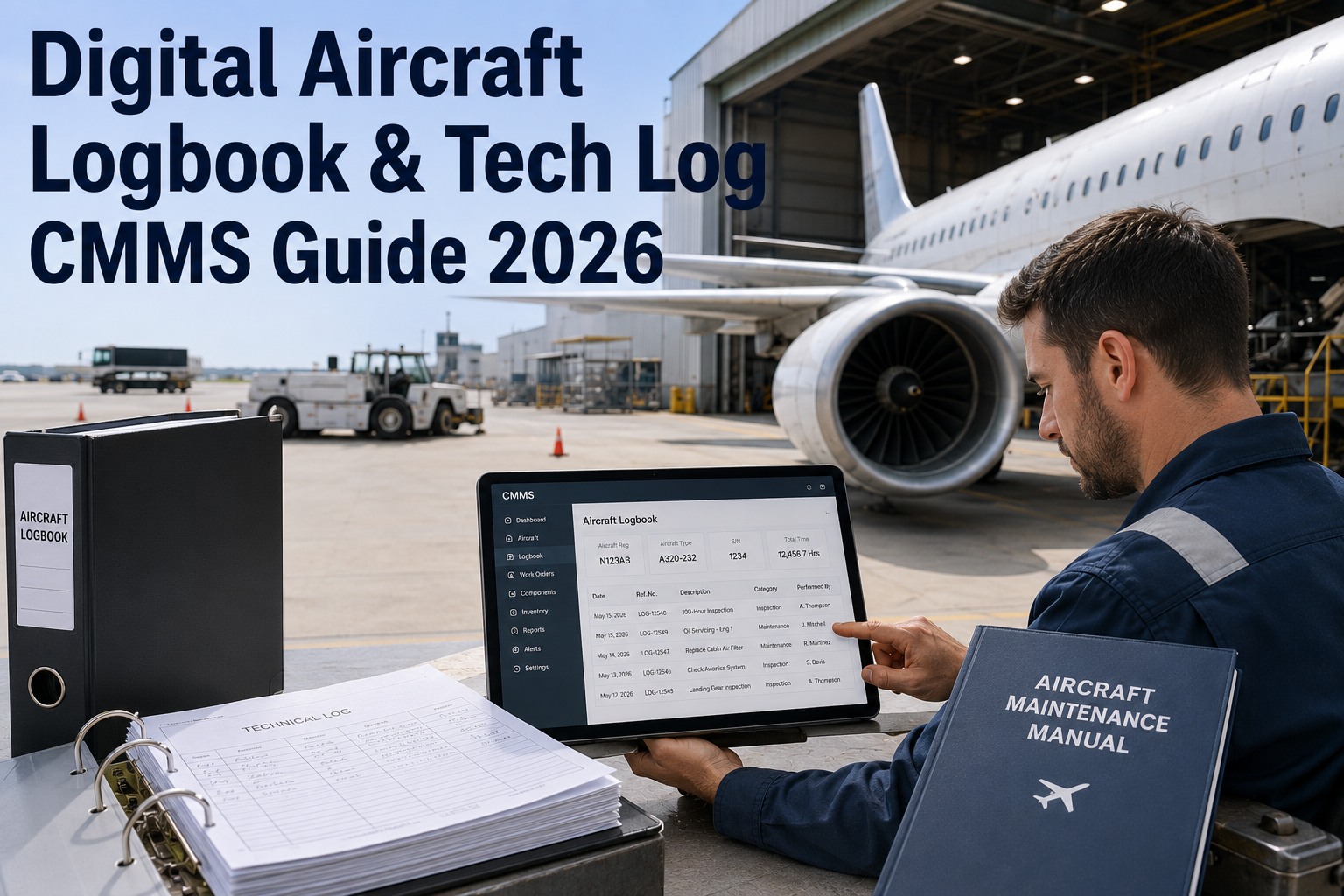
The global MRO market hit $84.2 billion in 2025 and is racing toward $134.7 billion by 2034. Behind that growth is a seismic shift: AI systems that predict failures weeks in advance, drones that inspect a widebody in under an hour, and blockchain ledgers that make counterfeit parts nearly impossible to sneak into the supply chain. If your maintenance operation still runs on paper checklists and calendar-based schedules, 2026 is the year the gap becomes a gulf. Schedule a demo to see how OXmaint helps MRO teams digitize every work order, calibration, and inspection cycle.
The 2026 MRO Landscape at a Glance
Aviation maintenance is no longer a cost center—it is a competitive weapon. Airlines that have embraced digital maintenance strategies are seeing measurable gains in uptime, cost reduction, and regulatory compliance. Here is where the industry stands heading into 2026.
$84.2B
Global MRO market size in 2025, growing at 5.4% CAGR
65%
Maintenance teams planning to adopt AI by end of 2026
35%
Reduction in unscheduled downtime with AI-driven maintenance
17,000+
Aircraft backlog requiring a decade-plus to fulfil
Sources: Research and Markets, Deloitte, Delta Air Lines, IATA
Eight Technologies Redefining MRO in 2026
The trends shaping aviation maintenance this year are not theoretical—they are in hangars, on flight lines, and inside CMMS platforms right now. Each one creates a direct opportunity for MRO operations that are ready to act.
Predictive Intelligence
AI-Powered Predictive Maintenance
Predictive maintenance has moved from pilot programs to production reality. Airlines using AI-driven maintenance diagnostics are achieving 35–40% reductions in unscheduled maintenance events and pushing dispatch reliability above 99%. Platforms like Airbus Skywise now aggregate data from over 11,000 aircraft, identifying maintenance needs up to six months in advance. Predictive maintenance alone held a 28.45% share of the AI in aviation market in 2025—the single largest application segment.
25% reduction in aircraft downtime
15% fewer unscheduled component removals
6 mo advance failure prediction window
Virtual Replicas
Digital Twins for Fleet Health
Digital twins are live virtual models of aircraft, engines, and subsystems that mirror real-world performance in real time. Rolls-Royce, GE Aerospace, and Lufthansa Technik use digital twins to predict engine wear and optimize service intervals. McKinsey estimates global investment in digital twin technology will surpass $48 billion by 2026. For MRO operations, this means simulating maintenance scenarios before touching the aircraft—reducing planning errors and optimizing resource allocation.
$48B global digital twin investment by 2026
40% reduction in planning cycle time
Autonomous Inspection
Drone-Based Aircraft Inspections
After a decade of regulatory groundwork, drone inspections are scaling commercially in 2026. Delta Air Lines, KLM, Austrian Airlines, and LATAM have all received regulatory approval for drone-based visual inspections. Donecle, the leading drone inspection provider, expects all major OEM and regulatory approvals to be in place by mid-2026, enabling high-volume production deployment. A drone can complete a full exterior inspection in under one hour—work that takes technicians 10 to 12 hours manually.
90% faster exterior inspections
95% defect detection accuracy with AI imaging
Sensor Networks
IoT-Connected Aircraft Systems
Modern aircraft generate hundreds of terabytes of sensor data daily. IoT-enabled health monitoring systems continuously track engine vibration, hydraulic pressure, temperature anomalies, and structural stress across thousands of parameters. This real-time data stream feeds predictive models that flag degradation patterns long before they trigger alerts. Airlines integrating IoT sensor data with their CMMS platforms are closing the loop between detection and action—automating work order generation the moment a threshold is crossed.
1,000+ engines monitored daily by GE platform
5B+ data points processed annually
Immutable Records
Blockchain for Parts Traceability
The 2023 AOG Technics scandal—where falsified parts documentation forced airlines including United and Delta to ground aircraft—accelerated blockchain adoption across the supply chain. Boeing, GE Aerospace, and American Airlines formed the Aviation Supply Chain Integrity Coalition in response. Blockchain creates tamper-proof lifecycle records for every serialized part, from manufacture through repair and reinstallation. Smart contracts automate compliance verification at each handoff, eliminating paperwork disputes and reducing counterfeit risk.
25-40% reduction in record reconciliation costs
12.8% CAGR for digital aerospace MRO market
Hangar Mobility
Mobile-First Digital Workflows
Paper checklists and desktop-bound maintenance systems are being replaced by tablet-based, mobile-first platforms that function on the ramp, in the hangar, and at remote line stations. Technicians now access real-time task cards, record inspection results, and capture photographic evidence directly from the point of work. Offline capability with automatic synchronization ensures no data is lost even in connectivity-challenged environments. This shift is cutting maintenance planning cycle times by up to 40% at facilities that have made the transition.
40% faster planning cycles
100% digital task card capture at point of work
Hangar Robotics
Robotics & 3D Printing in MRO
Robotic systems are expanding beyond inspection into active repair work. Composite repair robots deliver CNC-precision scarfing and automated ply layup. Wall-climbing robots perform non-destructive inspection of fuselage panels without scaffolding. Meanwhile, 3D printing enables on-demand manufacturing of non-critical replacement parts, reducing lead times from weeks to hours. OEMs like Airbus and Boeing are both expanding robotic capabilities across their MRO networks as part of their smart hangar initiatives.
60% faster automated scarfing vs. manual
80% reduction in inspection time with 3D scanners
Cloud Platforms
Cloud-Native CMMS & Analytics
Cloud-based maintenance platforms are replacing legacy on-premise systems, particularly for Tier 2 and Tier 3 MRO providers who need enterprise-grade capability without enterprise-grade IT budgets. Cloud CMMS platforms deliver real-time dashboards, automated PM scheduling, calibration tracking, and regulatory audit trails from any device, anywhere. The scalability of cloud architectures means facilities can add assets, locations, and users without infrastructure overhauls—critical for MRO operations expanding into new regions.
65% of AI deployments are cloud-based
$1.88B digital aerospace MRO market by 2030
These trends demand a maintenance platform that keeps pace. OXmaint gives your MRO team cloud-native CMMS with predictive scheduling, mobile workflows, and audit-ready records—built for aviation.
Start Free
Adoption Readiness: Where Does Your MRO Stand?
Not every technology is at the same stage of maturity. This readiness map shows where each trend sits on the adoption curve—so you can prioritize investments that deliver returns now, not five years from now.
AI Predictive Maintenance
Scaling
6–12 months
Implement now—clean data foundations are prerequisite
Digital Twins
Growing
12–24 months
Start with engine-level twins, expand to fleet
Drone Inspections
Scaling
3–6 months
Regulatory approvals in place—begin pilot programs
IoT Sensor Integration
Scaling
6–12 months
Connect sensor feeds to CMMS for automated WOs
Blockchain Traceability
Early Adoption
18–36 months
Monitor coalition standards, prepare digital records
Mobile Digital Workflows
Mainstream
1–3 months
Deploy immediately—highest speed to value
MRO Robotics & 3D Printing
Growing
12–24 months
Evaluate composite repair automation ROI first
Cloud-Native CMMS
Mainstream
1–3 months
Migrate from legacy systems—lowest barrier to entry
How These Trends Connect to Your CMMS
Every trend on this list generates data, demands traceability, or requires scheduling precision. A modern CMMS is the connective tissue that turns isolated technologies into a coordinated maintenance operation.
AI Predictions
Auto-generated work orders triggered by failure probability thresholds
Drone Data
Inspection findings linked to asset records with photographic evidence
IoT Sensors
Real-time meter readings feeding condition-based PM schedules
Blockchain
Tamper-proof maintenance records exported for regulatory audits
Mobile Workflows
Technicians complete and sign off tasks from any device, anywhere
Calibration
Robotic tool and sensor calibration tracked with auto-lockout on overdue
OXmaint: The CMMS Built for Modern MRO
From predictive scheduling and mobile work orders to calibration tracking and audit-ready documentation—OXmaint connects every maintenance technology in your hangar to a single digital thread.
Frequently Asked Questions
What is the biggest aviation maintenance trend for 2026?
AI-powered predictive maintenance is the most impactful trend, with 65% of maintenance teams planning AI adoption by end of 2026. Airlines using predictive systems report 25–35% reductions in unscheduled downtime and dispatch reliability improvements above 99%. The key enabler is clean, connected data—which starts with a modern CMMS platform.
How are drones being used in aircraft maintenance?
Drones equipped with high-resolution cameras and AI-powered image analysis perform exterior visual inspections of aircraft in under one hour—a task that takes technicians 10–12 hours manually. Major airlines including Delta, KLM, and LATAM have received regulatory approval for drone-based inspections, and providers like Donecle expect full-scale commercial deployment throughout 2026.
How does OXmaint support these new MRO technologies?
OXmaint serves as the digital backbone connecting new technologies to your maintenance operation. It provides condition-based PM scheduling driven by sensor data, mobile-first work order management for hangar technicians, calibration tracking for robotic and inspection equipment, and audit-ready records that satisfy regulatory requirements.
Book a demo to see how it fits your operation.
What is the role of blockchain in aviation maintenance?
Blockchain creates tamper-proof digital records for every aircraft part across its entire lifecycle—from manufacture through installation, repair, and disposal. This eliminates paperwork disputes, reduces counterfeit parts risk, and streamlines compliance verification through automated smart contracts. While still in early adoption, the digital aerospace MRO market is growing at 12.8% CAGR toward $1.88 billion by 2030.
How quickly can we implement a cloud-based CMMS?
Cloud CMMS platforms like OXmaint can be operational within one to two weeks, including asset registration, PM template setup, and team onboarding. Unlike legacy on-premise systems, cloud deployment requires no infrastructure investment and scales instantly as you add assets and locations.
Start your free trial to begin setup today.
Ready to Bring Your MRO Into 2026?
OXmaint gives aviation maintenance teams the digital foundation every emerging technology depends on—cloud-native scheduling, mobile workflows, calibration tracking, and regulatory-grade documentation from a single platform.