Aviation predictive maintenance succeeds only when teams follow a sequenced implementation roadmap — from sensor deployment and AI threshold configuration to that critical first CMMS-triggered predictive work order. Airlines, MROs, and airport operators that skip the roadmap typically stall at pilot stage, while those that follow a structured CMMS predictive implementation path cut unscheduled removals by 25–40% and recover millions in AOG ground time. This guide walks through the five phases of an aviation predictive maintenance implementation roadmap, including readiness assessment, pilot asset selection, ROI proof, platform standardization, and the organizational changes required for PdM to scale. Ready to skip the trial-and-error? You can Start Free Trial of OxMaint or book a guided demo today.
What if your first predictive work order fired 90 days from today — not next fiscal year?
Most aviation maintenance teams stall predictive programs at the pilot stage because they lack a sequenced CMMS implementation roadmap. OxMaint gives you the sensor-to-work-order pipeline, AI threshold configuration, and rollout plan — so your first AI-triggered task lands in weeks, not quarters.
Predictive Work Order
Aviation CMMS Implementation: Are You Actually Ready for Predictive Maintenance?
Before any sensor is purchased, top-performing airlines score themselves across five readiness dimensions. Teams that skip this step burn 6–9 months reworking data models — those that assess first reach their first predictive work order in under 90 days.
Are your asset hierarchies, tail-number mappings, and removal histories clean enough for AI training? Most airlines discover a 15–20% gap rate in legacy CMMS records during the first audit — OxMaint's onboarding scan flags every missing asset, orphan work order, and duplicate equipment ID automatically.
Do your critical assets — APUs, landing gear, engines, hydraulic pumps — already stream vibration, temperature, or oil-quality data? If less than 60% of priority equipment has sensor coverage, Phase 1 sensor deployment must close that gap before AI models can generate reliable predictions.
Are technicians closing work orders with structured failure codes, root-cause notes, and parts consumed? OxMaint enforces mandatory failure-code fields at closeout, building the historical dataset your AI models need — without it, predictions degrade to educated guesses within 3 months.
Does your reliability team have authority to convert predictions into grounded maintenance actions? Airlines where reliability engineers report directly to the VP of Maintenance scale PdM 2.3x faster than those where the function sits inside IT or operations.
CMMS Sensor Deployment and AI Threshold Configuration: The 90-Day Timeline
A phased rollout is the backbone of any predictive implementation guide. Here is the month-by-month timeline that moves a typical 50-aircraft fleet from raw sensor data to its first AI-triggered predictive work order inside a CMMS.
Sensor Deployment & Asset Onboarding
Install or connect existing vibration, temperature, and oil-debris sensors on 10–15 pilot assets — typically high-cost, high-criticality components like APUs and auxiliary hydraulic pumps. OxMaint ingests live sensor streams via MQTT or REST, auto-creates asset records, and maps each sensor to the correct tail-number hierarchy in your CMMS.
Baseline Data Collection
Let the sensors run for 4–6 weeks to establish normal operating envelopes. OxMaint's AI engine builds statistical baselines per asset — mean vibration RMS, temperature drift curves, oil-debris particle counts — and flags anomalies that deviate beyond 2-sigma. No predictions yet; this phase is about teaching the model what "healthy" looks like for each tail number.
AI Threshold Configuration & Model Tuning
Calibrate prediction thresholds against known failure modes. For an APU, a sustained vibration increase of 18% above baseline combined with exhaust-gas temperature drift of 12°C over 50 flight hours may signal bearing degradation. OxMaint lets reliability engineers set multi-variable thresholds visually — no data science team required — and backtests each rule against 12–24 months of historical removal data to validate precision before going live.
First Predictive Work Order Generated
OxMaint auto-generates a predictive work order when an asset crosses a configured AI threshold — pre-filled with the anomaly description, recommended corrective action, required spare parts, and the assigned technician. The reliability engineer reviews, approves, and dispatches it. This is the moment your CMMS predictive roadmap transitions from theory to measurable ROI.
How to Build the ROI Case After Your First Predictive Work Order
One predictive catch does not justify a fleet-wide rollout. You need a defensible ROI calculation that translates avoided AOG hours, saved spare-part costs, and reduced man-hours into dollars. Here is the formula successful aviation maintenance teams use.
Use a 12-month rolling window. Exclude one-time onboarding costs after Year 1 to show steady-state ROI.
A 50-Aircraft Narrow-Body Fleet — 12-Month ROI
A regional airline operating 50 A320-family aircraft instruments 40 APUs and 80 hydraulic pump assemblies with OxMaint. In the first 12 months, predictive alerts catch 7 incipient bearing failures before they escalate to in-flight shutdowns. Each avoided IFSD saves an average of $340,000 in AOG ground time, passenger rebooking, crew repositioning, and emergency spare-part expedite fees.
CMMS Predictive Roadmap: Scaling From 15 Pilot Assets to Fleet-Wide PdM
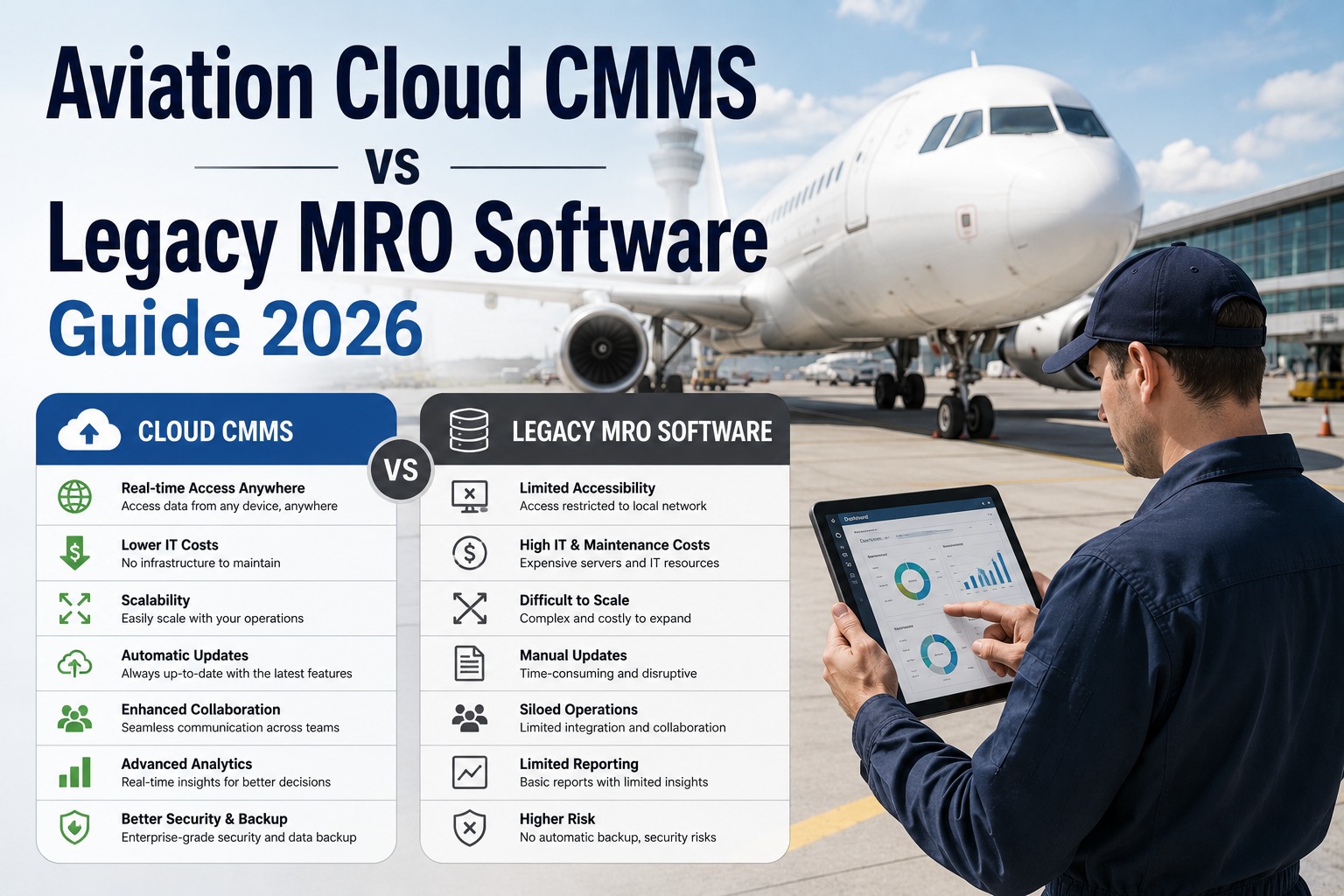
The jump from pilot to fleet-wide predictive maintenance is where 60% of aviation programs stall — usually because the pilot ran on a disconnected point tool that cannot scale. Standardizing on a single CMMS that natively handles preventive, predictive, and corrective work eliminates that failure mode.
| Capability | Pilot-Stage Point Tool | OxMaint Standardized CMMS |
|---|---|---|
| Sensor data ingestion | Manual CSV export, 24–48h delay | Live MQTT / REST streams, real-time |
| AI threshold management | Data-science team required per rule | Visual threshold editor, no-code |
| Work-order generation | Email alert → manual WO creation | Auto-generated WO with parts & tech |
| Spare-parts linkage | Separate inventory system lookup | Native inventory reservation on WO |
| Fleet-wide scaling | Re-build models per asset group | Clone thresholds across tail numbers |
| Audit & compliance trail | No native audit log | FAA / EASA Part-145 ready, full traceability |
How OxMaint Closes the Gap Between Sensor Data and Grounded Aircraft
OxMaint is not a bolt-on analytics dashboard — it is the CMMS that owns the full pipeline from sensor ingestion to signed-off work order. Here is how four core capabilities map directly to your predictive implementation roadmap.
Live Sensor-to-CMMS Pipeline
OxMaint ingests vibration, temperature, and oil-debris data via MQTT or REST in real time — no CSV exports, no 24-hour lag. Every reading is timestamped and mapped to the correct tail-number asset record automatically.
No-Code AI Threshold Configuration
Reliability engineers set multi-variable prediction rules visually — combine vibration RMS, temperature drift, and flight-hour windows without writing Python. Each rule is backtested against your historical removal data before it goes live.
Auto-Generated Predictive Work Orders
When an asset crosses an AI threshold, OxMaint creates a work order pre-filled with the anomaly description, recommended action, required spare parts, labor estimate, and assigned technician — ready for reliability-engineer review and dispatch.
FAA / EASA Audit-Ready Traceability
Every sensor reading, threshold change, prediction, work order, and technician sign-off is logged in an immutable audit trail. OxMaint exports compliance reports aligned with Part-145 and MSG-3 requirements — ready for any regulatory review.
Predictive Implementation Guide: The Org Changes Airlines Must Make to Scale
Technology is 40% of the work — the other 60% is organizational. Airlines and airports that successfully scale PdM restructure three areas: roles, workflows, and KPIs. Here is what changes and what stays the same.
Elevate the Reliability Function
Move reliability engineers from a back-office reporting role into the maintenance dispatch loop. At airlines that scale PdM, reliability engineers have direct authority to approve, modify, or reject AI-generated work orders — they do not hand recommendations to a separate planning team and hope action follows.
Retrain Line Mechanics on Data Closeout
Every work order — corrective or predictive — must close with structured failure codes, root-cause categories, and parts-consumed entries. This data feeds back into OxMaint's AI models, improving prediction precision by 3–5% per quarter. Mechanics need 4–6 hours of training and a CMMS interface that makes coded closeout faster than free-text notes.
Align Spare-Parts Inventory to Predictions
When OxMaint predicts an APU bearing failure 200 flight hours out, the spare part must be pre-positioned at the destination maintenance base — not sitting in a central warehouse 2,000 miles away. Inventory planning shifts from min-max reorder points to prediction-driven pre-positioning for high-value, long-lead-time components.
See OxMaint generate your first predictive work order — live on your assets
Book a 30-minute demo and our aviation maintenance specialists will walk you through the sensor-to-work-order pipeline on a sample fleet, show you the AI threshold editor, and map your 90-day rollout plan.
Aviation Predictive Maintenance Implementation: Your Questions Answered
How long does a CMMS predictive implementation take in aviation?
A well-scoped aviation predictive maintenance implementation takes 90 days from sensor deployment to your first AI-triggered work order, assuming 60%+ sensor coverage on pilot assets and clean asset hierarchy data. Fleet-wide rollout to 200+ assets typically takes an additional 6–9 months. You can accelerate the timeline by starting with OxMaint's onboarding scan — book a demo to see your custom roadmap.
What is the first step in an aviation predictive roadmap?
The first step is a readiness assessment across data quality, sensor coverage, work-order maturity, and organizational alignment. Teams that skip this step and jump straight to sensor purchasing typically lose 6–9 months reworking data models. OxMaint automates the assessment by scanning your existing CMMS records and flagging gaps in asset hierarchies, missing failure codes, and orphan work orders.
How do you configure AI thresholds in a CMMS for aviation assets?
AI thresholds are configured by combining two or more sensor variables — for example, vibration RMS exceeding 18% above baseline and exhaust-gas temperature drifting 12°C over 50 flight hours. OxMaint provides a visual, no-code threshold editor that lets reliability engineers set multi-variable rules and backtest each one against 12–24 months of historical removal data before activation, ensuring 90%+ prediction precision.
What ROI can airlines expect from predictive maintenance in the first year?
A typical 50-aircraft fleet implementing predictive maintenance via OxMaint sees 600–800% ROI in the first 12 months, driven primarily by avoided in-flight shutdowns (each worth ~$340,000 in AOG and passenger-rebooking costs), spare-part life extensions, and reduced unplanned labor. Payback period averages 4–5 months when pilot assets are selected correctly — high-criticality, high-cost components like APUs and hydraulic pumps.
Can OxMaint integrate with existing aviation sensors and IoT gateways?
Yes. OxMaint ingests sensor data via MQTT, REST API, and direct database connectors — compatible with all major aviation IoT gateways and condition-monitoring systems. If your APUs, engines, or landing gear already stream vibration, temperature, or oil-debris data, OxMaint connects to those existing feeds without requiring sensor replacement. Start a free trial to test the integration on your data streams.
Your 90-day predictive roadmap starts now
Deploy sensors, configure AI thresholds, and generate your first predictive work order inside a single CMMS — built for aviation maintenance and reliability teams.
Free 14-day trial · No credit card