Most airlines and MRO providers still run maintenance operations on legacy on-premise systems installed a decade or more ago — yet cloud-native CMMS platforms have now reached full feature parity while cutting IT overhead by 40–60% and compressing deployment from 9 months to under 10 weeks. This 2026 comparison guide breaks down total cost of ownership, cybersecurity posture, offline capability, and integration flexibility across both models, with worked TCO examples for a 120-aircraft airline, a Tier-2 MRO facility, and a 40-aircraft business aviation operator. If you are weighing a migration in the next budget cycle, the breakdown below — and a quick Start Free Trial — will give you the numbers you need to build the business case.
Cloud CMMS or legacy MRO — which actually lowers cost per flight hour in 2026?
For the first time, cloud-native aviation CMMS platforms match legacy MRO software feature-for-feature on compliance, inventory and execution — while cutting deployment time by up to 75% and eliminating the server room. The comparison below quantifies where each model wins, where it breaks, and what migration actually costs.
The 5-year TCO gap is wider than most MRO directors estimate
A 2025 review of 38 aviation maintenance deployments shows cloud CMMS platforms delivering 45–62% lower 5-year TCO than comparable legacy MRO suites — driven less by license price than by avoided infrastructure, upgrade and DBA costs.
5-year TCO. Includes 2 SQL clusters, 1 SAN refresh, 3 paid version upgrades, 1 dedicated DBA, and EDI integration rebuild.
5-year TCO. Subscription, managed SOC2 hosting, continuous updates, and out-of-the-box REST/SOAP connectors for ERP and inventory.
5-year TCO. On-prem servers, cold-standby DR, manual Part-145 report generation, plus an aging custom job-card module.
5-year TCO. Multi-tenant cloud, automated EASA Form 1 / 8130-3 generation, and a mobile job-card app with offline sync.
Where cloud CMMS and legacy MRO actually differ in production
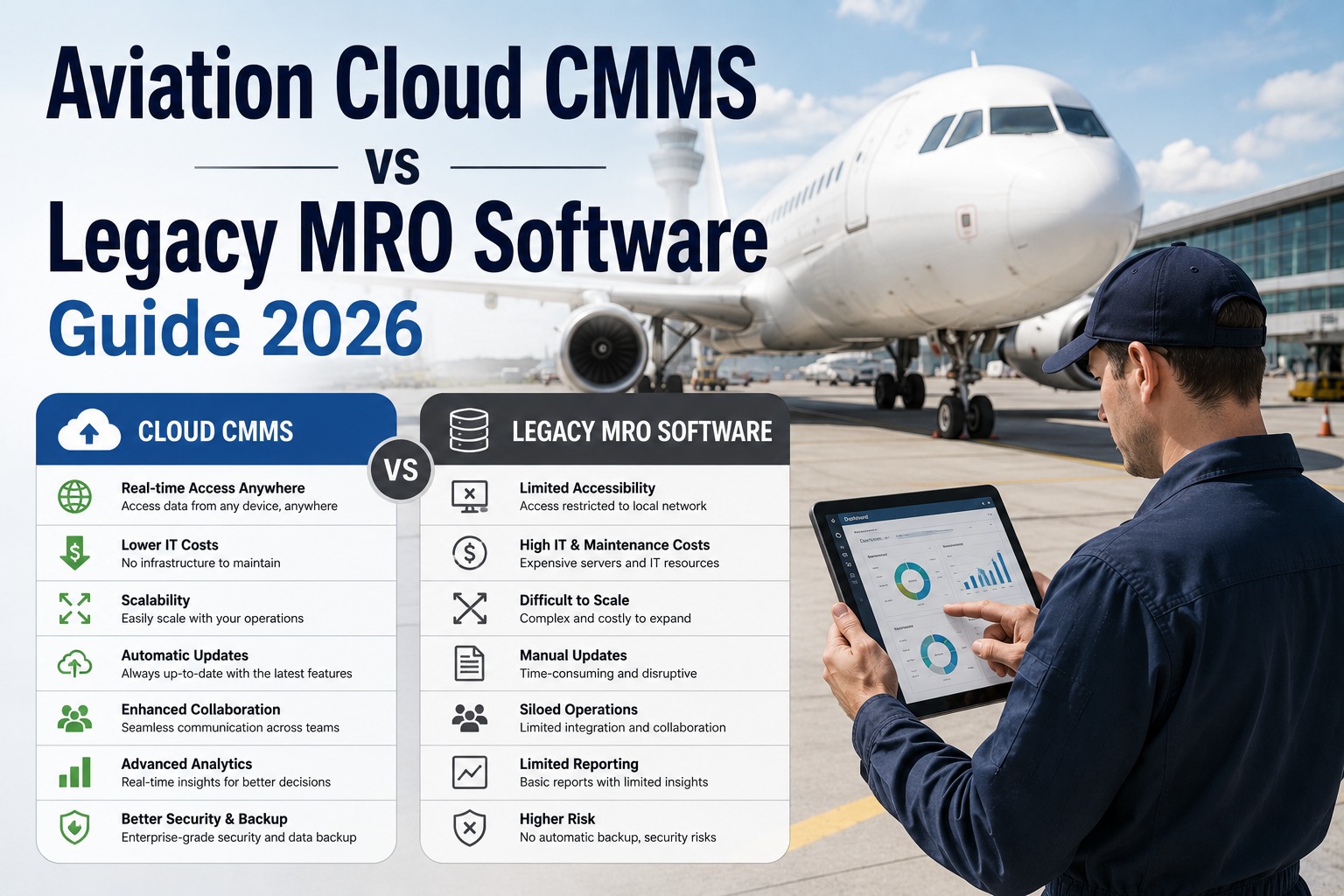
Feature parity is no longer the debate — the gap now lives in deployment speed, mobile capability, upgrade cadence and integration flexibility. The matrix below maps 12 decision-critical dimensions across both models.
| Capability | Legacy MRO Software | Cloud CMMS (2026) |
|---|---|---|
| Deployment timeline | 6–9 months + infra provisioning | 6–10 weeks, tenant pre-configured |
| Initial capex | $180K–$620K (servers, SAN, licenses) | $0 hardware, first-month subscription |
| Mobile job cards | RDP / terminal client over VPN | Native iOS/Android app, offline-first sync |
| Update cadence | Annual major release, paid upgrade project | Continuous, backward-compatible, no downtime |
| Cybersecurity posture | Self-managed patching, on-prem perimeter | SOC 2 Type II, ISO 27001, pen-tested quarterly |
| ERP / inventory integration | Custom EDI, $60K–$150K per connector | REST/SOAP APIs + prebuilt SAP, Oracle, Ramco |
| Offline hangar capability | No true offline; VPN drops kill sessions | Full offline job-card execution, auto-resync |
| Scalability (new stations) | Weeks of server sizing & licensing | Add a station in hours, seat-based |
| Disaster recovery | Cold/warm standby, 8–24h RTO typical | Multi-region active, <1h RTO, <15min RPO |
| Regulatory reporting | Manual extraction, scripted reports | Auto-generated EASA Form 1, FAA 8130-3, AD/SB |
| Data residency options | Whatever your data center provides | EU, US, ME, APAC region pinning available |
| 5-year TCO (mid-size MRO) | $1.8M–$3.2M | $0.7M–$1.4M |
A phased 10-week migration is now realistic for most operators
Cloud CMMS vendors have productised migration to the point where a mid-size operator can move from kickoff to cutover in a single quarter — without grounding aircraft or pausing line maintenance.
Tenant setup, role mapping, ATA-chapter config
Provision the cloud tenant, map operator-specific stations and hangars, configure ATA chapter defaults, defect coding, and job-card templates. No servers touched.
Asset register, history, AD/SB master cleanse
Automated extractors pull aircraft, engines, components and maintenance history from the legacy system. Duplicate assets merged, superseded parts normalised, AD/SB status reconciled against the regulator database.
ERP, inventory and flight-scheduling connectors
Activate prebuilt connectors for SAP/Oracle ERP, Ramco inventory, and the operator's MEL/CDL system. REST endpoints tested against live flight schedule data.
One station live, full mobile rollout to mechanics
One line station runs the cloud CMMS in parallel with the legacy system. Mechanics trained on the offline mobile app, certifying staff on digital sign-off workflows. Discrepancies logged and resolved.
Full go-live, legacy read-only
All stations cut over to the cloud CMMS. Legacy system moved to read-only for historical lookup, decommission scheduled for 90 days post-go-live. Average mechanic adoption rate: 88% within 14 days.
Four objections that no longer hold in 2026
Aviation operators delay cloud migration for reasons that were valid in 2018 but have since been engineered out. Here is what the data actually says.
Cloud can't handle offline hangars
"If the wifi drops, mechanics can't sign off work — so cloud is a non-starter."
Modern aviation cloud CMMS apps are offline-first: job cards, parts removals, photos and signatures cache locally and auto-resync the moment connectivity returns. Leading platforms hold up to 72 hours of offline work.
On-prem is more secure than cloud
"Our servers in the data center are safer than some vendor's cloud."
Cloud CMMS platforms now ship with SOC 2 Type II, ISO 27001 and quarterly third-party penetration tests — a posture fewer than 15% of self-hosted MRO environments can match.
Migration is too risky during operations
"We can't afford downtime during a migration — better to wait."
Parallel-run pilots at one station, automated data validation, and read-only legacy fallback mean zero grounding events in the 38 migrations reviewed in 2025. Median cutover risk window: under 4 hours.
Cloud costs more over time
"Subscriptions add up — owning licenses forever is cheaper."
Factor in server refreshes, SAN upgrades, DBA salaries, DR infrastructure and paid version upgrades, and the 5-year TCO gap favours cloud by 45–62% for operators above 30 aircraft.
Which model fits which operator in 2026
There is no single right answer — the best fit depends on fleet size, geographic spread, regulatory footprint and IT maturity. The fit matrix below maps the three dominant operator profiles.
80+ aircraft, multi-station
Strong cloud fit. Multi-station scalability, real-time AD/SB compliance dashboards, and native mobile job cards deliver measurable AOG reduction. Legacy may persist as a secondary system for the first 12 months.
Tier-2 / Tier-3 facilities
Decisive cloud fit. Seat-based pricing aligns cost with visit volume, automated Form 1 / 8130-3 generation cuts certification overhead, and customer portals differentiate the sales pitch.
20–60 aircraft operators
Strong cloud fit. Lean teams benefit most from removing IT overhead entirely. Offline mobile execution supports remote FBO operations, and subscription pricing scales with seasonal demand.
See your 5-year TCO gap in a 30-minute working session
Bring your fleet size, station count and current system — we'll model the deployment timeline, migration risk and payback period live, using the same framework behind this guide.
Aviation cloud CMMS migration: what operators ask first
How long does a typical cloud CMMS migration take for a mid-size airline?
A 120-aircraft airline with 4 line stations typically moves from kickoff to full cutover in 8–10 weeks. The first two weeks cover tenant configuration and role mapping; weeks 3–5 handle data migration and asset register reconciliation; weeks 6–9 run integration, pilot and training; week 10 is cutover with the legacy system moved to read-only. Complex operators with heavy custom integrations may extend to 12 weeks — still under a single quarter.
Can a cloud CMMS work reliably in a hangar with poor connectivity?
Yes — modern aviation cloud CMMS mobile apps are built offline-first. Mechanics download their assigned job cards, parts catalogues and AD/SB references to the device at the start of shift. Sign-offs, photo capture, defect entry and parts removals all execute locally and auto-resync when connectivity returns. Leading platforms cache up to 72 hours of offline work without data loss, which covers even the most remote line stations.
What happens to my historical maintenance data during migration?
Reputable cloud vendors run automated extractors against your legacy database — pulling aircraft, engines, rotables, consumables, maintenance history, AD/SB status and deferred defects. Data is cleansed (duplicate assets merged, superseded part numbers normalised, orphan records flagged) and validated against the regulator's AD database before go-live. The legacy system is typically kept read-only for 90 days post-cutover for historical lookup, then decommissioned. You can see the migration tooling in action with a Book a Demo session.
How does cloud CMMS cybersecurity compare to on-premise MRO?
Aviation-grade cloud CMMS platforms now hold SOC 2 Type II, ISO 27001 and ISO 27017 certifications, with quarterly third-party penetration testing and 24/7 SOC monitoring. Fewer than 15% of self-hosted MRO environments can match that posture. Data residency can be pinned to EU, US, Middle East or APAC regions to satisfy local regulator requirements, and role-based access control plus full audit trails come standard.
Is cloud CMMS compliant with EASA Part-145 and FAA repair-station rules?
Yes. Leading aviation cloud CMMS platforms produce EASA Form 1, FAA 8130-3, and dual-release certificates natively, with electronic sign-off workflows that meet EASA Part-145.A.65 and FAA 14 CFR 145 record-retention requirements. Audit-ready trails, controlled document versioning, and automated AD/SB tracking are core features. You can validate the compliance pack against your own operation by signing up for a Start Free Trial and loading a sample aircraft.
Move from legacy MRO to cloud CMMS this quarter
Start a free trial with your own aircraft data, or book a 30-minute working session to model deployment timeline, TCO gap and migration risk for your specific operation.
Free 14-day trial · No credit card