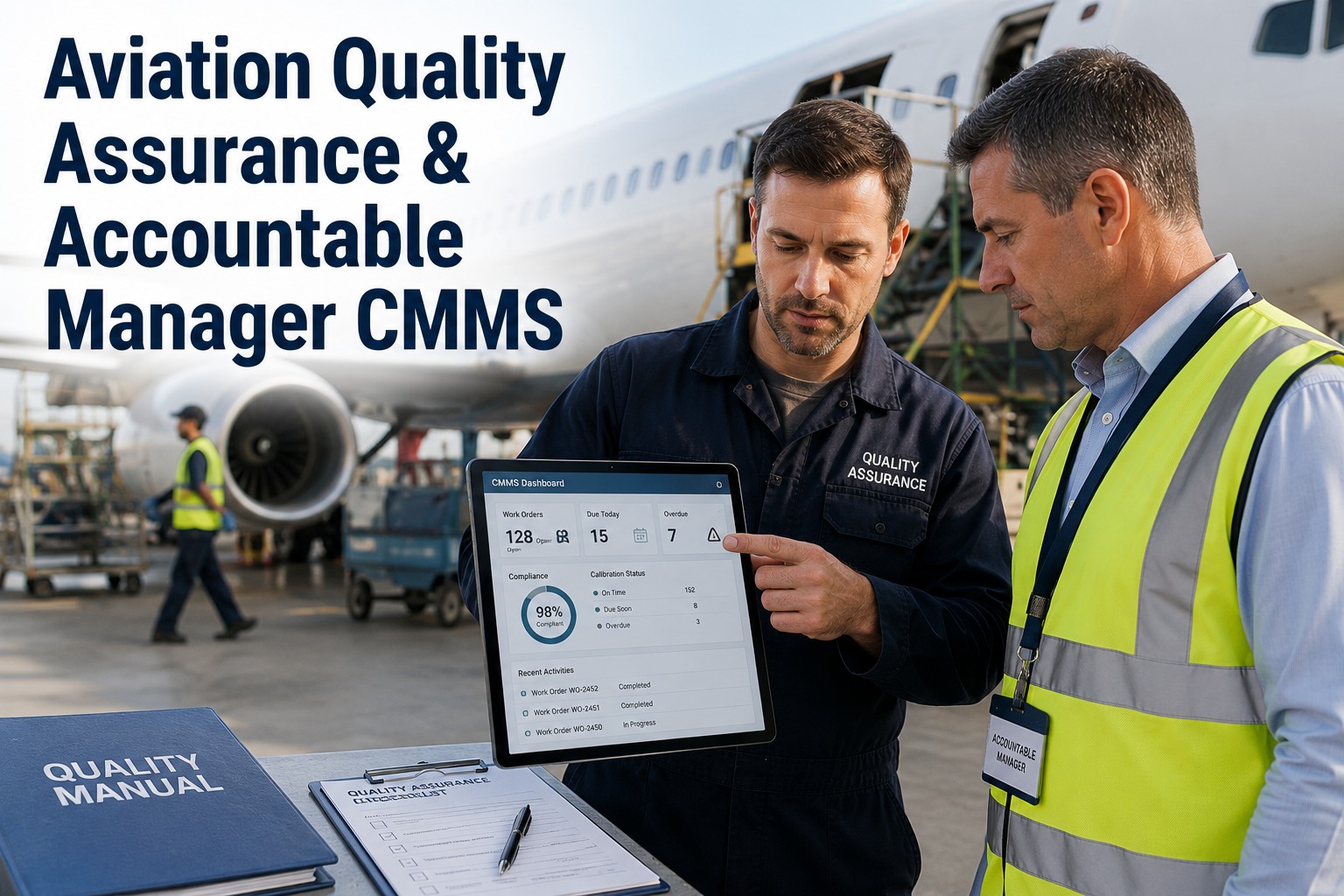
Aviation quality assurance lives or dies on traceability — every maintenance action, tool calibration, and spare part installation must be documented, auditable, and instantly retrievable when regulators arrive. An aviation quality assurance CMMS gives the Accountable Manager a single system of record that ties work orders, asset histories, and QA events together so nothing slips through the cracks. In this guide, we break down how to build a CMMS-driven QA oversight structure that satisfies EASA Part-145 and FAA Part 145 expectations, streamlines escalation authority, and ensures every quality indicator is visible at the top. Ready to replace your spreadsheet sprawl with a defensible audit trail? Start Free Trial and see how OxMaint operationalizes accountability from the hangar floor to the boardroom.
Accountable Manager Guide · 2026
Are you personally liable for a quality gap you can't see?
As the Accountable Manager, you carry personal responsibility for the entire aviation quality system. Yet most QA failures stem not from negligence — but from invisible escalation paths, disconnected audit logs, and work orders that never reached the quality review board. OxMaint closes that gap with a CMMS built for regulatory accountability.
Quality System Architecture
What the Accountable Manager needs from an aviation QA CMMS
A defensible quality system rests on five pillars. If any one is manual, fragmented, or delayed, the Accountable Manager is exposed. Here is what each pillar demands — and how a CMMS enforces it.
Quality Indicators & KPI Dashboards
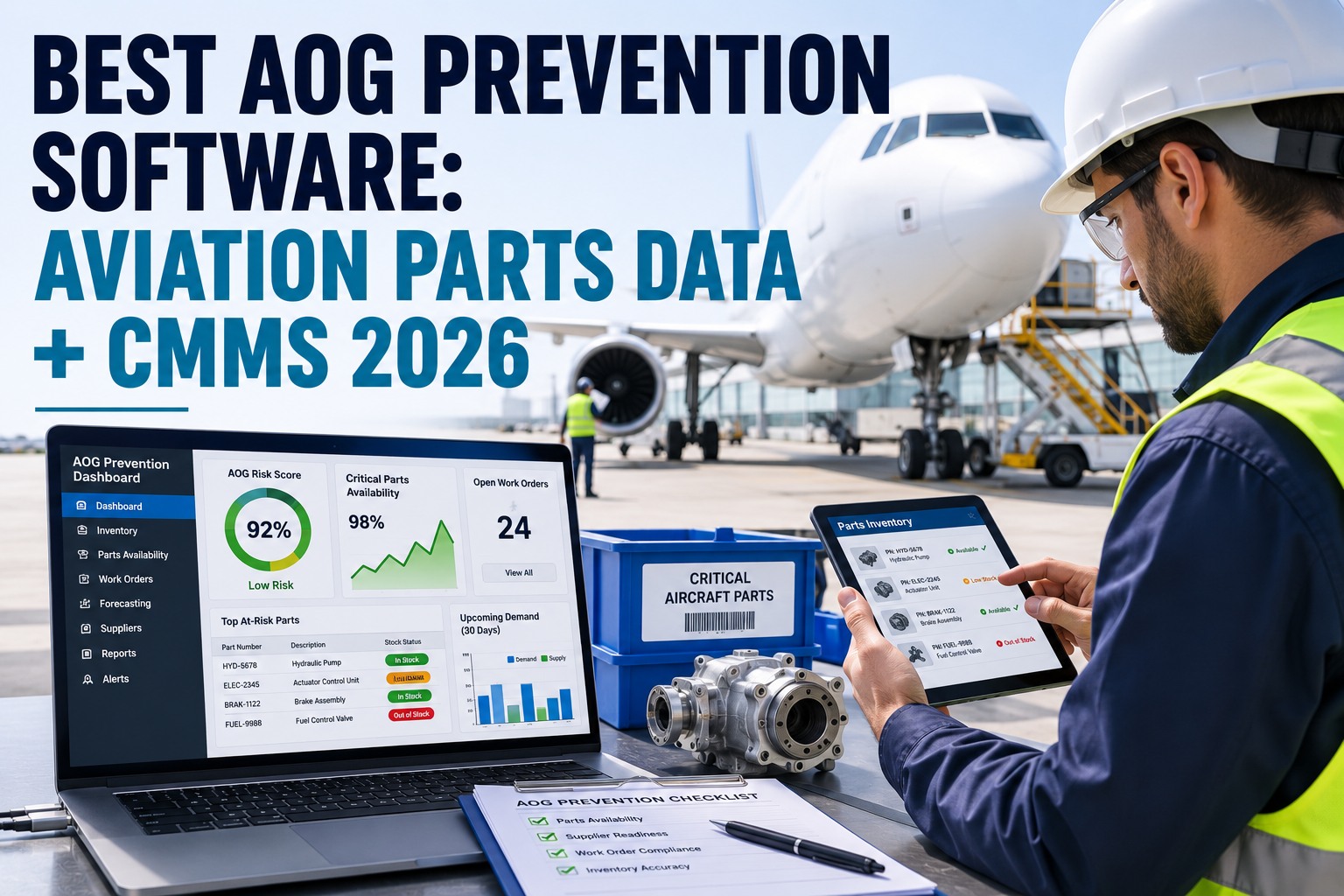
Regulators expect leading and lagging indicators: repeat defect rates, deferred MEL items, on-time release rates, and audit closure times. A CMMS dashboard auto-aggregates these from live work-order data — no manual spreadsheet roll-ups.
Audit & Inspection Readiness
Every asset, technician stamp, torque check, and parts certificate must be retrievable in minutes. CMMS QA documentation links each maintenance action to its evidence — calibration certs, borescope images, tool serials — in one searchable thread.
Escalation Authority & Routing
When a QA event is raised (a non-conformance, an NRB trigger, a recurring fault), the CMMS must auto-route it to the Accountable Manager or Quality Manager based on severity, aircraft registration, and category — with a time-stamped audit chain.
Management Review Evidence
The quarterly quality review meeting needs evidence, not anecdotes. The CMMS should generate a one-click review pack: KPI trends, open CAPAs, overdue corrective actions, and supplier performance — all exportable for the board and the authority.
Supplier & Parts Traceability
Counterfeit and unairworthy parts are a top-5 CAA finding. The CMMS must bind every installed part to its FAA 8130-3 / EASA Form 1 release, its supplier approval record, and its shelf-life expiry — and block installation if any link is broken.
Competency & Human Factors Log
Part-145 requires evidence of type training, human factors refreshers, and authorization currency. The CMMS tracks each technician's qualifications against every assigned task — and prevents work-order sign-off if authorization has lapsed.
Worked Scenario
The cost of a fragmented QA trail: a 40-aircraft regional operator
Consider a regional operator managing 40 turboprops with 12,000 annual maintenance events. Their QA team ran on spreadsheets, a legacy MRO module, and email-based escalation. Here is what happened over 12 months — and what changed when they switched to an integrated CMMS.
| QA Metric | Before CMMS (Spreadsheets) | With OxMaint CMMS |
|---|---|---|
| Time to retrieve a full work-order audit pack | 4–6 hours of manual digging | Under 90 seconds — one click |
| Average QA escalation delay (event to Accountable Manager) | 5–11 days, often lost in email | Auto-routed in under 1 hour |
| Overdue corrective actions (CAPAs past 30 days) | 27 open at any given time | 3 open — auto-escalated at day 25 |
| Regulatory audit findings (corrective action notices) | 9 findings in one cycle ($180K remediation) | 1 minor finding, closed in 72 hours |
| Management review pack preparation time | 3 staff × 2 weeks = 240 labor hours | 1 click — generated in real time |
| Estimated annual QA overhead cost | $420,000 (labor + remediation + fines) | $95,000 — 77% reduction |
The Accountable Manager went from reacting to audit findings to preventing them — because every quality event, escalation, and corrective action was visible, time-stamped, and enforceable inside a single system.
QA Escalation Workflow
How to build a CMMS escalation path the Accountable Manager trusts
Escalation is where most QA systems break. A fault is logged, a non-conformance is raised, and then it stalls — because nobody owns the next step. Here is the four-stage escalation architecture OxMaint enforces inside the CMMS.
Detection & Logging
A technician, inspector, or automated predictive alert flags a quality event inside the CMMS — a repeated defect, a tool out of calibration, a parts certificate gap. The system assigns a unique QA event ID and time-stamps the origin. No sticky notes, no email threads.
Triage & Severity Classification
The Quality Manager reviews the event in a structured triage queue. OxMaint applies a severity matrix (Category A: airworthiness-critical → Category D: administrative) and auto-assigns SLA timers. Category A events trigger immediate aircraft-grounding workflow.
Investigation & Root Cause
A CAPA (Corrective and Preventive Action) record opens, linked to the original work order, asset history, and technician competency file. OxMaint's AI surfaces similar past events and suggests root-cause categories — cutting investigation time from weeks to days.
Accountable Manager Review & Sign-Off
For Category A and B events, the CMMS routes the closed CAPA — with full evidence chain — to the Accountable Manager's dashboard for electronic sign-off. The signature is cryptographically time-stamped. The authority sees a complete, unbroken chain from detection to closure.
CMMS Quality Assurance Capabilities
How OxMaint helps Accountable Managers enforce QA oversight
OxMaint is not a generic CMMS with a QA plugin — its core data model was designed for maintenance accountability. Here are four concrete capabilities that map directly to the Accountable Manager's responsibilities, and the measurable outcome each delivers.
Automated QA Event Routing
OxMaint's rules engine auto-escalates quality events based on severity, aircraft tail number, and repeat-fault count — routing Category A findings to the Accountable Manager's dashboard within 60 minutes. No event is lost in email.
One-Click Audit Pack Generation
Pull a complete audit trail for any asset, work order, or time period in under 90 seconds. OxMaint compiles the work card, technician authorization, parts certificates (FAA 8130-3 / EASA Form 1), tool calibration records, and sign-off chain into a single PDF.
Live Quality Indicator Dashboards
Twelve pre-built aviation QA KPIs — repeat defect rate, MEL deferral count, on-time release rate, CAPA closure aging, supplier defect rate — update in real time. The Accountable Manager sees trends before they become findings.
Competency-Gated Work Orders
OxMaint cross-references each technician's type-training, human-factors currency, and authorization scope against the assigned task. If a qualification has lapsed, the work order locks — and the system routes a renewal alert before the gap affects production.
See it on your assets
Book a 30-minute demo — see your QA oversight gap close in real time
Bring your toughest QA headache. We'll load a sample asset register and show you exactly how escalation, audit-pack generation, and Accountable Manager dashboards work inside OxMaint.
Implementation Roadmap
Aviation QA CMMS rollout: a 4-month timeline for Accountable Managers
Switching from spreadsheets or a legacy MRO module to a CMMS that truly supports QA accountability is not an overnight project — but it should not take a year either. Here is the phased timeline OxMaint recommends for a mid-size MRO or airline.
Data Migration & Asset Register Build
Import aircraft registrations, component serials, ATA chapter structures, technician competency matrices, and supplier approval lists. OxMaint's onboarding team maps your existing data — even from PDFs and Excel — into the CMMS schema.
QA Workflow Configuration
Configure escalation severity matrices, SLA timers, CAPA templates, and KPI dashboard thresholds to match your Exposition and regulatory framework (EASA Part-145, FAA Part 145, or CAA CAP 731). Set the Accountable Manager's review and sign-off routing.
Pilot on One Aircraft Type
Run all maintenance and QA events for one fleet type through OxMaint. Technicians log work orders on mobile devices. The Quality Manager triages events in the CMMS. The Accountable Manager reviews the dashboard weekly — and the first management review pack is generated.
Full Fleet Rollout & Authority Demo
Expand to all fleet types and hangar lines. Conduct an internal mock audit — generate audit packs for 20 random work orders and verify every evidence link is intact. Invite your regulatory inspector for a CMMS walkthrough. Most operators pass with zero findings.
Frequently Asked Questions
Aviation QA CMMS: what Accountable Managers ask most
What is an aviation quality assurance CMMS and why does the Accountable Manager need one?
An aviation quality assurance CMMS is a maintenance management system that integrates work orders, asset tracking, parts traceability, and QA event management into a single auditable platform. The Accountable Manager needs it because personal liability under EASA Part-145 and FAA Part 145 requires demonstrable, real-time oversight of every quality indicator — something spreadsheets and email cannot provide. Start Free Trial to see how OxMaint makes that oversight automatic.
How does CMMS QA tracking differ from a standard maintenance management system?
A standard CMMS manages work orders and preventive schedules. A CMMS with QA tracking adds severity-based escalation routing, CAPA management, competency-gated sign-offs, live quality indicator dashboards, and one-click audit pack generation — all linked by a time-stamped evidence chain. It turns maintenance data into a defensible quality record that satisfies regulatory inspectors.
Can OxMaint generate management review evidence for the Accountable Manager's quarterly meeting?
Yes. OxMaint compiles a management review pack in one click — KPI trends, open and closed CAPAs, overdue corrective actions, supplier performance scores, repeat defect analysis, and competency currency summaries. The pack is exportable as a board-ready PDF and includes the full evidence trail regulators expect to see behind each data point.
How long does it take to implement an aviation QA CMMS for a mid-size MRO?
A mid-size MRO managing 30–60 aircraft can fully implement OxMaint's QA CMMS in 3–4 months. Month 1 covers data migration, Month 2 configures QA workflows and escalation rules, Month 3 pilots on one fleet type, and Month 4 rolls out to the full operation. Most operators pass their first post-launch regulatory audit with zero or one minor finding.
Does the CMMS support both EASA Part-145 and FAA Part 145 quality system requirements?
Yes. OxMaint's data model supports the quality system documentation requirements of both EASA Part-145 (Section A — Quality System, Subpart C) and FAA Part 145 (quality assurance programs under 14 CFR §145.161). The escalation matrix, CAPA templates, and audit pack formats are configurable to either framework — and to national CAA variants like CAA CAP 731. Book a Demo to see your regulatory framework configured live.
Your quality system starts here
Stop defending QA gaps. Start preventing them.
OxMaint gives the Accountable Manager the visibility, escalation control, and audit-readiness that regulators expect — and that spreadsheets can never deliver. See it on your assets in 30 minutes.
Free 14-day trial · No credit card