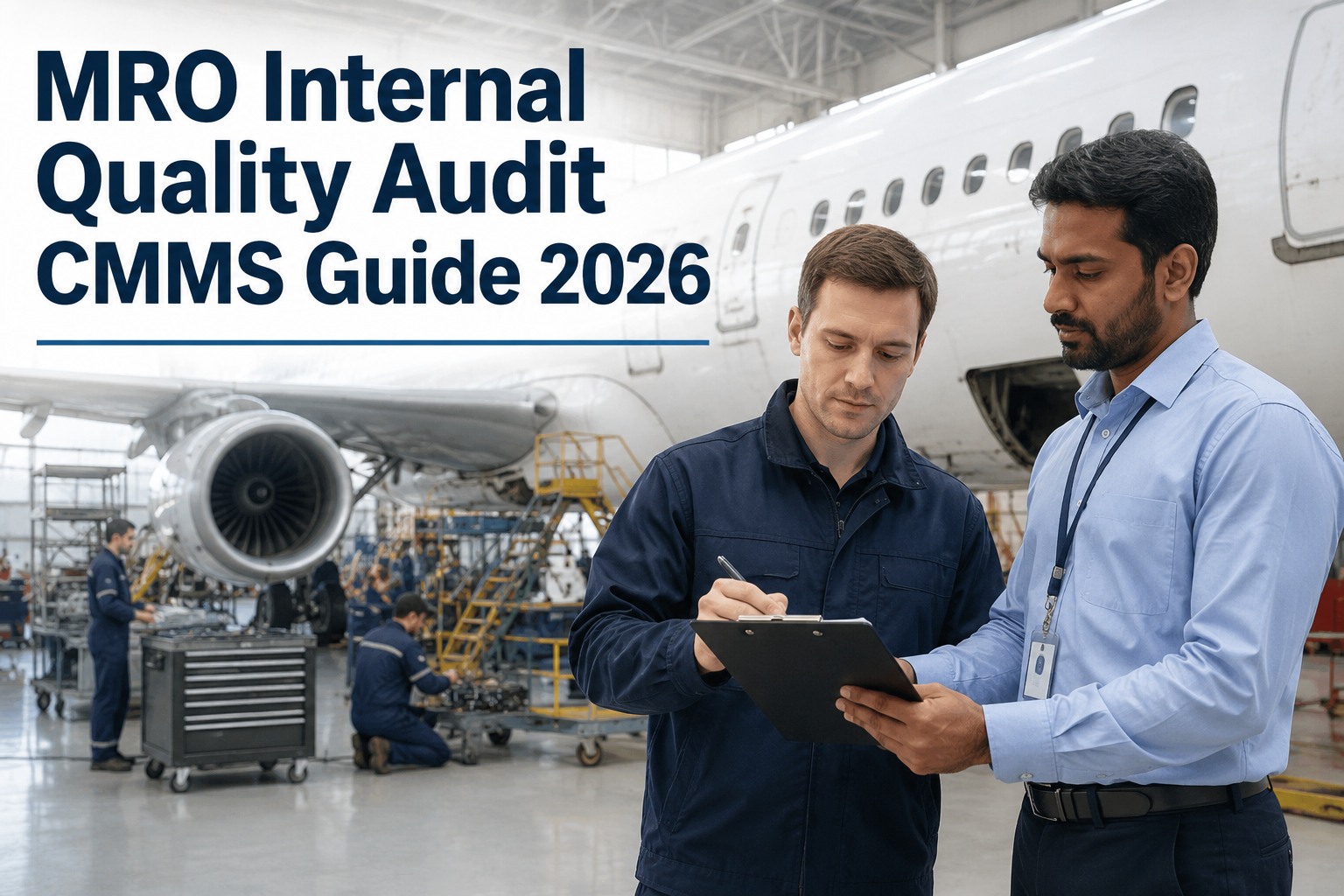
Internal quality audits are what separate MROs that pass their FAA, EASA, and CAA surveillance inspections on the first attempt from those scrambling to assemble paperwork under a 72-hour clock. Most maintenance organizations still treat internal auditing as an annual box-checking event, leaving a gap of up to 11 months between the last self-inspection and the regulator's arrival. A CMMS closes that gap by converting findings, corrective actions, and trend data into a live compliance signal visible to quality managers in real time. This 2026 guide walks through audit scheduling, finding tracking, and corrective action loops, showing how a digital system turns scattered quality data into a defensible audit trail. To see the platform in action, Start Free Trial today.
Why do regulators keep finding what your internal team missed?
Because most MROs run internal audits as a once-a-year sprint instead of continuous monitoring. A CMMS converts every self-inspection finding, corrective action, and recurring discrepancy into a live compliance signal—so the next surveillance audit is a formality, not a fire drill.
Annual audits hide 11 months of drift
The average Part 145 station runs one comprehensive internal audit per year per department, meaning findings discovered in January sit uncorrected—or worse, undiscovered—until the next cycle. Here is what that gap actually costs an MRO.
A mid-size MRO with 45 technicians generates roughly 312 audit findings annually—80% never trended across cycles.
Average cost of a single Level 1 regulatory finding—lost revenue, rework, rectification, and consultant remediation.
Time from a paper-based self-inspection closeout to a signed, distributed corrective action plan in a manual system.
Reduction in repeat findings when a CMMS enforces automated 30/60/90-day corrective action verification loops.
From annual scramble to continuous monitoring
A CMMS-anchored internal audit program replaces the once-a-year audit blitz with a rolling 12-month schedule. Each phase feeds the next, so findings close and trend data accumulates without manual reconciliation.
Audit Plan & Schedule Lock
CMMS auto-generates the annual internal audit master schedule by department, shift, and aircraft type—mapped to FAA Part 145.214 and EASA Part-145.A.65 requirements. No spreadsheets, no missed quarterly windows.
Self-Inspection Cycles
Line and hangar self-inspections run weekly on mobile checklists. Each finding drops into the CMMS with photo evidence, asset tag, technician ID, and a severity score within 60 seconds of capture.
Corrective Action Loops
Every finding auto-assigns a CAR with a 30-day closure target. The system escalates overdue items to the QA manager on day 25, day 28, and day 30—closing the loop before the regulator ever asks.
Trend Analysis Review
CMMS dashboards surface repeat findings by tail number, technician, tool calibration, and procedure revision. QA managers review Pareto charts and adjust the Q4 audit focus accordingly.
Management Review
A one-click report bundles audit scores, CAR closure rates, and trend data into the annual management review pack required by AS9100D Clause 9.3 and Part 145.A.65(b).
Surveillance Audit Prep
The regulator arrives. Every finding, CAR, trend chart, and sign-off is already in the CMMS audit trail—exportable to PDF in under two minutes. No binder assembly, no late nights.
The audit closure math that regulators check first
Inspectors do not just count findings—they measure how fast and how completely you close them. A CMMS tracks three metrics that together form your Audit Closure Health Score.
A score above 85 indicates a healthy, self-correcting system. Below 65 triggers an automatic QA escalation in the CMMS, flagging the station for a focused re-audit before the regulator schedules one.
On-Time Closure Rate
Percentage of CARs closed within their 30-day target. Industry benchmark for a compliant Part 145 station is 88% or higher. The CMMS auto-tracks this per department and per shift.
Repeat Finding Rate
Share of findings that recur within two audit cycles. A rate above 12% signals a systemic process failure, not a one-off error—and regulators will dig deeper into root cause documentation.
Trend Velocity
Rate at which a finding category is improving or degrading month-over-month. Negative velocity on calibration findings, for instance, can trigger an early tooling audit before a discrepancy reaches production.
A 180-asset MRO station in Dallas ran 312 internal findings in 2025 with a 71% on-time closure rate and a 19% repeat finding rate—yielding an ACHS of 57. Within six months of deploying a CMMS-driven audit loop, on-time closure climbed to 93%, repeats fell to 6%, and the ACHS hit 87. The station passed its FAA surveillance audit with zero Level 1 findings for the first time in four years.
What a CMMS-backed MRO audit trail must contain
Before any surveillance audit, your CMMS should be able to produce these records on demand. If any item below is still tracked in a spreadsheet or a shared drive, it is a compliance risk.
Scheduling & Scope
- ✓ Annual master audit schedule locked by January 15
- ✓ Department-level audit scope mapped to Part 145.214
- ✓ Auditor qualifications and independence logged per area
- ✓ Rolling 12-month calendar visible to all QA staff
Finding Documentation
- ✓ Every finding tagged with asset ID and work order link
- ✓ Photo and evidence files attached at point of capture
- ✓ Severity classification (Level 1–3) auto-assigned
- ✓ Digital sign-off by inspector within 24 hours
Corrective Action Records
- ✓ CAR number, owner, and due date auto-generated
- ✓ Root cause analysis documented in structured fields
- ✓ Verification of effectiveness recorded at 60 days
- ✓ Escalation log for overdue CARs reviewable on demand
Trend & Management Reports
- ✓ Pareto charts of top-10 finding categories by quarter
- ✓ ACHS scorecard live on the QA dashboard
- ✓ Management review pack auto-compiled per AS9100D 9.3
- ✓ Exportable PDF audit trail for the full 12-month cycle
The cost of paper audits vs continuous monitoring
The difference between a binder-based audit program and a CMMS-driven one is not just efficiency—it is the difference between discovering a finding in week one and discovering it during a regulatory inspection.
| Audit Capability | Paper / Spreadsheet | CMMS-Driven |
|---|---|---|
| Audit schedule visibility | Static PDF, emailed quarterly | Live 12-month calendar, role-based access |
| Finding capture lead time | 3–5 days from field to log | Under 60 seconds via mobile checklist |
| CAR assignment & tracking | Email chains, manual follow-up | Auto-assigned, auto-escalated at day 25/28/30 |
| Repeat finding detection | Manual cross-reference, rarely done | Automatic trend flag on second occurrence |
| Management review pack | 40+ hours of manual compilation | One-click report, under 2 minutes |
| Surveillance audit prep time | 2–3 weeks of binder assembly | Zero—trail is always audit-ready |
| Average Level 1 findings per audit | 4–7 per cycle | 0–1 per cycle |
What changes when audit data goes live
"We went from 23 Level 1 findings in our 2024 FAA surveillance to zero in 2025. The CMMS trend dashboard caught a recurring torque-wrench calibration gap three months before the inspector would have. That single catch paid for the platform."
"Our CAR closure rate was stuck at 68% for years because nobody owned the follow-up. After moving to automated 30/60/90-day verification loops, we hit 94% within two quarters. The regulators noticed before we even told them."
Turn your next internal audit into a live compliance signal
Stop assembling binders the night before a surveillance visit. Deploy a CMMS audit loop and walk into every inspection already audit-ready.
MRO internal quality audit & CMMS, answered
How does a CMMS schedule internal audits across multiple MRO departments?
A CMMS auto-generates a rolling 12-month master schedule based on department, shift, aircraft type, and regulatory requirement (Part 145.214 / EASA Part-145.A.65). Each audit block is assigned to a qualified auditor with independence checks, and reminders fire 14, 7, and 1 day before the window opens—so no quarterly audit is ever missed due to calendar drift.
What is an acceptable corrective action closure rate for a Part 145 MRO?
Industry benchmark is 88% on-time closure within 30 days of CAR assignment. Below 80% typically triggers a QA escalation and may draw regulator scrutiny during the next surveillance cycle. The CMMS tracks this metric live on the QA dashboard and auto-flags any department dipping below threshold. You can see how this works by booking a Book a Demo session.
Can a CMMS detect repeat audit findings before the regulator does?
Yes. When a finding is logged, the CMMS cross-references the asset ID, procedure reference, and finding category against the prior 24 months of audit data. If the same finding type appears twice within two cycles, the system flags it as a repeat and triggers a focused root-cause review—often weeks or months before a regulator would surface the pattern.
How long does it take to deploy a CMMS for internal audit management?
A typical Part 145 station with 40–80 technicians can go live in 4–6 weeks. The platform imports existing audit checklists, CAR templates, and the master schedule, then configures escalation rules and dashboards. Most QA teams see their first full self-inspection cycle run inside the system within 30 days of kickoff.
Does the CMMS produce audit documentation that satisfies FAA and EASA inspectors?
Yes. Every finding, CAR, trend report, and management review pack is exportable as a timestamped, digitally-signed PDF with a full chain-of-custody trail. Inspectors receive a single compiled dossier rather than scattered binders, and the system maintains version history so nothing appears altered or backdated. Start Free Trial to generate your first audit-ready report.
Your next surveillance audit should be a formality
Deploy a CMMS audit loop, close findings on time, and walk into every inspection with a live, defensible compliance trail.
Free 14-day trial · No credit card