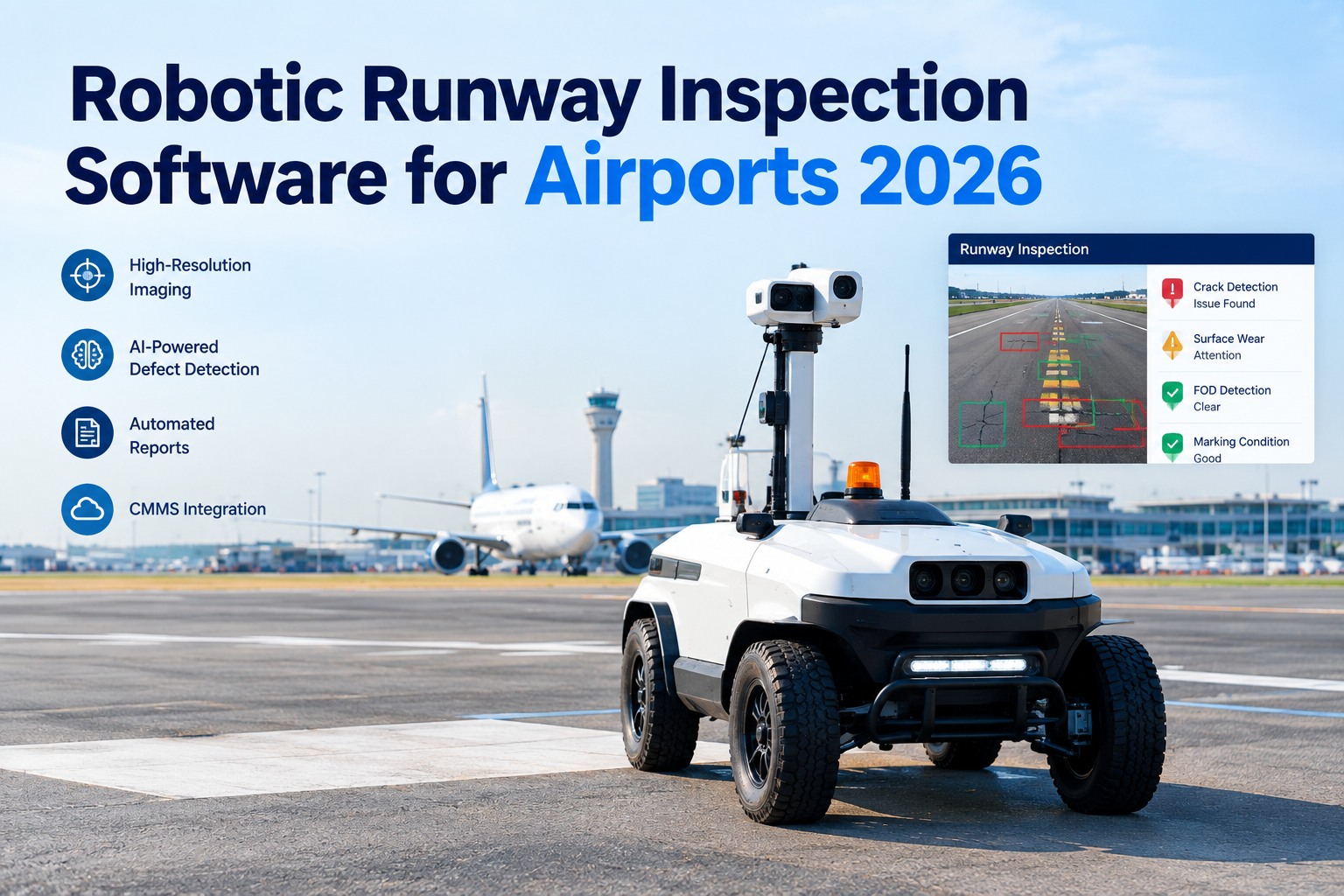
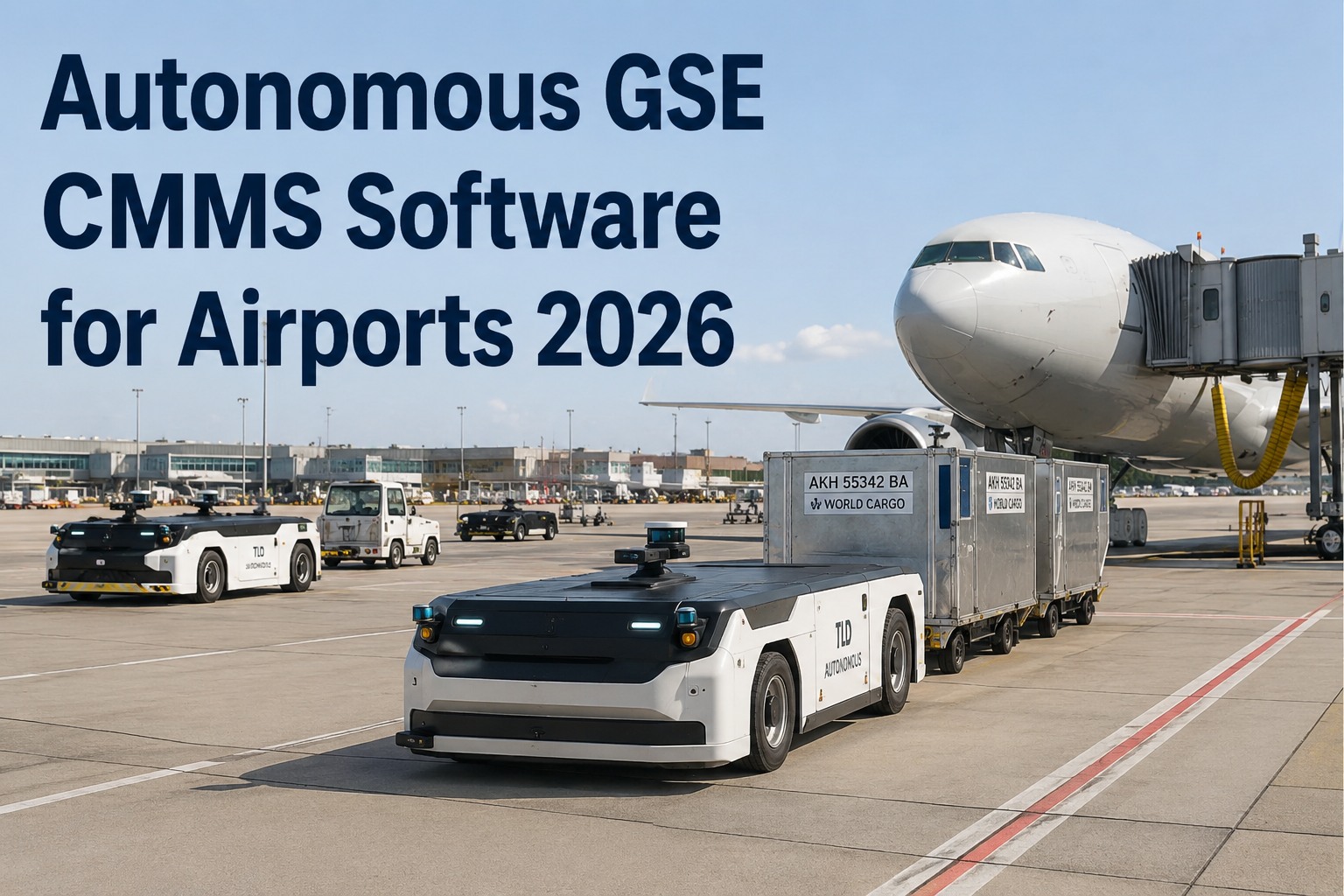
By 2026, the airport robots market will surpass $1.98 billion — with autonomous cleaners, delivery bots, and security patrols navigating terminals 24/7. Behind nearly every one of these machines is ROS 2, the open-source middleware powering real-time navigation, safety-critical communication, and sensor fusion. But here is the problem nobody talks about: who maintains these robots? When a Nav2 map drifts after a gate renovation, when a LiDAR sensor degrades in a dusty cargo hall, when an SROS2 certificate expires — downtime costs airports thousands per hour. OXmaint CMMS connects directly to ROS 2 diagnostic publishers, auto-generating maintenance work orders the moment robot health drops below your safety thresholds. Book a demo to see the integration live.
The $1.98 Billion Airport Robot Revolution
Airports are no longer experimenting with robots — they are deploying fleets. Munich Airport runs autonomous scrubbers around the clock. Delhi's IGI Airport uses humanoid greeters for multilingual passenger support. Changi orchestrates multi-vendor robot fleets through Open-RMF built on ROS 2. The common thread across every deployment is a need for reliable navigation, bulletproof safety, and a maintenance system that keeps pace with machines that never sleep.
$1.98B
Global Airport Robot Market Size in 2026
Growing at 16.8% CAGR toward $3.67B by 2030
40%
North America Market Share
Leading adoption of terminal automation
5+
Robot Types per Major Airport
Cleaning, delivery, security, greeting, cargo
24/7
Continuous Operation Demand
Zero tolerance for unplanned downtime
Why ROS 2 Is the Backbone of Airport Robotics
ROS 2 replaced the original Robot Operating System with a ground-up redesign for production environments. Its DDS-based communication layer, lifecycle-managed nodes, and real-time capabilities make it the only middleware trusted for passenger-adjacent robot operations in safety-critical airport zones.
ROS 2 Airport Robot Architecture
How DDS middleware, Nav2, and SROS2 work together inside terminal robots
Application Layer
Fleet Management (Open-RMF)
Task Allocation
Passenger Interaction
Navigation & Safety Layer
Nav2 Path Planning
SLAM Toolbox
SROS2 Security
Lifecycle Nodes
Communication & Hardware Layer
DDS Middleware (Fast/Cyclone)
QoS Profiles
LiDAR / Camera / IMU Drivers
Three Pillars That Make ROS 2 Airport-Ready
01
DDS Real-Time Communication
Data Distribution Service replaces the old ROS master with peer-to-peer pub/sub messaging. Quality-of-Service profiles let airport robots prioritize safety-critical messages (emergency stops, collision alerts) over routine telemetry — essential in RF-noisy terminal environments with thousands of Wi-Fi devices competing for bandwidth.
02
Nav2 Terminal Navigation
The Navigation 2 stack provides SLAM-based mapping, global and local path planning, costmap generation, and dynamic obstacle avoidance. Airport robots use Nav2 to navigate crowded boarding gates, avoid luggage carts, and reroute around temporary barriers — all while maintaining passenger-safe velocities and smooth trajectory control.
03
SROS2 Security Framework
Secure ROS 2 encrypts all DDS traffic, manages x.509 certificates for node authentication, and enforces permission policies per robot enclave. In airports — classified as critical infrastructure — SROS2 prevents unauthorized command injection, protects passenger data from interception, and satisfies aviation cybersecurity audit requirements.
Your robots generate thousands of diagnostic messages per hour. OXmaint turns every ROS 2 health metric into an actionable work order — automatically.
Start Free Trial
Airport Robot Zones & Navigation Challenges
Every zone in an airport terminal presents different navigation demands. Gate areas have dense, unpredictable pedestrian flow. Cargo halls are dark, dusty, and full of heavy equipment. Airside aprons require geo-fenced no-go zones and strict safety compliance. ROS 2 robots must be configured — and maintained — differently for each environment.
Terminal Concourse
Cleaning bots, delivery bots, greeters
Dense pedestrian flow, dynamic obstacles, narrow corridors near shops
High Map updates after retail changes
Gate & Boarding
Wheelchair assist, delivery bots
Crowd surges during boarding, jet bridge obstacles, stanchion repositioning
High Sensor recalibration for crowd density
Cargo & Baggage
AGVs, towing bots, inspection robots
Low-light conditions, heavy vehicle traffic, dust accumulation on sensors
Critical LiDAR cleaning, wheel inspection
Airside Apron
FOD detection, ramp support robots
GPS-denied zones near terminals, jet blast, extreme weather exposure
Critical Weatherproofing, GPS/IMU drift
Security Checkpoint
Patrol bots, surveillance units
Restricted movement corridors, strict geo-fencing, high RF interference
Medium QoS profile tuning, SROS2 cert renewal
The Maintenance Problem Nobody Is Solving
Airport robots are sophisticated machines with dozens of failure points — from LiDAR lenses coated in terminal dust to Nav2 maps that become obsolete after a gate renovation. Traditional maintenance approaches cannot keep up with robots that operate continuously, generate diagnostic data in ROS 2 topics, and require both software and hardware servicing on completely different schedules.
Software Maintenance
Weekly
Nav2 occupancy map updates when terminal layout changes
Monthly
SROS2 certificate rotation and security policy patching
Quarterly
QoS profile optimization for seasonal RF interference patterns
On-Event
Costmap parameter tuning after new obstacles or construction zones
Hardware Maintenance
Daily
LiDAR lens cleaning in dusty cargo and arrival hall environments
Weekly
Wheel tread inspection and drive motor torque verification
Monthly
Battery health assessment and charging contact maintenance
Quarterly
Full sensor fusion recalibration — LiDAR, cameras, IMU alignment
OXmaint CMMS + ROS 2 Diagnostic Integration
OXmaint connects directly to the ROS 2 /diagnostics topic — the standard channel where every ROS 2 node publishes its health status. When a robot's battery drops below threshold, when a LiDAR scan frequency degrades, or when Nav2 reports repeated path planning failures, OXmaint automatically creates a prioritized work order and assigns it to the right technician.
From Robot Diagnostic to Completed Work Order
1
Robot Publishes
ROS 2 diagnostic_updater nodes publish health metrics to /diagnostics topic — battery level, sensor status, navigation errors, motor temperatures
2
OXmaint Subscribes
Our bridge node listens to DiagnosticArray messages and evaluates each robot's health against configurable airport safety thresholds
3
Work Order Created
When a metric breaches threshold, OXmaint auto-generates a prioritized work order with robot ID, zone, failure type, and recommended action
4
Technician Dispatched
The right technician gets notified instantly on the OXmaint mobile app — with full diagnostic context, location, and repair checklist
Robot Fleet Health
Live ROS 2 diagnostic feed across all terminal zones
Export
Live View
CLN-T1-04
Floor Scrubber
Terminal 1 Concourse
All Systems Normal
DLV-G7-02
Delivery Bot
Gate B7-B12
Nav2 Path Failures: 12/hr
SEC-P3-01
Security Patrol
Parking Level 3
LiDAR Scan Rate Degraded
Auto Work Order #4892: SEC-P3-01 LiDAR scan frequency dropped below 8Hz threshold. Assigned to Robotics Tech — priority: Critical.
View WO
Stop Losing Uptime to Preventable Robot Failures
Connect your ROS 2 robot fleet to OXmaint CMMS. Get automatic work orders from diagnostic data, predictive maintenance schedules, and full compliance documentation — purpose-built for airport operations.
Maintenance Checklist: ROS 2 Airport Robot Fleet
This operational checklist covers both the software and hardware maintenance tasks required to keep ROS 2-powered airport robots running safely and efficiently. OXmaint automates scheduling, tracking, and compliance documentation for every item below.
Validate Nav2 occupancy maps against current terminal floor plan
Verify AMCL localization accuracy in each operational zone
Update costmap parameters for new construction or barriers
Test dynamic obstacle avoidance with simulated crowd scenarios
Recalibrate odometry and wheel encoders after tire replacement
Rotate SROS2 x.509 certificates before expiry dates
Audit DDS permission policies per robot enclave
Verify DDS encryption active on all inter-node communication
Review and update geo-fence boundaries for restricted zones
Generate compliance report for aviation security audit
Measurable Impact
Airports that integrate ROS 2 robot fleet diagnostics with OXmaint CMMS see dramatic improvements in uptime, maintenance efficiency, and compliance readiness within the first 90 days of deployment.
94%
Robot fleet uptime achieved through predictive maintenance driven by ROS 2 diagnostic data
60%
Reduction in unplanned robot downtime by catching failures before they escalate
3x
Faster mean-time-to-repair with auto-generated work orders and diagnostic context
100%
Audit trail coverage for every maintenance action, SROS2 patch, and sensor calibration
Frequently Asked Questions
How does OXmaint connect to ROS 2 robots?
OXmaint provides a lightweight ROS 2 bridge node that subscribes to the standard
/diagnostics topic published by every ROS 2 robot. It supports DDS middleware implementations including Fast DDS and Cyclone DDS. The bridge translates DiagnosticArray messages into structured CMMS events, creating work orders when configurable thresholds are breached. Deployment takes under a day per fleet.
Schedule a demo to see the integration with your robot fleet.
What ROS 2 diagnostic parameters trigger work orders?
Any metric published via the diagnostic_updater framework can trigger a work order — battery voltage, LiDAR scan frequency, motor temperature, Nav2 path planning failure rate, AMCL localization confidence, wheel encoder drift, and more. You define the thresholds per robot type and zone. OXmaint also supports composite rules like "battery below 20% AND distance from charging dock greater than 50m."
Can OXmaint manage both software and hardware maintenance?
Yes. OXmaint tracks software maintenance tasks like Nav2 map updates, SROS2 certificate rotations, and QoS profile changes alongside hardware tasks like sensor cleaning, wheel replacement, and battery servicing. Each task type has its own schedule, checklist, and compliance documentation trail — all managed from a single dashboard.
Start your free trial to explore the full platform.
Does this work with multi-vendor robot fleets?
Absolutely. Because OXmaint integrates at the ROS 2 middleware layer — not the robot hardware layer — it works with any robot that publishes to the standard /diagnostics topic. Whether your fleet includes Gausium scrubbers, custom-built delivery bots, and Knightscope security units, OXmaint treats them all as standardized diagnostic sources in a single fleet management view.
Your Robots Never Sleep. Your CMMS Shouldn't Either.
Connect ROS 2 diagnostic publishers to OXmaint CMMS and get automatic work orders, predictive maintenance, and full compliance documentation for your entire airport robot fleet.