The aviation maintenance industry is facing a workforce reckoning that no hiring budget alone can solve. The FAA projects demand for 190,000 new certified mechanics by 2037 — yet training pipelines, steep certification timelines, and a historic retirement wave mean supply will fall critically short of that number every year between now and then. With the average certificated aviation mechanic now aged 51 and the retirement wave accelerating, MRO facilities are losing decades of irreplaceable institutional knowledge faster than they can replace it. The operations that navigate this shortage without disruption will not be the ones that simply hire harder — they will be the ones that capture knowledge digitally, standardise workflows across every skill level, and use real-time workforce data to keep every aircraft maintained to schedule regardless of headcount. OxMaint's workforce management module was built for exactly this pressure. To see what it delivers for your team, start a free trial for 30 days or book a demo with the OxMaint team today.
OxMaint digitises your entire maintenance operation — capturing procedural knowledge, tracking certifications, auto-dispatching work orders, and giving leadership real-time workforce visibility across every site. No heavy implementation, no consulting fees, and no six-month timeline. Most aviation operations are live and operationally productive within five to fourteen days.
Eight Structural Forces Driving the Global Aviation Mechanic Shortage Through 2030
This is not a cyclical hiring problem with a cyclical solution — it is a structural workforce crisis with eight compounding causes that will define MRO operations for the next decade. Each root cause compounds the others: a shrinking pipeline produces fewer candidates just as retirements accelerate, wage competition removes the candidates who do qualify, and the absence of digital knowledge systems means every departure doubles as an institutional loss. Understanding the full picture is the first step to building a maintenance operation that remains compliant, reliable, and cost-controlled despite the talent gap. For operations ready to act on that understanding immediately, start a free trial for 30 days or book a demo to see how OxMaint maps to your specific workforce challenges.
Six Ways the Technician Shortage Creates Compounding Operational and Financial Risk
Workforce shortfalls do not appear as a single obvious problem — they cascade across six compounding operational failure points that simultaneously increase maintenance costs, compliance exposure, and unplanned downtime. If your operation is managing more than three of these patterns right now, the cost of inaction already exceeds the cost of a digital platform. Start a free trial for 30 days and let OxMaint surface the exact cost exposure inside your operation, or book a demo to model the impact against your actual headcount and fleet data.
How OxMaint Closes Workforce Gaps Without Waiting for the Hiring Market to Recover
OxMaint is not a hiring tool — it is a workforce multiplication platform. It extends the capacity of every technician you currently have by replacing paper-based, memory-dependent operations with structured digital workflows, automated compliance, and real-time knowledge access. A team of 12 performs at the consistent output and compliance standard previously requiring 16. A new AMT reaches operational independence in 60 days instead of nine months. A senior technician's departure no longer takes irreplaceable knowledge with them. Every feature below was built to directly offset a specific shortage-driven failure point. To see it mapped against your fleet and team structure, start a free trial for 30 days or book a demo with a product specialist today.
The Real Operational Gap: Traditional Workforce Management vs. OxMaint Digital Platform
The table below maps the concrete operational difference between maintenance teams managing the technician shortage manually — with spreadsheets, paper records, and institutional memory — versus operations running OxMaint's digital workforce platform. Every row represents a decision, process, or outcome where the gap between the two approaches translates directly into cost, compliance risk, or downtime. If your current operation sits in the left column on more than four of these metrics, the ROI case for switching is already made before a single calculation is run. Start a free trial for 30 days and begin the migration to the right column immediately, or book a demo to see the platform live against your own workforce structure.
| Workforce Function | Without Digital Tools | With OxMaint |
|---|---|---|
| Technician assignment | Manual scheduling from memory — misassignment risk under pressure | Automatic skill-matched assignment by certification level and availability |
| Procedure access | Paper manuals, verbal instruction, tribal knowledge — inconsistent | Digital SOPs on mobile at point of execution — consistent every time |
| Knowledge when staff leave | Lost permanently with departing technician — unrecoverable | Captured in searchable procedures and complete asset maintenance history |
| New AMT onboarding | 6–9 months to operational independence in a new facility | Under 60 days with guided workflows and knowledge base access |
| Certification tracking | Spreadsheet — manual, error-prone, rarely current or enforced | Live registry with automatic renewal alerts and assignment controls |
| Compliance documentation | Manual records — audit risk under staffing pressure and time constraints | Auto-generated, tamper-proof, digital — audit-ready per task completed |
| Coverage gap visibility | Only visible once a shift starts short-staffed — zero lead time | Identified days in advance via scheduling alerts and coverage dashboards |
| Workforce cost visibility | Overtime known after payroll closes — never predictive, never preventive | Real-time cost tracking per work order, technician, and shift across all sites |
Four Measurable Outcomes MRO Operations Achieve with OxMaint Workforce Management
These outcomes are drawn from documented results across MRO and multi-site maintenance operations that have deployed digital workforce management platforms integrated with a modern CMMS. They represent what is achievable within 6 to 18 months of deployment for operations of 10 or more technicians. If you want to model the specific financial impact for your team size and fleet, start a free trial for 30 days or book a demo and we will build the ROI model together against your actual data.
Frequently Asked Questions
How does OxMaint capture institutional knowledge before experienced technicians retire?
OxMaint captures knowledge at the moment it is applied — not reconstructed after the fact. As technicians complete work orders, the platform records every step, diagnostic finding, part used, and deviation from standard procedure into a searchable digital record permanently tied to the specific asset. Maintenance managers can also build structured SOP libraries directly in OxMaint, converting verbal procedures into step-by-step digital workflows illustrated with photos and accessible on mobile at the point of execution. Over time, this creates an organisational knowledge base that survives any individual departure. When a new AMT approaches an unfamiliar asset, they have immediate access to the complete maintenance history, documented failure patterns, and proven diagnostic procedures from every technician who has worked on that component before them. To see how the knowledge capture workflow operates for your specific asset types, start a free trial for 30 days or book a demo with the OxMaint team.
Can OxMaint track AMT certifications and alert managers before licences expire?
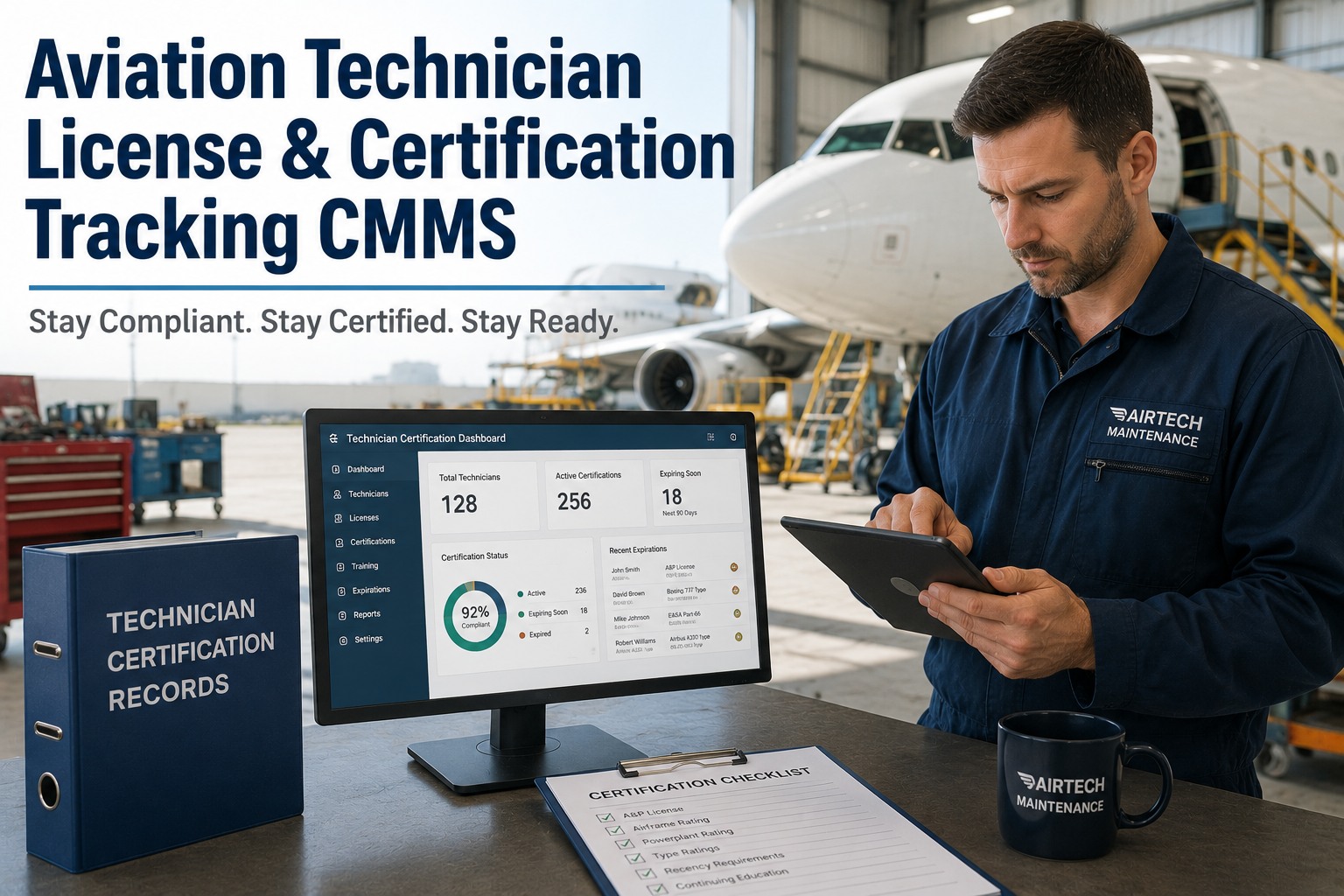
Yes. OxMaint maintains a live certification registry for every technician — including FAA A&P ratings, EASA Part 66 licence categories, type authorisations, and any custom qualification your operation requires. The platform generates automated alerts at configurable intervals before any certification expires, typically at 90, 60, and 30 days. It also enforces qualification controls at work order assignment: if a task requires a specific rating or authorisation, OxMaint will not allow assignment to an unqualified technician. For operations managing technicians across multiple bases, the certification dashboard gives directors a single view of qualification coverage across the entire workforce — identifying gaps before they become audit findings, shift coverage failures, or enforcement actions. To configure your certification registry from day one, start a free trial for 30 days or book a demo to see the qualification tracking module in detail.
How does OxMaint reduce the onboarding time for newly certificated A&P mechanics joining the operation?
The primary bottleneck for new AMT onboarding is not certification — it is operational familiarity: learning the specific equipment, local procedures, maintenance history, and facility-specific protocols that previously only came from months alongside a senior mentor. OxMaint eliminates that bottleneck by giving every technician immediate access to the complete maintenance history of every asset in the fleet, the structured SOP library for every routine and non-routine task, and guided work orders that walk them through each procedure step by step on their mobile device. New mechanics operate independently from day one with the same procedural support that previously required years of in-facility experience. Most operations using OxMaint report new AMT time-to-full-productivity dropping from 6 to 9 months down to under 60 days. To start building your SOP library and asset maintenance history immediately, start a free trial for 30 days or book a demo.
What workforce analytics does OxMaint provide for MRO staffing and planning decisions?
OxMaint's workforce analytics module gives maintenance directors and VP Operations teams the metrics that drive intelligent staffing decisions: work order completion rates by technician and shift, first-time fix rates at the individual level, average task duration vs. standard time per procedure type, overtime hours by period and site, repeat defect rates by technician and asset, and real-time shift coverage status across all bases. At the portfolio level, the dashboard identifies which sites are running lean, which shifts are structurally understaffed, and which technicians are carrying disproportionate workload — enabling proactive reallocation rather than reactive management. For CapEx planning, OxMaint's 5-to-10-year forecasting model incorporates workforce cost trends alongside asset maintenance requirements, giving ownership groups a complete picture of operational cost trajectory under different headcount scenarios. To explore the analytics module for your operation size and fleet, start a free trial for 30 days or book a demo with a product specialist.