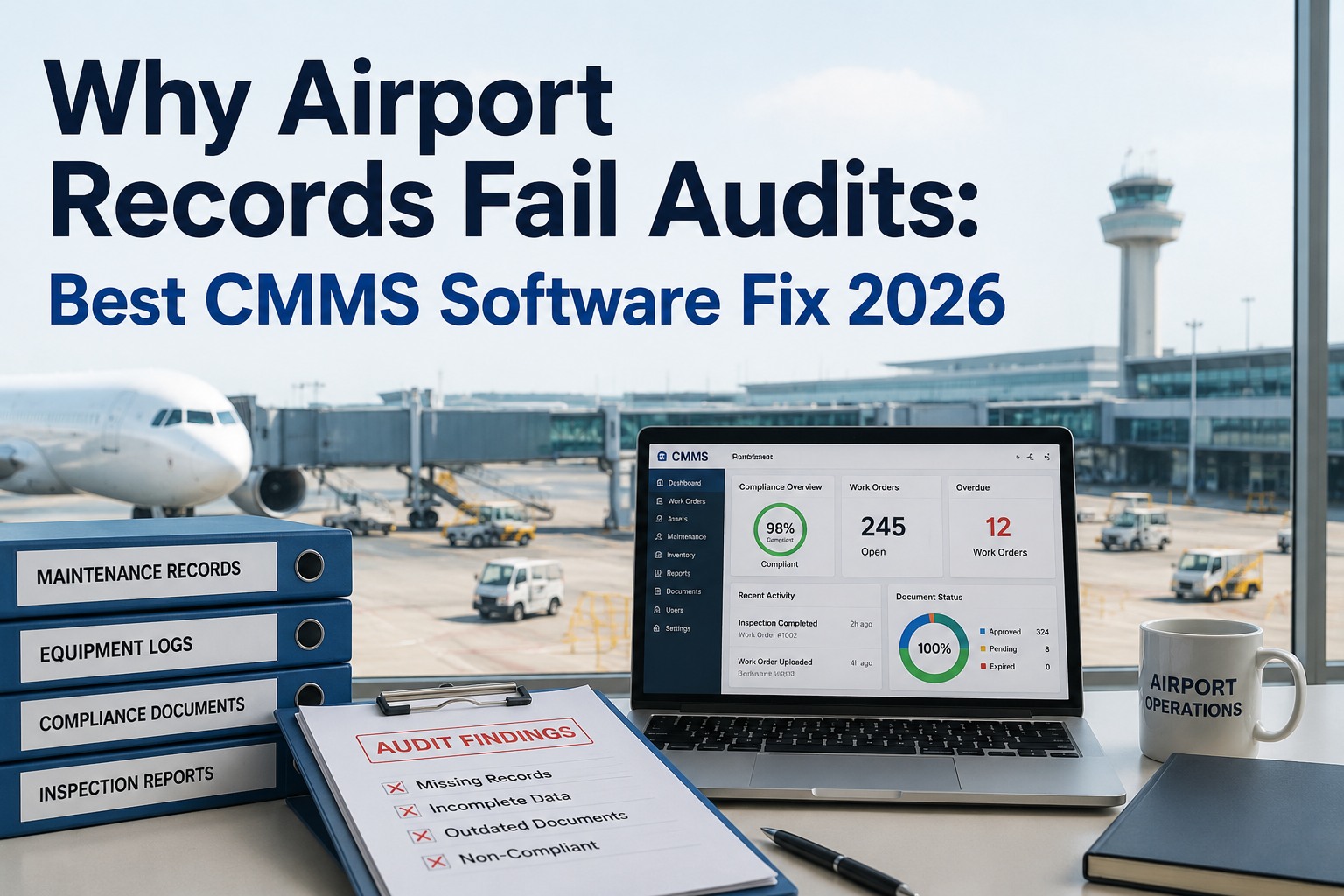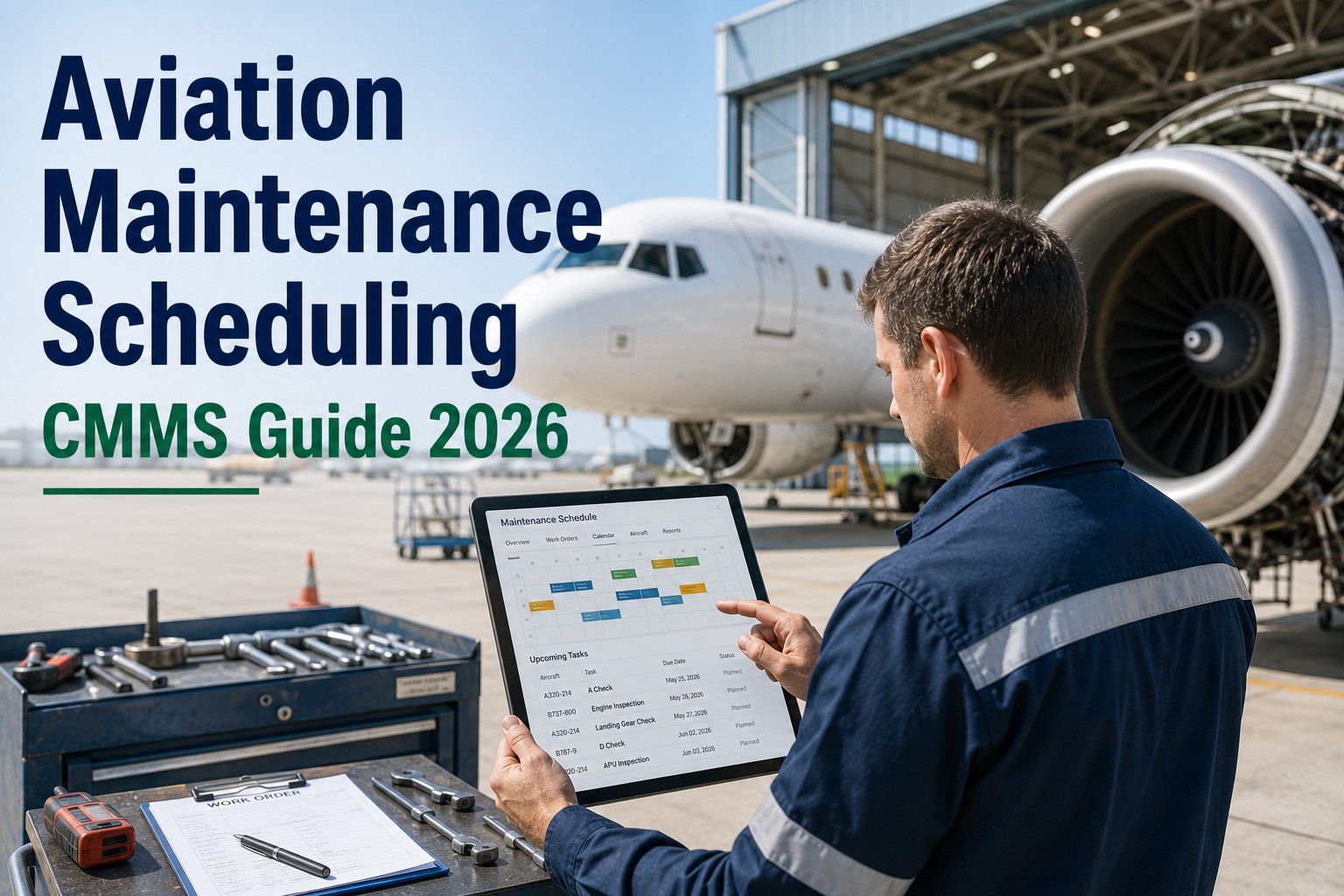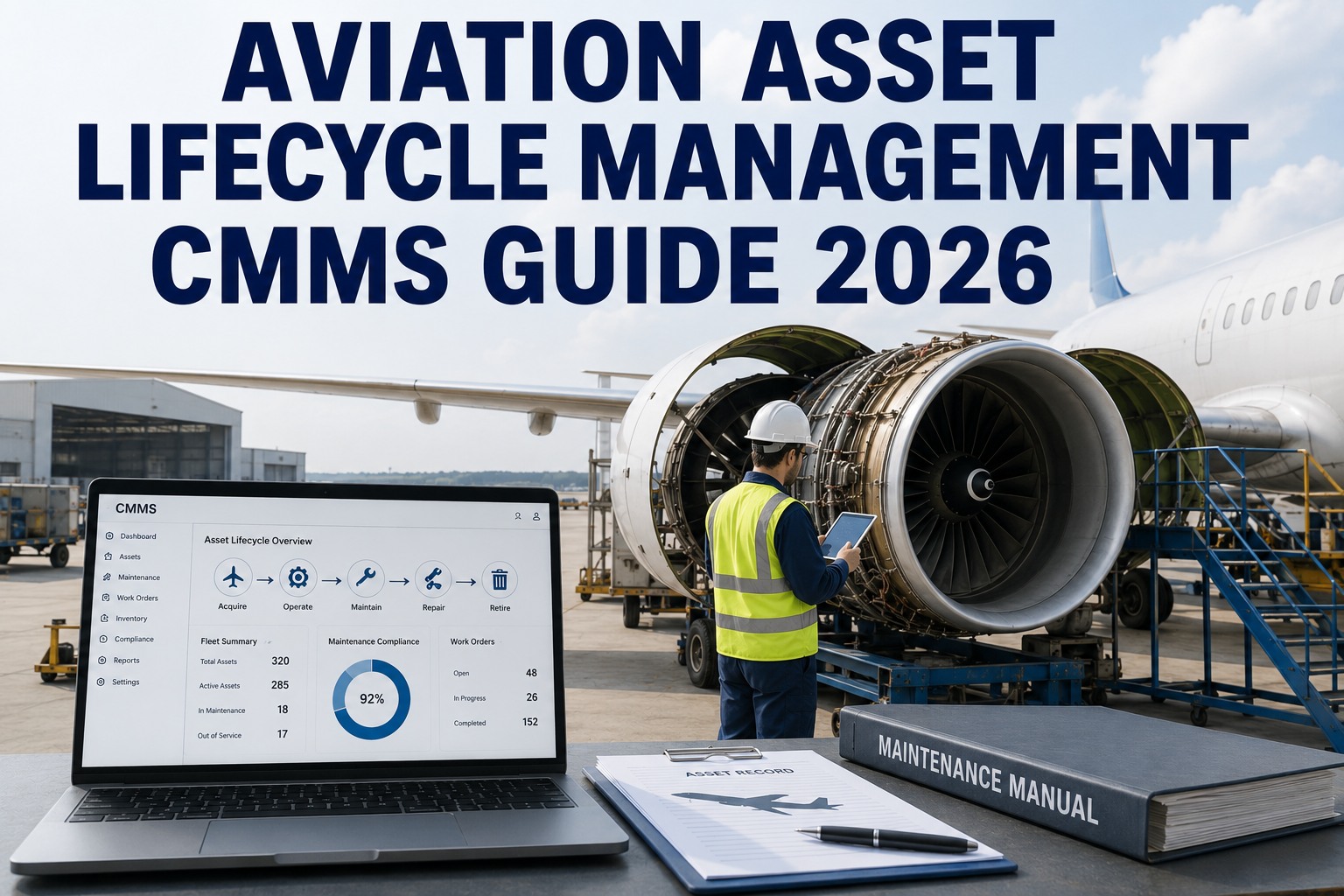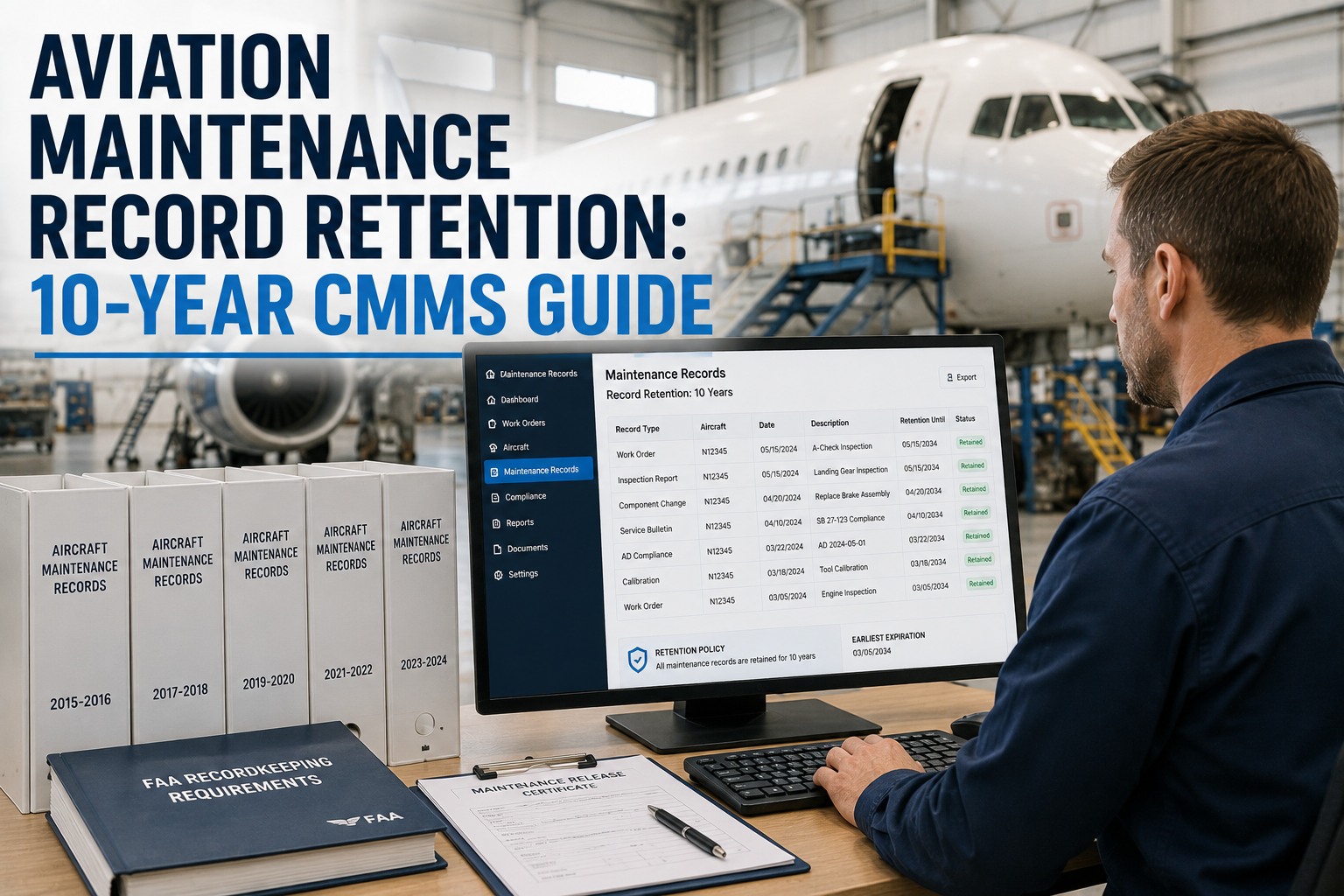
Aviation maintenance records aren't just paperwork — they're the legal spine of every aircraft's airworthiness, and losing them can ground a fleet overnight. FAA 14 CFR Part 91.417 and EASA Part-M.402 mandate that operators preserve maintenance records for the operational life of the aircraft, with major component and structural records retained far longer than a single ownership cycle. This 10-year CMMS guide breaks down exactly which records you must keep, for how long, in what format, and how a modern computerized maintenance management system turns regulatory burden into audit-ready infrastructure. If your current archive lives in shared drives and banker's boxes, it's time to Start Free Trial and see what permanent, tamper-evident retention actually looks like.
Can your maintenance records survive a 10-year regulator audit — and outlive the aircraft itself?
A single missing 337 form or incomplete work-order trail can trigger certificate suspension, lease-return penalties of $40,000–$120,000 per aircraft, and resale value erosion exceeding 8% of hull value. Build a CMMS retention program that holds up for the full life of the fleet.
What must be kept — and for how long
Aviation regulators don't apply a single clock to every document. Record classes carry distinct retention horizons, and a CMMS must let you configure each class independently so short-cycle items auto-expire while life-of-aircraft records lock permanently.
Aircraft logbooks & total-time records
Total time-in-service, airframe total cycles, and all major repair/alteration entries (FAA Form 337) must be retained for the operational life of the aircraft under 14 CFR 91.417 and EASA Part-M.402.
Major component & life-limited part records
Engine, APU, propeller, rotor, and landing-gear records — including life-limited-part tracking, AD compliance, and SB disposition — should be archived a minimum of 10 years after the part is removed from service.
Routine work orders & inspection checklists
Line maintenance work packages, 100-hour/annual inspection sign-offs, and pilot discrepancy logs are typically retained 3–5 years, but most operators configure 7 years in CMMS to absorb cross-border lease and insurance claims.
Tool calibration & NDT personnel certs
Calibration certificates for torque wrenches, NDT personnel qualifications, and special-tool traceability follow ISO 17025-style retention — 7 years is the defensible standard, longer for critical-fracture-critical programs.
Weight & balance, MEL dispatch records
Aircraft weight-and-balance revisions, equipment lists, and MEL dispatch/release records are retained a minimum of 5 years after the flight; CMMS tags these as auto-archivable with read-only lock on the 61st month.
AD / SB compliance evidence
Airworthiness Directive and Service Bulletin compliance records — including method of compliance, date, and signatory — are kept permanently in CMMS as immutable PDF bundles tied to the aircraft tail-number master record.
One archive policy doesn't fit every airspace
Operators flying across FAA, EASA, and CAA jurisdictions face overlapping — and sometimes conflicting — retention rules. The CMMS must let you stack jurisdictional requirements and enforce the longest applicable clock automatically.
| Record type | FAA (14 CFR) | EASA (Part-M) | CMMS recommended | Lock rule |
|---|---|---|---|---|
| Airframe total-time logbook | Life of aircraft | Life of aircraft | Permanent | Immutable, no edit |
| Engine / APU records | Life of component | Life of component | Permanent + 10 yr | Immutable + tamper-evident |
| Major repair / alteration (Form 337) | 1 yr + life of aircraft | Life of aircraft | Permanent | Immutable, dual sign-off |
| AD / SB compliance evidence | Life of aircraft | Life of aircraft | Permanent | Immutable, hash-sealed |
| Routine line-maintenance work order | 1 yr | 3 yr | 7 yr | Edit-lock at close |
| Inspection checklists (annual / 100-hr) | 1 yr | 3 yr | 7 yr | Edit-lock at close |
| Tool calibration certificates | Until superseded | 5 yr | 7 yr | Auto-expire + alert |
| MEL dispatch / release records | 3 mo | 3 yr | 5 yr | Auto-archive at 30 days |
| Pilot discrepancy & defect logs | 3 mo | 3 yr | 5 yr | Auto-archive at 30 days |
CMMS "recommended" column applies the longest of FAA, EASA, and common lease/insurance claim horizons. Lock rules govern whether records can be edited, or only annotated with a corrective entry.
How a 10-year record survives scrutiny
Retention only counts if the record is provably unaltered. Regulators will ask not just "do you have it?" but "prove it hasn't been touched since sign-off." A CMMS archive must combine write-once storage, cryptographic hashing, and a complete access log.
Record integrity = Write-once storage × SHA-256 hash seal × Append-only audit log × Time-stamped sign-off chain
If any single factor equals zero, the entire record fails audit. A PDF in a shared drive satisfies none of them.
Write-once object storage
Closed work orders export to immutable WORM storage — S3 Object Lock, Azure Immutable Blob, or equivalent. The file can be read infinite times but never overwritten, even by an administrator.
SHA-256 hash sealing
Every archived record receives a cryptographic hash stored separately from the file. Any byte-level alteration — even a metadata tweak — breaks the hash and immediately flags the record as compromised in the audit dashboard.
Append-only audit trail
Every read, export, annotation, and access attempt is logged with user ID, IP, timestamp, and action. The log itself is append-only, giving investigators a forensic chain stretching back to the original sign-off.
Jurisdiction-aware retention tags
Each record class carries a metadata tag — FAA, EASA, CAA, or lease-contract — that drives its retention clock and lock rule. Cross-border operators run the longest applicable window without manual intervention.
The real cost of a broken archive — and the fix
Consider a regional operator flying 24 turboprops across FAA and EASA airspace, generating roughly 14,000 maintenance documents per year. Their legacy archive — a mix of scanned PDFs on a file server and paper logbooks in three hangars — nearly failed a CAA audit.
Shared-drive + paper logbooks
- $48K annual audit-prep labor across 3 inspectors
- 11 days average retrieval time for a single tail-number record bundle
- 3 near-misses in 18 months — missing Form 337 entries discovered during lease return
- $95K lease-return penalty on one aircraft for incomplete AD compliance evidence
Immutable, hash-sealed retention
- $11K annual audit-prep labor — auditors self-serve via read-only portal
- 90 seconds retrieval time for any record, filtered by tail, date, or AD number
- Zero missing-record incidents in the 24 months since go-live
- $0 lease-return penalties across 6 aircraft transitions
From scattered files to audit-ready archive in 90 days
A defensible retention program isn't a software purchase — it's a configuration project. Here's the sequence that gets a mid-size operator from chaos to clean audit in one quarter.
Record-class inventory
Catalog every document type the fleet generates — logbooks, work orders, 337s, AD/SB evidence, calibrations, MEL releases — and map each to its FAA and EASA retention clock.
Jurisdiction stacking & policy config
In CMMS, configure retention policies per record class, applying the longest applicable jurisdictional window. Set lock rules — immutable for life-of-aircraft, edit-lock for routine, auto-expire for transient.
Legacy migration & hash-sealing
Bulk-import existing PDFs and scanned logbooks. Each file receives a SHA-256 hash at ingest; corrupted or incomplete files are flagged to a remediation queue before they enter the archive.
Sign-off chain & dual-auth
Wire inspector and mechanic sign-offs into the record lifecycle. Life-of-aircraft and major-repair records require dual authentication — mechanic plus inspector — before the lock engages.
Audit-portal & read-only access
Open a regulator-facing portal with filtered, read-only access by tail number, date range, or record class. Auditors self-serve; every query is logged to the append-only trail.
Drill, sign-off, go-live
Run a mock CAA audit — pull 50 random records across 5 aircraft, verify hash integrity, confirm retrieval under 2 minutes. Sign the compliance attestation and go live with the 10-year policy active.
Stop hoping your records survive — engineer them to.
Configure a 10-year immutable retention policy in OxMaint CMMS and walk into your next audit knowing every record is hash-sealed, time-stamped, and retrievable in under two minutes.
Aviation record retention, answered
Does the FAA really require records for the entire life of the aircraft?
Yes. Under 14 CFR 91.417, total-time records, major repair and alteration entries (Form 337), and all AD compliance evidence must be retained for the operational life of the aircraft — not a fixed number of years. When an aircraft changes ownership, these records transfer with it. A CMMS enforces this by marking those record classes as permanent and immutable, with no auto-expire clock.
Can I keep digital records instead of paper logbooks?
Both FAA and EASA accept electronic records if they meet integrity and accessibility standards — typically meaning write-once storage, audit trail, time-stamped sign-offs, and the ability to produce a readable copy on demand. Paper scans dumped into a shared folder do not qualify. To see what a compliant digital archive looks like, Start Free Trial and explore the retention policy builder.
What happens if a record is discovered missing during an audit?
A missing record triggers a formal finding, which can range from a corrective-action notice to certificate suspension depending on severity. For life-limited parts, missing traceability can ground the aircraft until the part is re-verified or replaced — a cost that can exceed $500K for an engine. CMMS mitigates this with gap-detection reports that flag missing entries before an auditor ever asks.
How does CMMS handle records when an aircraft is sold or leased out?
The CMMS generates a complete transfer bundle — every permanent record, all AD/SB compliance evidence, and the full audit trail — as a single hash-sealed package. The buyer or lessor receives read-only portal access, and your organization retains a permanent copy. Lease-return inspections typically drop from days to hours when the bundle is pre-assembled and self-verifying.
Is a 10-year retention window enough for every record type?
No — 10 years is the floor for major-component and structural records, not a universal standard. Airframe logbooks and AD compliance evidence are life-of-aircraft (effectively permanent). Routine work orders may be shorter. The safest configuration stacks all applicable jurisdictional rules and applies the longest. To map your specific fleet, Book a Demo with our aviation compliance team.
Build a records program that outlives the aircraft.
Join operators using OxMaint CMMS to configure jurisdiction-aware retention, immutable storage, and tamper-evident audit trails — all in a single platform built for aviation maintenance compliance.
Free 14-day trial · No credit card