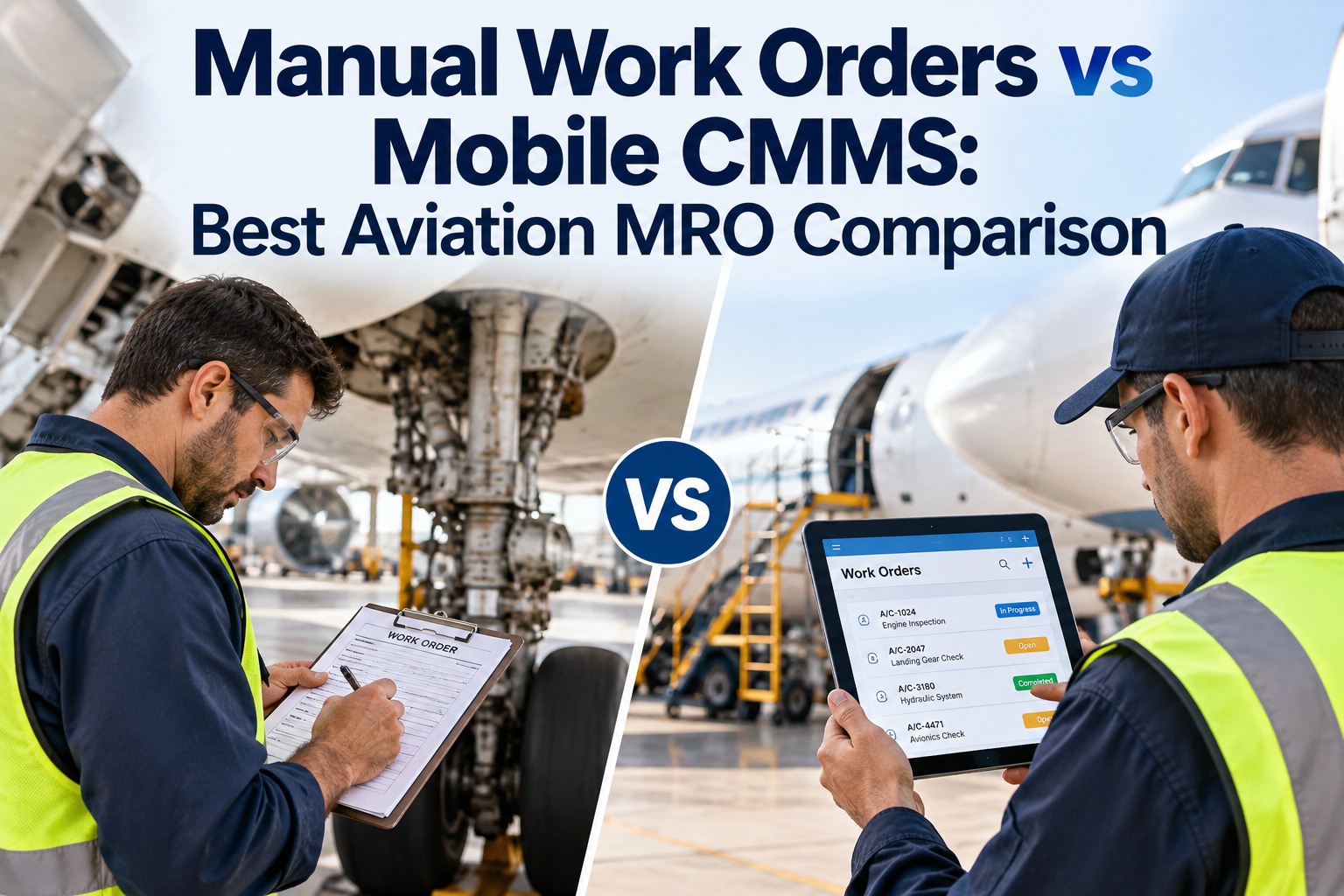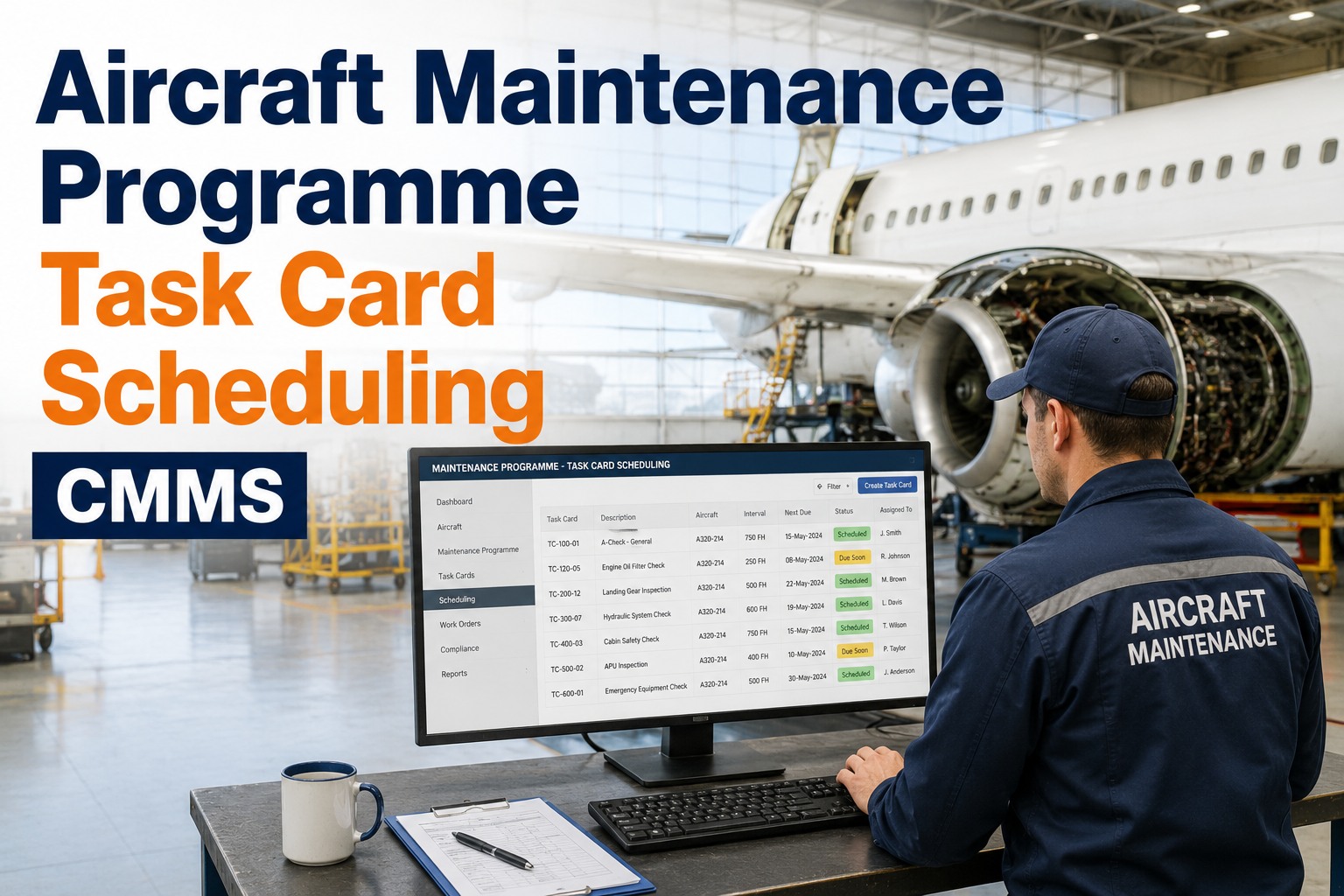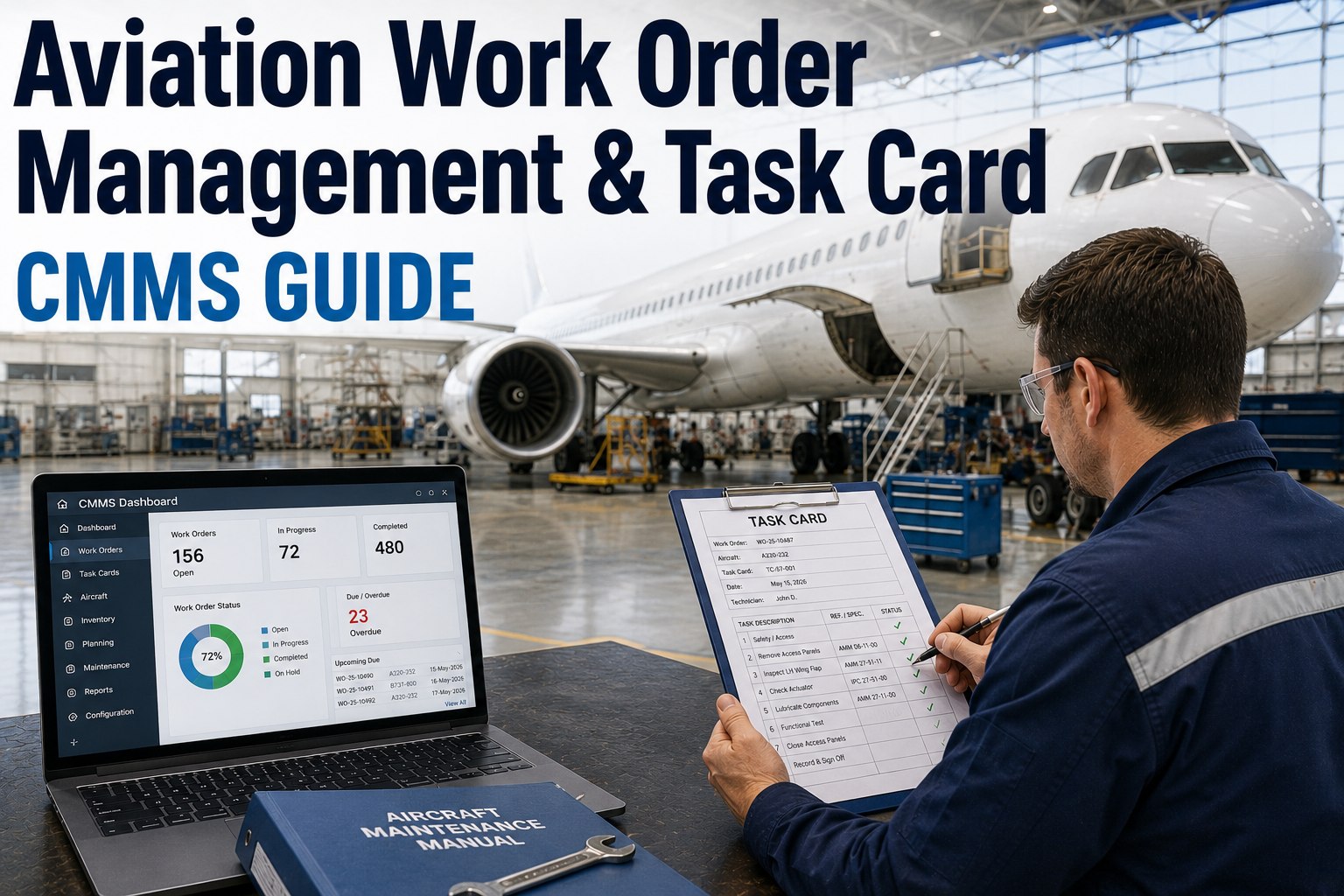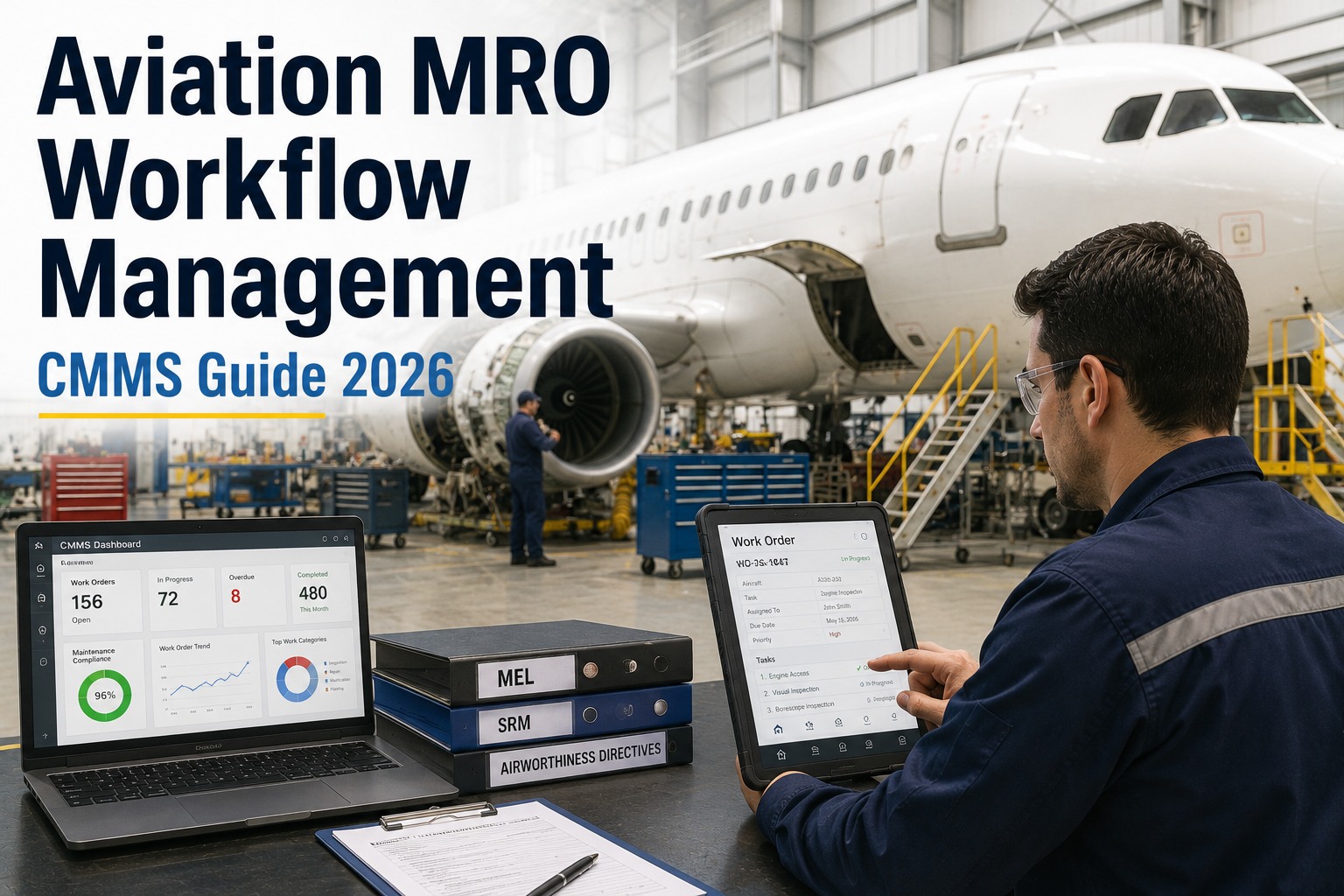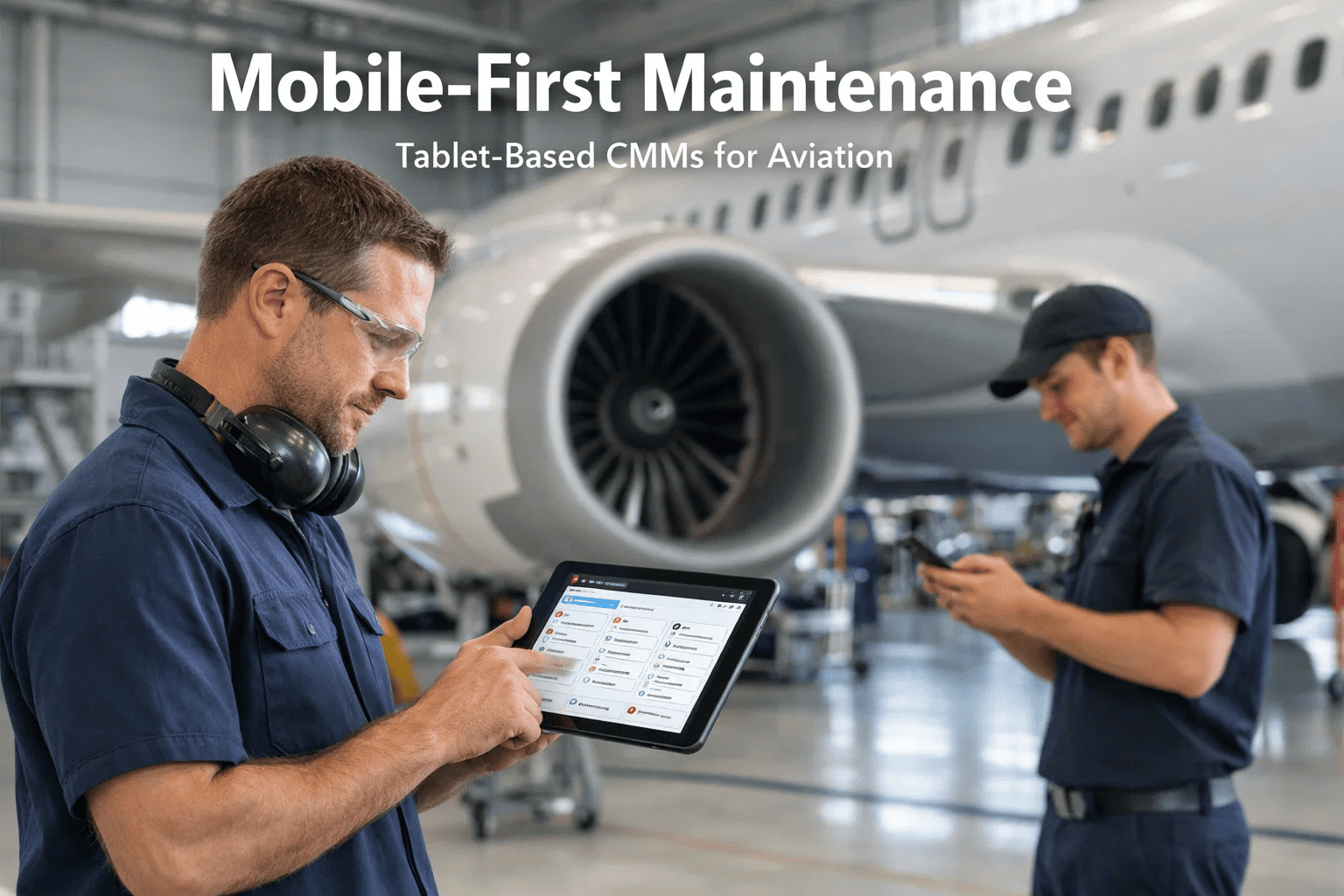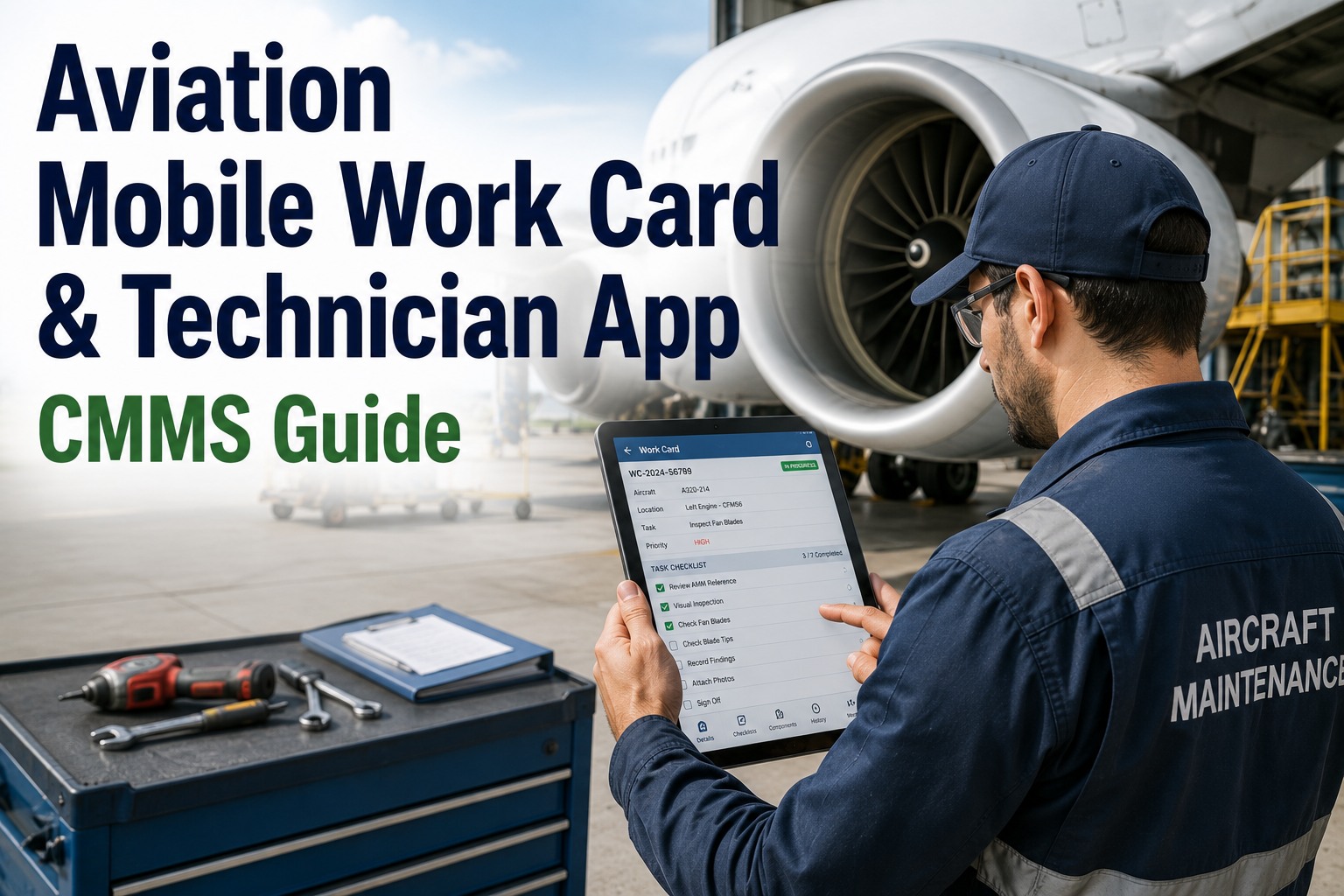
For line maintenance crews working turnarounds at the gate, every minute spent walking back to a workstation to print task cards or re-key defect notes is a minute of AOG risk. A mobile work card app puts authorized procedures, illustrated parts catalogues, e-signatures and photo evidence directly on the technician's tablet or phone — at the aircraft skin. For a mid-size MRO running 40 line technicians, replacing paper job cards with a CMMS-connected mobile workflow typically removes 18–25 minutes of administrative drag per shift and cuts sign-off errors by over half. This guide walks through the capability set that actually moves the needle on the ramp, in the hangar, and on the shop floor, and shows how to drive adoption past the initial rollout. If you want to skip ahead and pilot it on one station this month, you can Start Free Trial and be capturing sign-offs within a day.
What if every technician carried the entire task-card packet in their pocket — signed, synced, and audit-ready before they left the aircraft?
A mobile work card app collapses the gap between the mechanic's hands and the technical records system. No re-keying, no paper chasing, no authorization waits at the line station. Here is what a mobile-first CMMS delivers on the ramp, in the hangar, and at the shop floor — and the numbers that justify the rollout.
Six capabilities that define a production-grade mobile work card
Not every "aviation app" survives a turn at a remote stand in winter. The features below separate consumer-grade checklists from a Part-145-grade mobile CMMS that records inspectors actually trust at audit.
Offline-first capture
Task cards, defects and sign-offs work with zero connectivity at the gate or in a hangar dead-zone. A local queue syncs to the CMMS the moment Wi-Fi or cellular returns — no data loss, no duplicate entries.
FAA / EASA e-signature
Biometric or PIN-bound electronic signatures meet Part 145 and AC 120-78 expectations. Inspectors sign on the device at the aircraft, with a timestamped, tamper-evident audit trail.
Photo & video evidence
Annotate a cropped photo of a tyre wear indicator or a boroscope finding and attach it to the defect line item. Auditors see the evidence in context — no more digging through shared drives.
Manuals & IPC inline
Link the task card directly to the AMM, IPC and SRM references. The technician taps the step and the illustrated procedure renders beside it — no separate PDF hunt on a shared laptop.
Real-time parts & stock
See shelf-life, batch and serial availability before walking to stores. The app reserves the part against the work order on sign-off, so two technicians never pull the same rotable.
Two-way CMMS sync
Work orders, MEL items and deferred defects flow down to the device; completed sign-offs, measurements and parts consumed flow up in real time. Technical records see the packet close, not a paper chase.
Paper packet vs mobile work card — where the hours actually go
A paper-driven line station spends roughly 55 minutes per aircraft on documentation hand-offs. A mobile-first station gets that under 20. The table below shows the shift, task by task.
| Maintenance task | Paper work card | Mobile work card | Time saved |
|---|---|---|---|
| Task card packet retrieval & printing | 12 min | 0 min (pushed to device) | 12 min |
| Authorization / inspector wait | 18 min | 4 min (remote e-sign) | 14 min |
| Defect description & photo attach | 9 min | 3 min (in-app photo) | 6 min |
| Parts lookup & reservation | 8 min | 2 min (linked IPC + stock) | 6 min |
| Re-keying into CMMS / records | 8 min | 0 min (auto-sync) | 8 min |
| Total per aircraft | 55 min | 9 min | 46 min |
A regional operator with 18 ATR-72s running 4 turns per aircraft per day was burning 46 minutes of tech documentation per turn — roughly 55 hours of technician time daily, or $4,200/day in loaded labor. After deploying a mobile work card CMMS tied to their existing maintenance system, the same work closed in 9 minutes per turn. The 46-minute reclaim translated to $1.53M in annualized labor recovery and pushed first-flight-of-day readiness from 71% to 96%.
A 12-week path from paper to mobile-first adoption
Most aviation mobile deployments stall at week 6 because the rollout plan stops at "install the app." The timeline below is the sequence that gets a station past 80% adoption — the threshold where labor savings actually show on the P&L.
Scope & station selection
Pick one line station with a mix of transit checks and daily inspections — not the most complex base. Inventory the top 25 task cards used there and confirm the CMMS API can push them as JSON to the mobile app. Target: 25 cards live on devices by end of week 2.
Configure forms & offline rules
Map each task card to a mobile form: required fields, conditional steps, photo prompts, e-sign blocks. Define the offline sync window (typically 24 hours of cached task data) and test on the actual ramp hardware the technicians will carry — not a clean office tablet.
Pilot with 6–8 technicians
Run the app alongside paper for two weeks. Have the pilot crew flag every field that takes more than two taps. This is the make-or-break window — most adoption failures come from skipping this feedback loop and pushing a clunky form to the whole station.
Station-wide cutover
Retire paper for the scoped task cards at the pilot station. Stand up a 15-minute daily stand-up where the shift lead reviews any sync failures or pending e-signs. Target: 80% of scoped task cards completed on-device by end of week 9.
Measure, refine, replicate
Pull the metrics: avg. sign-off latency, defect-photo attachment rate, re-key incidents, sync-failure rate. Publish a one-page scorecard to the station. Once two consecutive weeks hit target, replicate the playbook at the next base.
What a mobile work card actually pays back
The savings from a mobile CMMS are not abstract — they are a function of time recovered per turn, technician loaded cost, and the error-rework delta. The formula and table below let you plug in your own numbers.
| Fleet profile | Minutes saved / turn | Annual labor recovered | Error-rework savings | Payback period |
|---|---|---|---|---|
| 10 aircraft, regional | 38 min | $420K | $95K | 3.4 months |
| 25 aircraft, narrow-body | 44 min | $1.18M | $310K | 2.1 months |
| 50 aircraft, mixed fleet | 46 min | $2.45M | $680K | 1.6 months |
Why most mobile work card rollouts stall — and how to push past 80%
Software does not deliver savings; adoption does. These are the four failure patterns we see at line stations and the specific counter-move for each.
"The form takes longer than paper"
When a mobile form mirrors a 6-page paper card field-for-field, technicians resent it. Fix: cut required fields to the regulatory minimum, make everything else optional, and use conditional logic so a routine transit check shows 12 fields, not 60.
"Sync failed, so we lost the sign-off"
A single lost sync destroys trust. Fix: a visible offline-queue indicator on the home screen, automatic retry every 90 seconds, and a hard rule that no completed card is ever deleted locally until the server acknowledges receipt.
"Inspectors won't sign on a phone"
Older inspectors often distrust e-signatures. Fix: bring the inspector into the form design in week 3, show them the AC 120-78 compliance documentation, and let them pilot on a non-revenue check first. Buy-in is contagious.
"Nobody uses it after week 4"
Without a visible scorecard, the app fades. Fix: publish a weekly station-level adoption metric (share of scoped task cards completed on-device) and tie shift-lead KPIs to it. What gets measured on the wall gets done on the ramp.
Put a pilot station live in under two weeks
Scope one line station, configure 25 task cards, and watch sign-off latency drop by half inside the first month. No rip-and-replace of your existing CMMS.
Mobile work card questions, answered straight
Does a mobile work card app work with no internet at the gate?
Yes — and this is the single most important capability for line maintenance. A production-grade aviation mobile CMMS caches the assigned task cards, AMM references and parts lists locally on the device for at least 24 hours. The technician completes the card, captures photos and signs offline; a local queue then syncs to the server the moment connectivity returns. No data is lost and no duplicate entries are created during the handshake.
Are e-signatures captured on a tablet legally compliant for Part 145?
When implemented correctly, yes. The app must bind each signature to a unique technician identity (PIN or biometric), record a UTC timestamp, and write the event to a tamper-evident audit log. This aligns with FAA AC 120-78 and EASA Part-145.A.50 expectations for electronic recordkeeping. Most operators also run a one-time validation with their CAMO before going station-wide. You can Book a Demo to see the audit trail format.
Can the app pull task cards from the CMMS we already run?
In most cases, yes — provided your CMMS exposes a REST or SOAP API for work orders and task card definitions. The mobile layer reads the card structure (steps, required tools, parts, sign-off blocks) and renders it as an interactive form on the device. Completed data flows back as structured JSON, eliminating the re-keying step that eats 6–10 minutes per aircraft on paper-driven stations.
How long does a typical pilot take to stand up?
A focused pilot at one line station with 25 scoped task cards typically takes 10–14 calendar days from kickoff to first live sign-off. The critical path is not the software — it is form configuration and inspector buy-in. Budget two weeks of parallel paper-plus-mobile running before retiring paper on the scoped cards, and expect to iterate on field layout at least twice based on technician feedback.
What hardware do technicians need on the ramp?
Most operators standardize on a ruggedized 8–10 inch Android or iPadOS tablet with an IP65 rating and a hot-swappable battery. Phones work for defect capture and MEL lookups, but the form factor gets fatiguing for full transit checks. Budget for a charging dock in the line office and a tethered stylus — the stylus alone cuts sign-off typos noticeably. The app itself is hardware-agnostic within those specs.
Stop re-keying sign-offs. Start reclaiming turns.
Spin up a mobile work card pilot on one station this month. Most operators see a 40%+ drop in documentation cycle time inside the first 30 days.
Free 14-day trial · No credit card