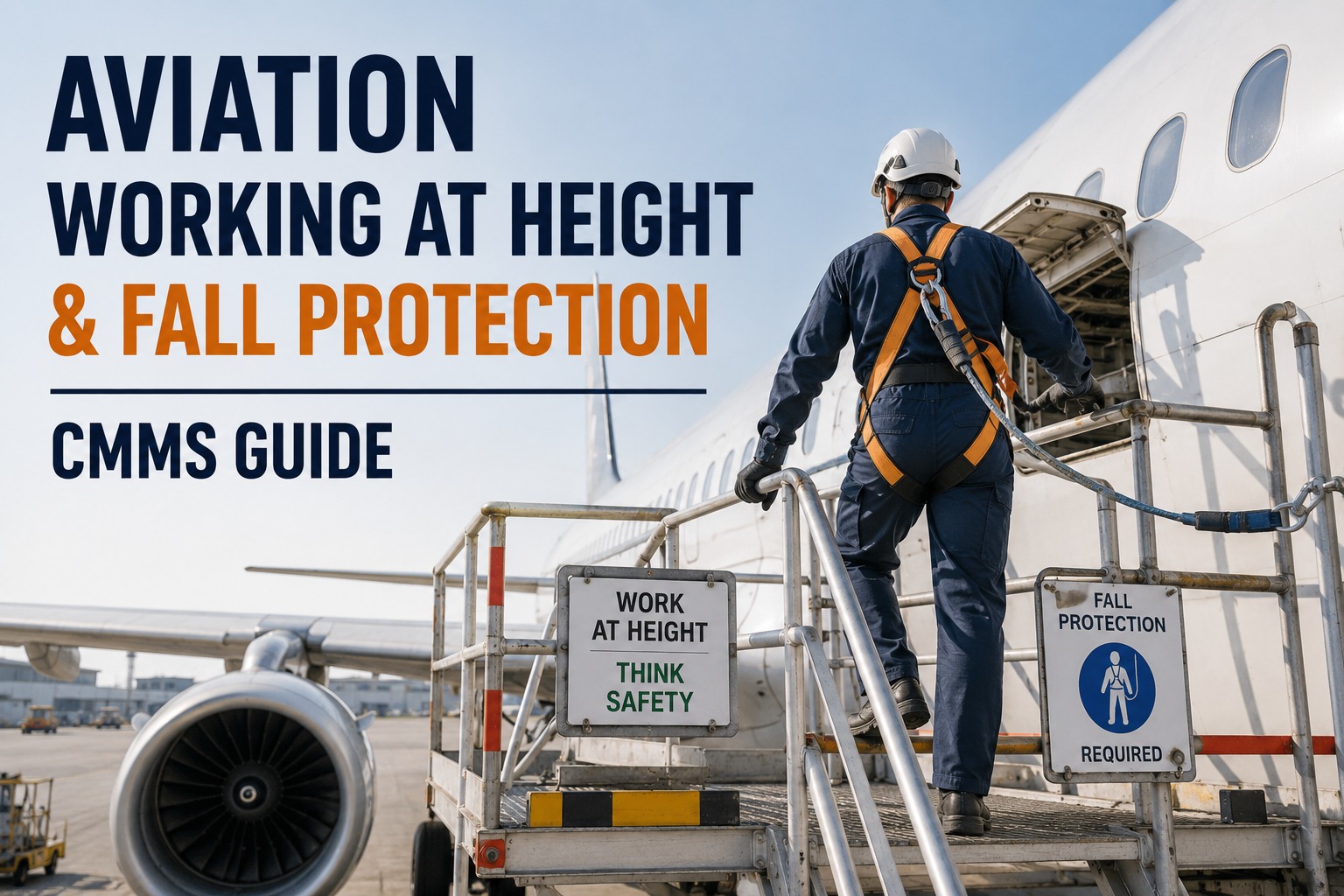
Working at height remains one of the most underestimated risk categories in aviation MRO, where technicians access aircraft tails, wing upper surfaces, engine pylons and hangar steelwork on a near-daily basis. Despite OSHA and EASA-aligned requirements for engineered anchor points, certified harnesses and documented rescue plans, many maintenance organisations still track fall protection equipment on spreadsheets or paper tags that fail the moment an auditor walks in. A purpose-built CMMS closes that gap by tying harness inspection cycles, anchor certifications and rescue drills directly to every work order. You can Start Free Trial to see how this works before your next audit window closes.
Is a fall from an aircraft tail really “just part of the job”?
Aviation MRO teams perform thousands of work-at-height tasks every year — tail inspections, wing-skin NDT, pylon access, hangar truss lighting. Yet fall protection compliance is still tracked on clipboards. The result: expired harnesses, uncertified anchors, and rescue plans that exist only in a binder.
Four access zones that drive fall incidents
Not every elevated task carries the same risk profile. Before you build a CMMS work-order rule, map the access zones in your hangar. Each one has a different anchor strategy, harness requirement and rescue window.
Tail & Vertical Stabiliser
Access heights reach 8–14 m on widebody tails. Without a certified dorsal anchor or tail-platform SRL, technicians free-climb the leading edge — the single highest-risk manoeuvre in hangar maintenance.
Wing Upper Surface
Sweep angles and wet or frost-coated skins make wing-walk slips the most frequent lost-time event. OSHA-classified leading-edge work demands a horizontal lifeline engineered to 5,000 lb per worker.
Engine Pylon & Cowling
Pylon stand work combines height, awkward posture and hot-section residual heat. Twin-leg lanyards with energy absorbers are mandatory; inspection cycles are frequently missed because stands move between bays.
Hangar Steelwork
Crane rails, truss lighting and overhead door tracks are accessed by mobile elevated platforms or fixed catwalks. Anchor recertification on structural steel is the most commonly lapsed item in MRO audits.
A compliant harness lifecycle, built into every work order
ANSI Z359.11 and OSHA 1926.502 require documented pre-use checks plus periodic competent-person inspections. A CMMS turns those paper checklists into time-stamped, audit-ready records — and locks out equipment the moment a cycle lapses.
Issue & register the harness
Each unit gets a unique asset ID, serial number, manufacturer date and assigned technician. The CMMS auto-creates the first inspection ticket and a QR label for the bag.
Pre-use check on mobile
Technician scans the QR code, completes a 12-point visual checklist (webbing, stitching, hardware, labels) on phone or tablet, and the record attaches automatically to the day's work order.
Periodic competent-person inspection
A qualified inspector performs the detailed Z359.11 exam. Findings — even minor wear flags — are logged with photos. A failed result quarantines the harness in the CMMS and blocks its ID from future work orders.
Retire and replace
Most harnesses carry a 5-year service life from first use. The system flags retirement 60 days out, auto-generates a purchase request, and schedules disposal with a chain-of-custody record.
What fall-protection non-compliance actually costs an MRO
Consider a mid-size MRO station with 180 active harnesses, 24 engineered anchors and 12 SRLs. When inspections live on paper, the station is almost certainly carrying hidden cost — and hidden risk — every single shift.
Hidden cost of paper-based tracking
A single serious fall injury pushes that figure past $1.2M in direct and indirect costs — before insurance impact or line downtime.
Recoverable & avoided cost
CMMS subscription cost: typically $4–6K/yr for this station. Payback lands inside the first quarter of deployment.
Engineered anchors, SRLs and rescue plans in one register
An anchor is only compliant if its certification is current and traceable. The CMMS keeps every fixed anchor, mobile anchor and self-retracting lifeline on a recertification clock — and surfaces overdue items on the maintenance dashboard before they reach a work order.
| Asset type | Standard | Recertify | CMMS trigger |
|---|---|---|---|
| Fixed roof anchor | ANSI Z359.6 | Annual | Auto work order 60 days prior |
| Horizontal lifeline (wing) | OSHA 1926.502 | Annual + after load event | Load-event flag + quarantine |
| Self-retracting lifeline | ANSI Z359.14 | Annual factory service | Shipping label + loaner pool |
| Engineered tail platform | EASA Part-145 / OSHA | Biennial | Two-stage sign-off workflow |
| Mobile elevating platform | ANSI A92.20 | Quarterly + annual | Coupled to operator licence expiry |
If a technician is suspended, minutes decide the outcome
Suspension trauma can render a conscious worker unconscious in 5–10 minutes. OSHA requires a prompt rescue plan for every work-at-height task — not a generic site plan, but one scoped to the specific aircraft and bay.
Detect & alert
Lone-worker alert or spotter call triggers the CMMS rescue workflow. Assigned rescue team paged automatically with bay, aircraft type and access route.
Reach & stabilise
Rescue kit (descent device, trauma strap) deployed from marked bay cabinet. CMMS records time-stamp at each step for post-event review.
Lower & hand off
Worker lowered to ground, assessed by on-site medic. If beyond 10 min, automatic escalation to external EMS per the site emergency plan.
We tied rescue drill completion to the CMMS the same way we tie calibrations. Every hangar work order now refuses to release until the assigned rescue plan is current for that bay and aircraft type.
Five CMMS rules that embed fall protection into every task
The difference between a spreadsheet and a CMMS is enforcement. These five configuration rules turn fall protection from a manual reminder into an automated gate that no technician — and no auditor — can bypass.
Mandatory harness ID on every height task
Any work order tagged “work at height” requires a valid, in-service harness asset ID before it can be opened. No ID, no task — the system blocks release.
Pre-use checklist gate
A 12-point pre-use inspection must be submitted from the technician's mobile device within 4 hours of shift start. The work order stays locked until the checklist passes.
Anchor-bay matching
The CMMS matches the work bay to its certified anchor inventory. If the anchor's recertification is expired, the bay is flagged and the task reroutes to an alternate stand.
Rescue plan currency check
Each work order validates that a bay-specific rescue plan is on file and that the last drill was within 90 days. Expired plans trigger an automatic drill work order.
Auto-retirement & quarantine
Any harness or SRL that fails inspection, passes its service life or records a load event is quarantined in the system — physically and digitally — pending disposal or factory service.
Audit packet in one click
When OSHA or EASA walks in, the safety manager exports a complete fall-protection audit packet — harness logs, anchor certs, drill records, corrective actions — as a single timestamped PDF.
Turn fall protection from a binder into a system
Deploy harness tracking, anchor certification and rescue-plan enforcement across every hangar work order in under 30 days.
Aviation working at height & CMMS fall protection
How often must aviation harnesses be inspected under ANSI Z359.11?
A pre-use visual check by the wearer is required before every shift, plus a documented competent-person inspection at least every six months. High-use environments — and any harness involved in a fall arrest event — require more frequent inspection. The CMMS schedules both cycles automatically and locks the harness ID out of future work orders if either lapses. You can Start Free Trial to configure these cycles for your fleet today.
Can a CMMS track fall protection for both fixed hangar anchors and mobile stands?
Yes. Fixed anchors, horizontal lifelines, mobile anchor weights, SRLs and engineered platforms are all registered as distinct asset types with their own recertification intervals. Mobile stands are tracked across bays, so an anchor moving with a stand carries its certification history wherever it goes — and the system flags overdue items before they reach a work order.
What happens if a harness fails inspection inside the CMMS?
The harness is digitally quarantined: its asset ID is blocked from any open or future work order, a disposal or factory-service ticket is auto-generated, and the physical unit is tagged out through the workflow. The failed inspection record — including photos and inspector notes — is retained permanently for audit traceability.
How does the system handle rescue plan requirements?
Every work-at-height work order validates that a bay- and aircraft-specific rescue plan is on file and that the assigned rescue team completed a drill within the past 90 days. If either condition is unmet, the work order cannot be released until a corrective drill is scheduled. To see a live rescue-plan workflow, Book a Demo with our team.
Is the fall protection data exportable for OSHA or EASA audits?
Yes. The CMMS compiles harness inspection logs, anchor certifications, SRL service records, rescue drill completions and corrective actions into a single timestamped audit packet. Safety managers export it as a PDF or CSV in one click, with digital signatures and chain-of-custody records preserved for every asset.
Make every hangar work order fall-protection compliant
Join MRO teams using CMMS to track harnesses, certify anchors and enforce rescue plans — without a single spreadsheet.
Free 14-day trial · No credit card