Shift changeovers account for less than 5% of total operational time. They also contribute to 40% of all plant incidents — a finding from Yokogawa research consistently confirmed in aviation maintenance data. In parallel, the FAA's Human Factors "Dirty Dozen" lists poor cross-shift communication as the number-one precursor to maintenance errors. At a US West Coast hub introducing rigorous equipment audits, 44% of ground support equipment failed inspection — and the primary failure mode was not mechanical. It was documentation. Faults seen by day shift never handed to night shift. Verbal briefings that never made it into the log. Deferred items scribbled on the back of a page nobody could locate on the morning after. This is what paper logbooks quietly do to airport operations: they leak the one piece of information — "what did the previous shift see" — that determines whether the next shift builds on progress or restarts the same problem. And from January 1, 2026, the FAA's amended Part 145 digital records mandate makes the record system itself subject to audit, not just the records it contains. Below is the working forensic of why paper logbooks fail airports, the specific failure modes at the physical/handover/audit levels, and the digital execution model that closes each one. Start free and replace the paper logbook on one shift this week, or book a demo to see the digital handover mapped to your shift structure.
Aviation · Shift Handover · FAA Part 145 Digital Records · 2026
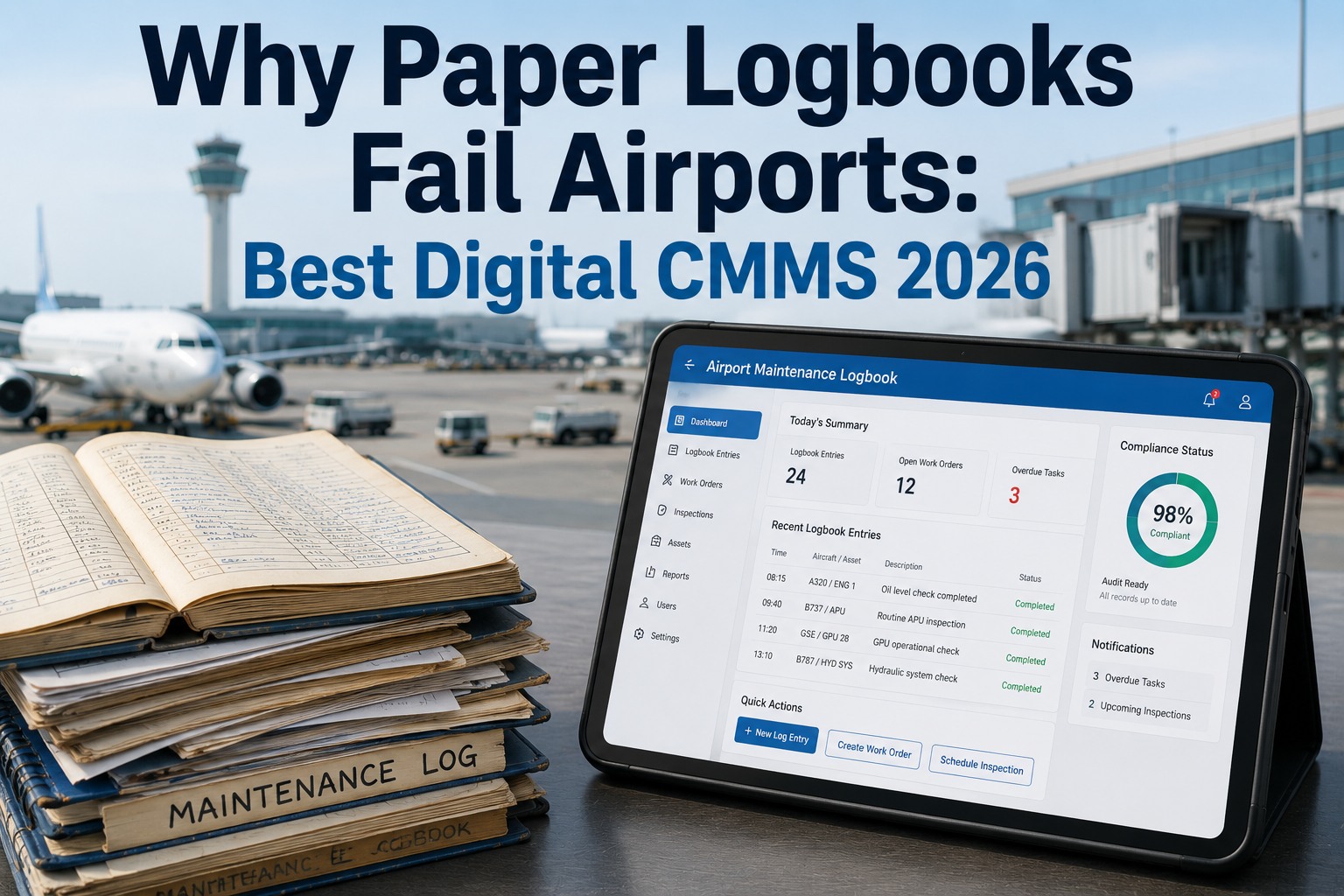
Why Paper Logbooks Fail Airports: Best Digital CMMS 2026
The 5% window that causes 40% of incidents, the seven failure modes paper logbooks share, and the digital handover model that turns shift transitions from an operational liability into an audit-ready evidence chain. Aligned to the FAA 2026 Part 145 digital records amendment and AC 120-78B.
-
5% / 40%
shift-change time / share of all incidents traced to it (Yokogawa)
-
#1
cross-shift communication — top FAA "Dirty Dozen" maintenance error cause
-
44%
of GSE at one US hub failed audit — from documentation gaps, not mechanical
-
Jan 1, 2026
FAA amended records mandate — the system itself is now subject to audit
The Structural Problem
The 5% Window That Produces 40% of Airport Incidents
Shift changeover is disproportionately dangerous because it is the moment operational knowledge lives entirely in one person's memory, then must transfer to another person's memory, via a medium — paper — that captures only what the outgoing tech chooses to write down and can be read. The mathematics are brutal: 5% of the operating clock produces 40% of the operational risk. This is the working shape of the problem.
The Seven Failure Modes
Every Paper Logbook Fails in the Same Seven Ways
Paper logbooks do not fail in exotic ways. They fail in seven predictable, well-documented modes — some physical, some organisational, some at the audit level. Every single one is closed by a properly implemented digital CMMS logbook. Below is the working forensic map, sorted by frequency.
- Physical
01 · Illegible Handwriting
Ramp entries written at 03:00 in gloves, in rain, on a moving vehicle. Incoming tech spends 10 minutes deciphering what the outgoing tech meant — and gets it wrong on the ambiguous cases.
- Physical
02 · Missing or Damaged Pages
Coffee spills, torn pages, moisture from the ramp. EASA identifies these physical weaknesses as threats to long-term maintenance data integrity. A missing page equals a missing record equals a compliance exposure.
- Handover
03 · Verbal-Only Handover
Outgoing tech tells incoming tech verbally about the deferred item; neither writes it. It exists only in short-term memory. Repeat fault two days later — no one remembers the original observation.
- Handover
04 · Incomplete Entries
"Checked ramp lights, some out" with no fixture number, no location, no photo. Incoming shift has to re-walk the ramp to find what "some" means. Time cost per handover: 15–30 minutes.
- Access
05 · One-Copy, One-Location
The logbook lives in the ops room. Maintenance control, planning, and the CAMO office cannot see the entry until someone walks over and looks. Cross-team visibility approaches zero.
- Audit
06 · Retrieval Time in Days, Not Seconds
Auditor asks for every entry against a specific asset over 12 months. Paper answer: several days of manual reassembly. FAA 2026 standard: retrievable in 30 seconds by aircraft registration, work order, and date range.
- Audit
07 · No Audit Trail on Edits
Erasures, whiteout, later-added notes. Paper cannot prove that a Tuesday entry was actually written on Tuesday. The 14 CFR Part 3 Subpart D falsification rule tightens exactly this exposure.
The New Compliance Bar
From January 1, 2026 — the Record System Itself Is Under Audit
The FAA's amended Part 145 digital records mandate is now in effect. Organisations with accurate digital records but an undocumented system in their Repair Station Manual are non-compliant from January 1, 2026. The bar is no longer whether records exist — it is whether the system producing them meets AC 120-78B for audit trail, access control, backup verification, and 30-second retrieval by aircraft registration, work order, or date range. Paper cannot meet that bar. A properly implemented digital CMMS logbook does — as a matter of configuration, not policy.
The Handover, Two Ways
Same Shift Change — Paper vs Digital, Side by Side
The clearest way to see the difference is to walk the same shift change both ways. Below is a real-world night-to-day handover on the airside operations team — the paper version, then the digital-CMMS version — showing exactly where the failure modes above manifest in practice.
Paper Logbook Handover · 06:00
- Outgoing tech finishes 04:00 apron walk, writes entry in log
- Ambiguous entry: "some ramp lights out south apron"
- Verbal add-on to incoming tech: "and check the fuel farm gate camera, sensor odd"
- Log physically stays in the ops room; maintenance planning cannot see it
- Incoming tech re-walks apron to figure out which lights, loses 20 min
- Fuel farm gate item forgotten by 09:00 — verbal item, never written
- Camera fails at 11:00 mid-shift; two hours of investigation reveals it was noted overnight
- Root cause on the incident report: "handover documentation gap"
Result: two known items became two production issues. The record of "what the previous shift saw" was incomplete, illegible, and un-retrievable — exactly the pattern producing 40% of shift-change incidents.
Digital CMMS Handover · 06:00
- Outgoing tech captures apron walk on mobile with GPS + photo
- Structured entry: fixture IDs L-27L-14, L-27L-15, L-27L-17 flagged; photo attached
- Fuel farm gate item logged as a work order with sensor reading, photo, priority
- Entries visible in real time to maintenance planning, CAMO, ops manager
- Incoming tech opens the handover screen; every open item, every deferred fault, every reading
- Route dispatched with the light-bar WO already scheduled for morning fix
- Fuel farm gate WO auto-escalated at 09:00 pre-expiry threshold — action taken before failure
- Camera stays operational; both items closed with per-user sign-off by 10:00
Result: two known items became two closed work orders inside four hours. The handover became an evidence chain — searchable, timestamped, and defensible against the FAA 2026 records standard.
Buyers-Guide Criteria
Eight Standards Any 2026 Digital Logbook CMMS Must Meet
A digital logbook that is worse than the paper version is not rare. Slow devices, clumsy forms, confusing access rights — engineers lose faith fast. The format matters less than how well it performs in real line conditions. This is the working buyers-guide checklist for evaluating any 2026 digital logbook against airport-grade requirements.
| # | Criterion | Standard | Why It Matters |
|---|---|---|---|
| 1 | Server-set timestamps | Client clock never trusted | 14 CFR Part 3 Subpart D falsification rule |
| 2 | 30-second retrieval | By asset, WO, or date range | FAA 2026 digital records standard |
| 3 | Per-user authentication | Biometric or SSO, bound to device | AC 120-78B access control |
| 4 | Immutable audit trail | Every edit / override with reason | Silent edits impossible |
| 5 | Photo evidence in-app | EXIF timestamp + GPS baked in | Ambiguous entries eliminated |
| 6 | Offline sync integrity | Preserves original capture time | Ramp dead zones supported |
| 7 | Handover screen | Every open item at shift change | The 5% window that produces 40% of incidents |
| 8 | RSM system documentation | System documented in Repair Station Manual | Non-compliance from Jan 1, 2026 without it |
Built for Airports
How Oxmaint Runs the Digital Logbook End to End
-
Handover Screen
Every Open Item Visible to the Incoming Shift
A single screen at shift change shows every open work order, deferred fault, in-progress inspection, and outstanding NOTAM — with priority, owner, and last-touched timestamp. The 5% window loses its incident-density advantage.
-
Structured Entry
Mandatory Fields, In-App Photo, Server Timestamp
No "some lights out" entries possible. Fixture IDs from the asset register, mandatory photo capture on high-risk faults, server-set timestamps that cannot be back-dated. Illegibility becomes a paper problem, not a digital one.
-
Cross-Team Visibility
One Record, All Roles, Real Time
Maintenance control, planning, CAMO, and Ops Manager all see the same entry the moment it is created — with permissions appropriate to their role. Not one copy in the ops room; a single source of truth across the operation.
-
30-Second Retrieval
Filter by Asset, WO, or Date Range
FAA 2026 digital records standard met by configuration. Full history against any asset, any work order, or any date range produced in under 30 seconds. The auditor visit becomes a filter query.
-
Immutable Audit Log
Every Edit, Override, and Reopen Recorded
Full before/after audit trail per record with user, timestamp, and required reason. Silent edits — the primary paper-logbook integrity failure — are impossible. Directly addresses the 14 CFR Part 3 Subpart D falsification rule.
-
RSM-Documented
System Documented Ready for Part 145 Audit
Complete system documentation package ready to drop into the Repair Station Manual — audit trail, access control, backup verification, retention configuration. The Jan 1, 2026 non-compliance risk closes at implementation.
Measured Outcomes
What Airports Gain Retiring the Paper Logbook
-
-40%
Shift-Change Incident Rate
The 5% time window that used to produce 40% of incidents becomes structurally addressed by the handover screen and mandatory entry standards.
-
30 sec
Records Retrieval by Asset / WO / Date
FAA 2026 digital records standard met by configuration. Full history for any asset produced in the time it takes to type the filter.
-
0
Verbal-Only Handover Items
Structured mandatory fields make "I meant to tell you about" a physical impossibility. Every item exists on the handover screen or it does not exist.
-
$0
Free Forever Plan to Start
Airport ops teams start on the free plan, retire the paper log on one shift, and scale to 24/7 rollout when the operational and audit gains are proven.
Frequently Asked
Digital Logbook Questions
Are digital maintenance records legally acceptable for aviation?
Yes. Digital maintenance records are authorised under 14 CFR Part 43 and Advisory Circular AC 120-78B, and the FAA's 2026 Part 145 Digital Records Amendment now accepts electronic records without requiring a paper backup. Required capabilities include audit trails, electronic signatures, access controls, and secure backup — all standard features in an airport-ready digital CMMS. Start free and stand up an AC 120-78B compliant logbook this week.
What changed on January 1, 2026 for airport digital records?
The record system itself became subject to audit, not just the records it contains. Organisations with accurate digital records but an undocumented system in their Repair Station Manual are non-compliant from Jan 1, 2026. The bar is now audit trail, access control, backup verified, retention configured — with retrieval in under 30 seconds by aircraft registration, work order number, or date range.
Is a "bad" digital logbook worse than a "good" paper logbook?
Yes. Slow devices, clumsy form design, and confusing access rights make engineers lose faith fast — and a logbook the crew avoids using is worse than paper. The format matters less than how well it performs in real line conditions. That is why buyers-guide evaluation matters: fast entry, mobile-first, offline-capable, and a handover screen that actually gets used. Book a demo to test the digital logbook in your line conditions.
How long does a paper-to-digital migration typically take?
On a modern platform, one shift can be running the digital logbook within a week — the free plan is enough to prove out the handover screen, structured entry, and 30-second retrieval on one team. Full 24/7 airport-wide rollout typically runs 4–8 weeks, with historical paper records digitised progressively rather than as a big-bang migration.
Is there a free plan to retire the paper log on one shift first?
Yes. Oxmaint offers a free forever plan — enough to run the digital logbook for one shift, prove the handover-screen gain, and scale to full airport-wide rollout when ready. Historical paper records can be attached to the digital record as scanned PDFs during transition. Sign up for the free plan and retire tonight's paper log.
Handover · Structured · Timestamped · Retrievable
The Paper Logbook Is the Airport's Single Biggest Reliability Leak
Five percent of the operating clock. Forty percent of the incidents. Number one on the FAA "Dirty Dozen." And from Jan 1, 2026, the record system itself is under audit. Oxmaint replaces the paper log with a digital handover chain that is structured, timestamped, per-user signed, cross-team visible, and retrievable in under 30 seconds — so every shift builds on the last one instead of restarting the same problem, and the next FAA visit finds the record already ready.