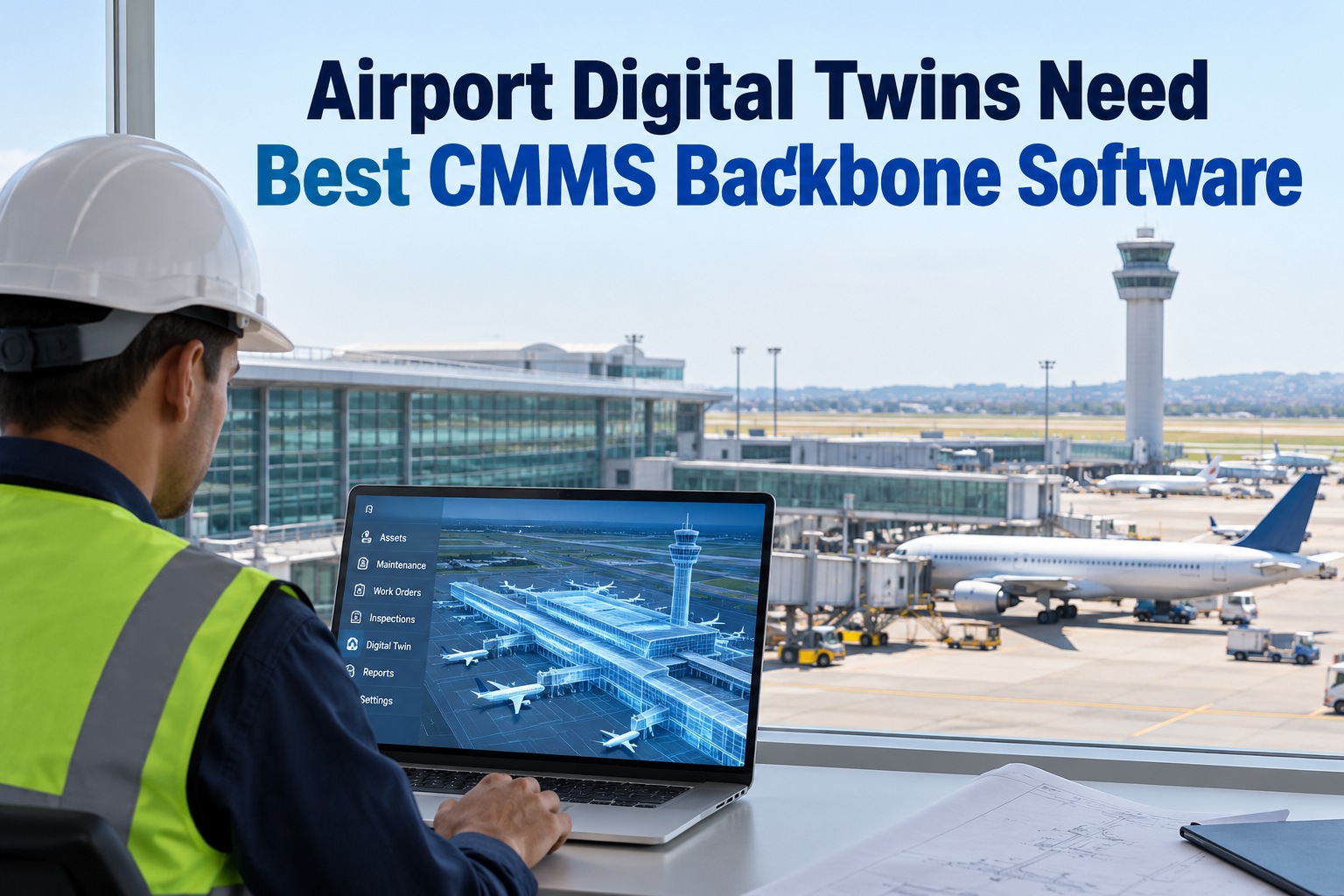
Airport Digital Twins Need Best CMMS Backbone Software

By William Jerry on September 7, 2026

airport-digital-twins-need-best-cmms-backbone-software

An airport digital twin is a spectacular thing to demo — a live 3D model of terminals, runways, jet bridges, and baggage systems, pulsing with real-time sensor data. It's also where a lot of expensive programs quietly stall, because a twin that predicts a failure nobody acts on isn't a business tool — it's a data science experiment with a nice interface. The prediction only becomes value when it turns into a work order, an assigned technician, a checked parts bin, and a tracked completion. That's the CMMS's job, and it's why roughly 37% of airports — sitting on twins and BIM models — never see the ROI: there's no operational backbone underneath. This guide covers what that backbone has to do, and how to evaluate the twin-plus-CMMS stack for 2026.

Aviation · Airport Operations · Digital Twin + CMMS · 2026 Buyer's Guide

Airport Digital Twins Need a CMMS Backbone — Or They're Just Expensive Dashboards

The 3D model and the sensor feeds are the visible half. The half that decides whether the twin actually cuts downtime is the CMMS underneath — the system that converts a prediction into a completed repair and feeds the result back to make the next prediction sharper. Here's how to build and evaluate that backbone.

37%
of airports lack integration between BIM, CMMS, and operational systems — the gap where twins stall

$260/min
average cost of unplanned downtime — far higher when a jet bridge or baggage line cascades into delays

The Uncomfortable Truth About Twins

Real-time monitoring without real-time action is just expensive dashboards. A digital twin generates predictions and simulations, but a prediction with no operational pathway is a data point, not a decision. Without a modern CMMS capturing structured asset data, work-order history, and condition-based triggers, a twin platform has no foundation to build on — and no way to close the loop that makes it smarter over time. The twin sees the future; the CMMS is what lets you change it. That order matters. Sign up free — no credit card and put the operational backbone in place before layering the twin on top.

The Twin Stack: Five Layers, One Backbone

A working airport twin is a layered system, and the CMMS sits at the load-bearing center — every layer above it depends on it to turn insight into action, and every completed action feeds the layers below. Miss the backbone and the top layers float free. Schedule a 30-minute demo to see the full stack running on airport assets.

Layer 5 · Simulation
What-if scenarios — baggage-flow changes, gate reassignments, capacity plans — tested virtually before touching live operations.
Layer 4 · Predictive AI
ML models forecast remaining useful life and flag anomalies from live and historical data — surfacing the failure before it happens.
Layer 3 · IoT Telemetry
Vibration, temperature, current draw, and health sensors stream continuously via OPC-UA, MQTT, BACnet, and Modbus.
Layer 2 · BIM / Asset Registry
The 3D spatial model and asset inventory — every gate, belt, bridge, and chiller with full geometry and specs.
Layer 1 · CMMS Backbone
The operating system: asset hierarchy, work orders, PM automation, parts, and the closed-loop record every layer above depends on.
The Closed Loop That Makes a Twin Worth Owning
1
Sense
IoT streams live asset condition
→
2
Predict
AI flags the emerging failure
→
3
Act
CMMS auto-creates the work order
→
4
Learn
Outcome feeds back, sharpening the model
Break the loop at step 3 — no CMMS to act — and steps 1, 2, and 4 produce nothing but charts.

The Twin Predicted the Baggage Motor Failure. Nobody Owned the Next Step.

The model flagged the bearing three weeks out — and the alert landed in a dashboard nobody had authority to action. The belt motor failed at 6 AM during peak departures: three-hour emergency repair, twelve delayed flights, and a prediction that had been right and useless. OxMaint closes the loop: a twin anomaly becomes a work order automatically — asset identified, failure mode predicted, parts recommended, priority set by operational impact, technician assigned. Detection to correction in one system.

What the CMMS Backbone Has to Deliver

Score any 2026 twin-plus-CMMS stack against these. Each is a place the program either becomes a reliability discipline or reverts to a break-fix culture with a fancier screen. Create your free account and test them against your own airport's asset mix.

Asset Hierarchy Mapped to the Real Operation
Every gate, baggage belt, jet bridge, chiller, and runway section modeled with lifecycle cost and failure history — the structure the twin and PM logic both build on.
PM & Inspection Automation
PMs triggered by meter readings, flight cycles, or condition — not just the calendar — pushing PM compliance toward the 90%+ that separates systematic airports from reactive ones.
Mobile Technician Execution
Work orders, asset history, and sign-offs on a device anywhere on airport property — airside to terminal — so the loop closes at the asset, not back at a desk.
Open IoT Integration
Connects to virtually any BMS or IoT platform through OPC-UA, MQTT, BACnet, Modbus, and REST APIs — the twin's telemetry has somewhere to land and act.
Prediction-to-Work-Order Automation
A flagged anomaly becomes an assigned, prioritized work order with recommended parts — the step that turns the twin from monitoring into maintenance.
Reporting That Drives Decisions
Downtime, maintenance cost, and MTBF tracked against baseline, so validated ROI on one asset category becomes the business case for the next five.

Why You Build the Backbone First

The airports that succeed don't start with the twin — they start with the CMMS and layer the twin on a foundation that already works. The foundation phase pays for itself long before a single predictive algorithm goes live, which is what funds the rest of the roadmap. Schedule a live walkthrough to map the sequence for your airport.

Phase 1 · Foundation
Deploy the CMMS: build the asset hierarchy, digitize work orders, automate PM. Eliminate paper logbooks and spreadsheet PM calendars. Most airports see measurable ROI this quarter — before any IoT.
Phase 2 · Connect
Wire IoT sensors on the top critical systems — jet bridges, baggage, HVAC, GSE — into the CMMS. Replace calendar PMs with condition-based triggers on those assets.
Phase 3 · Predict
Layer ML models on the accumulated sensor and work-order data, and route predictions into CMMS scheduling — shifting from "maintain when due" to "maintain when needed."
Phase 4 · Simulate & Scale
Add simulation and what-if planning, and expand across domains and asset categories sequentially — each proven category funding the next, rather than a big-bang rollout that overwhelms the team.

Put the CMMS backbone in first, connect the IoT to a system that can act, and the twin becomes a reliability engine instead of a visualization — cutting unplanned downtime and scaling as operations grow. Sign up free or schedule a demo to see it on your operation.

"

We chased the digital twin first — the 3D model looked incredible in the boardroom and changed nothing on the ramp, because predictions landed in a dashboard with no line to a work order. When we flipped it and stood up OxMaint as the backbone, the twin finally had somewhere to act: a flagged jet-bridge anomaly now opens a prioritized work order with the parts already recommended, and the completion feeds back into the model. Our first-quarter downtime numbers moved before we'd even switched on the predictive layer. The twin got the applause; the CMMS got the results.

Director of Facilities & Maintenance · International Hub Airport

Frequently Asked Questions

Do we need a CMMS before implementing a digital twin?
Yes — it's the essential foundation. The twin generates predictions and simulations, but without a CMMS to turn them into work orders, technician assignments, and documented actions, the predictions have no operational pathway.
Does a digital twin replace our existing systems?
No. A twin integrates with what you already run — CMMS, BMS, SCADA, ERP — through APIs and standard protocols, creating a unified view without ripping out current workflows.
What's the minimum we need to start?
A CMMS with a real asset hierarchy, plus BIM models or CAD drawings. Added value comes from connecting maintenance history and IoT sensor data — most airports already have enough to begin.
Which IoT protocols does the backbone need to support?
Open standards — OPC-UA, MQTT, BACnet, Modbus, and REST APIs — so telemetry from jet bridges, baggage systems, HVAC, and GSE flows into a system that can act on it.
How fast do airports see results?
The CMMS foundation phase — asset hierarchy, work-order digitization, PM automation — typically runs 60–90 days, and most airports see measurable ROI within the first quarter, well before IoT or predictive layers go live.
Won't a twin overwhelm our team if we deploy everything at once?
That's why sequencing matters — build the backbone, connect a few critical systems, then add prediction and simulation. Each proven asset category funds the next. Sign up free to start with the foundation.

Give Your Airport Twin the Backbone That Turns Predictions Into Results.

OxMaint is the operating system airports run underneath the twin — asset hierarchies mapped to the real operation, PM and inspection automation, mobile technician execution, open IoT integration, and reporting that turns maintenance data into decisions. Build the backbone first, and the twin stops being a dashboard and starts cutting downtime.
Share This Story, Choose Your Platform!