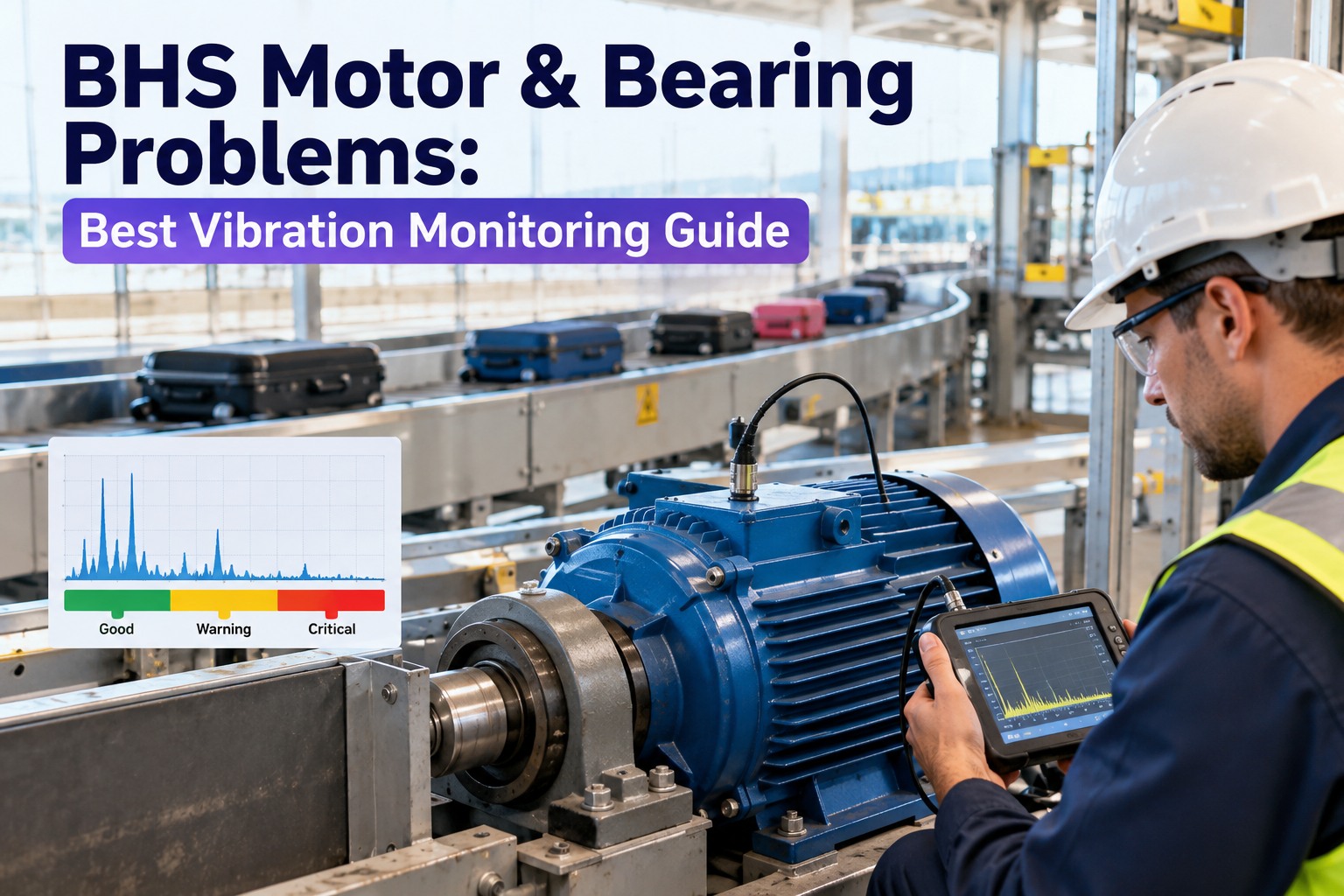
When a baggage handling system (BHS) slows down at peak hour, the cause is often small and hidden: a bearing running rough on a conveyor drive, a motor with a lubrication problem, a gearbox that has been getting louder for weeks. BHS equipment runs long hours with little spare time for repairs, so a bearing that fails mid-shift means diverted bags, manual handling and stressed teams. Vibration monitoring gives you the early warning — but only if the readings lead to action. This guide explains how to read BHS motor and bearing vibration, set practical alarm bands, and use OXMAINT AI, the AI-powered CMMS, to trigger lubrication and replacement PMs automatically.
BHS Motor & Bearing Problems: Best Vibration Monitoring Guide
Vibration readings in a handheld, lubrication notes on paper and breakdowns reported by phone — so a failing BHS bearing is easy to miss and slow to fix. OXMAINT AI links the workflow in one maintenance platform: route readings and inspections raise issues, alarms become work orders, and lubrication and replacement PM schedules keep motors and bearings on a planned footing.
How a Bearing Fails: The Four-Stage Warning Window
Bearings rarely fail without notice. They give signals in a typical order, and each technique catches a different stage. The earlier you detect, the more options you have. Book a demo to schedule the right checks for each stage.
Alarm Bands: Keep Them Simple and Local
ISO 10816 is widely used to judge overall vibration severity in four zones, and it has since been succeeded by ISO 20816. Exact limits depend on machine class, power and mounting, and many smaller BHS motors fall outside the standard's scope. So most sites use the zones as a model and set their own limits from baselines. Start free and store baselines and alarm limits per asset.
What the Spectrum Is Telling You
A Reading Nobody Acts On Is Just a Number.
The value of vibration monitoring is the work order that follows it. Keep every reading, alarm, photo and repair against the motor, and your team can tell the difference between a bearing to replace today and one to watch.
Let the Alarm Trigger the Right Work
| Trigger | Automatic response | Outcome recorded |
|---|---|---|
| Zone C reached on a motor | Inspection work order; shorten reading interval | Findings, photos, updated trend |
| Bearing tones in envelope data | Replacement PM planned for next window; parts reserved | Part used, hours, root cause |
| High-frequency noise rising | Lubrication task and ultrasound check | Grease type and amount logged |
| Zone D or sudden jump | Priority work order and escalation | Stop decision and repair record |
| Hours or cycles threshold | Routine lubrication and inspection PM | Completion and condition notes |
Build a Smart BHS Vibration Route
Frequently Asked Questions
Keep Bags Moving by Fixing Bearings on Your Schedule.
Connect vibration routes, alarms, lubrication and replacement PMs in one platform with OXMAINT AI. Try it free, or book a demo and see it on your own BHS motors and drives.