3D Printing for Airport Spare Parts: Faster Maintenance
By Lewis Abbott on April 22, 2026
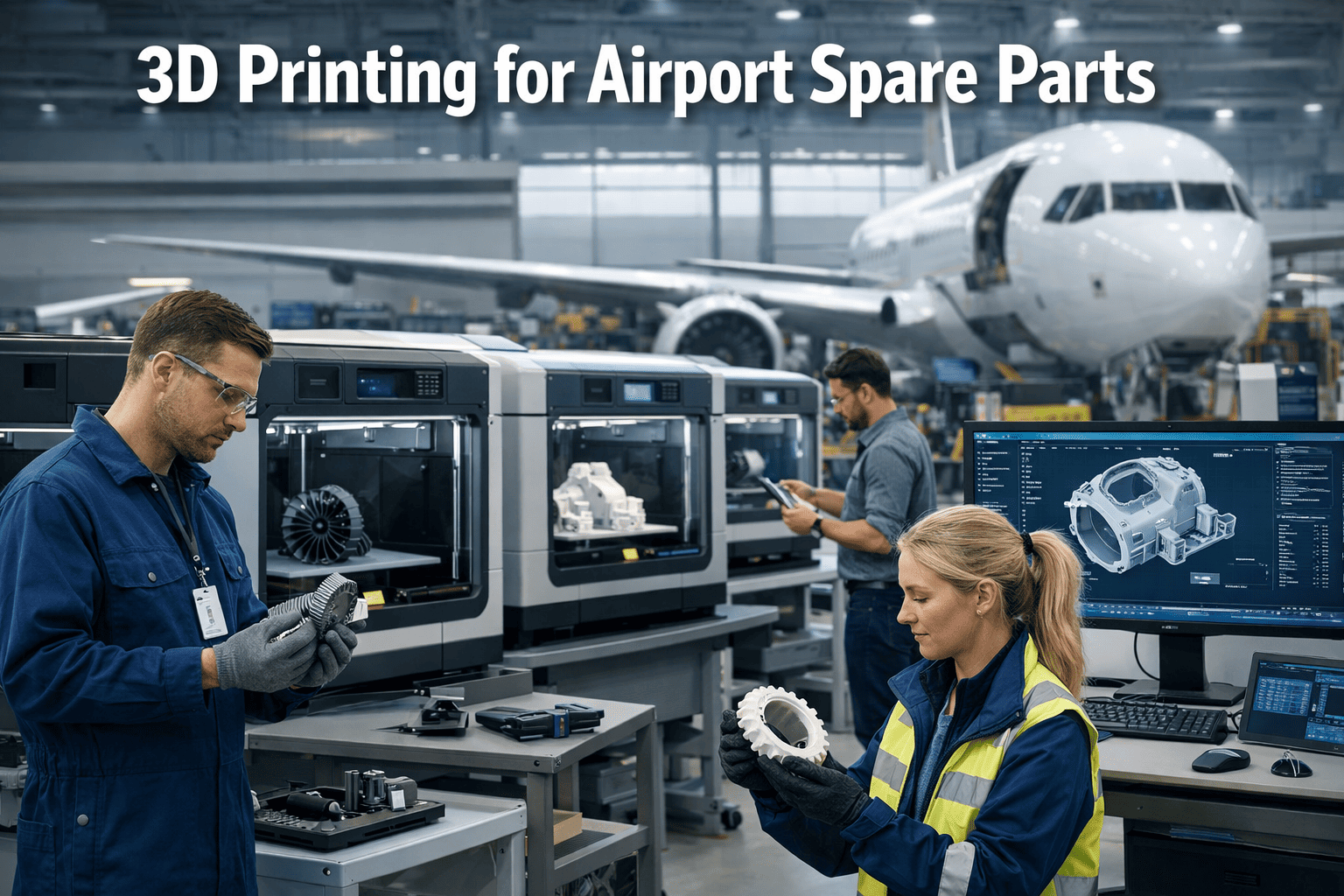
A passenger boarding bridge motor fails at 6am on a Monday during peak departures. The OEM replacement part: 14-day lead time. The delay cost: $100.76 per minute of aircraft block time. Multiply that across a fleet of boarding bridges, baggage conveyor motors, and airfield equipment — and the parts availability problem becomes one of the most expensive maintenance challenges airports face. 3D printing is changing this equation. Airports and MRO providers are using additive manufacturing to produce non-flight-critical spare parts on demand, cutting lead times from weeks to hours and slashing parts costs by 30–50%. But without a digital inventory management system tracking what can be printed, what has been printed, and what still needs printing, the technology remains a novelty rather than an operational tool. Start a free trial to connect your digital parts inventory to your maintenance workflows, or book a demo to see how Oxmaint manages spare parts in aviation environments.
$4.19B
Aerospace 3D Printing Market 2025
Projected to reach $10.59B by 2030 at 20.38% CAGR
30–50%
Cost reduction vs. traditional parts sourcing
Deloitte research on additive manufacturing spare parts production vs. conventional methods
40–60%
Weight reduction on 3D-printed components
Lightweight structures with equivalent strength — fuel savings and lower operational costs
Days vs. Weeks
Lead time comparison
On-demand production eliminates traditional 2–14 week parts sourcing delays for eligible components
Which Airport Parts Are Candidates for 3D Printing?
Not every airport part can or should be 3D printed. Flight-critical structural components require FAA/EASA certification pathways that are still maturing for additive manufacturing. But a significant category of non-flight-critical, non-structural maintenance parts qualify for on-demand production — and that category covers a meaningful slice of airport maintenance parts spend. Understanding the boundaries is essential before building a digital inventory strategy. Book a demo to discuss spare parts strategy for your airport maintenance operations.
Strong 3D Printing Candidates
Terminal Equipment Parts
Housing covers, mounting brackets, cable guides, fan shrouds for escalators, moving walkways, and baggage claim carousels
GSE Tooling & Fixtures
Custom jigs, holding fixtures, and non-structural brackets for ground support equipment maintenance
Cabin Interior Components
Non-structural cabin fittings, ventilation duct connectors, and interior panel components that require custom geometry
Legacy Equipment Parts
Parts for equipment no longer manufactured by OEMs — 3D printing from original drawings eliminates obsolescence risk
Requires Certification Pathway
Load-Bearing Structural Parts
Structural components in movement areas require FAA/EASA Parts Manufacturer Approval (PMA) before additive manufacturing is permissible
Aircraft-Interface Equipment
Any component that directly interfaces with aircraft fuselage, engines, or fuel systems must follow aviation certification protocols
ARFF Critical Components
Fire fighting vehicle critical safety parts require documented materials certification and load testing before on-site production is approved
Pressurized System Parts
Hydraulic system components, fuel system fittings, and pneumatic connectors in safety-critical applications require formal qualification
The Digital Inventory Model: How It Works in Practice
The concept of a digital warehouse replaces physical stockrooms with files. Instead of holding a physical part in a bin, airports maintain a certified digital file of the part geometry — and print it when needed. This shifts inventory cost from physical carrying cost to digital storage. Boeing has reported that additive manufacturing enables them to produce parts on demand, materially reducing the need for physical inventory and storage costs. For airports, the model requires three connected systems: a 3D printer, a digital file library, and a CMMS that connects parts requests to the production queue automatically.
Step 1
CMMS Triggers Parts Request
Work order created for failed terminal component. CMMS inventory check finds zero stock. System flags part as 3D-printable and queries digital file library for the part geometry.
Step 2
Digital File Retrieved
Certified part geometry file retrieved from digital library. Material specification confirmed. Production parameters loaded. Estimated print time: 2–8 hours depending on complexity and size.
Step 3
Part Produced On-Site
3D printer at the airport maintenance depot produces the part. Post-processing and quality check completed by technician. CMMS work order updated with part production record and material traceability data.
Step 4
Installed & Documented
Part installed by the assigned technician. Work order closed with digital signature, part serial number, material certification reference, and installation photographs — creating a complete maintenance record in the CMMS.
Traditional Parts Sourcing vs. Digital On-Demand
Metric
Traditional OEM Sourcing
3D Print On-Demand
Lead Time
2–14 weeks standard; emergency expedite 3–7 days at premium cost
2–8 hours for eligible parts; ready same day in most cases
Cost per Part
Full list price + shipping + expedite fees; emergency premium 2–4×
30–50% lower than traditional methods (Deloitte research)
Inventory Carrying Cost
Physical stock + storage space + risk of obsolescence and expiry
Digital file library — storage cost near zero; no obsolescence risk
Legacy Parts
Discontinued parts unavailable — force equipment retirement or costly redesign
Print from original drawings — eliminates obsolescence problem entirely
Customization
Limited to OEM catalog specifications
Geometry can be modified for improved fit, weight reduction, or failure point correction
How Oxmaint Supports a Digital Parts Strategy
The value of 3D printing in airport maintenance is fully realized only when the production capability is connected to the maintenance system that knows what's needed and when. A standalone 3D printer without inventory integration is just another tool that technicians have to remember to use. Oxmaint connects parts requests, digital inventory, and work order management so on-demand production is triggered automatically — not manually. Start a free trial to build your digital-first parts inventory strategy.
Digital Parts Classification
Flag each part in the Oxmaint inventory as OEM-source, stock-held, or 3D-printable. When a work order triggers a parts request, the CMMS directs to the correct sourcing pathway — no manual lookup
Zero-Stock Alerts with Print Trigger
When stock reaches zero for a printable part and a work order is pending, the CMMS generates a production request automatically — eliminating the gap between parts failure and production initiation
Material Traceability Records
Every 3D-printed part installed carries a CMMS work order record linking to its material specification, print date, printer ID, and quality check sign-off — creating the audit trail required for maintenance documentation
CapEx Reduction Modelling
Track cost savings from 3D printing vs. OEM sourcing per asset and per period. Feed documented savings into CapEx forecasting to demonstrate ROI on additive manufacturing investment to airport leadership
Parts Availability Shouldn't Ground Your Operations. Oxmaint Keeps the Supply Chain Moving.
Connect your digital parts library to your work order management system. Oxmaint flags printable parts, triggers production requests at zero-stock, tracks material traceability, and documents every on-demand part through the full maintenance record — so your team spends time repairing equipment, not waiting for shipments.
What regulatory approval is needed before using 3D-printed parts in airport maintenance?
Regulatory requirements vary by part criticality and application. Non-flight-critical, non-structural maintenance parts — terminal equipment housing, tooling, legacy replacement brackets — generally don't require formal aviation authority approval when produced for ground-based airport infrastructure. For any aircraft-interface component or safety-critical airside equipment part, FAA PMA or EASA Part 21 approval is required. Most airports start their additive manufacturing programs with clearly non-critical applications and develop certification pathways as capabilities mature. Start a free trial to identify which of your parts inventory qualifies for digital-first sourcing.
How does 3D printing help airports manage parts for legacy equipment that's no longer manufactured?
This is one of the highest-value applications. When OEMs discontinue parts for older equipment, airports traditionally face forced equipment retirement or expensive reverse-engineering through third parties. With a digital file library, the original part geometry can be reverse-scanned and certified, then reproduced on demand indefinitely. This extends equipment lifespan well beyond the OEM support window and eliminates the forced CapEx of premature equipment replacement driven by parts obsolescence.
How does Oxmaint integrate with a digital parts library for 3D printing requests?
Oxmaint supports document and specification attachment within part records. Each printable part in the inventory can have its technical file reference, material specification, and print parameter notes stored within the CMMS part record. When a work order triggers a production request, the technician has immediate access to all production information. For full digital manufacturing platform integration, Oxmaint connects via REST API to external digital warehouse and PLM systems. Book a demo to discuss integration with your current parts management setup.
What materials are available for 3D printing airport maintenance parts?
For airport ground infrastructure maintenance, high-performance polymers dominate: ULTEM 9085, PEEK, and PEKK offer heat resistance, chemical resistance, and mechanical strength suitable for most terminal equipment applications. Selective Laser Sintering (SLS) processes enable complex geometries from thermoplastic powders. For more demanding structural applications requiring metal, Selective Laser Melting (SLM) processes work with titanium and aluminum alloys — though at higher cost and with longer qualification requirements. Material selection depends on the operating environment and load conditions of the specific part.