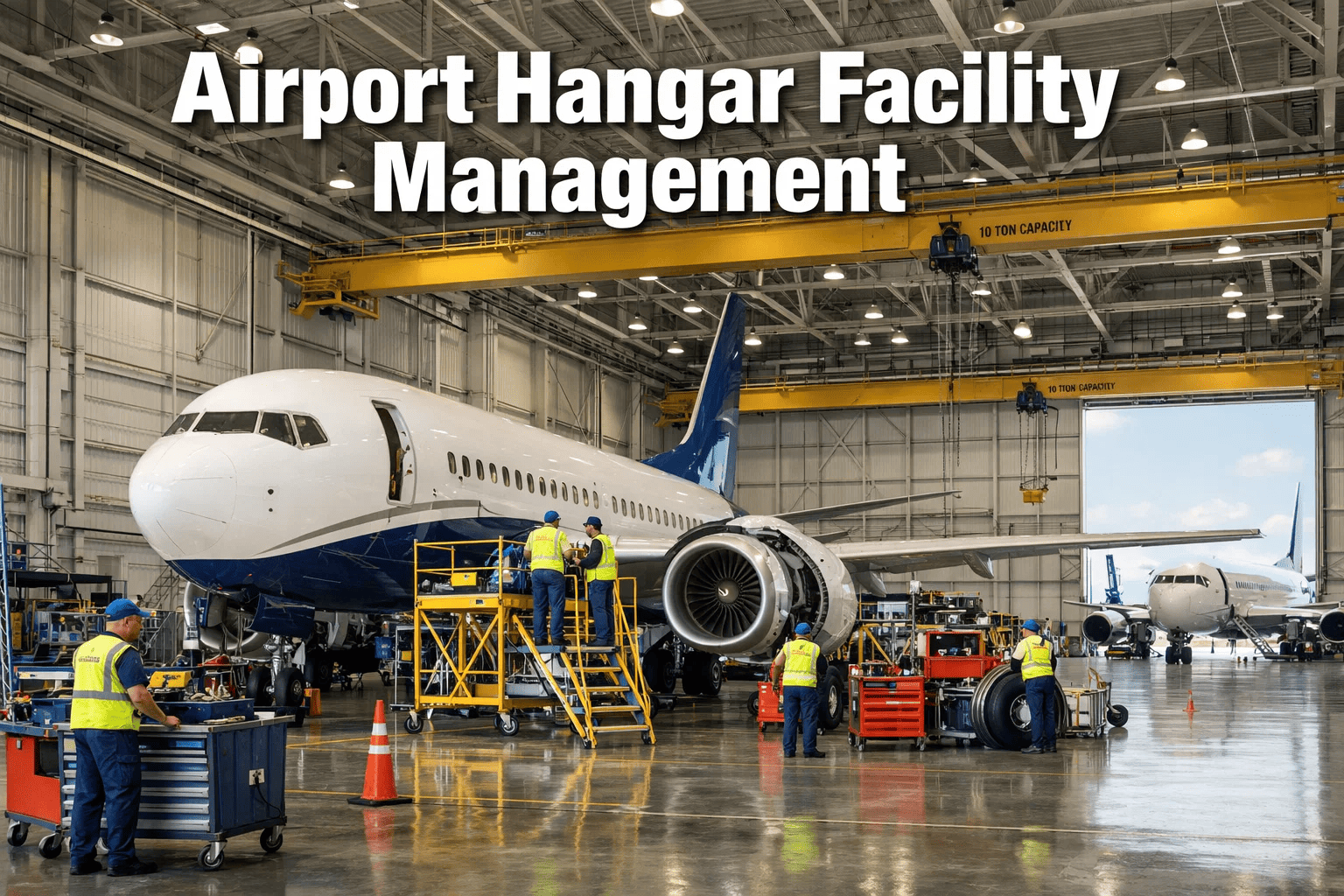
Airport hangar facilities are among the most maintenance-intensive environments in aviation — combining heavy industrial equipment, aircraft maintenance operations, high fire suppression requirements, and OSHA and FAA safety obligations in a single physical space. A hangar door that fails mid-cycle grounds the aircraft inside. A floor coating that becomes slick with hydraulic fluid creates an immediate injury risk. A fire suppression system that last received maintenance beyond its certification window is both a liability and a regulatory violation waiting to be discovered on the next inspection. Most hangar facility managers are managing these assets across multiple disconnected systems — or worse, on spreadsheets. Start a free trial of Oxmaint and bring your hangar assets under structured CMMS management today — or book a live demo to see how Oxmaint manages MRO hangar maintenance and safety compliance together.
Airport Hangar Facility Management: MRO Support, Safety Compliance & Asset Maintenance
A complete guide for hangar facility managers covering hangar door maintenance, fire suppression systems, overhead cranes, floor management, HVAC, and OSHA compliance — with CMMS-driven scheduling and digital inspection records.
What Makes Airport Hangar Maintenance Uniquely Complex
An airport hangar combines the asset complexity of a heavy industrial facility with the safety demands of aviation operations and the compliance requirements of multiple overlapping regulatory frameworks — FAA, OSHA, NFPA, and local fire authority standards all apply simultaneously. The assets inside a hangar span mechanical, electrical, structural, and life safety categories: giant hangar doors weighing dozens of tonnes, overhead travelling cranes rated for multi-tonne aircraft loads, high-expansion foam or halon suppression systems, ventilation systems designed to handle aircraft engine exhaust and fuel vapour, and floor coatings designed to contain spills and maintain traction under heavy equipment load. Each asset category has its own inspection frequency requirements, its own failure consequence profile, and its own compliance documentation standard. Managing this without a CMMS means every inspection due date lives in someone's head — and every missed interval is an undiscovered liability. Start a free trial of Oxmaint today and build your hangar maintenance programme with structured PM schedules and digital compliance records — or book a demo to see how Oxmaint handles multi-asset hangar facility management.
Six Critical Asset Categories in Airport Hangar Facilities
Bi-fold, sliding, and bottom-rolling door systems are the single most failure-visible asset in any hangar. Drive unit condition, guide rail wear, seal integrity, and emergency stop functionality require monthly operational checks and annual full certification. A door failure during aircraft movement creates an immediate grounding event and potential airworthiness investigation.
NFPA 409 governs fire protection for aircraft hangars and mandates specific suppression system types based on hangar class. High-expansion foam, low-level discharge, or halon replacement systems require quarterly inspection, annual testing, and discharge system certification on defined cycles. Documentation of all inspections must be available on-site for fire authority inspection at any time.
ASME B30.2 requires frequent (pre-shift or daily) and periodic (monthly/annual) inspections for all overhead travelling cranes. Wire rope condition, hook deformation, brake function, and runway alignment are critical inspection points. OSHA 1910.179 adds additional requirements for hooks, limit switches, and overload protection — all requiring documented inspection records.
Aviation hangar floors carry aircraft axle loads, ground support equipment, and heavy tooling — and must maintain slip-resistance ratings in the presence of fuel, hydraulic fluid, and coolant contamination. Epoxy coating condition, expansion joint integrity, floor drain functionality, and oil-water separator performance require scheduled inspection and recoating programmes before degradation creates injury or environmental compliance risk.
Hangar ventilation must continuously dilute and remove fuel vapour and exhaust gases from aircraft maintenance activity, keeping vapour concentrations below the Lower Explosive Limit (LEL). Fresh air intake rates, explosion-proof fan motor condition, and ductwork integrity all require maintenance programmes aligned to NFPA 30 and local fire code requirements — not just standard HVAC PM intervals.
Hangars require explosion-proof or Zone 2-rated fixtures in fuel vapour zones. LED high-bay replacements, emergency lighting battery backup function, and fixture mounting integrity in high-movement areas (crane travel zones, door operation zones) require documented inspection cycles — particularly where lighting failure during aircraft maintenance creates both a safety and an MRO continuity issue.
Every Missed Hangar Inspection Is a Future Compliance Event
Oxmaint gives hangar facility managers a single platform to schedule, execute, and document every mandatory inspection — from daily crane pre-shift checks to annual fire suppression certifications. Compliance evidence always ready. Nothing missed. No liability gaps.
What Reactive Hangar Maintenance Actually Costs
Average repair and downtime cost when a hangar door drive system fails without warning — vs. under $4,000 for a planned drive unit replacement on condition assessment
Maximum penalty per OSHA citation for serious violation — documentation of inspection records is the primary defence during facility audits; absent records are treated as absent inspections
Planned overhead crane maintenance is 94% less expensive per event than reactive repairs following an undetected wire rope failure or brake system seizure under load
Hangar facilities with CMMS-managed inspection schedules report zero undocumented inspection intervals during regulatory audits — eliminating the single largest compliance risk in hangar operations
Oxmaint Features Built for Hangar Facility Management
Register every hangar door, crane, suppression system, floor zone, HVAC unit, and lighting array with manufacturer specs, certification dates, inspection history, and condition score in a fully searchable asset hierarchy.
Build inspection schedules from NFPA 409, ASME B30.2, OSHA 1910.179, and local fire authority requirements. Crane pre-shift checks, quarterly foam system tests, and annual door certifications — all auto-triggered, auto-escalated on overdue.
Mobile checklists for pre-shift crane checks, monthly door operational tests, and quarterly fire system inspections — completed on-site with pass/fail criteria, photo capture, and digital technician sign-off timestamped to the second.
Aviation MRO contractors, fire system specialists, and crane certification engineers receive and complete work orders in Oxmaint — attaching test certificates, service reports, and compliance sign-off directly to the asset record.
Rolling 5–10 year capital plans for hangar door drive unit replacement, crane refurbishment, suppression system upgrade, and floor recoating — built on actual condition scores and maintenance history, not guesswork.
Live view of overdue inspections, upcoming certification deadlines, open safety work orders, and asset condition status across all hangar bays — giving facilities managers a single operational picture of their compliance posture.
Frequently Asked Questions
What are the NFPA 409 requirements for aircraft hangar fire suppression maintenance?
NFPA 409 requires quarterly inspection of aircraft hangar fire protection systems including foam concentrate sample testing, discharge nozzle condition checks, detection system functional tests, and suppression system valve position verification. Annual full-flow discharge tests are required on a frequency determined by system type and local AHJ (Authority Having Jurisdiction) requirements. Documentation of all inspections must be maintained on-site. Oxmaint allows fire suppression PM schedules to be built directly from NFPA 409 requirements, with automatic escalation on overdue items. Start a free trial to build your fire suppression PM schedule.
How frequently must hangar overhead cranes be inspected under ASME B30.2?
ASME B30.2 requires frequent inspections (daily to monthly depending on service class) covering hook condition, rope wear, brake function, and limit switch operation. Periodic inspections (monthly to annually depending on service class) cover structural members, fasteners, electrical components, and running gear. OSHA 1910.179 adds requirements for hook safety latches and overload protection documentation. Critical point: all inspections must be recorded. Oxmaint supports pre-shift mobile checklist completion with automatic record creation and escalation when frequency is missed. Book a demo to see the crane inspection workflow.
Can Oxmaint manage both the hangar facility assets and the MRO maintenance workload in the same system?
Yes. Oxmaint is designed to manage facility infrastructure assets (doors, cranes, suppression systems, HVAC) and production or operational assets (aircraft ground support equipment, tooling, test equipment) in the same asset hierarchy. A hangar operator can use Oxmaint to schedule both building infrastructure PMs and MRO equipment maintenance in a single system, with shared work order management, technician scheduling, and parts inventory — eliminating the common situation where facility and MRO maintenance records live in separate systems with no integration. Start a free trial to see the unified approach.
How does Oxmaint handle hangar maintenance at airports with multiple hangar bays?
Oxmaint's asset hierarchy — Portfolio, Property, System, Asset, Component — maps directly to multi-bay hangar facilities: the airport or MRO organisation at the top, then individual hangar buildings, then asset categories (doors, cranes, suppression), then individual assets. Reporting and compliance dashboards can be viewed at any level — a facilities director sees all hangars' compliance status simultaneously, while a hangar bay technician sees only their bay's overdue items. Multi-bay and multi-building airport hangars are a standard Oxmaint deployment pattern. Book a demo to walk through a multi-bay hangar configuration.
Hangar Compliance Gaps Are Expensive. Close Them Before the Next Audit.
Oxmaint gives hangar facility managers a complete CMMS to schedule, execute, and document every inspection — from pre-shift crane checks to annual fire suppression certifications. Complete compliance evidence, always ready. No missed intervals. No liability gaps. No spreadsheets.