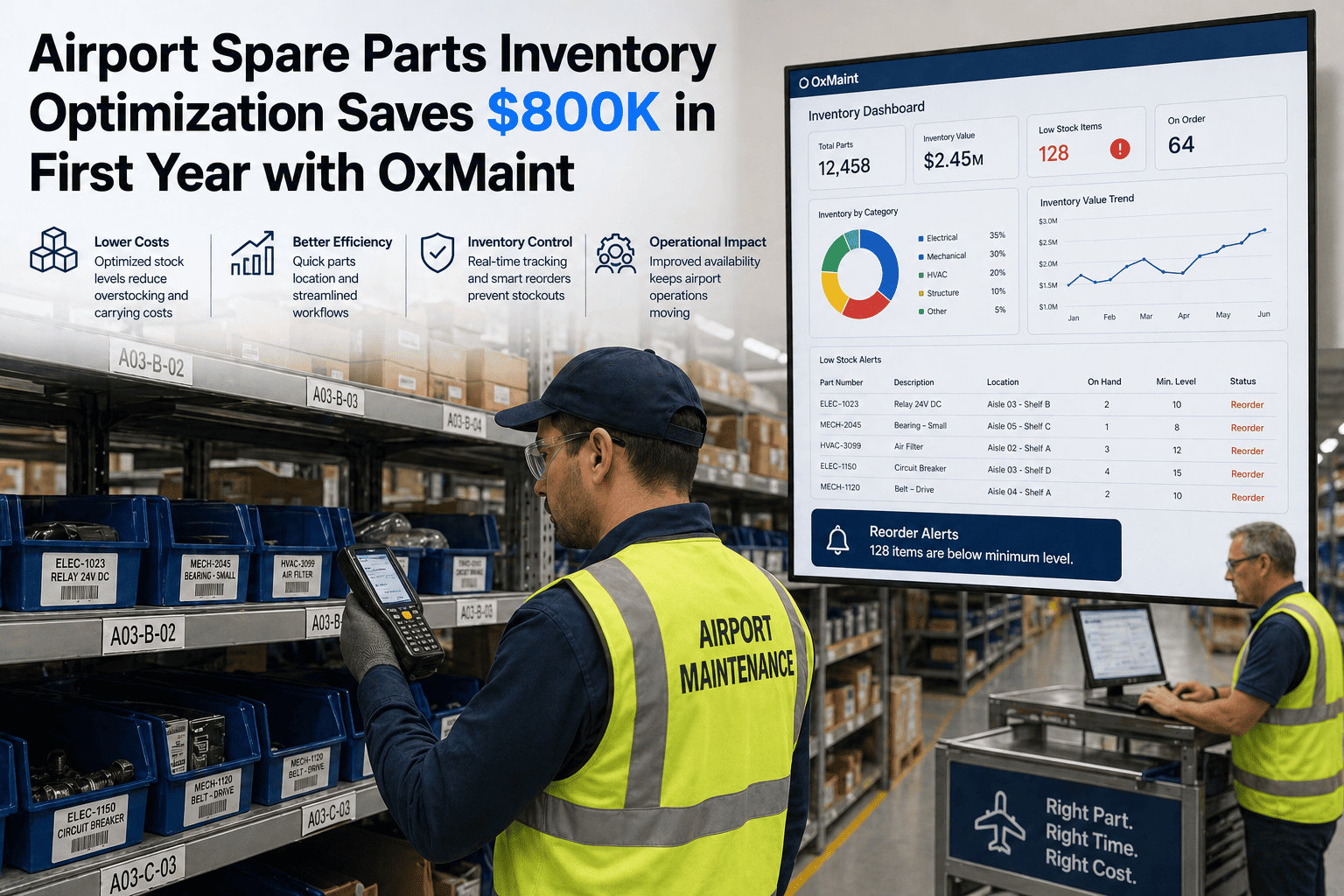
Spare parts inventory is one of the most under-managed cost centers in airport maintenance operations. Overstock ties up capital. Stockouts turn a two-hour planned repair into a 48-hour grounding event when a critical part has to be emergency-sourced. Most airport facilities teams manage parts through a mix of spreadsheets, tribal knowledge, and conservative hoarding — keeping too much of some things and running out of others at the worst possible moments. This case study details how one major hub airport used Oxmaint's inventory management module to recover $800,000 in annual parts spend by getting scientific about what to stock, how much, and when to reorder. If this sounds like your operation, start a free trial or book a demo today.
Airport Saves $800K with Spare Parts Inventory Optimization
How one international airport eliminated $800,000 in annual waste from its MRO parts program — by replacing guesswork with data-driven reorder logic, automated procurement triggers, and asset-linked inventory tracking.
Is Your Parts Room a Cost Center or a Strategic Asset?
Every dollar tied up in slow-moving or obsolete parts is a dollar not available for operations. Oxmaint connects your parts inventory directly to asset records and work orders — so reorder decisions are driven by actual consumption data, not guesswork. Get a free trial for 30 days and see how your inventory compares to best-in-class benchmarks. Book a demo with an inventory specialist.
Why Airport Parts Management Fails — and How Much It Costs
Before implementing Oxmaint, the airport maintained a parts inventory valued at approximately $4.2 million across three warehouse locations. Annual spend on MRO procurement ran to $1.6 million. The problem: no system connected parts consumption to asset records. Procurement was driven by past orders and technician preference, not failure rate data or scheduled maintenance needs.
Critical parts not in stock triggered emergency procurement with overnight freight — at 3x to 5x standard unit cost. These events averaged 4 per month across the fleet.
Parts ordered for equipment that was decommissioned, upgraded, or replaced sat in storage for years before being identified and written off. No asset-part link meant no visibility on relevance.
Without a live inventory system, technicians spent up to 6 hours searching warehouses, calling suppliers, or waiting for parts that were actually in stock — just in the wrong location.
Lack of visibility across the three warehouse locations led to the same SKU being ordered from suppliers while stock already existed elsewhere in the airport's own inventory.
From Guesswork to Data-Driven: The Five Steps
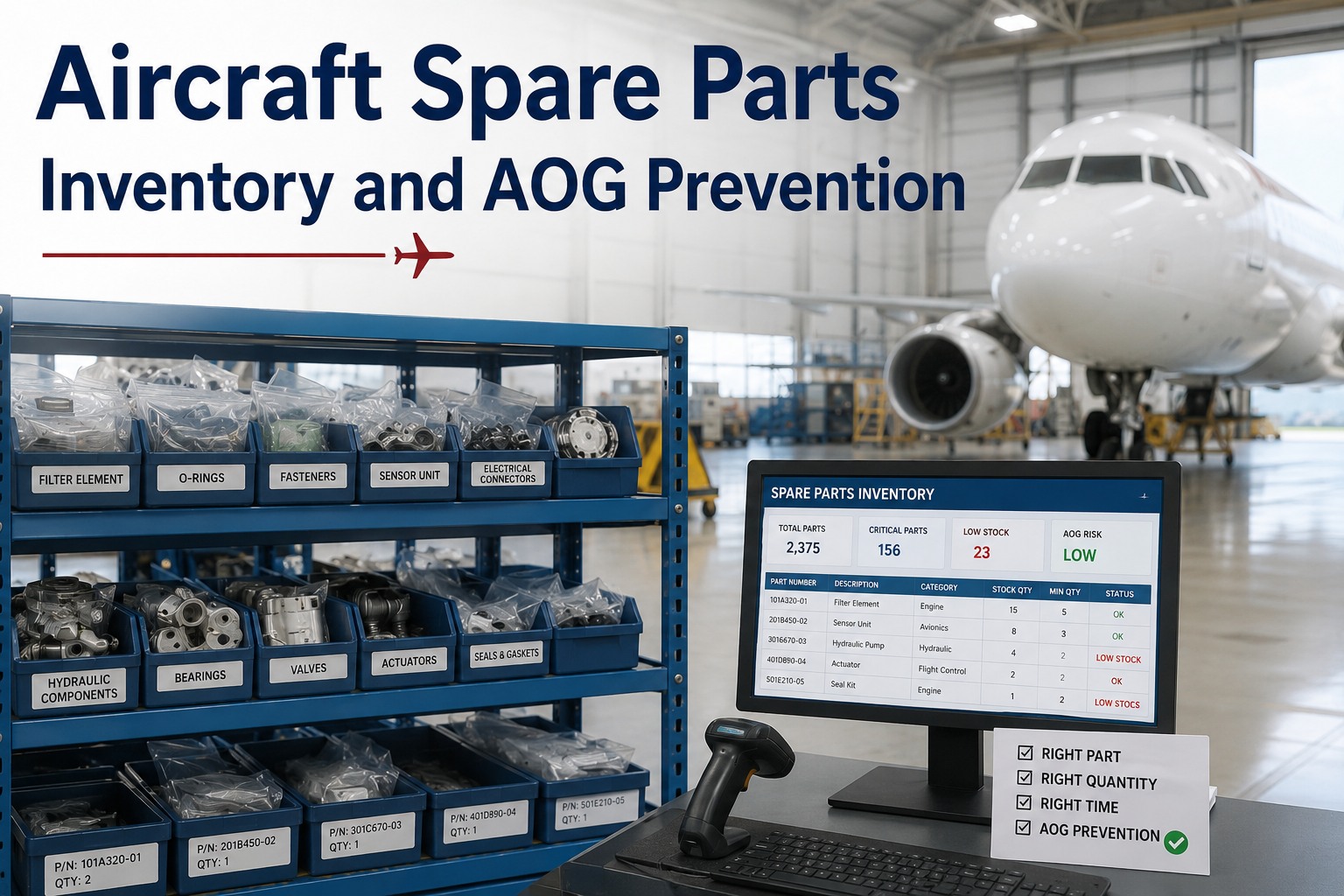
Every part across all three warehouse locations was catalogued in Oxmaint — part number, description, quantity on hand, unit cost, and supplier. 7,800 unique SKUs were identified. Each was linked to the assets it served using Oxmaint's asset registry hierarchy.
Parts were linked to specific asset records in Oxmaint's registry. This created an immediate view of which parts were tied to active equipment, which were for end-of-life assets, and which had no identifiable parent asset at all — a significant finding.
As technicians completed work orders, parts consumed were recorded in Oxmaint. Within 90 days, actual consumption rates by SKU were available — not estimates, not supplier recommendations, but real airport data. Reorder points were recalculated from this baseline.
For high-velocity and safety-critical parts, Oxmaint automated reorder alerts when stock fell below the calculated minimum quantity. For slow-moving parts, maximum stock levels were set — preventing over-procurement of items used once or twice per year.
With consumption and asset data in one view, 3,600 SKUs were identified for removal — either obsolete, duplicated, or below minimum usage thresholds. Supplier consolidation followed, with volume aggregated across fewer vendors to negotiate better per-unit pricing.
A separate critical spares register was created within Oxmaint for parts where a stockout would ground operations — runway lighting components, gate power equipment, and primary HVAC compressor parts. These maintained a non-negotiable minimum quantity at all times, with dual-supplier sourcing.
Reactive Procurement vs Demand-Driven Inventory
$800K Saved — Where It Came From
The Capabilities Behind $800K in Savings
Every SKU is linked to the assets it serves. When an asset is decommissioned or replaced, Oxmaint flags all associated parts — no more orphaned inventory accumulating for years.
Reorder alerts are calculated from actual work order consumption data — not manufacturer recommendations or gut feel. The system knows what you use and when you need more.
One live view across all warehouse locations eliminates duplicate purchasing and enables parts transfers between sites before triggering supplier orders.
Safety-critical and operationally essential parts are classified separately with non-negotiable minimum quantities, dual-supplier requirements, and immediate alerts on any stock movement below threshold.
Questions About Airport Inventory Optimization
How long before consumption-based reorder data becomes reliable?
Can Oxmaint integrate with existing procurement or ERP systems?
How are critical spares defined differently from standard MRO inventory?
What happens to the inventory data when equipment is replaced or upgraded?
Stop Overpaying for Parts You Do Not Need, While Running Out of the Ones You Do
Oxmaint connects your MRO inventory to your asset records and work orders — so every reorder decision is driven by real consumption data, not calendar assumptions. The $800K savings in this case study came from data that already existed, just not connected. We can help you connect yours.