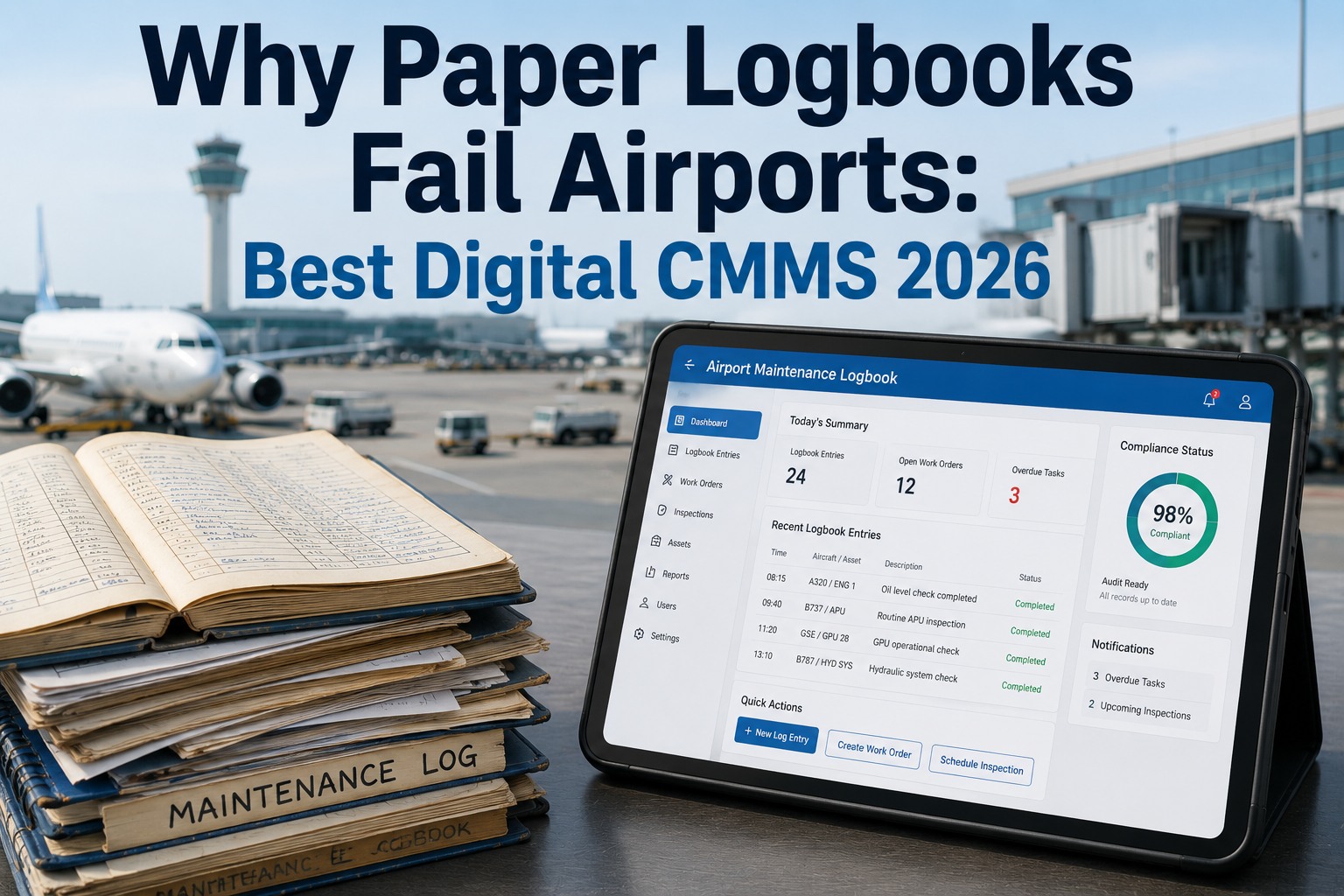
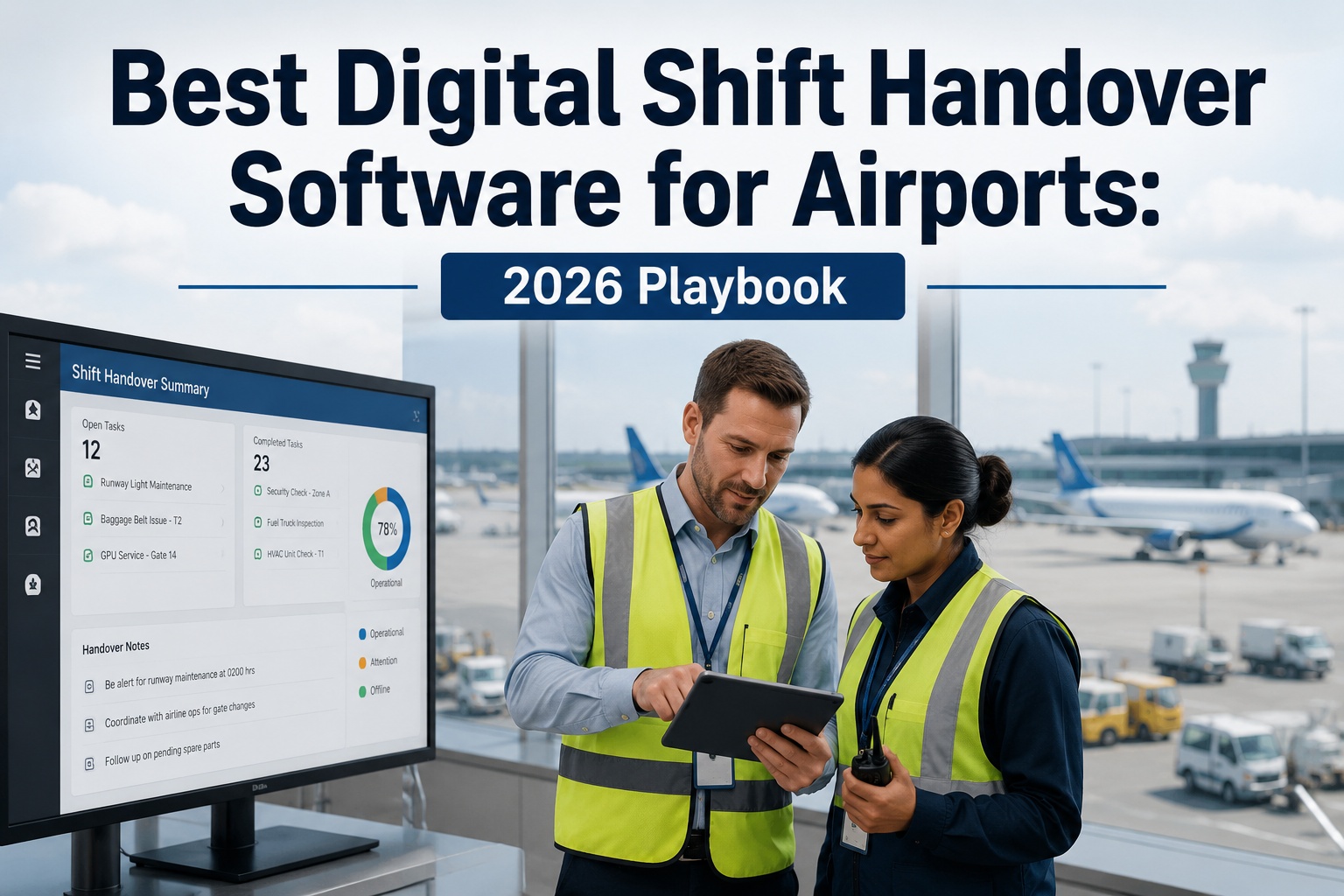
Digital shift handover rollout is what separates airports publishing a monthly KPI scorecard from airports actually operating on one — and the difference isn't the CMMS, it's the rollout playbook. Aviation research consistently shows that errors and accidents occur disproportionately after shift handover, with 28% of paper-based shift handovers losing critical work-in-progress context and one Continental Express handover failure — an outgoing maintenance shift that failed to log missing fasteners — costing 14 lives. The rollout playbook matters more than the platform: airports that deploy in stages with technician involvement hit 87% adoption in 90 days; those that push a big-bang deployment see 60% abandonment in the same window. This roadmap walks the four-phase rollout that gets ramp, terminal, GSE, and baggage teams onto one digital handover — with the change management, adoption metrics, and executive reporting that make it stick. Book a Demo to see OxMaint's airport-specific handover module — from technician mobile through supervisor dashboard up to the COO's monthly view.
Airport Operations · CMMS Rollout · 2026
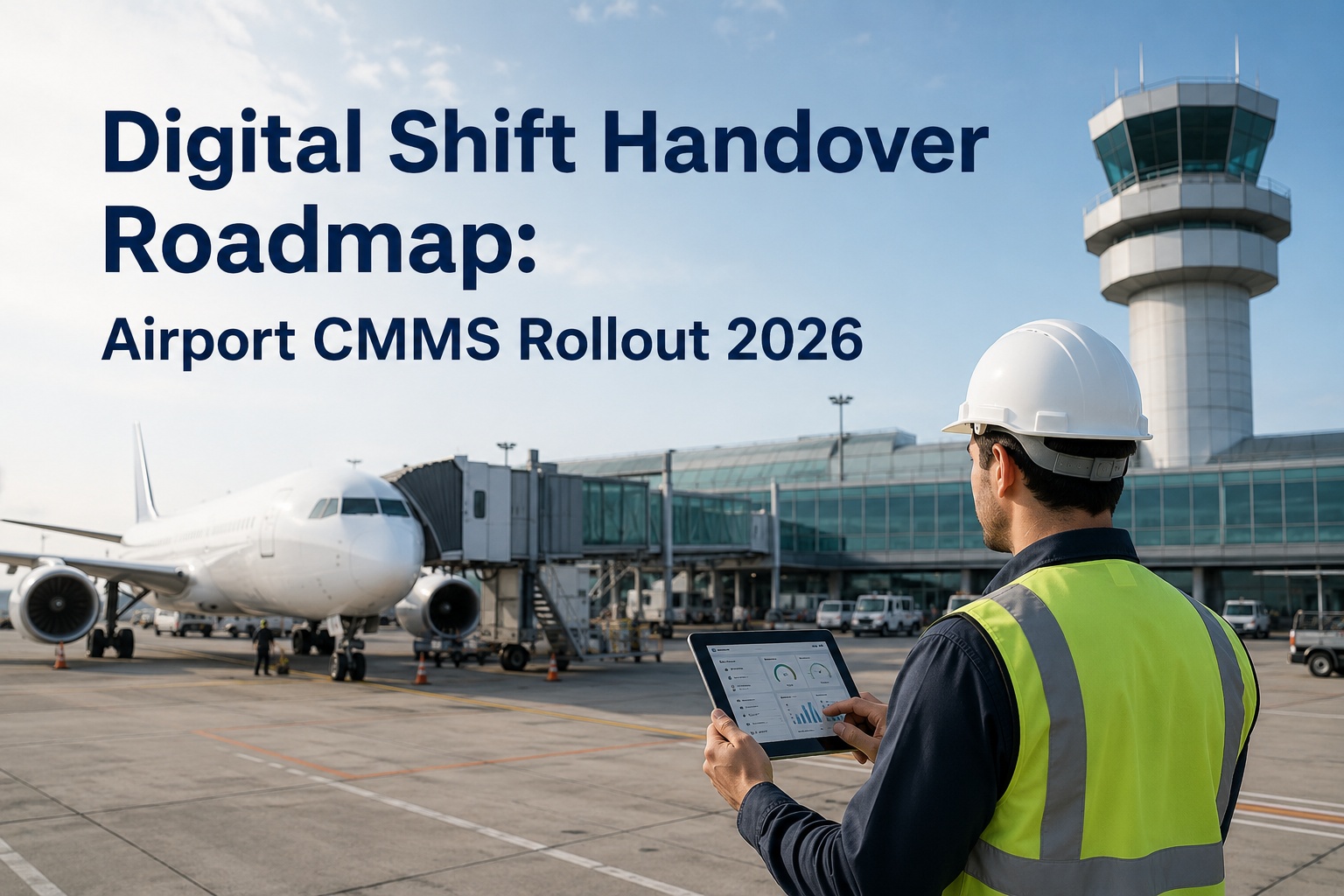
Digital Shift Handover Roadmap: Airport CMMS Rollout 2026
Roll out digital handovers with the best 2026 airport CMMS software — the four-phase playbook covering adoption, change management, and metrics that flow from the ramp technician's phone up to the COO's monthly review.
28%
Share of paper-based shift handovers that lose critical work-in-progress context
87%
Adoption within 90 days when rollout is staged with technician involvement
60%
Abandonment within 90 days when big-bang deployment is pushed with minimal training
40–55%
Fewer fatigue-related errors after CMMS-managed structured shift handovers
The 4-Phase Rollout Roadmap — From Pilot to Full Airport Coverage
The rollout that sticks is not a big-bang. It's a four-phase sequence — pilot one function, extend to adjacent functions, integrate with control tower and ops center, then wire executive dashboards. Compress this and adoption collapses. Below is the proven cadence for a mid-to-large airport. Start a free OxMaint workspace and configure Phase 1 pilot for one terminal maintenance crew within your first shift — the free plan includes handover templates, mobile execution, and supervisor dashboards from day one.
01
PILOT
Weeks 1–4
One function — typically terminal maintenance or GSE. Paper + digital in parallel for 5–7 days. Validate templates against existing shift-log formats. Retire paper when digital captures > 95% of prior detail.
02
EXTEND
Weeks 5–10
Roll to adjacent functions: airfield ops, baggage systems, ramp maintenance. Import validated templates from pilot. Train shift leads on defect logging, parts issuance, and mobile handover. Full adoption in 3–4 shifts per new function.
03
INTEGRATE
Weeks 11–18
Connect handover data to ops center dashboards. Wire escalation matrix — safety-critical items auto-route to duty manager. Bidirectional flow with existing SCADA, BMS, and airfield lighting systems where APIs allow.
04
OPERATIONALIZE
Weeks 19+ · Ongoing
Executive dashboards live. Monthly COO review runs off the same data the ramp technician entered on shift. KPI theatre becomes KPI operations. Continuous template refinement based on incident feedback loops.
The Data Flow — Technician's Phone to COO's Monthly Review
The reason paper handovers stall improvement programs isn't the paper — it's that the numbers a technician writes at 2 a.m. never reach the executive who owns the budget. Digital handover collapses that gap into one data flow. Same data, four audiences, four filtered views. Book a live demo to see the flow demonstrated against your specific airport's org structure — an OxMaint aviation specialist walks technician-to-COO on your actual asset hierarchy during the call.
TECHNICIAN
Mobile · Handheld
Enters defect, photo, part used, LOTO status, next shift note
Real time · At the asset
→
SHIFT SUPERVISOR
Tablet · Ops booth
Sees live handover board — open WOs, blocked jobs, safety escalations
Continuous · Per shift
→
OPS MANAGER
Desktop · Ops center
Weekly KPI trend: PM compliance, unplanned events, MTTR by system
Weekly · Cross-function
→
COO · CFO
Executive dashboard
Monthly review: airport-wide reliability, cost per movement, safety trend
Monthly · Board-ready
Same source data. No re-entry. No monthly spreadsheet assembly. What the ramp technician logs at 02:30 is what the COO reviews at month-end — filtered, aggregated, and drill-downable to the individual work order.
Before & After — Verbal Briefing vs. Digital Handover Record
The most concrete way to see the value of a digital handover rollout is a side-by-side of one shift change under each model. Same crew, same open jobs, same aircraft on stand — different information transfer. Sign up free and run your first digital handover within your first week — OxMaint's handover template captures all eight required fields (open WOs, defects, parts, LOTO, safety events, escalations, next-shift priorities, sign-off) automatically.
BEFORE · Verbal Briefing
✗ 5-minute verbal pass at shift change
✗ Whiteboard notes half-erased by second shift
✗ No photo of the actual defect condition
✗ LOTO status unclear — verbal only
✗ "Acting funny" sensor note on a sticky
✗ Incoming tech re-diagnoses from scratch
✗ Ops center sees the number 3 days later
✗ COO monthly report assembled from memory
AFTER · Digital Handover
✓ Structured mobile handover with 8 required fields
✓ Persistent record — searchable, exportable, timestamped
✓ Photo + video attached to every open WO
✓ LOTO status enforced — cannot close without confirmation
✓ Sensor drift logged with baseline reading
✓ Incoming tech resumes with full context — MTTR halved
✓ Ops center sees status in real time
✓ COO monthly rolls up automatically from live data
The Difference Between KPI Theatre and KPI Operations Is the Rollout.
A CMMS that publishes a monthly scorecard nobody acts on isn't an operations tool — it's paperwork with better formatting. OxMaint's four-phase rollout makes the same data actionable at every level, from the technician's shift to the COO's monthly review.
Change Management — The 5 Levers That Move Adoption Above 87%
Rollout quality is the single biggest predictor of CMMS success — not platform capability, not budget, not vendor prestige. Below are the five levers that separate 87% adoption from 60% abandonment on the same platform. Schedule a working session to walk these five levers against your airport's specific change-management context — an OxMaint deployment lead runs the pre-flight checklist for your rollout live.
01
Technician Involvement in Template Design
The template a rollout team designs in a conference room fails at the gate. Involving shift leads in field templates cuts abandonment by more than half.
02
Staged Rollout — Never Big-Bang
One function, one station, five days parallel with paper. Prove the model, then extend. Big-bang deployments hit 60% abandonment in 90 days.
03
Offline Configuration for Ramp Environments
The mobile handover must work in a jet-bridge or belly hold with no signal. Offline-first design is non-negotiable for airport rollouts.
04
Escalation Matrix Wired From Day One
A safety-critical handover flag that doesn't reach a duty manager in five minutes teaches the crew that logging doesn't matter. Route from Phase 3, not Phase 5.
05
Executive Visibility of Adoption Metrics
If the COO tracks handover completion rate as a monthly KPI, adoption sticks. If the COO tracks it as an IT project, it drifts. Make it an operational KPI from Phase 4.
The 4 Airport Handover Categories — Rollout Order That Sticks
Airport shift handovers split into four functional categories with very different constraints and adoption profiles. Rolling them out in this order lets each phase build the muscle needed for the next. Start free and configure your Category 1 templates within your first workspace — OxMaint's aviation library includes pre-built templates aligned to EASA/FAA Part 145, airfield safety areas, and baggage-system incident categories.
Category 1 · Terminal Maintenance
Best pilot candidate — stable environment, predictable shift patterns, clear scope. HVAC, elevators, escalators, restrooms, jet-bridges. Rollout in 4 weeks.
Category 2 · Airfield & Ramp Operations
Higher stakes — safety-critical LOTO, live aircraft proximity, weather-sensitive. Templates must include foreign-object damage and airfield lighting protocols.
Category 3 · GSE Fleet Maintenance
Mobile assets across the field. Handover must include equipment location, current airline assignment, fuel/charge state, and next-turn scheduled use.
Category 4 · Baggage Systems & Sortation
Continuous 24/7 operation, high downtime cost. Handover critical for tracking induction-belt slippages, sortation-diverter drift, and BHS jam patterns.
"
Our first attempt at rolling out a digital handover was the classic big-bang — every function on the same Monday, four hours of training, and go-live. Twelve weeks later, half the ramp crew was back on paper and the tablets were charging in a supervisor's office. We restarted the program with OxMaint on the four-phase model, piloted with just the terminal maintenance crew, and let the shift leads redesign the template themselves. Ninety days in, we had 89% adoption across all four categories. The COO's monthly briefing now runs off the same data our night-shift tech enters at 03:00 — and we haven't reprinted a paper shift log in six months.
Director of Airport Operations · Mid-Size International Airport · 24 gates · Southeastern USA
Frequently Asked Questions
Why do most digital shift handover rollouts stall?
Big-bang deployments push every function onto the platform in the same week with minimal training and no template validation. Studies show these rollouts hit 60% abandonment within 90 days. Staged rollouts with technician-designed templates reach 87% adoption in the same window.
How long does a full airport rollout take?
A mid-to-large airport typically rolls out in four phases across 18–20 weeks — Pilot (Weeks 1–4), Extend (Weeks 5–10), Integrate (Weeks 11–18), Operationalize (Weeks 19+ ongoing). Larger hubs may take 24–30 weeks for full four-category coverage.
Does OxMaint work offline in ramp environments?
Yes. OxMaint's mobile handover runs offline in jet-bridges, belly holds, and dead-signal zones — captured entries sync automatically when the device rejoins the network. Offline-first design is non-negotiable for airport rollouts and built into the mobile client from day one.
How does OxMaint support EASA and FAA Part 145 documentation?
OxMaint ships with pre-built Part 145-aligned templates covering shift turnover documentation, defect logging, parts consumption, and sign-off chains. Every entry is timestamped, user-attributed, and exportable as an audit-ready package on demand.
Can the same data reach the COO's monthly review without spreadsheet assembly?
Yes. The data a technician enters at the asset flows directly into the ops center dashboard, the weekly manager review, and the monthly COO briefing — with no re-entry. Filtered aggregations at each level, drill-downable back to the individual work order.
What if we already run SAP PM or IBM Maximo?
OxMaint runs alongside SAP PM or Maximo — adding mobile-first handover execution, live dashboards, and ramp-friendly offline capture without disturbing ERP-side records. Bidirectional integration keeps procurement and finance data intact.
Roll Out the Handover That Actually Reaches the COO.
OxMaint's four-phase airport rollout gets terminal, airfield, GSE, and baggage teams onto one digital handover in 18–20 weeks — with the change management, adoption metrics, and executive reporting that turn KPI theatre into KPI operations.