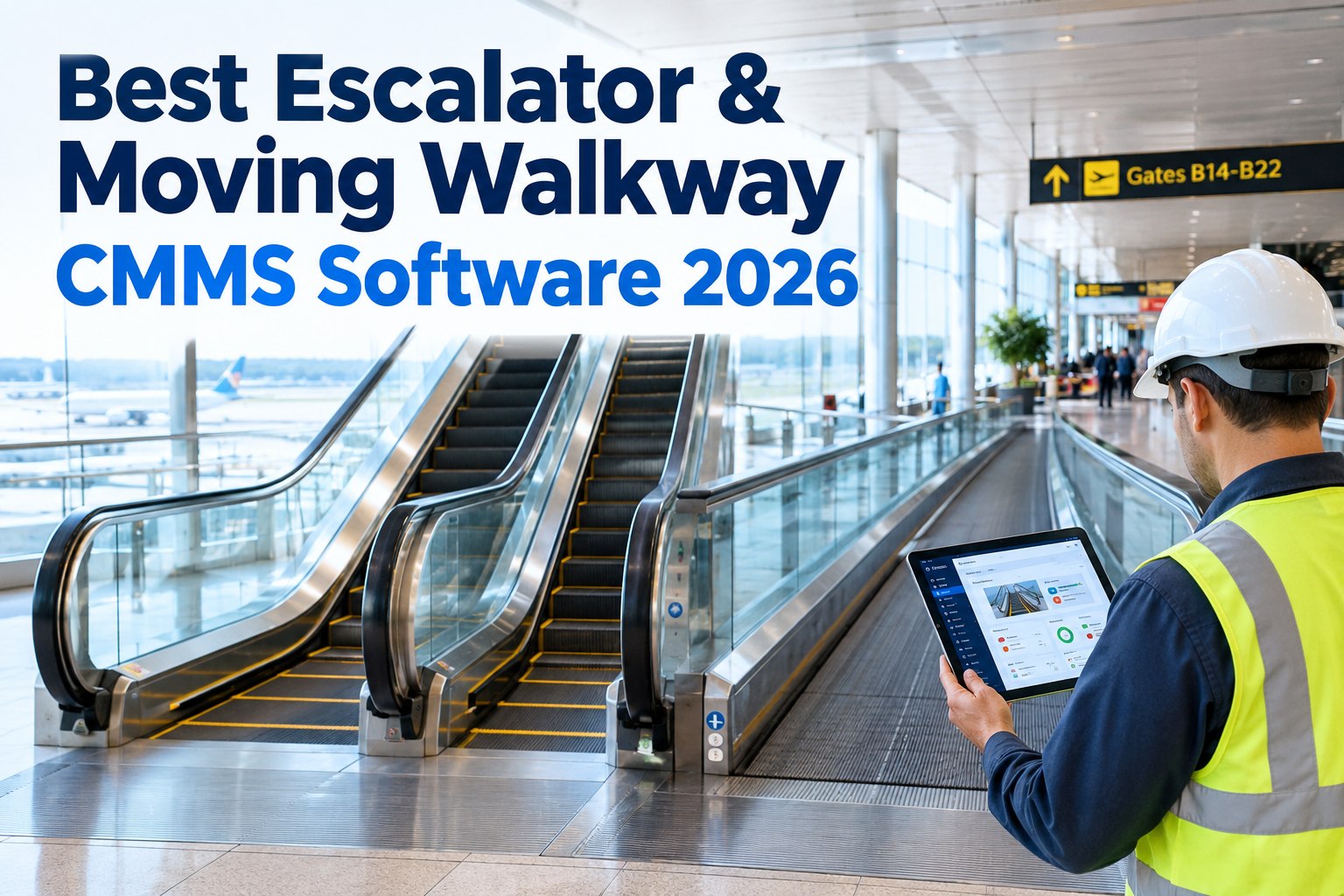
Best Escalator & Moving Walkway CMMS Software 2026

By William Jerry on September 9, 2026

escalator-moving-walkway-cmms-software-best-solutions-2026

Ask an airport facilities director how many escalators they run and you'll get an exact number. Ask how many were running yesterday at 3 p.m. and the answer goes vague. That gap is the whole problem. Most teams still find out a unit stopped the way they did in 1995 — a gate agent, a custodian, or a passenger calls it in — so the outage clock only starts at the phone call, and every minute before that is erased from the record. Meanwhile a down escalator quietly reroutes passengers past a different set of storefronts and drags the terminal-circulation score every ASQ survey asks about. This 2026 guide compares what separates the best escalator and moving walkway CMMS software from a generic tool, and where OxMaint's maintenance management software fits. Start free or book a demo.

Aviation · Vertical Transport · Buyer's Guide · CMMS 2026

Best Escalator & Moving Walkway CMMS Software 2026

The platforms that lift uptime and ASQ all close the same blind spot: the invisible interval between when a unit stops and when anyone knows. Here's how to evaluate them — and what a top platform must deliver.

$260K/hr
documented average cost of unplanned downtime in high-traffic facilities
98%
fleet uptime achievable pairing IoT sensors with a connected CMMS
74%
emergency callout reduction one hub saw moving to predictive PM
50–200+
conveyance units a large terminal must track across decades & makers

The Metric Nobody Measures: Time-to-Detection

Every maintenance team tracks mean time to repair. Almost none track the interval before it — the time between when a unit actually stopped and when the team learned it stopped. That interval is invisible precisely because nothing measures it: if your detection method is a phone call, the recorded outage begins at the phone call, and everything before it vanishes. A unit that stops at 5:40 a.m. and gets reported at 7:15 a.m. was down 95 minutes that no report will ever show. The best software makes that interval visible and shrinks it toward zero. Sign up free and OxMaint timestamps every status change automatically.

Phone-call detection
Down & unknown · 95 min erased from the record
MTTR (all anyone measures)
Sensor detection
Alert
MTTR — starts almost immediately
Uptime recovered
Same failure, two records. The hidden interval is where uptime and ASQ quietly leak away.

Where Escalators Actually Fail — and Why Calendar PM Misses It

Fixed calendar intervals over-maintain some units and let others fail between service windows, because the parts that break give no visible warning until the noise starts — and by then the damage is done. The best platforms watch the specific failure signatures below with sensors, turning a rising trend into a work order weeks early. Book a demo to see condition-based triggers on your fleet.

Step Chains
Stretch, loosen and lose alignment under constant load — tripping safety shutdowns. Chain tension is a leading, monitorable signal.
Handrail Drive
Speed-synchronization drift between handrail and steps builds silently until it fails a daily test or trips a fault.
Drive Motors
Vibration and current-draw rise ahead of failure — invisible to the eye, obvious to a sensor weeks before breakdown.
Debris & Sensors
Coins, grit and trash foul step tracks and safety sensors, causing nuisance stops that read as reliability problems to passengers.

The 2026 Evaluation Scorecard

Score any platform against the seven capabilities that decide whether it actually lifts uptime and ASQ. The best escalator and walkway CMMS clears all seven; a repurposed work-order tool clears two or three. Sign up free to score OxMaint against your own list.

01
Real-Time Status & Time-to-Detection
Knows the second a unit stops — not when someone calls it in — and logs it automatically.
Must-have
02
Multi-Manufacturer Sensor Support
Reads vibration, motor temp, current and chain tension on any maker's units — fleets span four decades.
Must-have
03
Condition-Based Work Orders
A rising trend auto-generates a pre-populated work order — acting on real signals, not scheduled guesses.
Must-have
04
Fleet Health Dashboard
Every unit mapped by location with health score, open work orders, PM compliance and last-inspection time.
Must-have
05
Mobile Daily Inspection
Shift-start safety checks and sign-off on a phone, tied to terminal zones and peak-traffic timing.
High-value
06
ADA & Certification Compliance Log
Documented uptime and state safety-certificate tracking — a defensible record, not a liability gap.
High-value
07
ASQ-Linked Reporting
A line of sight from work order to the terminal-circulation score leadership is judged on.
High-value

Escalators Aren't Background Infrastructure. They're Part of the Passenger Experience.

When a unit goes down at peak hours, passengers notice, airlines notice, and the operations metrics reflect it. OxMaint connects IoT sensor data straight to preventive work orders and puts every unit on one health dashboard — so your team acts on real signals, and every avoided outage shows up where ASQ is scored.

Three Tiers of Tooling — and Where Each Falls Short

The market sorts into three categories. Most airports sit at the left and feel it at every peak-hour breakdown and every ASQ cycle. Here's the honest trade-off. Sign up free to skip to a purpose-built program.

Tier 1
Reactive / Call-It-In
Wait for a fault code or a phone call, then dispatch. No detection metric, no trend, no early warning. Every failure is an emergency callout.
Uptime & ASQ leak
Tier 2
Generic CMMS
Calendar PM and work orders, but no sensor feed and no conveyance-specific logic. Over-maintains some units, misses the ones drifting toward failure.
Better — still blind
Tier 3
Connected Airport CMMS
IoT sensors feeding condition-based work orders, a live fleet dashboard, mobile inspections and ASQ-linked reporting in one program.
Lifts uptime & ASQ

Reactive / Generic Tool vs. OxMaint for Vertical Transport

Here's the side-by-side that matters across a 50–200-unit fleet — where the old model leaks uptime and where a connected program closes the gap. Start free and put your fleet on a live dashboard this week.

Capability
Reactive / Generic Tool
OxMaint Airport CMMS
Outage detection
A phone call — 60–90 min after it stops
Sensor alert the second a unit stops
PM trigger
Fixed calendar, condition-blind
Vibration, temp, current & chain tension
Work orders
Created manually after a complaint
Auto-generated with asset context
Fleet visibility
"How many run right now?" — unknown
Live health score per unit by location
Compliance
Paper logs, gaps at audit
Documented uptime & cert tracking
ASQ line of sight
None — maintenance & score disconnected
Work order tied to circulation metric

Why OxMaint Earns the Pick for 2026

OxMaint runs vertical transport as a measured, mobile-executed program — sensors to work orders to dashboard to ASQ — in the same system that maintains the rest of the terminal. Here's the concrete mapping to the scorecard. Book a demo to see it on your terminal.

Live Fleet Dashboard
Every elevator, escalator and walkway mapped by location with health score, open work orders, PM compliance and last-inspection timestamp.
Any-Manufacturer Sensors
Vibration, motor-temp, current and chain-tension probes install on any maker's equipment and stream into one analytics engine.
Auto-Generated Work Orders
Sensor alerts open pre-populated work orders with full asset context — no manual ticket creation, no lag from signal to action.
Flexible PM Triggers
Schedule by calendar, operating hours, door/step cycles or condition threshold — the right basis for each unit, not one blanket interval.
Documented Uptime & ADA
Every status change logged for a defensible compliance posture — turning downtime records from liability into evidence.
ASQ-Linked Reporting
Ties terminal assets that show up in passenger surveys to measured maintenance, making ASQ improvement a maintenance metric.

Use this scorecard plus OxMaint to close the detection gap, move from reactive callouts to predictive uptime, and give operations a clear line of sight from work order to passenger satisfaction score. Try OxMaint free or book a demo to see it on your airport.

"

We had 60-odd escalators and walkways on fixed monthly intervals, and we genuinely could not tell you how many were running at any given moment — we found out when a passenger complained. Some units got serviced they didn't need; others failed a week after their inspection. We put vibration and current sensors on the fleet feeding OxMaint, and the change was immediate: alerts the moment a unit degrades, work orders that open themselves, and a dashboard that shows every unit's health by concourse. Emergency callouts dropped sharply, uptime climbed toward the high nineties, and for the first time our terminal-circulation ASQ scores moved because we could tie them to work we'd actually done.

Facilities Director · Major International Airport

Frequently Asked Questions

What makes CMMS software "best" for escalators and moving walkways?
Real-time detection that closes the time-to-detection gap, multi-manufacturer sensor support, condition-based work orders, a live fleet dashboard, mobile inspections, compliance logging, and reporting that links to ASQ. Clearing all of these is what lifts uptime.
Why isn't calendar-based preventive maintenance enough?
Fixed intervals over-maintain healthy units and miss ones failing between service windows. Step chains, handrail drives and motors give no visible warning — only sensors catch the rising trend weeks before a breakdown.
How do escalators actually affect ASQ scores?
Terminal circulation is a category travelers notice and remember, and a down unit reroutes foot traffic and frustrates connections. Uptime and ASQ move together — which is why tying maintenance to the score matters.
Can it work across a mixed-age, mixed-brand fleet?
Yes — that's the point of multi-manufacturer sensor support. Probes install on any maker's units and feed one platform, so a fleet built over four decades is managed with one standard.
How quickly can OxMaint show results?
Sensor install runs a few hours per unit, and facilities moving reactive-to-predictive commonly see failure rates fall within the first quarter. Sign up free to start.

Close the Detection Gap. Lift Uptime. Move the ASQ Score.

OxMaint puts every escalator and walkway on a live health dashboard, turns sensor signals into work orders that open themselves, and ties maintenance to the passenger-satisfaction score leadership is judged on — so uptime is a number you control, not one you hear about after the fact. Start free — no credit card, unlimited users, forever. Or book a demo.

Share This Story, Choose Your Platform!