Aviation maintenance has always been a discipline where human judgment sits at the center of every safety-critical decision. The rapid integration of AI-driven diagnostics, predictive maintenance alerts, and automated work order prioritization is introducing a new class of risk that most MRO quality programs have not yet designed controls for — the risk of the human operator over-trusting the machine. Automation bias, alert fatigue, skill erosion, and decision fatigue are not theoretical concerns from academic papers. They are documented failure modes occurring right now in AI-augmented maintenance environments across every major aviation market, and they can reach airworthy aircraft before any existing quality gate is positioned to catch them. FAA human factors research consistently finds that over 80 percent of aviation maintenance errors carry a human factors element — and that proportion does not decline when AI tools are introduced. It shifts into new failure modes that traditional oversight systems were never calibrated to detect. Managing human factors in AI-driven maintenance is not an HR program or a training initiative. It is a structural airworthiness responsibility. Want to see how Oxmaint integrates human factors safeguards directly into the AI maintenance workflow? Start a free 30-day trial today or book a session with our aviation operations team to see the cognitive load monitoring and override analytics modules working on real MRO data.
Human Factors in AI-Driven Aviation Maintenance: Preventing Automation Risks Before They Reach the Hangar Floor
AI tools in MRO are accelerating maintenance decisions — but without structured human factors management, they are also accelerating a category of error that paper-based quality systems were never built to catch.
3 risk factors flagged — supervisor review and confirmation gate required before sign-off
of aviation maintenance errors carry a documented human factors element
of technicians show complacency signs after 6+ months with AI diagnostic tools
maintenance error increase under high cognitive load conditions
reduction in critical judgment quality after 6+ hours of AI-assisted review
Build an AI-Augmented Maintenance Program That Keeps Human Judgment at the Center
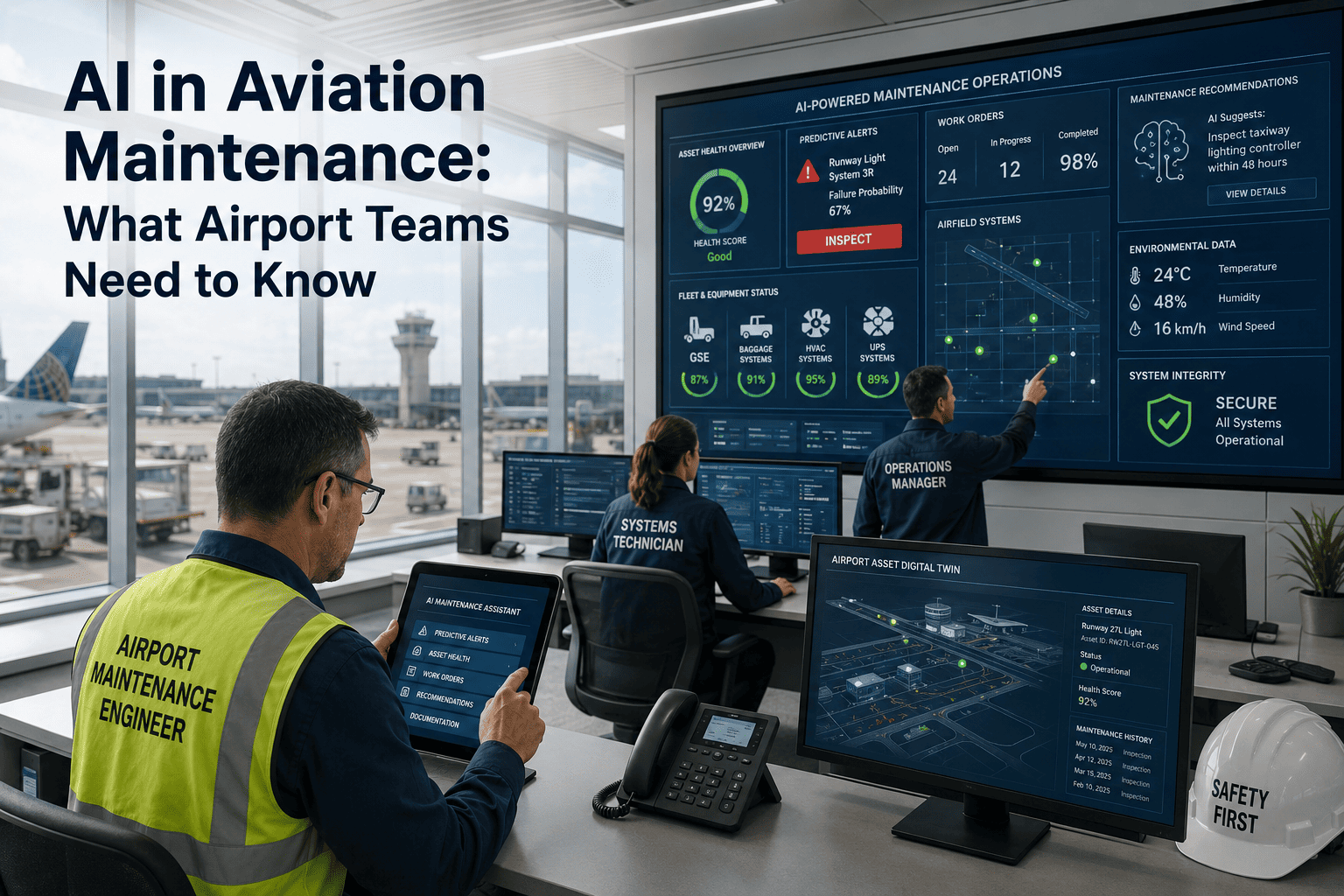
Oxmaint's Human Factors Analytics module tracks override patterns, alert acknowledgment behavior, cognitive load indicators, and shift-based decision volume — surfacing automation risk before it reaches a sign-off event.
What Are Human Factors in AI-Driven Aviation Maintenance?
Human factors in aviation maintenance is the study of how human capabilities, limitations, and behavioral patterns interact with tasks, tools, and environments to influence safety outcomes. In AI-driven maintenance, this discipline takes on a new dimension — because technicians are no longer working only with checklists and documentation. They are working with machine recommendations, probabilistic alerts, and automated prioritization that feels authoritative even when it carries significant uncertainty.
The fundamental risk is not that AI maintenance tools make mistakes. Every technology makes mistakes. The fundamental risk is that technicians and supervisors stop independently evaluating those mistakes — deferring to system outputs because overriding a machine recommendation feels uncomfortable, demands justification, or simply requires more cognitive effort than accepting it. This is automation bias, now the fastest-growing documented human factors risk category in MRO environments.
Well-designed AI maintenance platforms account for this risk at the workflow architecture level — building in mandatory verification steps, transparent confidence scoring, cognitive load monitoring, and behavioral override tracking that keeps human judgment active rather than sidelined. See how Oxmaint manages the human-AI interface — start a free 30-day trial or book a live session with our aviation human factors team.
Over-reliance on automated outputs — accepting AI recommendations without independent verification, even when physical inspection evidence contradicts the system's assessment.
Systematic desensitization to AI-generated maintenance alerts caused by high volume, poor specificity, or excessive false positives — leading technicians to dismiss critical notifications.
Operating at or beyond mental processing capacity due to simultaneous multi-system alert streams and high-tempo decision environments that exceed human working memory limits.
Gradual degradation of manual diagnostic proficiency as technicians rely increasingly on AI-generated guidance — creating hidden capability gaps that surface during system outages.
6 Documented Human Factors Risks in AI-Augmented Aviation MRO
Each risk category represents a documented failure mode identified through FAA human factors research, EASA safety analysis, and peer-reviewed studies published between 2019 and 2025. Start a free trial to see the human factors controls working live.
Automation Bias and Deference Behavior
Technicians working with high-accuracy AI systems progressively defer to recommendations even when physical evidence contradicts the output. Over-trust develops within 60 to 90 days of consistent AI tool use — and becomes invisible to quality management without behavioral monitoring infrastructure.
Identified as the primary risk factor in 38% of AI-related MRO incidents reviewed by the FAA between 2021 and 2024
Alert Fatigue from High-Volume Notification Streams
AI predictive systems generate significantly more alerts per shift than manual inspection regimes. When alert specificity is not actively managed, technicians develop dismissal behaviors that eventually extend to genuinely critical alerts at statistically dangerous rates.
Alert dismissal rates increase 54% per additional 20 non-critical alerts processed per shift without resulting action
Mode Confusion in Human-Machine Handoff Sequences
Modern MRO platforms shift between automated, semi-automated, and manual modes without consistently communicating the current mode to the technician. Task errors occur at rates 2.1 times above baseline inspection events.
Mode confusion events contribute to 17% of documented human-machine interface errors in aviation maintenance
Decision Fatigue in High-Tempo AI Workflows
AI-augmented environments increase discrete decisions per shift. Decision quality degrades measurably after sustained high-tempo sequences, with the highest-risk decisions statistically clustering in the final two hours of extended shifts.
Critical judgment quality decreases 47% in the final 2 hours of an 8-hour AI-assisted maintenance shift
Skill Erosion and Hidden Capability Gap Accumulation
As AI tools shoulder more diagnostic responsibility, technicians reduce independent application of technical knowledge. This erosion is invisible during normal operations but creates acute safety exposure during system outages or novel failure scenarios.
Manual troubleshooting proficiency declines in 71% of technicians after 18 months of primary AI-assisted workflow use
Opaque AI Confidence and Uncertainty Exposure
Most AI maintenance platforms present recommendations without confidence scores, uncertainty ranges, or data quality indicators. Technicians cannot distinguish a high-confidence recommendation from a low-confidence one generated from degraded inputs.
Only 23% of commercial MRO AI platforms currently expose confidence scoring to technicians in standard operational interfaces
4 Ways Current MRO Platforms Amplify Human Factors Risk Instead of Managing It
The majority of AI maintenance tools deployed in aviation today were designed to maximize predictive accuracy and workflow throughput — not to manage the human behavioral effects those tools create in the technicians who use them every shift.
Platforms Without Override Pattern Monitoring
89% of commercial AI-assisted MRO platforms do not track how frequently technicians override AI recommendations — leaving automation bias invisible to supervisors and quality managers until a defect escape event forces a retrospective analysis.
Alert Volume Increase Since AI Integration
Average daily alert volume in AI-equipped MRO environments is 4.3 times higher than in equivalent manual inspection regimes. Alert specificity improvements have not kept pace with volume growth.
Mandatory Human Factors Review in AI Deployment Frameworks
No major commercial aviation AI maintenance platform ships with a mandatory human factors impact assessment — meaning behavioral risks introduced by each new AI capability are never formally evaluated before reaching operational teams.
Supervisors Without Real-Time Cognitive Load Visibility
68% of maintenance supervisors in AI-assisted environments report no real-time visibility into their team's cognitive load state — unable to identify when a technician is approaching decision fatigue on a safety-critical task.
How Oxmaint Builds Human Factors Management Into the AI Maintenance Workflow
Oxmaint's Human Factors Analytics module monitors behavioral signals across the maintenance workflow — surfacing automation risk before it reaches a sign-off event. Start a free 30-day trial or book a live demo with our aviation team.
Override Pattern Monitoring and Automation Bias Detection
Every AI recommendation acceptance and override is tracked by technician, task type, shift hour, and task complexity — building a behavioral dataset that identifies automation bias patterns before they embed in team culture.
Intelligent Alert Tiering and Fatigue-Aware Notification Management
Alerts are assessed for confidence score, urgency, and operational context before routing to the technician interface — eliminating the high-volume false-positive stream that drives systematic dismissal behavior across shifts.
Mandatory Confirmation Gates for High-Risk Sign-Off Events
For tasks above a configurable risk threshold, Oxmaint inserts a human verification step that cannot be bypassed through AI recommendation acceptance alone — requiring the technician to document their own independent assessment.
AI Confidence Transparency at the Technician Interface
Every AI-generated recommendation in Oxmaint displays its confidence score, underlying data source quality, and model uncertainty range — providing the calibration information needed to set appropriate independent oversight levels.
Shift-Based Cognitive Load Monitoring and Supervisor Dashboard
Decision volume, task complexity, alert response timing, and shift duration metrics are tracked per technician in real time — providing supervisors a live dashboard that identifies team members approaching high-risk fatigue states.
Skill Maintenance Protocols and Manual Verification Scheduling
The Oxmaint workflow engine schedules regular manual inspection tasks without AI assistance — ensuring technicians maintain hands-on proficiency across skill areas most at risk of atrophy. Completion rates tracked per technician.
Unmanaged AI Integration vs Oxmaint Human-Factors-Aware Platform
The difference is not in AI capability itself — it is in whether the platform was designed to manage the human behavioral effects that AI generates in the maintenance teams using it.
| Human Factors Area | Unmanaged AI Integration | Oxmaint Human-Factors-Aware Platform |
|---|---|---|
| Automation Bias Detection | No override tracking — bias accumulates invisibly over months | Override patterns tracked per technician with supervisor alerts |
| Alert Volume Management | All alerts routed in real time — volume drives fatigue | Intelligent tiering — technician receives only actionable alerts |
| AI Recommendation Transparency | Recommendations without confidence scores | Every recommendation includes confidence score and uncertainty range |
| Cognitive Load Monitoring | No real-time visibility into technician cognitive state | Live cognitive load dashboard enables proactive reallocation |
| Sign-Off Verification Gates | AI acceptance substitutes for independent verification | Mandatory human confirmation gates — not bypassable |
| Skill Maintenance Scheduling | No manual skill workflow — AI handles all diagnostics | Scheduled manual tasks maintain proficiency across all AI-assisted areas |
| Mode Clarity | Technician unclear on current system mode | Persistent, unambiguous mode indicators on every task screen |
| Regulatory Documentation | No behavioral data captured for audits | Full behavioral dataset exportable for regulatory audits |
ROI of Structured Human Factors Management in AI-Augmented MRO Operations
Quantified outcomes that accountable managers, directors of quality, and VP-level operations leaders use to build the internal business case for human factors management investment. Book a demo to model your specific ROI with our team.
Decrease in documented automation bias sign-off events when override pattern monitoring and mandatory confirmation gates are implemented in the first 90 days.
Reduction in systematic alert dismissal behavior after intelligent tiering reduces notification volume to actionable, high-confidence items.
Average return through reduced defect escape rates, lower rework costs, avoided regulatory enforcement events, and improved SMS audit outcomes.
Technician compliance with scheduled manual verification tasks when integrated into Oxmaint — compared to 34% compliance when managed outside the work order system.
Frequently Asked Questions
What is automation bias and why is it a specific safety risk in AI-assisted aviation maintenance?
Automation bias is the tendency to over-rely on automated system outputs — accepting machine recommendations without independent verification, even when other cues indicate those recommendations may be incorrect. In aviation maintenance, this manifests when a technician accepts an AI-generated inspection pass because the system flagged it as complete, without independently confirming their own physical inspection findings. The risk is acute because the consequences of a missed defect are not a downstream quality problem. They are an airworthiness event. Without structured behavioral monitoring and override tracking in the platform, this bias accumulates invisibly — reaching dangerous levels before any quality gate catches it. Start a free trial and explore the override analytics dashboard today or book a live demo with our aviation human factors specialists.
How does Oxmaint prevent alert fatigue in high-volume AI maintenance environments?
Oxmaint addresses alert fatigue through intelligent alert classification rather than simply reducing overall notification volume. Each AI-generated alert is assessed for confidence score, task urgency, operational context, and potential consequence severity before routing to the technician interface. High-confidence, high-urgency alerts reach the technician immediately. Low-confidence alerts are batched into a reviewed queue, routed to supervisor oversight, or held pending additional data confirmation. The platform also monitors each technician's alert acknowledgment patterns over time — sudden increases in rapid acknowledgment without corresponding task action are flagged as potential alert fatigue indicators, triggering a supervisor review prompt before the behavior becomes entrenched.
How does Oxmaint support technician skill maintenance alongside AI-assisted workflows?
Oxmaint's workflow engine includes a dedicated skill maintenance scheduling module that integrates manual inspection and diagnostic tasks directly into the standard work order queue — ensuring technicians perform hands-on, AI-unassisted tasks across critical skill areas at defined intervals configured by the quality management team. Skill maintenance tasks require independent findings documentation before any AI recommendation is displayed. When a technician's manual task completion rate falls below a configurable threshold, an automatic competency review flag connects skill maintenance activity data directly to training program scheduling — ensuring that AI tool adoption never creates unacknowledged capability gaps in the team.
What regulatory frameworks currently address human factors in AI-assisted aviation maintenance?
Regulatory guidance is actively evolving across all major authorities. The FAA's Advisory Circular AC 120-72B on Maintenance Human Factors Programs provides the foundational framework for US operations. EASA's NPA 2023-11 on AI in aviation safety has proposed specific requirements for AI system transparency and human oversight, with formal rulemaking anticipated by 2026. The UK CAA and CASA in Australia have both issued safety notices highlighting automation complacency as emerging SMS risks. For UAE operations, GCAA circular guidance similarly requires demonstrable oversight of human-machine interaction risks. Oxmaint's documentation module generates audit-ready behavioral data reports mapping directly to human performance program requirements under each of these regulatory frameworks.
Keep Human Judgment Sharp — Even as AI Takes on More of the Workflow
Every AI tool you deploy changes how your maintenance teams think, decide, and verify. Oxmaint's Human Factors Analytics module builds the behavioral monitoring, alert management, and cognitive load visibility your quality program needs to ensure AI augments human judgment rather than replacing it — and that the human factors risks your AI tools introduce are identified, controlled, and documented before they reach a safety-critical sign-off event.
Trusted by aviation MRO operations across the USA, UK, Australia, UAE, Canada, and Germany. No lengthy implementation. Human factors monitoring active from day one of onboarding.