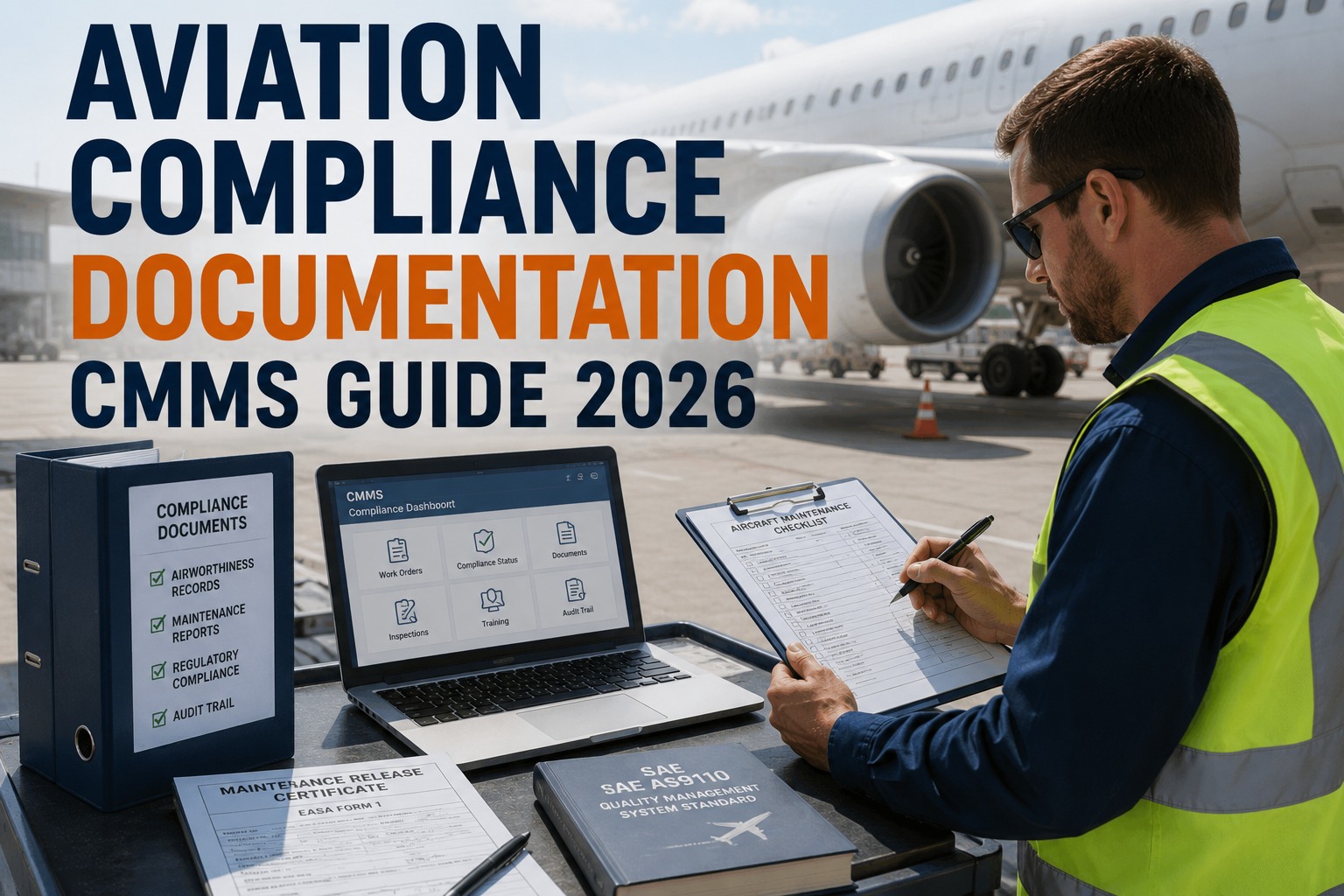
Aviation compliance documentation is where regulators judge your entire operation — a single missing sign-off can trigger enforcement, and one broken audit trail can cost a Part 145 station its approval overnight. In 2026, FAA, EASA, and CAA inspectors expect every maintenance record, e-signature, and retention archive to be retrievable in minutes, not days, which makes a purpose-built CMMS the difference between a clean audit and a finding. This guide walks through the regulatory frameworks, e-signature standards, retention rules, and CMMS architecture that turn scattered paperwork into a defensible compliance story. You can put these principles into practice today when you Start Free Trial or book a walkthrough with our team.
Can your CMMS prove compliance to an FAA, EASA, or CAA inspector in under 15 minutes?
A single missing sign-off triggers enforcement. A broken audit trail loses your Part 145 approval. Here is how aviation operators structure their CMMS so every regulator sees a defensible compliance story — instantly.
The real cost of a documentation gap
A regional MRO operating 18 aircraft under Part 145 can lose $28,000–$95,000 in revenue for every day a station is grounded pending re-audit — before counting the remediation labour.
FAA, EASA & CAA: what each regulator actually demands
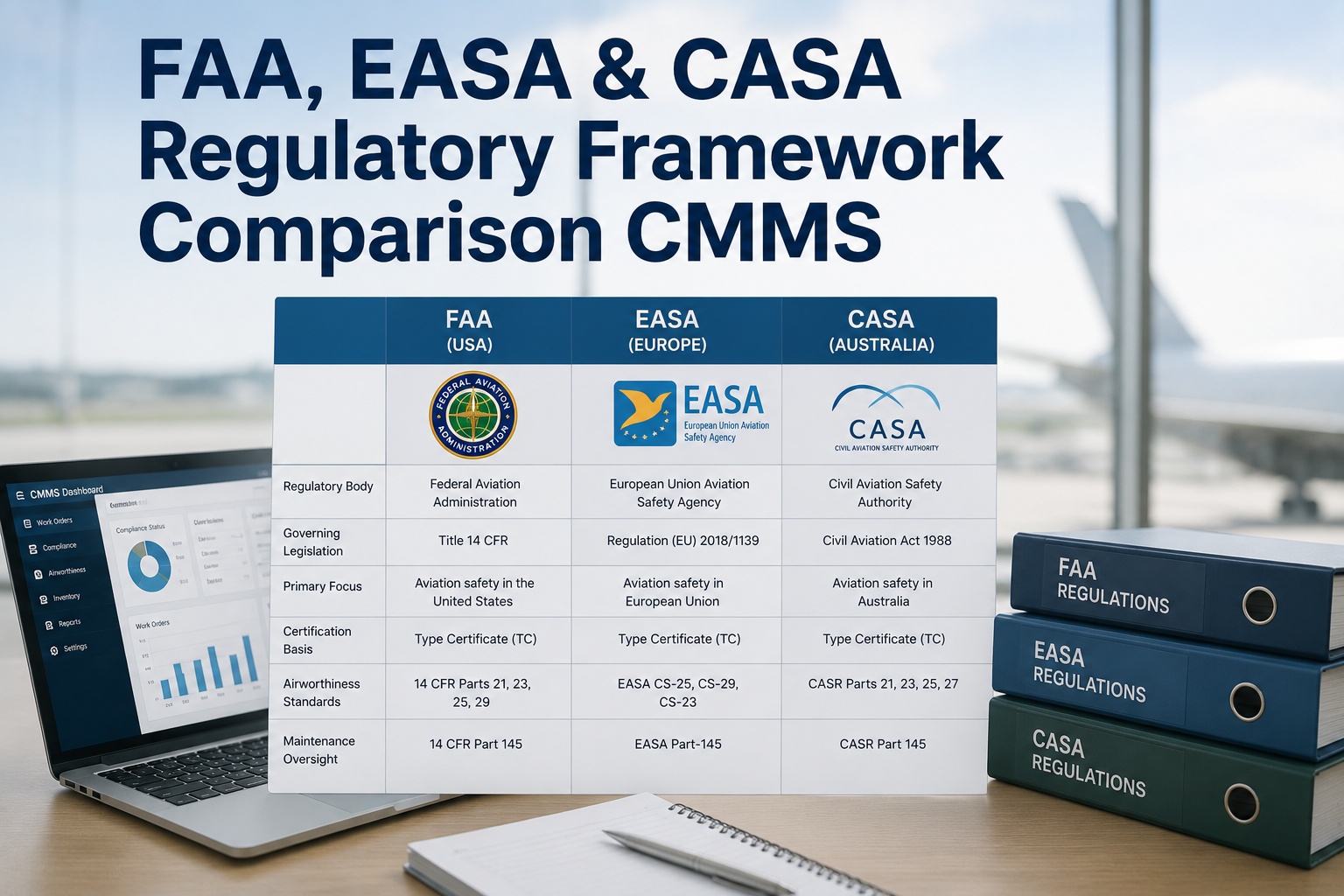
The three jurisdictions converge on the same principle — traceable, retained, electronically-signed records — but differ in scope, retention windows, and who is accountable inside the organisation.
| Regulator | Core framework | Coverage | Retention (maintenance records) | E-signature standard |
|---|---|---|---|---|
| FAA | Part 121 / 135 / 145 | Commercial operators, charter, repair stations | 1 year after work performed, or until superseded — typically 3–5 yrs in practice | 14 CFR Part 11 + AC 120-78A |
| EASA | Part-M / ML / 145 | CAMO, continuing airworthiness, approved stations | 24 months after the aircraft permanently withdrawn, or per airworthiness review cycle | Part-ML.A.305 + EU 912/2018 |
| CAA (UK) | Part-CAMO / Part-145 (post-Brexit) | UK AOC holders, CAMO, repair stations | Aligned to EASA baseline, minimum 24 months on operator records | CAA CAP 1414 + UK eIDAS |
A 5-phase CMMS rollout that holds up under audit
Operators that pass audits on the first attempt follow a sequenced rollout — not a single "go-live" weekend. Each phase below maps to a regulator-visible artefact.
Phase 1 · Record inventory & gap audit (Month 1)
Catalogue every existing form — work cards, non-routine sheets, dual-release tags, weight & balance, and AD/SB compliance folders. A 180-asset operator typically surfaces 900–1,400 active record templates that must be mapped into the CMMS.
Phase 2 · Role-based access & e-signature wiring (Month 2)
Bind every technician, inspector, and CAMO signatory to a role with a unique credential. Configure dual-signature gates for critical tasks (RII items, engine changes, structural repairs) so the CMMS refuses task closure without the second signature.
Phase 3 · Retention & immutable archive (Month 3)
Set retention policies per record type — 1 yr, 3 yr, 24 mo, or "life-of-aircraft." Lock closed records into a write-once archive so even administrators cannot backdate, satisfying Part 11 audit-trail integrity.
Phase 4 · Inspector self-service portal (Month 4)
Expose a read-only portal where FAA PMI or EASA inspector can pull any tail-number's complete airworthiness chain — AD status, last heavy check, open MEL items, deferred defects — in under 15 minutes without a chaperone.
Phase 5 · Continuous compliance dashboards (Month 5+)
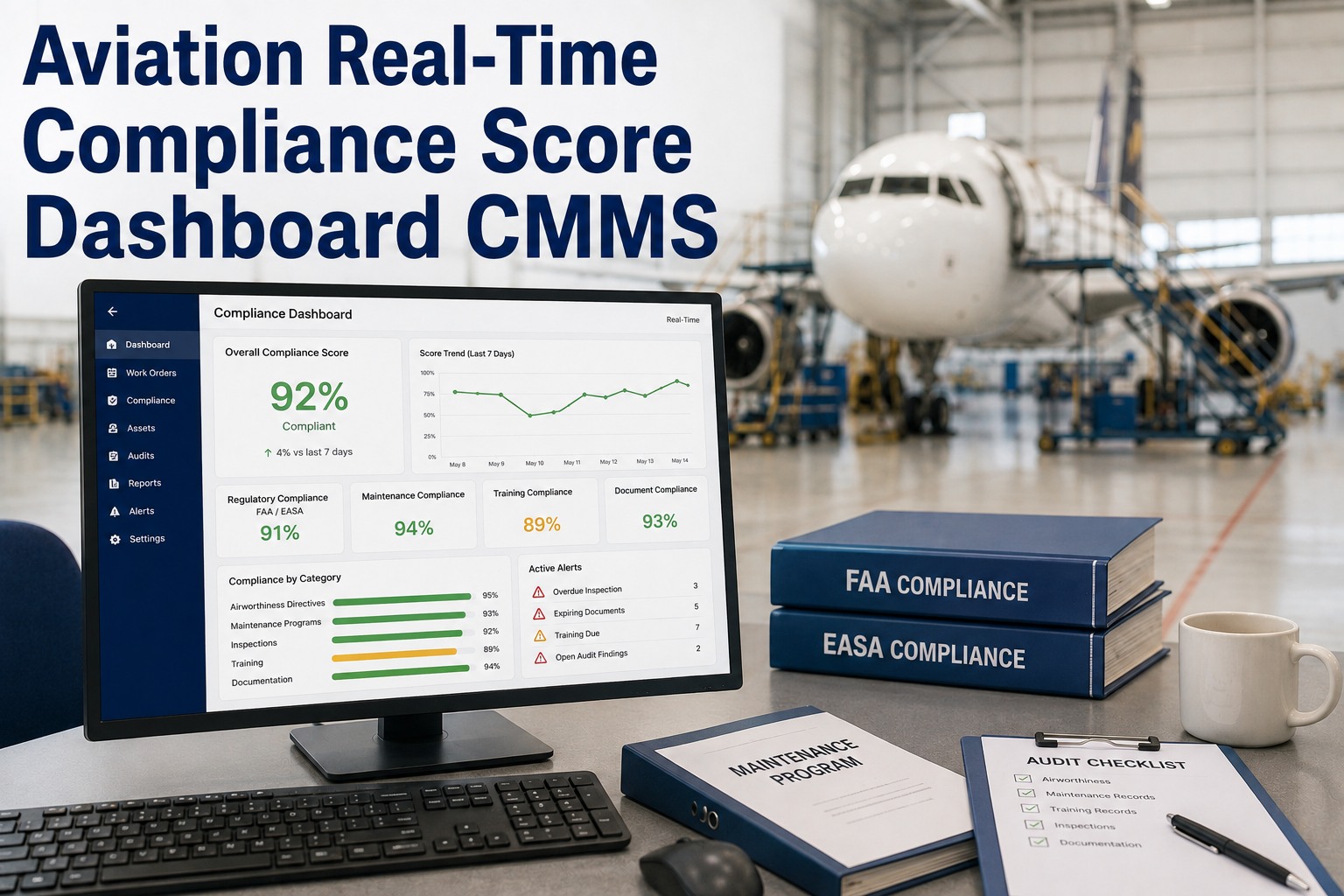
Stand up live KPIs: % tasks closed with full signature chain, records overdue for archival, AD/SB compliance aging. Operators running these dashboards cut audit-prep labour by an average of 73% within the first quarter.
12 must-have controls before your next surveillance audit
If your CMMS cannot tick every item below, you are carrying an unaddressed finding. Use this as a pre-audit self-check for FAA Part 145, EASA Part-ML, and CAA Part-CAMO environments.
Identity & signature
- Unique credential per individual, no shared logins
- E-signature captures intent, timestamp, and meaning of action
- Dual-signature workflow on RII / critical structural tasks
- Signature manifest links back to authorising certificate
Records & retention
- Retention rules per record type (1 yr / 3 yr / 24 mo / life-of-aircraft)
- Immutable, write-once archive on closed records
- Time-stamp server synchronised to a trusted NTP / UTC source
- Automated disposal schedule with sign-off before destruction
Audit & traceability
- Every field change logged with user, old value, new value, timestamp
- Inspector portal retrieves full airworthiness chain in < 15 min
- AD / SB compliance status visible per tail number, live
- Export package (PDF + structured data) generated in one action
From 42 hours of audit prep to 90 minutes
A 24-aircraft regional operator running maintenance on a mix of ERJ-145 and Q400 fleets was spending roughly 42 engineering-hours preparing each quarterly FAA surveillance audit — pulling paper work cards, reconstructing AD status, and reconciling sign-off gaps against the maintenance tracking system.
More importantly, the operator's last two FAA PMI visits closed with zero findings — the first back-to-back clean audits in the station's 11-year history. The PMI's comment: "I could see the airworthiness chain before I finished my coffee."
Stop assembling audit binders by hand.
Stand up a CMMS that produces a defensible compliance story for every tail number — FAA, EASA, and CAA — in one export.
Aviation compliance documentation — straight answers
Does a CMMS-based e-signature satisfy FAA Part 11 and AC 120-78A?
Yes, provided the signature binds the signer's identity to the record through a unique credential, captures the meaning of the action (approval, review, execution), and stamps a UTC timestamp. The CMMS must also prevent backdating and log every subsequent change. Operators running on a compliant platform pass Part 11 reviews without paper backups.
How long must aviation maintenance records be retained under EASA Part-ML?
Under Part-ML.A.305, records must be kept until the aircraft is permanently withdrawn from service, and in any case for a minimum of 24 months after the unit or aircraft has been permanently withdrawn. A CMMS lets you set per-record-type retention rules so the system archives and disposes automatically — you can Book a Demo to see the retention engine configured live.
Can a single CMMS cover FAA Part 145 and EASA Part-145 dual-release work?
Yes. Dual-release is one of the most audit-sensitive workflows in aviation maintenance. A properly configured CMMS generates a single work card carrying two independent signature blocks — one for each authority — with the system enforcing that neither release can be backdated or altered once signed. This eliminates the most common dual-release finding: mismatched sign-off timestamps.
What happens to records if we migrate CMMS platforms mid-life-of-aircraft?
Records must migrate with full audit-trail integrity — original signer, timestamp, and any amendments. Export your archive in a structured, regulator-readable format (PDF/A plus a structured data file) before migration, and validate a sample against the new system post-import. Operators who skip validation are the ones who surface findings two years later when an inspector pulls a historical record.
How quickly can we go live and pass an audit on the new system?
A focused rollout — inventory, e-signature wiring, retention archive, and inspector portal — takes 4 to 5 months for a mid-size operator. Most clients pass their first surveillance audit on the new platform within 60 days of go-live, provided the record inventory was complete. You can Start Free Trial today and begin the gap audit in parallel.
Your next audit should be 90 minutes, not 42 hours.
Put every FAA, EASA, and CAA record behind one defensible compliance story — built into your CMMS from day one.
Free 14-day trial · No credit card