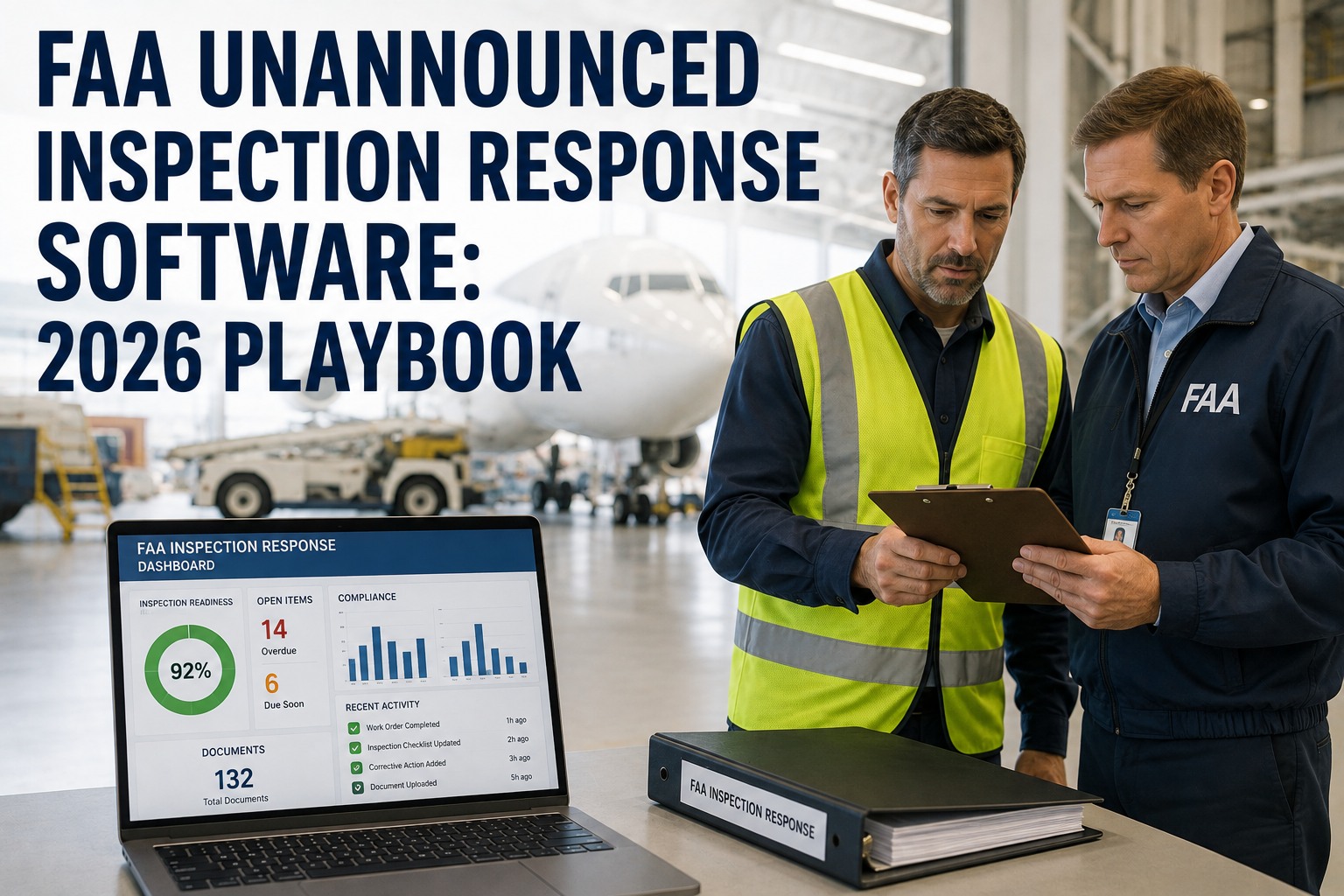
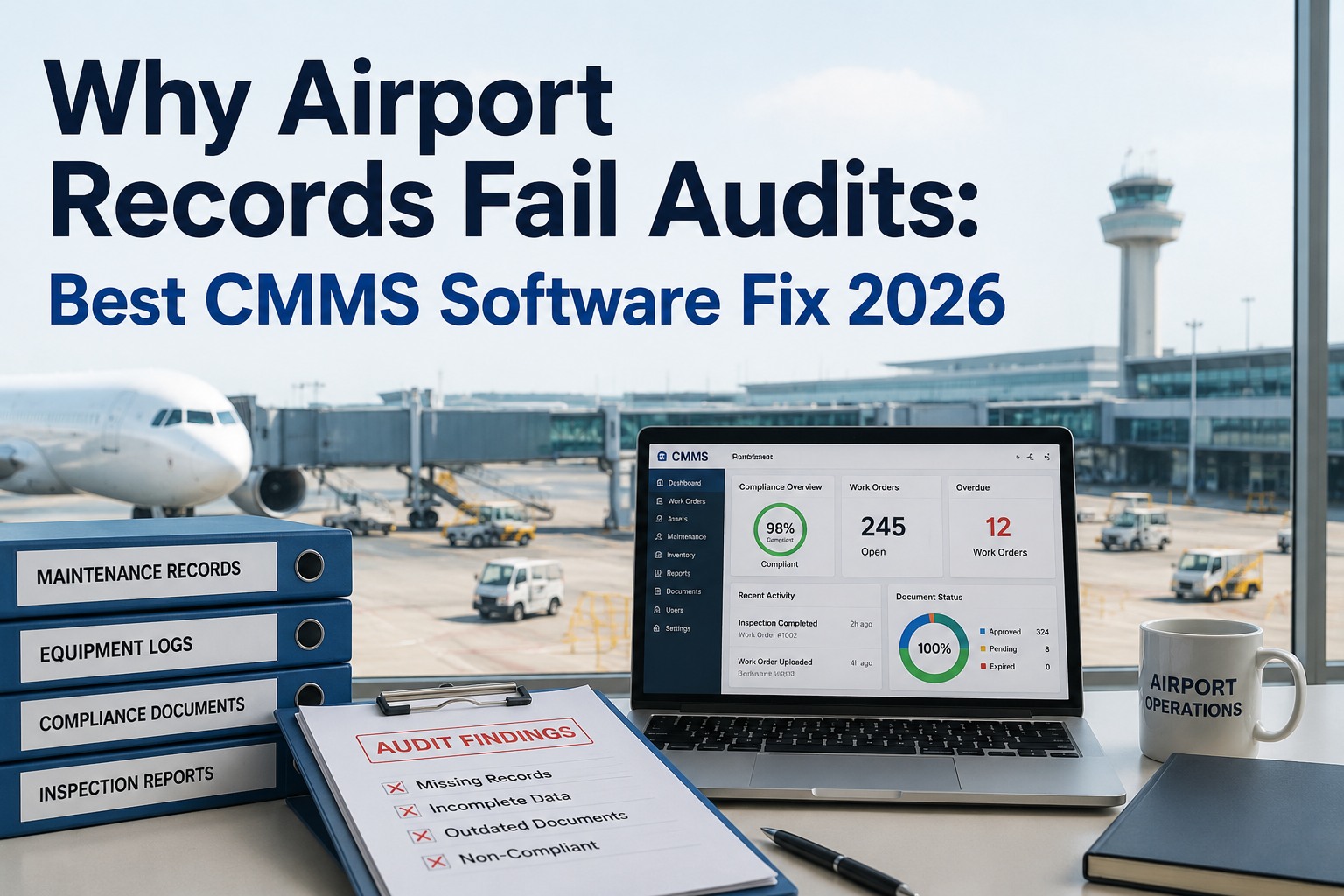
FAA unannounced inspections are the moment airport compliance stops being a documentation exercise and becomes a stopwatch at 520+ Part 139 certificated airports across the U.S., ~35 FAA Airport Certification Safety Inspectors can arrive on any day of a rolling 9–15 month cycle, and a single deficiency finding can trigger certificate action that grounds commercial operations until the corrective plan is formally accepted by the regional office. Fines run up to $1.1M. Records for training must be kept 24 consecutive months, tenant fueling inspections every 3 months with 12-month retention, and every self-inspection log must be produceable at one centralized location — with ARFF, Maintenance, and Operations records all present when the inspector walks in. Paper binders and spreadsheets simply can't satisfy the immediate-access standard. This playbook covers the four-hour arrival response, the 15 inspection areas the FAA covers, and the CMMS-native audit-trail architecture that assembles itself as work happens instead of the week before. Book a Demo to see OxMaint's Part 139 response module — every record filterable by inspection area, exportable in one click, ready before the inspector opens the first binder.
Aviation · 14 CFR Part 139 · Unannounced Inspection · 2026
FAA Unannounced Inspection Response Software: 2026 Playbook
Handle FAA unannounced inspections with the best 2026 airport software playbook — CMMS platforms delivering instant access to the records that pass Part 139 audits, from ARFF timed-response documentation through fueling facility inspections.
520+
Part 139 certificated U.S. airports subject to FAA certification safety inspections
Up to $1.1M
Enforcement fine ceiling for Part 139 violations under FAA regulatory action
9–15 mo
Standard inspection cycle window — plus unannounced visits at any time
24 months
Training record retention requirement per 14 CFR Part 139 documentation rules
The First Four Hours — Inspector Arrival to In-Briefing Handoff
The FAA inspection process starts before the inspector reaches the airport manager's office — with a pre-inspection review of files and the Airport Certification Manual. The first four hours after arrival set the tone of the entire visit. Below is the response timeline OxMaint enforces from the moment the inspector's arrival is confirmed. Start a free OxMaint workspace and configure your Part 139 response protocol within your first shift — the aviation library ships with pre-built inspector-arrival templates covering records-room activation, ARFF pre-brief, and operations sign-in.
FAA INSPECTOR ARRIVAL RESPONSE · 4-HOUR CLOCK
T + 0:00
ARRIVAL CONFIRMED
Inspector at airport manager's office. Auto-notify Records Custodian, ARFF Chief, Ops Duty Manager, Maintenance Supervisor via OxMaint distribution list. All entities converge on centralized records location.
T + 0:30
RECORDS ROOM ACTIVATED
OxMaint one-click Part 139 export queued for last 12 months: self-inspection logs, ARFF training + live-fire drill, tenant fueling quarterly inspections, corrective action closure records, ACM version log.
T + 1:00
IN-BRIEFING
Airport management + inspector. Inspection schedule agreed. Personnel and records available on OxMaint tablet at the meeting — no "we'll get back to you" moments for the routine documentation asks.
T + 2:00
ADMINISTRATIVE INSPECTION
Inspector reviews airport files, ACM/ACS, NOTAMs, self-inspection forms. Every record filterable by inspection area, date range, and asset — one click, no binder retrieval.
T + 4:00
FIELD INSPECTION BEGINS
Movement area, ARFF timed-response drill, fueling facilities, and (if applicable) night inspection. Every deficiency found routes back into OxMaint as a corrective action WO before the inspector leaves.
The 15 Inspection Areas — Complete Part 139 Coverage Map
The FAA Airport Certification Safety Inspector covers 15 specific areas during a Part 139 inspection. Each area demands its own evidence set, and any single one can produce a finding. Below is the coverage map with the record type OxMaint holds against each area. Book a live demo to see the area-by-area evidence coverage demonstrated against your airport's certification manual — an OxMaint aviation specialist walks all 15 areas on your specific ACM during the call.
01
Records & Personnel
Training logs (24-month retention), certification records, competency matrices per role
02
Paved Areas
Runway, taxiway, apron pavement condition; distress surveys; PCI trend documentation
03
Unpaved Areas
Shoulders, safety areas, drainage — inspection frequency + condition records
04
Safety Areas
RSA, ROFA, ROFZ compliance — obstruction surveys and clearance documentation
05
Marking, Signs & Lighting
Airfield lighting reliability, sign legibility, pavement marking retro-reflectivity
06
Snow & Ice Control
SICP plan, equipment PM, deicing chemical inventory, event logs per storm
07
ARFF (Rescue & Firefighting)
Timed-response drill, live-fire training annual, EMC certification, apparatus PM
08
Hazmat Handling & Storage
Fuel farm inspections, spill response plan, tenant fueling agent certifications
09
Wind & Traffic Indicators
Wind cone, lighted wind indicator, traffic direction — PM logs + serviceability
10
Airport Emergency Plan
AEP current, annual tabletop, triennial full-scale exercise documentation
11
Self-Inspection Program
Daily/continuous inspection logs, deficiency identification, corrective action chain
12
Pedestrians & Ground Vehicles
Airside driver training records, vehicle marking/lighting compliance
13
Obstructions & NAVAIDS Protection
Obstruction surveys, NAVAID protection zones, construction coordination logs
14
Wildlife Hazard Management
WHMP current, wildlife strike logs, control action documentation, annual review
15
Airport Condition Reporting
NOTAM issuance/cancellation timeliness, ACR retention, dissemination logs
The Inspector's Question Isn't "Do You Have It?" — It's "How Fast Can You Show It?"
Every deficiency finding starts the same way: a record request the airport can't produce in reasonable time. OxMaint holds every Part 139 record filterable by inspection area, date range, and asset — one-click export, no binder dive, no "we'll get back to you."
Records Retrieval Speed — Paper Binder vs. OxMaint Live Query
The single biggest gap between airports that pass unannounced inspections cleanly and those that produce findings is retrieval speed. Below is the head-to-head on the record requests inspectors make in the first hour. Sign up free and time your own record retrieval against these benchmarks in your first week — OxMaint's Part 139 filter view produces every category in under a minute.
The 4 Findings That Cost Airports Certificate Actions
Not every finding triggers certificate action, but four categories consistently do — because they represent systemic documentation failure rather than isolated defects. These are the categories a modern CMMS is specifically designed to eliminate. Schedule a working session to walk your current exposure against these four categories — an OxMaint aviation specialist reviews the gap between your existing evidence chain and Part 139 continuous-compliance standards.
01
Missed Self-Inspection Days
Coverage gaps in daily inspection logs — especially overnight and multi-runway operations where paper systems drop shifts. OxMaint auto-flags any missed daily cycle before the day rolls over.
02
ARFF Readiness Documentation Gaps
Overdue apparatus PM, expired foam agent, missed annual live-fire drill, lapsed EMC certification. OxMaint escalates ARFF compliance the moment any component drifts overdue.
03
Corrective Action Chain Broken
Deficiency identified but no linked corrective work order or closure record. Inspector cannot trace finding → action → verification. OxMaint enforces the chain — a defect cannot close without a linked corrective WO.
04
Tenant Fueling Inspection Lapses
Every 3 months mandatory, 12-month retention. Tenant fueling gaps are among the most-cited findings because the airport is responsible even when the fueler is a third party. OxMaint calendars every tenant automatically.
"
The FAA inspector arrived on a Wednesday at 09:15 — no advance notice. Under our old paper program, that same request twelve months earlier had cost us four hours of records-room reconstruction and produced two findings on missing tenant fueling documentation. This time, our Records Custodian had the last 12 months of self-inspection logs, ARFF training and live-fire drill records, and every tenant fueling inspection ready on an OxMaint tablet by the in-briefing at 10:15. Zero findings. The inspector spent the afternoon on the movement area walk rather than in the records room. It was the shortest, quietest unannounced visit we've had in eight years.
Director of Airport Operations · Regional Part 139 Airport · Class I certification · Southeastern USA
Frequently Asked Questions
Can the FAA really inspect an airport unannounced?
Yes. While Part 139 certification safety inspections typically occur on a 9–15 month cycle, the FAA can conduct an unannounced surveillance inspection at any time — often triggered by a safety event, a prior finding follow-up, or routine sampling.
Sign up free on OxMaint to configure your records-room activation protocol so any arrival — announced or not — starts a fast, structured response.
What records does the FAA typically request first?
The first-hour requests are almost always the last 12 months of self-inspection logs, ARFF training and annual live-fire drill records, tenant fueling quarterly inspections, corrective action closure chains, and the current Airport Certification Manual with its change log. OxMaint holds all five categories one filter click away.
What are the consequences of a Part 139 finding?
Findings range from a Letter of Correction requiring a corrective action plan to certificate action that suspends commercial operations until the corrective plan is formally accepted. Enforcement fines can reach $1.1M. A single systemic finding — missed self-inspection days, ARFF documentation gap — can trigger the more serious end of that range.
Book a demo to walk your specific exposure with a Part 139 specialist.
Does OxMaint produce a complete Part 139 compliance package on demand?
Yes. Every OxMaint work order and inspection is tagged with its applicable Part 139 area. Filtering to any area and date range produces a complete, timestamped, e-signed audit package exportable in one click — including photo evidence, corrective action chains, and training records tied to the responsible personnel.
How does OxMaint handle ARFF-specific documentation requirements?
OxMaint manages ARFF apparatus PM schedules (including quarterly pump and pressure tests), foam agent inventory with expiration alerts, annual live-fire drill documentation, EMC certifications, and timed-response drill records — all tied to the airport's certificated ARFF index. Any component that drifts overdue auto-escalates before it becomes a finding.
Can OxMaint replace our existing Airport Certification Manual system?
OxMaint holds the ACM as a version-controlled document with change log, links every inspection template to the applicable ACM procedure and version, tracks distribution and acknowledgement across airport personnel, and alerts on annual review dates. The ACM stays current; every field entry proves the crew ran the right SOP against the right version.
What if we already run a separate compliance system alongside our CMMS?
OxMaint runs alongside SAP PM, Maximo, or an existing compliance system — adding mobile-first inspection execution, area-tagged evidence capture, and one-click FAA export without disturbing ERP or existing records systems. Bidirectional integration keeps procurement, HR training records, and compliance data all coherent.
Start a free workspace to test the integration approach against your existing stack.
Make the Audit Trail Assemble Itself — Every Day, Not the Week Before.
OxMaint's Part 139 module tags every work order, inspection, and corrective action with its applicable FAA inspection area — self-inspection, ARFF, tenant fueling, ACM, all 15 areas. One-click export, filterable by date range and area, ready before the inspector opens the first binder.