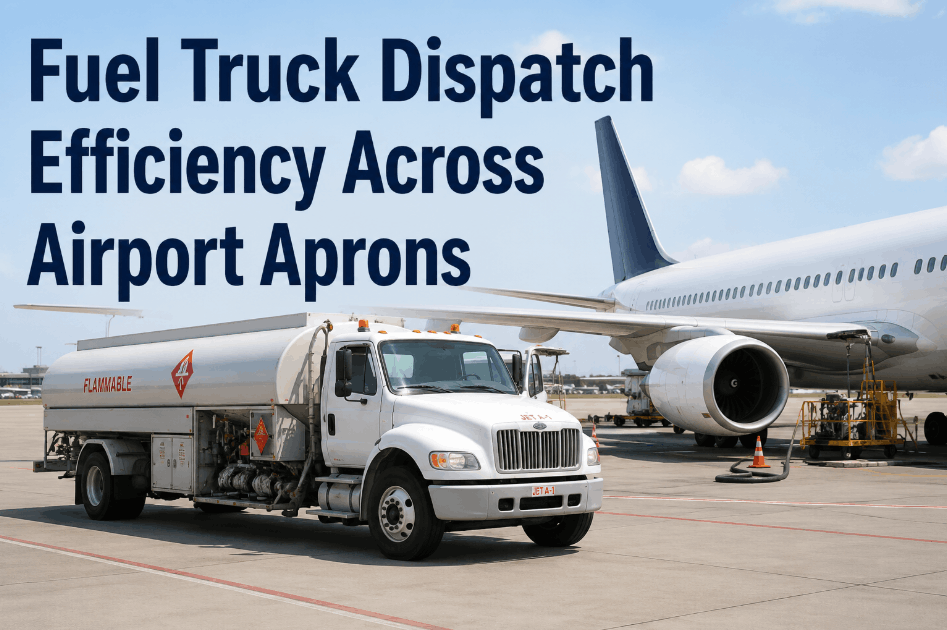
Refueling delays at busy hub airports rarely come from fuel supply problems — they come from truck routing that hasn't been optimized for the apron layout, dispatch decisions made on habit rather than real-time stand sequencing, and service block timing that compounds when even one truck runs a longer loop than necessary. When fuel trucks are covering unnecessary apron distance during peak departure blocks, every minute of extra travel time propagates directly into aircraft departure delays and tightening ground time margins. A major domestic hub operating 19 fuel trucks across a single-runway apron identified this pattern across its three busiest daily blocks: average refueling cycle times were 14% above industry benchmark, truck dispatch ran from a static daily plan rather than live stand sequencing, and there was no mechanism to reallocate a truck mid-block when a departure sequence shifted. If your hub is managing fuel truck operations without route optimization or live dispatch coordination, Sign Up Free to see how Oxmaint structures fuel fleet dispatch for apron efficiency — or Book a Demo with a fueling operations specialist.
Fuel Truck Routing · Apron Dispatch · Refuel Cycle Time
Stop Losing Ground Time to Fuel Truck Routes Built for Yesterday's Apron
Live stand sequencing, dynamic truck dispatch, and refuel cycle analytics — Oxmaint helps hub operations teams cut apron loop times and eliminate refueling delays across every operating block.
Facility Profile
The Operation: A Fuel Fleet Running Static Routes Across a Dynamic Departure Apron
Facility Overview
IndustryCommercial aviation — domestic hub, single-runway apron layout
Scope1 apron, 19 fuel trucks, 3 peak operating blocks, 210+ daily aircraft services, 4 fueling supervisors across 2 shifts
Team19 licensed fuel operators, 4 shift supervisors, 1 fueling operations manager
Prior SystemStatic daily dispatch plan distributed at shift start with no live stand-sequence feed or mid-block reallocation capability
Oxmaint FeaturesWork Order Management · AI & Automation · Analytics & Reporting Dashboards · Asset Management · Inspections & Checklists · Real-Time Alerts
Baseline Refueling Issues
+14%
Average refueling cycle time above industry benchmark across the three peak blocks
23%
Of refueling starts delayed by more than 5 minutes due to truck routing or positioning gaps
No reallocation
When departure sequences shifted mid-block, fuel trucks had no mechanism to reprioritize — they followed the original static plan
Root Cause Analysis
Why Fuel Truck Routing Was Adding Unnecessary Time to Every Refueling Cycle
A review of refueling logs, departure timing records, and truck movement data identified four compounding gaps in how fuel dispatch was structured. The trucks and fuel supply were adequate — the routing and dispatch logic were not. Sign Up Free to optimize fuel truck routing on your own apron — or Book a Demo to see dynamic dispatch coordination live.
39%
Static Daily Dispatch Plans Not Adjusted for Live Departure Sequence Changes
Trucks followed the morning plan even when departure sequences shifted during the block — sending trucks on longer routes to stands that had already pushed back or reprioritized.
28%
Apron Loops Designed Around Historical Stand Usage, Not Current Traffic Patterns
Routes had been set years earlier and not revised as gate assignments evolved, meaning trucks regularly covered more apron distance than the shortest current path between consecutive service stands.
21%
No Visibility Into Which Truck Was Closest to a Priority Stand at Any Given Time
Supervisors dispatched by radio without real-time truck position data, sometimes sending a truck across the apron when a closer unit was finishing a service two stands away.
12%
Refuel Cycle Data Not Analyzed Against Departure Performance
Operations management had no reporting linking individual refueling delays to their downstream effect on departure timing, making it impossible to prioritize routing improvements by impact.
The Solution
How Oxmaint Rebuilt Fuel Truck Dispatch Around Live Stand Sequencing and Cycle Data
The hub deployed Oxmaint to connect fuel truck dispatch to live departure sequencing, digitize refueling work orders with cycle time tracking, and give supervisors a real-time view of truck availability and stand priority across the full apron. Sign Up Free to bring live dispatch coordination to your fuel fleet — or Book a Demo to walk through apron routing analytics live.
01
Live Stand Sequencing Feed Connected to Fuel Dispatch Priority Queue
Oxmaint's work order and task management layer connected to the live departure sequence, automatically reordering the fuel dispatch priority queue when stand assignments or departure times shifted — replacing the static morning plan with a continuously updated service list.
02
Digital Refueling Work Orders Gave Supervisors Real-Time Truck Status Across the Apron
Each refueling service was logged as an Oxmaint work order with start, completion, and truck ID, giving supervisors a live view of which trucks were available and where on the apron — enabling nearest-truck dispatch rather than radio-based guesswork.
03
Apron Loop Routes Rebuilt Using Cycle Time Data From the First 30 Days of Tracking
Oxmaint's analytics identified the specific stand-to-stand loops generating the longest average transit times, allowing the fueling operations manager to redesign routes around current gate usage patterns rather than outdated historical assumptions.
04
Refuel Cycle Analytics Linked Delay Events to Departure Impact for Prioritized Improvement
Shift-level reporting in Oxmaint connected individual refueling delays to their downstream departure timing effect, letting operations management prioritize routing and dispatch improvements by actual impact rather than by frequency alone.
Results at 60 Days
Refuel Cycle Time, Truck Dispatch, and Departure Impact Two Months After Deployment
18%
Reduction in average refueling cycle time across all three peak operating blocks
23% → 6%
Refueling starts delayed more than 5 minutes due to routing or positioning gaps
100%
Of fuel dispatch now running from live stand sequence, not static morning plan
4.2 min
Average reduction in apron loop time per truck per block after route rebuild
31%
Reduction in departure delays directly attributable to fuel service timing
2.4×
ROI on Oxmaint within 60 days from reduced fuel delay penalties and recovered ground time
| Metric |
Before Oxmaint |
60 Days After |
Change |
| Avg refueling cycle time vs benchmark |
+14% above benchmark |
Within benchmark range |
-18% |
| Refuel starts delayed >5 min |
23% of services |
6% of services |
-74% |
| Dispatch method |
Static daily plan |
Live sequence-driven queue |
Dynamic |
| Apron loop time per truck per block |
Baseline (untracked) |
-4.2 min average |
-4.2 min |
| Departure delays from fuel timing |
Untracked baseline |
31% reduction measured |
-31% |
| Platform ROI |
Not measured |
2.4× within 60 days |
2.4× |
Key Business Impact
What Fuel Truck Route Optimization Means for Hub Departure Performance
Fuel truck routing problems are invisible until you have the data to see them. A static plan built for last year's gate map sends trucks on routes that made sense once but add unnecessary minutes to every cycle today. When you connect dispatch to live stand sequencing and track actual cycle times per loop, the inefficiencies show up immediately — and so do the fixes. Oxmaint gives fueling operations teams that data layer without requiring a complete rework of how dispatch is managed, just better information driving the same decisions.
Kwame Asante, Airport Fueling Operations & Apron Efficiency Specialist
17 years aviation ground services · Former fueling operations manager, major domestic hub · Specialist in fuel truck fleet coordination, apron route optimization, and refueling cycle performance
Live Dispatch · Route Optimization · Cycle Time Analytics
Give Your Fuel Fleet Dispatch Data That Moves as Fast as the Apron Does
Live stand sequencing, digital refueling work orders, route rebuild analytics, and departure impact reporting — Oxmaint helps hub operations teams cut refuel cycle times and protect ground time across every peak block.
FAQs
Frequently Asked Questions
How does Oxmaint help optimize fuel truck routing across a hub apron?
By connecting fuel dispatch to live stand sequencing and tracking actual cycle times per loop, Oxmaint identifies inefficient routes and enables nearest-truck dispatch rather than static radio-based assignment.
Can Oxmaint adjust fuel truck dispatch when departure sequences change mid-block?
Yes. The dispatch priority queue updates automatically when stand assignments or departure times shift, so trucks are always responding to the current sequence rather than a plan built hours earlier.
Does Oxmaint track individual refueling cycle times for performance analysis?
Yes. Each refueling service is logged as a work order with start, completion, and truck ID, giving supervisors per-loop cycle data to identify and eliminate the routes adding unnecessary time.
How does Oxmaint link fuel truck delays to downstream departure performance?
Shift-level analytics in Oxmaint connect individual refueling delays to their departure timing impact, letting operations teams prioritize routing improvements by actual downstream effect.
How quickly can a hub fueling operation go live with Oxmaint's dispatch and tracking tools?
Most fueling operations teams complete digital work order setup and live dispatch integration within two weeks, with cycle time analytics available from the first week of active logging.
Every Truck, Every Block, Every Stand
Bring Fuel Truck Route Optimization and Live Dispatch to Your Hub Operation
Oxmaint brings live stand sequencing, digital refueling work orders, apron route analytics, and departure impact reporting to hub fueling operations — without replacing your existing dispatch infrastructure.