Aviation asset failures do not happen without warning — they happen without detection. Every baggage conveyor bearing that seizes mid-shift, every jet bridge drive motor that fails at gate, and every AGL circuit that trips during an approach had a detectable degradation signature days or weeks before the failure event. The problem is not a lack of data — modern airport systems generate enormous volumes of sensor readings, BMS alerts, and operational logs. The problem is the absence of an analytical layer that converts those readings into specific, actionable predictions before failure costs are incurred. AI forecasting closes that gap: not by replacing maintenance engineers, but by giving them visibility into failure trajectories that no human monitoring programme can match at scale. Start a free trial with Oxmaint to see AI-powered failure forecasting applied to your airport's asset portfolio, or book a demo and walk through your specific asset structure with our team.
Article · AI Forecasting · Aviation Asset Failures · Predictive Maintenance
How AI Helps Forecast Aviation Asset Failures
How machine learning models, IoT sensor integration, and predictive analytics are giving airport maintenance teams 2–8 weeks of advance warning before asset failures — and what it takes to deploy AI failure forecasting across airport equipment portfolios.
82%
Reduction in unplanned downtime at airports deploying IoT-connected predictive maintenance (McKinsey)
2–8 wks
Advance warning window delivered by AI anomaly detection before failure events on airport equipment
$2.3M
Average annual maintenance savings at mid-size airports using AI-driven predictive programmes (Deloitte)
5–10×
ROI on predictive maintenance AI investment in airport and commercial building portfolios (Deloitte)
Most airport asset failures have a detectable sensor signature 2–8 weeks before the failure event — AI forecasting turns that signal into a scheduled repair before operations are disrupted.
What Is AI Failure Forecasting for Aviation Assets?
AI failure forecasting for aviation assets is the application of machine learning models to continuous sensor data streams — identifying degradation patterns that precede specific failure modes on airport equipment classes, and generating maintenance recommendations with enough lead time for planned intervention. It is distinct from threshold-based alarming (which fires after a reading exceeds a limit) and from calendar-based preventive maintenance (which services assets on fixed intervals regardless of actual condition). AI forecasting operates between those two approaches: detecting the pattern of change that indicates a developing failure, estimating remaining useful life, and recommending the optimal intervention window.
For airport operations, the value proposition is direct. A baggage conveyor that fails mid-peak hour generates flight delays, passenger complaints, and emergency contractor call-outs at 3–5× standard labour rates. The same conveyor, serviced three weeks earlier when an AI model detected developing bearing wear, costs a fraction of the reactive event — with zero operational disruption. Multiplied across the full airport asset portfolio (baggage systems, jet bridges, HVAC, AGL, GSE, lifts, generators), the financial impact of shifting even 30% of failures from reactive to predicted is measured in millions annually.
The shift from reactive to AI-predicted maintenance is not a future-state aspiration for most airports — it is achievable with existing sensor infrastructure. Most commercial airports already have BMS, SCADA, and IoT sensors generating the data required. The gap is the analytical layer that converts raw readings into failure forecasts. Teams making this shift see up to 40% lower breakdown costs within the first year — start a free trial with Oxmaint to see AI failure forecasting applied to your assets, or book a demo to review your current sensor coverage and forecasting readiness.
The 8 AI Forecasting Capabilities That Transform Airport Maintenance
01
Anomaly Detection Engine
ML classifiers compare incoming sensor patterns against baseline operating profiles for each asset — detecting deviations that indicate developing failures weeks before threshold alarms would fire.
02
Remaining Useful Life Estimation
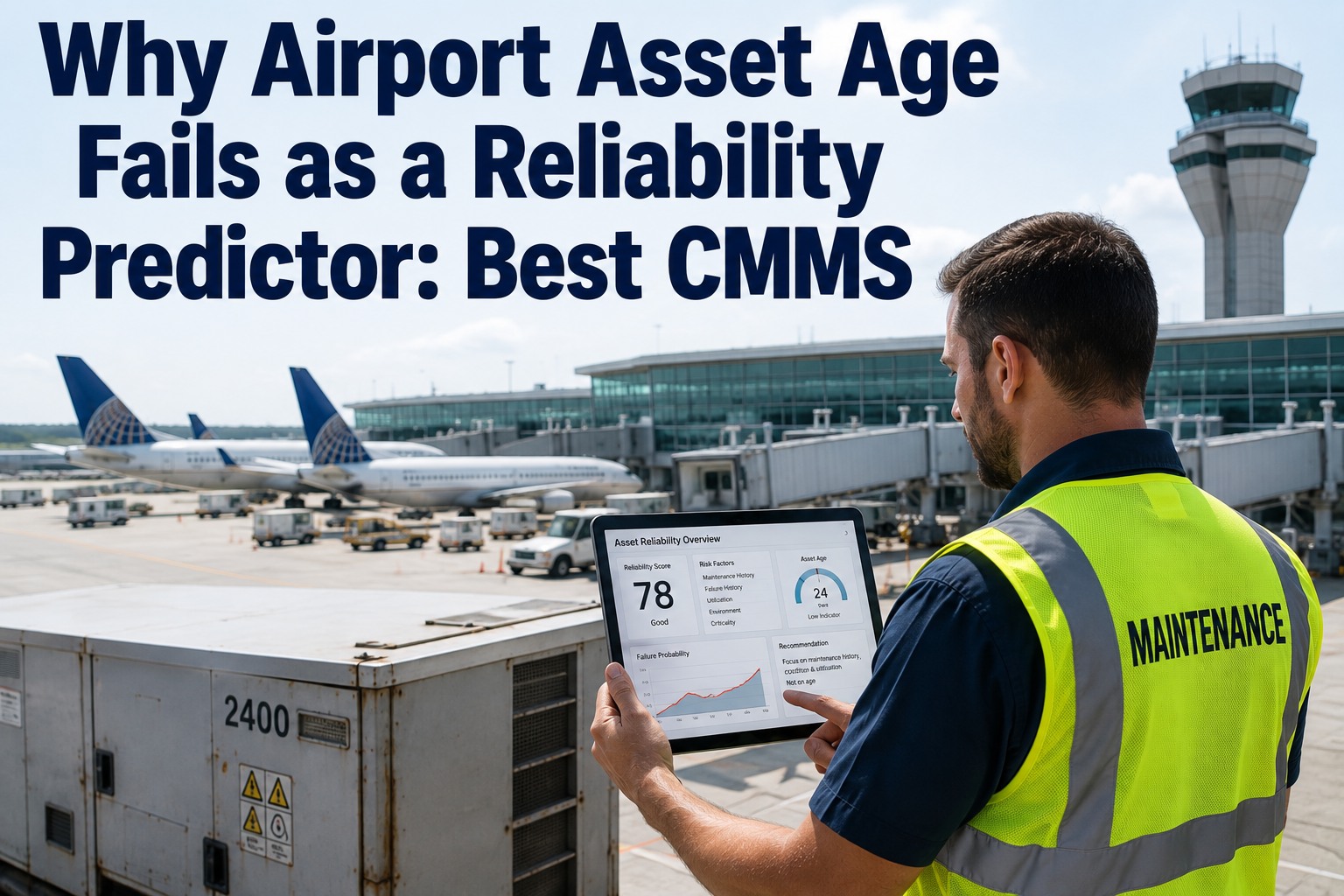
Once a degradation pattern is confirmed, RUL models estimate time to failure based on degradation rate, operational load, and historical failure data — producing a specific intervention window, not just an alarm.
03
Failure Mode Classification
AI models distinguish between specific failure types on the same asset — identifying whether a conveyor motor anomaly is bearing wear, winding degradation, or belt tension — enabling targeted repair rather than generic inspection.
04
Multi-Sensor Fusion
Combining readings from vibration, temperature, current draw, pressure, and flow sensors produces higher-accuracy predictions than any single sensor. AI correlates cross-sensor patterns invisible to individual threshold monitoring.
05
Auto Work Order Generation
Confirmed failure predictions auto-generate CMMS work orders with asset ID, failure mode, predicted failure window, recommended action, and priority level — delivering forecasts as actionable maintenance tasks, not raw alerts.
06
Confidence Scoring and Prioritisation
Every prediction carries a confidence percentage — allowing maintenance teams to prioritise high-confidence critical alerts for immediate action while monitoring developing medium-confidence patterns. Eliminates alarm fatigue from binary threshold systems.
07
Continuous Model Improvement
Work order outcomes feed back into the AI model — improving prediction accuracy from the generic baseline to site-specific as the system accumulates data from your airport's actual equipment failure history.
08
CapEx Forecasting Integration
AI-generated asset health trajectories feed directly into rolling CapEx models — replacing age-based replacement assumptions with condition-driven forecasts that show when specific assets will reach end-of-life intervention thresholds.
6 Reasons Airport Maintenance Still Runs Reactive — and Why AI Fixes Each One
Threshold Alarms Fire Too Late
Traditional BMS and SCADA alarms trigger when a reading exceeds a fixed limit — by which point the failure is already developing or complete. AI anomaly detection identifies the pattern of change 2–8 weeks before any threshold is crossed.
Calendar PM Misses Actual Condition
Fixed-interval PM services assets that don't need it and misses assets degrading faster than the interval predicts. AI condition-based scheduling services assets at the right time — extending asset life and eliminating unnecessary PM labour cost.
No Cross-Asset Pattern Visibility
Human monitoring cannot correlate sensor patterns across hundreds of assets simultaneously. AI multi-sensor fusion identifies compound degradation signatures — where two individually unremarkable readings combine into a high-confidence failure prediction.
Alarm Fatigue Suppresses Response
Threshold-based systems generate high false-positive rates — maintenance teams learn to discount alerts. AI confidence scoring filters noise: only confirmed high-probability predictions generate immediate action items, restoring alert credibility.
Emergency Repairs Cost 4.8× More
Reactive airport failures trigger emergency contractor rates, parts expediting premiums, and operational disruption costs. A single avoided major failure on a baggage conveyor or jet bridge system typically covers months of AI platform cost.
CapEx Based on Age, Not Condition
Without AI condition trending, asset replacement schedules are driven by age assumptions — replacing assets with remaining useful life and missing assets that are degrading faster than expected. AI-driven CapEx forecasting eliminates both failure modes.
Each of these pain points has a direct financial cost — and a direct AI solution. Airport maintenance teams switching to AI-powered forecasting eliminate the reactive premium systematically, asset class by asset class — start a free trial with Oxmaint to see which of your assets are showing early degradation signatures right now, or book a demo and we will walk through your specific asset failure risk profile.
A single avoided baggage conveyor failure at a major hub saves $80,000–$250,000 in emergency repairs, flight delays, and operational disruption — AI forecasting makes that avoidance systematic, not lucky.
How Oxmaint AI Forecasts Aviation Asset Failures
IoT and SCADA Integration
Oxmaint connects to existing BMS, SCADA, and IoT sensor feeds via BACnet, MQTT, Modbus, and OPC-UA — no new sensor infrastructure required to start. Live sensor data flows directly into asset-class-specific AI prediction models.
Asset-Class Prediction Models
Pre-trained models for baggage handling systems, jet bridges, HVAC, AGL circuits, GSE motors, lifts, and standby generators — each calibrated to the specific failure signatures of that equipment class, not generic industrial models.
30-Day Baseline Calibration
The AI model learns your airport's specific operating profile during a 30-day baseline period — distinguishing site-specific normal variation from genuine degradation patterns. Prediction accuracy increases from generic to site-specific within 60 days.
Failure Prediction Dashboard
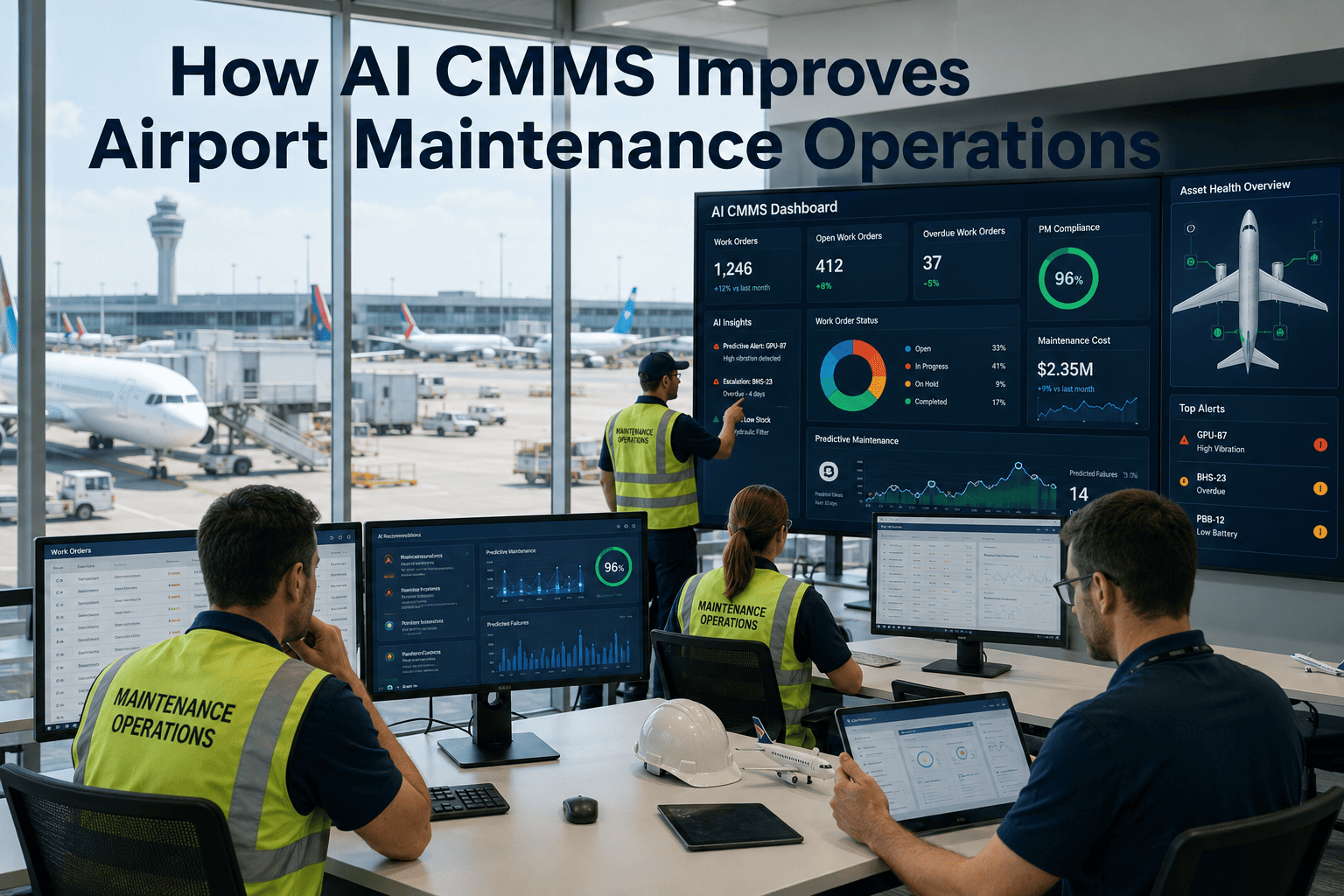
Live dashboard surfaces asset health scores, active predictions with confidence percentages, predicted failure windows, and recommended intervention actions — updated continuously as sensors report and models process new data.
Automated Work Order Creation
Confirmed predictions auto-generate CMMS work orders at the optimal intervention window — with failure mode, recommended action, required parts, and priority level pre-populated. Forecasts become maintenance tasks without manual translation.
Rolling CapEx Forecast Integration
AI asset health trajectories feed directly into Oxmaint's 5–10 year CapEx forecasting models — replacing age-based assumptions with condition-driven replacement timing that reflects actual asset degradation rates.
Oxmaint AI forecasting requires no dedicated data science team, no custom model development, and no extended implementation project. Most airports see their first predictions within 30 days of sensor integration — start a free trial to connect your existing sensor data and see what the AI finds, or book a demo to get a custom AI readiness assessment for your airport.
Reactive Monitoring vs AI Failure Forecasting: The Full Comparison
| Capability |
Reactive / Threshold Monitoring |
AI Failure Forecasting (Oxmaint) |
| Detection Timing |
At or after failure; threshold alarm fires when damage is occurring |
2–8 weeks before failure; degradation pattern detected at earliest stage |
| Alert Specificity |
Binary alarm — sensor exceeded limit; no failure mode identification |
Failure mode classified (e.g. bearing wear vs belt tension); targeted repair |
| False Positive Rate |
15–30%; threshold exceedances frequently environmental or transient |
3–8% post-calibration; confidence scoring filters noise automatically |
| Intervention Timing |
Emergency response after failure; peak-hour disruption unavoidable |
Planned repair at optimal window; scheduled off-peak with parts pre-ordered |
| Repair Cost |
4.8× standard rate: emergency contractor, expedited parts, operational disruption |
Standard planned rate; parts from MRO stock; no operational disruption |
| CapEx Planning Input |
Age-based assumptions; surprise replacements; CapEx spike risk |
AI health trajectory feeds rolling CapEx model; condition-driven timing |
| Multi-Asset Visibility |
Individual asset alarms; no portfolio-level degradation view |
Portfolio health dashboard; ranked risk list across all monitored assets |
| Continuous Improvement |
Static thresholds; no learning from failure history |
Work order outcomes feed model; accuracy improves continuously |
AI Forecasting ROI: What Airport Teams Achieve
82%
Reduction in Unplanned Downtime
Airports deploying IoT-connected AI predictive maintenance report 82% fewer unplanned failure events within 12 months (McKinsey)
91%
AI Prediction Accuracy
Post-calibration prediction accuracy on airport equipment classes after 30-day baseline period; bearing failure models reach 88–95%
40%
Lower Total Maintenance Cost
Reduction in annual maintenance spend driven by elimination of reactive premium, optimised parts procurement, and planned labour scheduling
5–10×
ROI on AI Platform Investment
Measured across avoided emergency repairs, CapEx deferral, energy efficiency gains, and labour cost reduction (Deloitte)
30 days
Time to First AI Predictions
Most Oxmaint airport customers see first actionable failure predictions within 30 days of sensor integration — no extended implementation required
$2.3M
Average Annual Savings
Average annual maintenance cost saving at mid-size airports deploying AI-driven predictive maintenance programmes (Deloitte, 2023)
These are outcomes from airports already running AI failure forecasting — not projections. A single avoided major failure event on a baggage conveyor system or jet bridge typically covers months of platform cost. The compounding value across a full airport asset portfolio is measured in millions annually — start a free trial to see which assets are showing early degradation now, or book a demo to get a site-specific ROI estimate based on your asset count and failure history.
Frequently Asked Questions
What sensor infrastructure is needed to deploy AI failure forecasting at an airport?
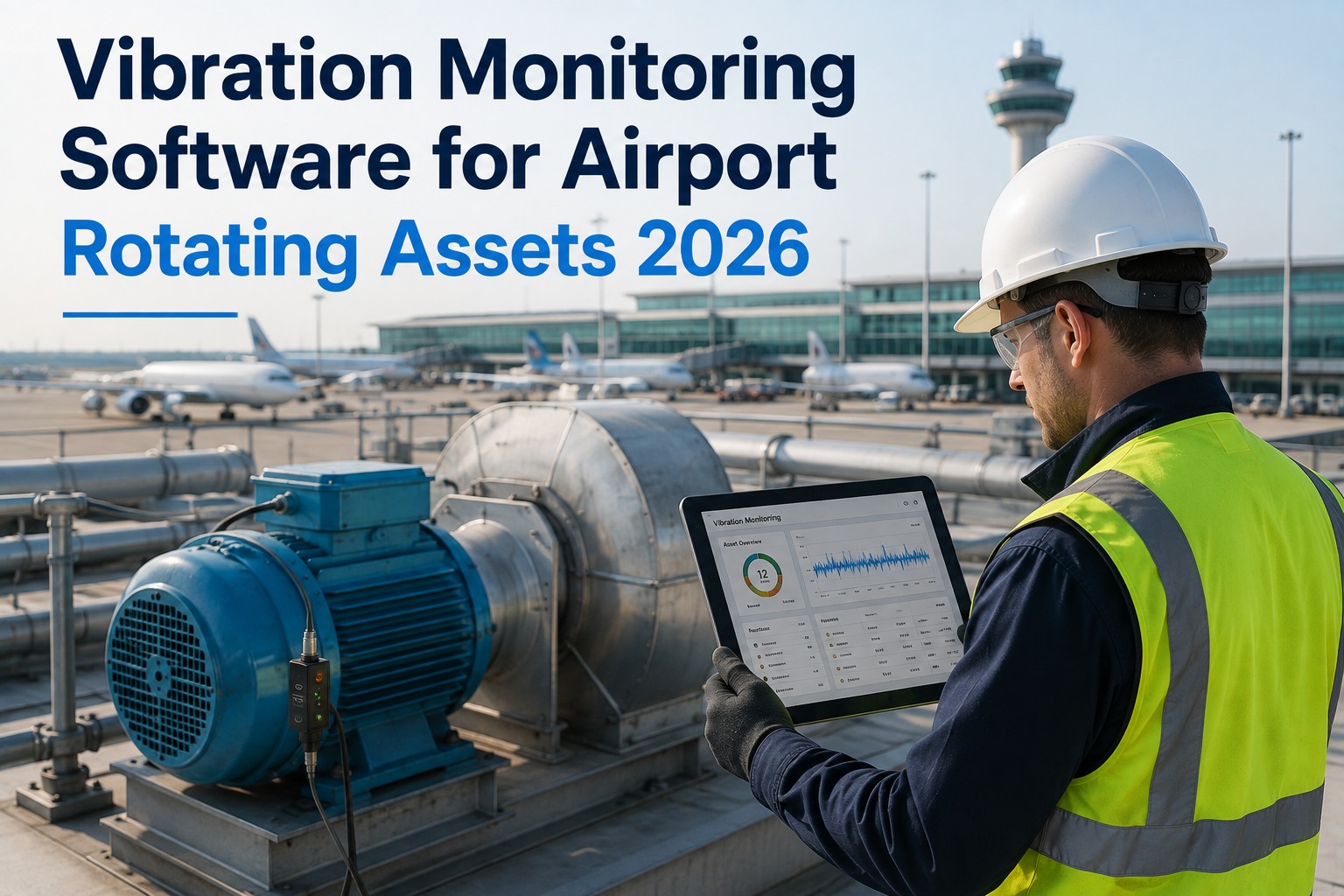
Most commercial airports already have the sensor infrastructure required to begin AI failure forecasting. The minimum viable starting point is BMS or SCADA data — temperature sensors, current draw monitoring, and pressure readings that most airport systems already record. This enables fouling detection on HVAC systems, motor current signature analysis on conveyor and GSE equipment, and pressure monitoring on hydraulic systems. Adding vibration sensors on rotating equipment (conveyor motors, HVAC compressors, pump sets) unlocks bearing wear prediction with 3–6 week lead times. Oxmaint connects to existing data sources via BACnet, MQTT, Modbus, and OPC-UA — a full sensor retrofit is not required to start. Begin with your highest-criticality assets and expand sensor coverage incrementally as AI-driven ROI justifies the investment.
Which airport asset classes benefit most from AI failure forecasting?
The highest-ROI asset classes for AI failure forecasting at airports are: baggage handling systems (high failure frequency, direct flight delay consequence, $80,000–$250,000 per major failure event), jet bridges (passenger safety impact, peak-hour failure cost), HVAC and terminal building chillers (39–50% of building energy; compressor failures $18,000–$45,000 reactive vs $3,500–$8,000 planned), standby generators and power systems ($50,000–$500,000 per power failure at critical facilities), and airfield ground lighting circuits (regulatory consequence, FAA reporting requirement). GSE vehicle fleets also deliver strong ROI from AI monitoring — bearing and hydraulic system predictions prevent airside vehicle failures that cause tarmac disruption and flight delays. Oxmaint's pre-trained models cover all major airport equipment classes without requiring custom model development.
How accurate are AI failure predictions for airport equipment in practice?
Post-calibration accuracy for airport equipment AI prediction models typically ranges from 85–93% for confirmed degradation patterns, with false positive rates of 3–8% after the 30-day baseline calibration period. Bearing failure prediction for conveyor motors, HVAC compressors, and pump sets tends to be highest accuracy (88–95%) because the vibration signature is distinctive and well-characterised. Baggage system belt and drive failures range from 82–90% accuracy. Jet bridge drive system predictions range from 78–88% depending on sensor coverage. Oxmaint displays confidence percentages with every prediction — allowing maintenance teams to prioritise high-confidence critical alerts for immediate action while monitoring medium-confidence alerts for developing confirmation. This confidence scoring eliminates the alarm fatigue that undermines threshold-based monitoring systems.
How does Oxmaint AI forecasting integrate with existing airport CMMS and maintenance workflows?
Oxmaint's AI layer generates standard CMMS work orders from confirmed failure predictions — with asset ID, failure mode classification, predicted failure window, recommended action, required parts, and priority level pre-populated. The work order enters the maintenance queue and follows the same assignment, completion, and documentation workflow as any scheduled PM task. There is no separate alert management interface — predictions become maintenance work orders automatically. For airports with existing CMMS or CAFM systems, Oxmaint integrates via API for work order synchronisation. Maintenance teams do not need to learn a new system workflow; they receive better-informed work orders through the process they already use. Work order completion data feeds back into the AI model continuously, improving site-specific prediction accuracy over time.
OXMAINT AI FAILURE FORECASTING · AIRPORT MAINTENANCE
Stop Reacting to Airport Asset Failures — Start Predicting Them 2–8 Weeks Earlier
Oxmaint connects to your existing airport sensor infrastructure, applies asset-class-specific AI failure prediction models, and delivers actionable maintenance work orders before failure costs are incurred. See measurable results in the first 30 days.
- ✔ AI failure predictions 2–8 weeks before disruption occurs
- ✔ Predictive alerts auto-converted to CMMS work orders
- ✔ 5–10 year CapEx forecasting from live AI condition data
Used by operations teams managing 10,000+ assets · Live in days, not months · No data science team required