Every airport operations director has lived through it — a baggage conveyor jams at peak hour, a jet bridge hydraulic fails mid-boarding, or a runway light cluster goes dark during an instrument approach. The equipment did not break without warning. The warning was there in vibration data, in pressure readings, in current draw trends — but nobody was watching the right signals at the right time. Airports that deploy predictive maintenance stop chasing failures and start preventing them. Explore how Oxmaint helps aviation teams catch failures before they happen.
Blog · Predictive Maintenance · Airport Operations · Aviation Asset Management
Top Airport Equipment That Benefits from Predictive Maintenance
From baggage handling to jet bridges to runway lighting — the airport assets most vulnerable to reactive failure, and how predictive monitoring changes that equation permanently.
$260B
Annual economic cost of aviation delays globally (IATA, 2023)
72%
Of airport equipment failures are predictable with IoT sensor data (Boeing Report)
4.8×
More expensive to repair equipment reactively vs planned maintenance (DOE)
35%
Maintenance cost reduction reported by airports using predictive systems (ACI)
What Is Predictive Maintenance in an Airport Context?
Predictive maintenance (PdM) uses sensor data, IoT feeds, and AI analytics to detect early signs of equipment degradation — before failure occurs. Unlike time-based preventive maintenance, which schedules work on a calendar, predictive maintenance intervenes based on actual asset condition. That distinction matters enormously in aviation, where equipment downtime has a direct, immediate impact on flight schedules, passenger safety, and regulatory compliance.
In an airport setting, predictive maintenance applies to both airside and landside equipment — from jet bridges and baggage conveyors to HVAC systems, runway lighting, ground support vehicles, and escalators. Each asset class has distinct sensor signatures, failure modes, and consequence severity. The value of predictive monitoring scales directly with asset criticality: a failed jet bridge delays a 200-seat flight; a failed baggage claim carousel affects every passenger on that flight; a failed runway light may close an entire approach path.
Modern CMMS platforms like Oxmaint integrate IoT sensor streams, work order history, and condition scoring to surface predicted failures weeks before they occur — allowing maintenance teams to schedule planned interventions rather than scramble through emergencies. Start a free trial to see how predictive maintenance works on your airport's asset portfolio, or book a demo and we'll walk through your specific equipment mix.
Most airports lose 20–40% of their maintenance budget to unplanned equipment failures that sensor data could have predicted weeks earlier.
Key Concepts in Airport Predictive Maintenance
01
Condition-Based Monitoring
Continuously tracks asset health using vibration, temperature, pressure, and current sensors — triggering maintenance when degradation is detected, not on a fixed schedule.
02
Remaining Useful Life (RUL)
AI models estimate how much operational time an asset has before failure — giving maintenance teams a precise intervention window rather than a vague alarm.
03
IoT Sensor Integration
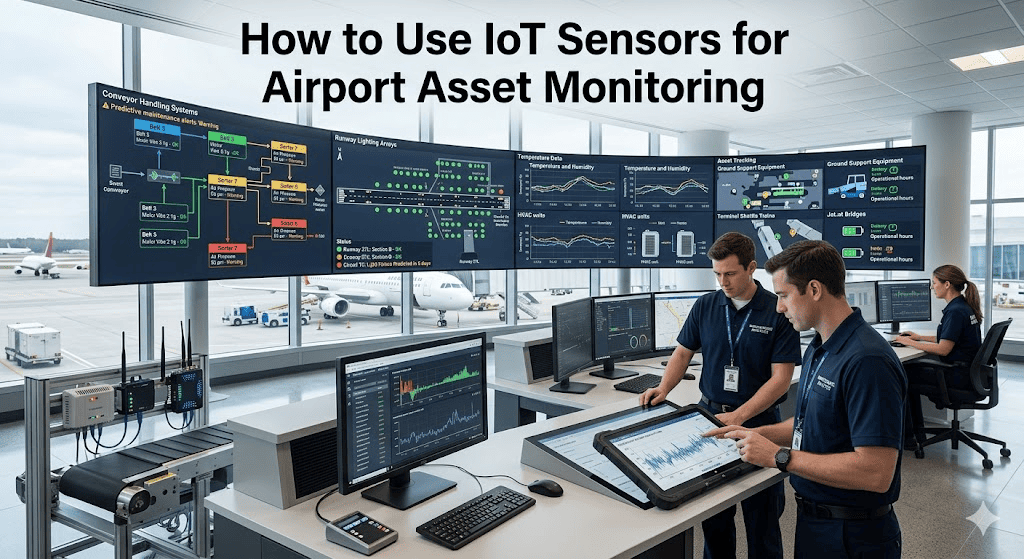
Accelerometers, pressure transducers, thermal cameras, and current clamps feed real-time data into CMMS platforms for continuous equipment health scoring.
04
Failure Mode Signature Libraries
Pre-trained AI models compare live sensor readings against known failure signatures for each equipment class — identifying bearing wear, hydraulic degradation, and electrical faults early.
05
Work Order Automation
When degradation crosses a threshold, the CMMS auto-generates a PM work order with asset ID, fault description, predicted failure window, and priority — no manual triage required.
06
Asset Criticality Ranking
Assets are weighted by operational impact — airside equipment, life safety systems, and revenue-generating assets receive priority monitoring and faster escalation paths.
07
SCADA and BMS Integration
Airport SCADA systems, building management systems, and ground support equipment telemetry feed directly into predictive platforms — no separate data collection layer required.
08
Maintenance ROI Tracking
Every predicted failure that is resolved before it occurs is logged against reactive repair cost estimates — giving finance teams auditable ROI data for programme justification.
Where Airports Bleed Maintenance Budget — 6 Critical Pain Points
⚠
Baggage System Jams at Peak Hour
Conveyor belt failures and sorter jams during peak traffic cause cascading delays across check-in, security, and gates. Reactive repair costs run $15,000–$80,000 per event, not counting operational disruption penalties.
⚠
Jet Bridge Hydraulic Failures Mid-Boarding
Jet bridge hydraulic and drive motor failures ground aircraft during boarding. Airlines bill airports for delay costs. A single boarding failure can chain to 3–4 subsequent flight delays and passenger compensation claims.
⚠
Runway Lighting Failures Without Warning
AGL (Airfield Ground Lighting) failures require immediate NOTAM issuance and potentially restrict approach categories. Emergency AGL repair at night under operational conditions costs 3–5× planned maintenance rates.
⚠
Ground Support Equipment Downtime
GPU failures, pushback tractor breakdowns, and de-icing unit failures during turns directly delay aircraft. GSE fleets managed reactively experience 40% higher breakdown rates than condition-monitored fleets.
⚠
HVAC Failures in Terminal and Cargo Areas
Terminal HVAC failures create compliance issues (temperature-sensitive cargo), passenger comfort complaints, and regulatory scrutiny. Chiller failures in cargo facilities can spoil pharmaceutical and perishable shipments worth millions.
⚠
Escalator and Lift Compliance Failures
Terminal vertical transport failures trigger accessibility compliance issues under ADA and UK Equality Act requirements. Each unplanned shutdown requires safety inspection clearance before reinstatement — averaging 6–18 hours of downtime.
These are not edge cases — they are the weekly operational reality for airports without structured predictive maintenance programmes. Start a free trial to see how Oxmaint surfaces early warnings across every one of these asset classes.
How Oxmaint Solves Airport Equipment Reliability
Asset Health Scoring Across the Entire Portfolio
Every airport asset — from baggage conveyor drives to AGL regulators — receives a live condition score updated as sensor data and work order history accumulate. Maintenance managers see the full picture in one dashboard, not scattered across spreadsheets and paper logs.
IoT and SCADA Integration Without Rip-and-Replace
Oxmaint connects to existing BACnet, MQTT, Modbus, and OPC-UA data sources — ingesting sensor streams from existing airport infrastructure without requiring new hardware installations on day one.
Failure-Mode-Specific Alerts with Lead Time
Rather than generic alarms, Oxmaint identifies specific failure modes — jet bridge drive motor bearing wear, baggage sorter belt tension degradation, AGL constant current regulator drift — with predicted failure windows and recommended actions.
Automated PM Work Orders at the Right Moment
When a degradation threshold is crossed, the system auto-generates a work order with fault details, asset history, priority level, and required parts — routed to the right technician without dispatcher intervention.
Multi-Terminal, Multi-Site Portfolio View
For airport groups managing multiple terminals or facilities, Oxmaint aggregates asset health across all sites — giving portfolio-level visibility into which assets need attention and where maintenance resource deployment will deliver the highest return.
GMP-Compliant Inspection Records for Regulatory Audit
Every inspection, work order, and maintenance event is timestamped and stored in an audit trail that meets CASA, EASA, FAA, and UK CAA documentation requirements — eliminating paper logs and reducing audit preparation time by 60–80%.
Reactive vs Predictive: Airport Maintenance Compared
| Equipment Category |
Reactive Approach |
Predictive Approach |
Cost Saving |
| Baggage Handling Systems |
Jam occurs at peak; emergency repair $20K–$80K + operational penalties |
Belt tension and motor current monitored; intervention scheduled in off-peak window at $3K–$8K |
Up to 78% |
| Jet Bridges |
Hydraulic or motor failure during boarding; aircraft delay, airline billing, 4–8hr repair |
Drive motor current and hydraulic pressure monitored; 3–5 week lead time on bearing failures |
Up to 82% |
| Airfield Ground Lighting |
Circuit failure triggers NOTAM; airside repair at night at 3–5× day rates + approach restriction |
CCR load monitoring detects lamp failure trends; batch replacements planned in daylight windows |
Up to 70% |
| Ground Support Equipment |
GPU or tug failure delays aircraft turn; emergency substitution at premium rates |
Battery state, hydraulic pressure, and engine hours monitored; PM scheduled before performance degradation |
Up to 65% |
| Terminal HVAC and Chillers |
Compressor failure in summer peak; emergency contractor, passenger complaints, cargo loss |
Vibration and refrigerant pressure trends flagged 3–6 weeks before compressor failure |
Up to 80% |
| Escalators and Passenger Lifts |
Failure triggers accessibility compliance issue; safety inspection required before reinstatement (6–18hrs) |
Motor current signature and door cycle monitoring; failures predicted 2–4 weeks ahead for planned shutdown |
Up to 72% |
ROI and Results — What Airports Actually Achieve
82%
Reduction in Unplanned Downtime
Airports using IoT-connected predictive maintenance vs reactive baselines (McKinsey)
35%
Maintenance Cost Reduction
Average across ACI member airports deploying structured PdM programmes over 24 months
6–8 wks
Average Failure Lead Time
Advance warning before critical airport equipment failure events — enough time to plan, parts-procure, and schedule
$1.2M+
Avoided Repair Cost per Year
Typical avoided reactive repair value for a single medium-size international airport running full PdM coverage
Operations teams that shift from reactive to planned maintenance see 35–40% lower total maintenance costs within the first 12 months — start a free trial to see how Oxmaint builds that shift into your airport's workflow, or book a demo and we'll walk through your specific asset structure.
Frequently Asked Questions
Which airport equipment has the highest ROI from predictive maintenance?
Baggage handling systems and jet bridges consistently deliver the highest predictive maintenance ROI because failure consequences are immediate, visible, and expensive — airline delay billing, operational penalties, and emergency contractor rates stack quickly. Secondary high-ROI assets are terminal chillers (failure consequences include cargo loss and passenger complaints in summer peaks) and airfield ground lighting (nighttime emergency repair rates are 3–5× daylight rates). Ground support equipment follows closely for high-utilisation fleets where a single unit downtime creates cascading turn delays.
Does predictive maintenance require replacing existing airport sensor infrastructure?
No. Most international airports already have BACnet, Modbus, or MQTT-capable sensor infrastructure on major systems — HVAC, electrical distribution, and some conveyors. Oxmaint connects to existing data sources without hardware replacement. The most common gap is vibration sensors on rotating equipment (baggage conveyor drives, jet bridge motors, GSE engines), which can be added incrementally at $200–$800 per asset point — far below the cost of a single avoided emergency repair. Oxmaint recommends starting with existing data coverage and expanding sensor investment based on measured ROI.
How does predictive maintenance interact with CASA, EASA, and FAA maintenance record requirements?
Oxmaint's maintenance records are timestamped, technician-attributed, and stored with full work order history — meeting the documentation trail requirements under CASA (Australia), EASA (Europe), FAA (USA), and UK CAA requirements for airport equipment maintenance. Inspection checklists are digitised with pass/fail records, photo attachments, and signature capture. Audit preparation that previously took 2–3 days of document assembly reduces to a filtered export from the CMMS. The system also supports GMP-compliant inspection protocols for airports handling pharmaceutical cargo.
How quickly can an airport deploy Oxmaint and see first results?
Most airports complete initial asset registry setup and sensor integration within 2–4 weeks. The AI model calibration period — where the system learns your specific equipment's operating baseline — runs for 30 days before alert activation. Most Oxmaint airport customers see their first predicted failure alerts within 45 days of go-live, and measurable reductions in reactive work orders within 90 days. Oxmaint does not require a multi-month implementation project or dedicated data science resources — maintenance coordinators can operate the system directly.
OXMAINT FOR AIRPORT OPERATIONS
Stop Losing Millions to Airport Equipment Failures
Turn every airport asset — from jet bridges to baggage systems to AGL — into a predictable, trackable system with condition-based monitoring, auto-generated work orders, and investor-grade maintenance reporting.
✔ Real-time asset health across every terminal and airside system
✔ Predictive failure alerts with 2–8 week lead times
✔ Regulatory-compliant inspection records and audit trails
Used by operations teams managing 10,000+ airport assets · Live in days, not months · No heavy implementation required