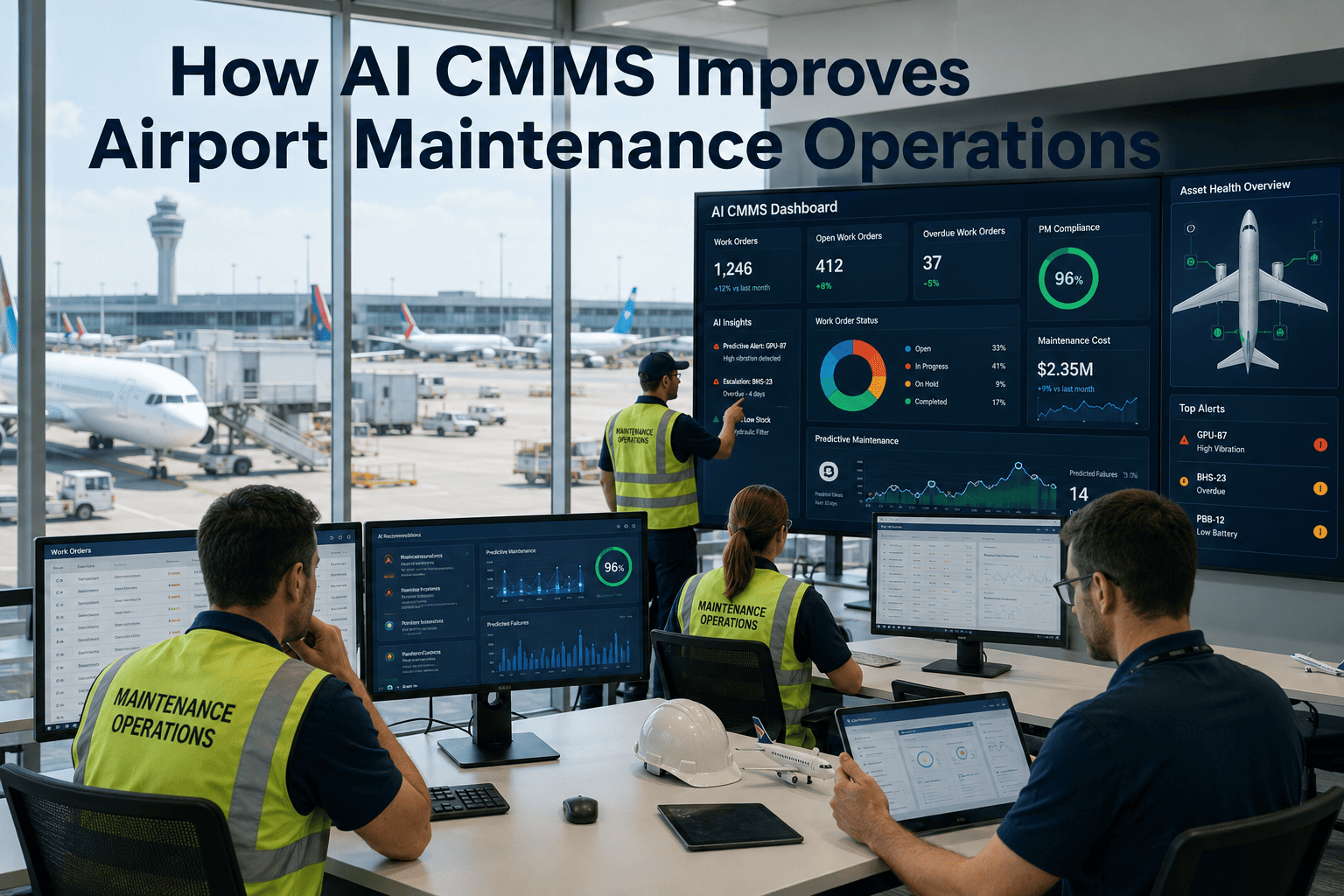
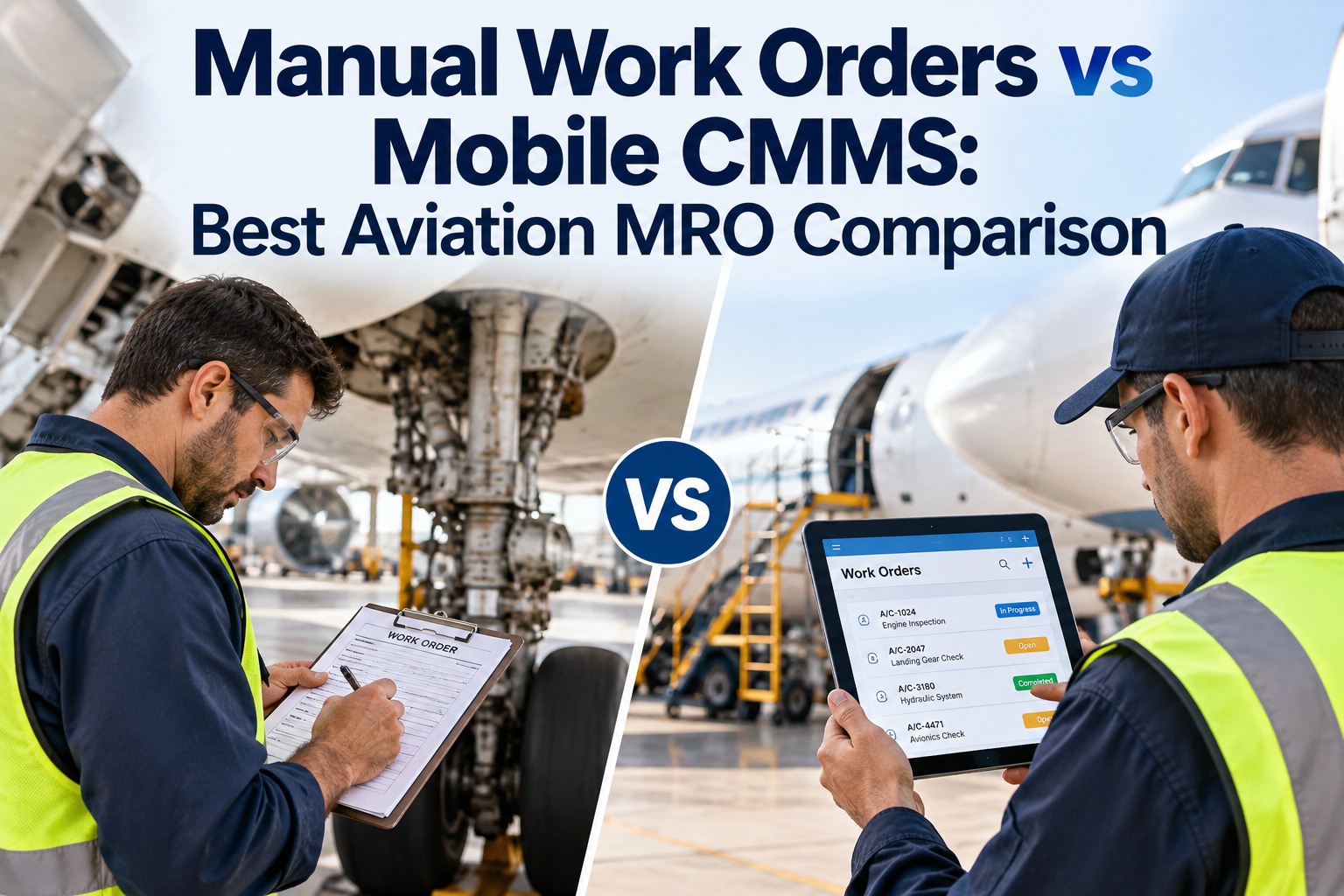
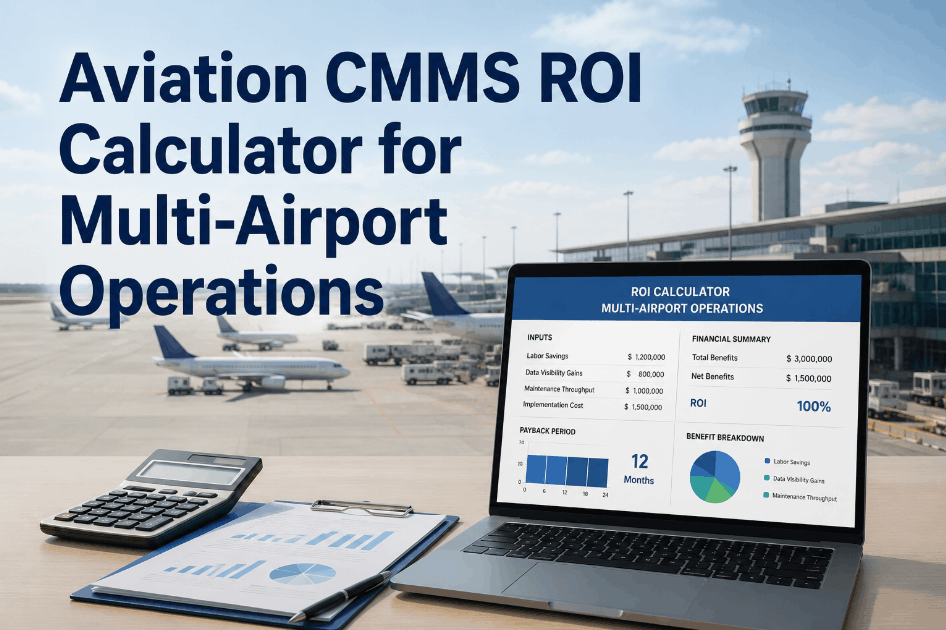
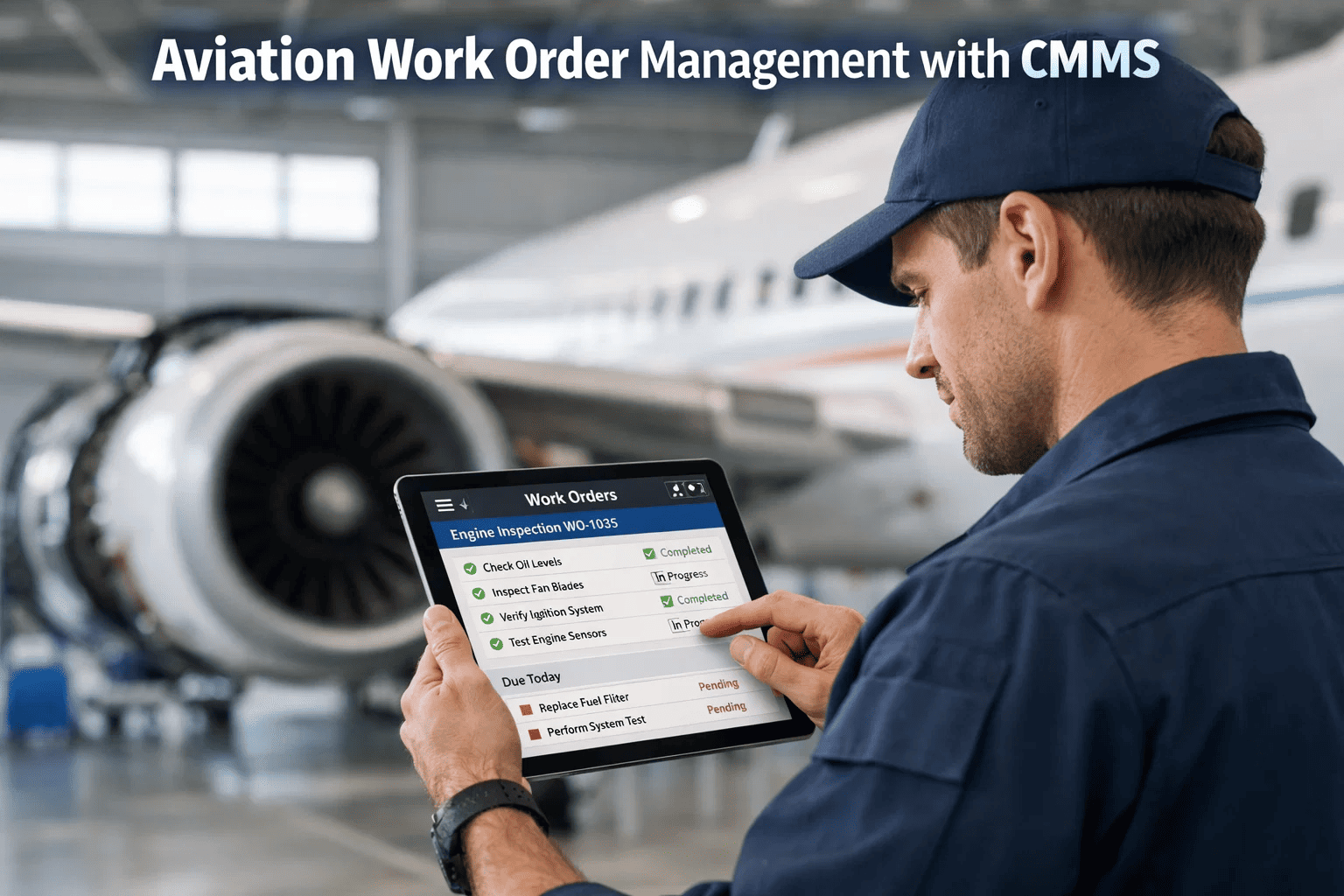
How AI CMMS Improves Airport Maintenance Operations
By Lewis Abbott on May 9, 2026
Modern airports operate as complex industrial cities — runway lighting, baggage handling systems, jet bridges, escalators, HVAC, security checkpoints, fuel depots, and de-icing infrastructure all running 18 to 24 hours a day, every day. The cost of a single unplanned failure is brutal: airline studies put the average cost of an aircraft delay at USD 101.18 per minute, and a tarmac-impacting equipment fault can cascade across dozens of flights within an hour. Yet most airport operations teams still manage maintenance using paper logs, siloed CMMS instances per terminal, and reactive callouts. AI and IoT-powered CMMS software changes that — turning airport maintenance into a predictive, automated, and centrally controlled operation that prevents failures before they touch a flight schedule. Start a free trial to see how Oxmaint pulls every airport asset onto one operations dashboard, or book a demo tailored to your terminal estate.
average cost per minute of an aircraft delay (Airlines for America operating cost benchmarks)
30%
of airport equipment downtime is preventable with predictive maintenance and IoT condition monitoring
$8.6B
global smart airport market value in 2024, growing toward USD 21B by 2030 (industry analyst consensus)
25%
average reduction in maintenance labor cost reported by airports adopting AI-driven CMMS platforms
What Is an AI and IoT-Powered Airport CMMS?
An airport CMMS is a centralized maintenance management platform built to handle the operational density of airfields and terminals — thousands of assets, hundreds of work orders per week, dozens of contractors, and zero tolerance for unplanned downtime on safety-critical equipment. The AI and IoT layer makes that platform predictive: IoT sensors stream live condition data from baggage motors, HVAC chillers, jet bridges, and runway lighting, while AI models flag anomalies, forecast remaining useful life, and auto-generate work orders before assets fail.
For airport operations leaders, this is the shift from a reactive cost center to a measurable reliability program — one where every asset has a digital condition score, every PM is scheduled by data rather than calendar, and every emergency callout is the exception, not the rule. Start a free trial and see how an AI-driven asset registry maps your airport in under a week.
The 6 Pillars of an AI + IoT Airport CMMS
01
Centralized Asset Registry
Every terminal, runway zone, baggage line, gate, and utility asset captured in a single hierarchy — Portfolio > Terminal > System > Asset > Component — with condition score, criticality, and maintenance history.
02
IoT Sensor Integration
Vibration, temperature, pressure, and current sensors feed live telemetry from chillers, conveyor motors, jet bridge hydraulics, and runway lighting circuits into one operations dashboard.
03
AI Failure Prediction
Machine learning models compare live sensor data against historical failure patterns and flag anomalies 7 to 30 days before breakdown — converting reactive failures into scheduled work.
04
Automated Work Orders
When a sensor breaches a threshold or AI flags a degradation trend, the CMMS auto-generates a work order, assigns the right technician, and pushes parts requirements to the spares system.
05
Mobile Field Execution
Technicians receive jobs on phones or tablets across the airfield — with asset history, schematics, safety procedures, and digital sign-off all available on the move, even on remote stands.
06
Compliance & Audit Trail
Every inspection, repair, and certification timestamped and stored — ready for FAA, CAA, EASA, and ICAO audits without scrambling through paper logs or scattered spreadsheets.
Most airports lose 20–40% of their maintenance budget to untracked assets and reactive emergency callouts.
Why Traditional Airport Maintenance Is Failing
Even at well-resourced international airports, maintenance teams routinely fight three structural problems — and these compound every year as fleets age and passenger volumes recover above pre-2020 levels. Book a demo to see how Oxmaint surfaces these gaps inside your existing operation.
Reactive Failure Cycle
Emergency repairs cost 4 to 5 times more than planned work, yet most airport teams still discover failures only when a tenant, airline, or passenger complains. The cost compounds across fuel, crew, and slot penalties.
Siloed Systems Per Terminal
Many airports run separate CMMS instances per terminal, plus standalone systems for baggage, HVAC, and airfield lighting. No single dashboard means no portfolio view of risk, spend, or technician capacity.
Paper-Based Inspections
Daily runway inspections, jet bridge checks, and baggage system audits still happen on clipboards. When auditors arrive, evidence reconstruction takes days — and gaps mean fines or operational restrictions.
CapEx Guesswork
Without condition data, airport finance teams forecast 5 to 10 year asset replacement budgets from age alone — leading to either premature CapEx or sudden multi-million-dollar emergency replacements.
Contractor Visibility Gaps
Specialist contractors handle 40 to 60% of airport maintenance scope. Without SLA tracking and invoice matching, airports routinely overpay for jobs that were never completed to specification.
PMs Run on Calendars, Not Condition
Time-based PMs over-service some assets and under-service others. The result: wasted technician hours on healthy equipment while degrading assets fail unmonitored between scheduled visits.
See where your airport is hemorrhaging maintenance budget
Oxmaint maps every airport asset, scores its condition, and surfaces hidden cost leaks within the first 30 days of deployment.
How Oxmaint Solves Airport Maintenance with AI & IoT
Oxmaint is built around a portfolio model — one platform managing every terminal, every airfield system, every contractor, and every CapEx forecast on the same hierarchy. The AI and IoT layer feeds that platform with live data, so airport operations leaders move from monthly review meetings to daily decisions backed by real condition scores. Start a free trial to map your first terminal in under a week.
Unified Portfolio Hierarchy
Manage Terminal 1, Terminal 2, airfield, cargo, and ground transport from one console — with rolled-up KPIs at the airport, region, or operator-group level.
IoT & SCADA Connectivity
Native connectors pull data from baggage handling PLCs, BMS, runway lighting controllers, and standalone IoT gateways into a single condition-scoring engine.
AI-Driven PM Optimization
Models analyze failure history, runtime hours, and live sensor trends to recommend optimal PM intervals — replacing one-size-fits-all calendar schedules.
Mobile Work Orders & Sign-Off
Technicians receive jobs across the airfield on mobile, attach photos and readings, and digitally sign off — every action timestamped and audit-ready.
Rolling 5–10 Year CapEx Forecasting
Condition-scored asset registry feeds investor-grade CapEx models — so finance and operations agree on replacement timing, not estimate from age alone.
Compliance-Ready Audit Trail
Every inspection, certification, and corrective action stored against the asset — FAA, CAA, EASA, and ICAO audits served from the same dashboard.
Airports running AI-driven CMMS report up to 30% lower equipment downtime within 12 months of deployment.
Reactive Maintenance vs. AI + IoT-Driven Maintenance
Operational Dimension
Traditional Reactive Model
Oxmaint AI + IoT Model
Failure detection
Discovered when asset breaks or passenger complains
Predicted 7–30 days before failure by AI analytics
Work order creation
Manual, after the failure has occurred
Auto-generated when sensor or AI threshold is breached
PM scheduling basis
Calendar-only, identical for every asset
Condition-based, optimized per asset by runtime & trends
Airports adopting AI-driven CMMS platforms report measurable returns within the first 12 months — and the gains compound as the asset history database deepens. Book a demo to model these numbers against your own operation.
30%
average reduction in unplanned equipment downtime within 12 months of CMMS rollout
25%
labor cost savings from automated work order routing and condition-based PM scheduling
35%
cut in total maintenance spend reported across multi-site airport CMMS deployments
3.2x
faster audit preparation when every inspection and corrective action is timestamped in one platform
Frequently Asked Questions
What makes an airport CMMS different from a generic facility CMMS?
An airport CMMS handles asset density and operational tempo no generic facility platform is designed for — runway lighting circuits, jet bridge hydraulics, baggage handling PLCs, ILS systems, and de-icing infrastructure all on the same hierarchy as terminal HVAC and escalators. It also natively supports FAA, CAA, EASA, and ICAO compliance evidence, multi-terminal portfolio reporting, and the contractor-heavy delivery model airports rely on.
How long does AI + IoT CMMS deployment take at a major airport?
A pilot terminal can be live in 4 to 8 weeks with Oxmaint — covering asset registry import, IoT gateway integration, and mobile rollout to technicians. Full multi-terminal deployment typically completes within 3 to 6 months. Heavy onboarding is not required; Oxmaint is designed for operations teams to self-configure their hierarchy, PMs, and dashboards.
Does AI predictive maintenance work without replacing existing IoT sensors?
Yes. Oxmaint integrates with existing BMS, SCADA, baggage PLCs, and standalone IoT gateways through standard protocols and APIs. Most airports already have far more sensor data than they actively use — the value comes from feeding that data into AI models that score condition and predict failure, not from ripping and replacing sensor infrastructure.
How does Oxmaint help with FAA, EASA, and ICAO compliance audits?
Every inspection, work order, calibration, and corrective action is timestamped and stored against the specific asset — with photos, technician sign-off, and parts records attached. When auditors request evidence for a runway lighting check, jet bridge inspection, or fire system test, the records are exported in minutes, not days. The same audit trail also drives internal SMS and continuous improvement reviews.
Stop Losing Millions to Reactive Airport Maintenance
Turn Every Airport Asset into a Predictable, Trackable System
Used by operations teams managing 10,000+ assets. See measurable downtime reduction in the first 30 days. Live in days, not months — no heavy implementation required.
Real-time asset visibility across every terminal and airfield system
AI-driven predictive failure alerts before flights are impacted
Investor-grade 5–10 year CapEx forecasting from one dashboard