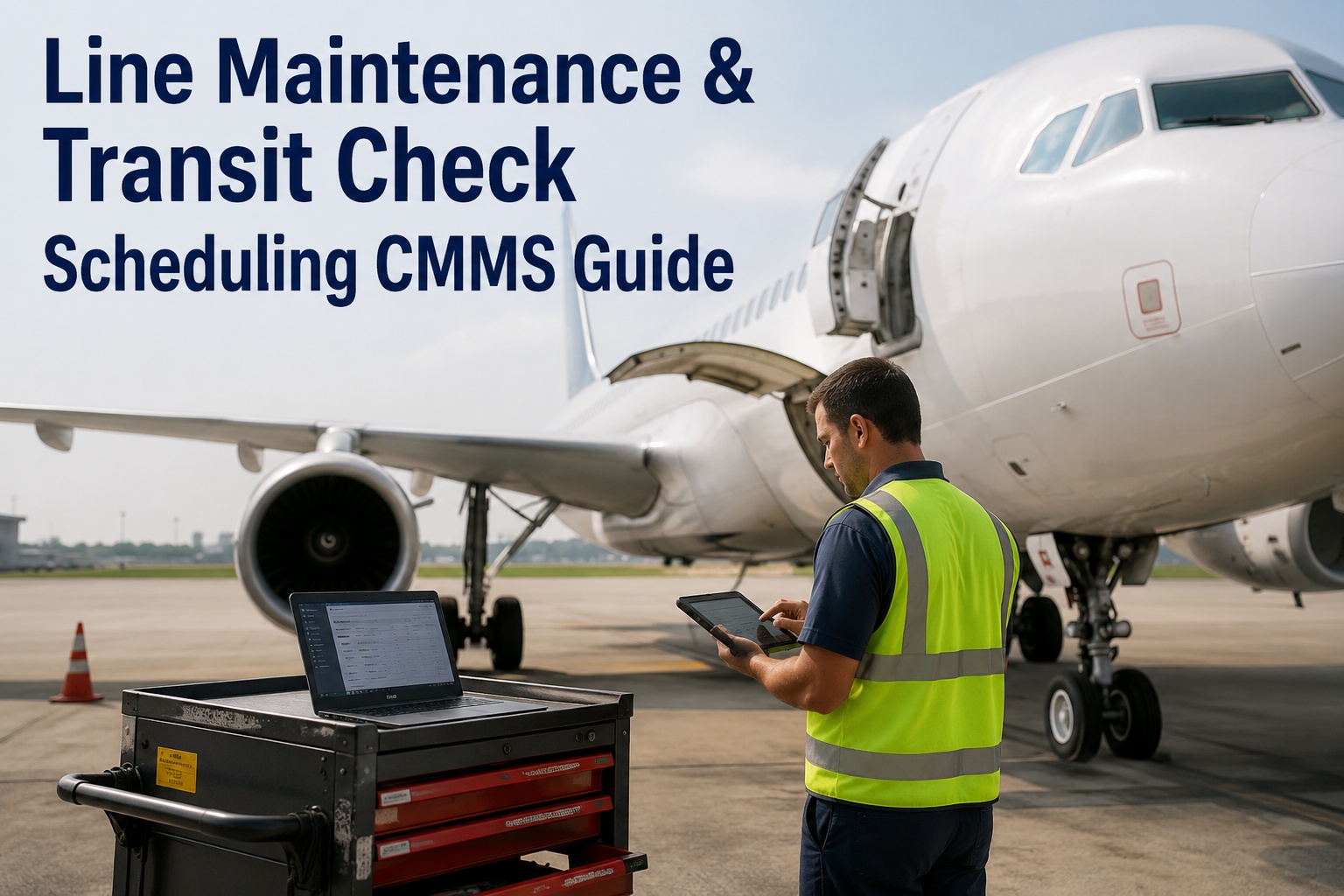
Line maintenance scheduling is the discipline of organising transit checks, daily inspections, and pre-flight tasks so they fit within tight aircraft turnaround windows — often 30 to 90 minutes — at main bases and outstations alike. This guide covers how an aviation CMMS streamlines transit check work orders, defect deferral (MEL/CDL) workflows, and line station coordination so dispatch reliability stays high and delays stay low. Whether you manage a fleet of 20 narrow-body aircraft or a hub handling 400 daily rotations, the right CMMS for line maintenance transforms chaotic paper logs and WhatsApp messages into structured, auditable, AI-assisted task execution. Ready to replace clipboard-driven line checks with a digital trail? Start Free Trial and see the difference on your next shift.
Line Maintenance Guide 2026
Can your line stations clear a transit check in 45 minutes — every time?
Aircraft earn revenue only when they are airborne. Delays caused by unstructured line maintenance scheduling, lost defect tags, or missing sign-offs cost carriers $150–$300 per minute in AOG recovery and passenger re-accommodation. OxMaint brings transit checks, daily checks, and turnaround inspections into one AI-powered CMMS — so your mechanics work from a single digital work order and dispatch never waits on paperwork.
Line Check Scheduling
What is line maintenance scheduling and why it runs on minutes, not days
Unlike base or hangar maintenance — where an aircraft may sit for weeks — line maintenance operates inside the commercial schedule. Every transit check, daily check, and weekly check must be planned around block times, gate availability, crew duty limits, and minimum equipment list (MEL) deferral limits. A single missed sign-off can trigger a 4-hour delay chain across five downstream legs.
Pre-flight & turnaround inspection
- Walk-around visual inspection of tires, brakes, surfaces
- Fluid levels (oil, hydraulic, oxygen) and leak check
- Cabin safety equipment and door seal verification
- Logbook review and open defect acknowledgement
Overnight or layover inspection
- Extended visual inspection of airframe and engines
- Landing gear free-play and tire-wear measurement
- Avionics BIT test and fault code clearance
- Cabin deep-clean and emergency lighting test
Scheduled line maintenance interval
- Engine boroscope sampling (rotating subset)
- APU performance run and load check
- Emergency locator transmitter and life-raft expiry
- Deferred MEL items approaching category limit
CMMS Transit Check Workflow
How a CMMS transforms line maintenance from clipboard to digital trail
A purpose-built aviation CMMS replaces paper log cards and radio calls with structured work orders that auto-generate from the flight schedule. Here is how a transit check flows through OxMaint in five stages — from flight-plan integration to closed sign-off.
Schedule-driven task generation
The CMMS ingests the daily flight schedule and auto-creates transit, daily, and weekly check work orders 24 hours ahead — each tied to tail number, station, gate, and expected arrival time.
Technician assignment & parts staging
Line mechanics receive tasks on mobile devices with skill-match logic. Required ground equipment, tool kits, and rotable spares are pre-staged at the gate before the aircraft parks.
Execution & real-time defect capture
Findings are logged with photos, fault codes, and ATA chapter tagging directly into the work order — no paper, no re-entry. AI suggests likely causes and parts based on fleet history.
Deferral (MEL/CDL) workflow
If a defect cannot be cleared at the gate, the CMMS triggers an MEL deferral with category (A/B/C/D), repair-by date, and required operational procedures — auto-routed to the PIC and dispatch.
Sign-off, release & analytics
Certifying staff sign electronically (CAA/EASA/FAA compliant). The aircraft release timestamp feeds back into dispatch reliability dashboards, MTBUR trends, and station performance scorecards.
Outstation Coordination
Line station coordination: keeping outstations productive and dispatch-ready
Outstations typically operate with lean crews — sometimes a single contracted mechanic — and no local stores. The biggest scheduling risk is an undocumented defect discovered 10 minutes before pushback. A transit check CMMS closes the visibility gap between central control and remote stations.
| Line Station Challenge | Clipboard / Spreadsheet | CMMS (OxMaint) |
|---|---|---|
| Defect visibility for central control | Phone call or photo message — no audit trail | Real-time work-order feed with ATA tag, photo, and status |
| Spare part availability at outstation | Manual stock check; parts flown in reactively | Multi-site inventory view; auto re-order to min/max |
| MEL deferral tracking & repair-by dates | Excel sheet reviewed daily — easy to miss limits | Automated countdown alerts at 72h, 24h, and 4h before expiry |
| Certifying staff sign-off authority | Physical logbook — no remote verification | Electronic signature with license validity check |
| Handover between shifts at outstation | Verbal brief; open items dropped | Digital shift handover with open-defect carry-over |
Worked Example
A regional carrier operating 38 ATR 72-600s across 14 outstations was losing an average of 22 dispatch delays per month to mis-routed defect tags and expired MEL items. After deploying OxMaint as their line maintenance CMMS, the central maintenance control team gained real-time visibility into every open work order across all stations. Within 90 days, MEL-related delays dropped by 68%, and average defect-to-repair cycle time fell from 6.2 days to 2.1 days — saving an estimated $340K annually in delay costs and AOG recovery logistics.
How OxMaint Helps
How OxMaint powers line maintenance and transit check scheduling
OxMaint is an AI-powered CMMS and EAM platform built for maintenance and reliability teams that cannot afford delays. Four capabilities map directly to the pressures of line maintenance operations:
Auto-generated line check work orders
OxMaint reads your flight schedule and creates transit, daily, and weekly check tasks automatically — each pre-loaded with check cards, estimated durations, and required tooling.
Cuts pre-check admin time by 70%MEL/CDL deferral automation
When a defect is deferred, OxMaint calculates the repair-by date based on MEL category, auto-notifies the PIC and dispatch, and escalates before the limit expires.
Eliminates expired-deferral delaysMulti-station inventory visibility
See rotable and consumable stock across every outstation in one dashboard. Min/max triggers auto-create replenishment requests so critical parts are always available.
Reduces AOG parts-wait time by 40%AI-driven dispatch reliability analytics
OxMaint's AI engine analyses defect trends, MTBUR, and station performance to flag recurring faults before they cause delays — turning line maintenance data into predictive action.
Lifts dispatch reliability above 99%See OxMaint on Your Operation
Stop losing dispatch minutes to paper-based line checks
Book a 30-minute demo and we will show you how OxMaint auto-generates transit check work orders from your flight schedule, tracks MEL deferrals to the minute, and gives central control a live view of every outstation.
Line Maintenance CMMS FAQ
Frequently asked questions about line maintenance scheduling and CMMS
What is the difference between a transit check and a daily check in aviation line maintenance?
A transit check is a short inspection (typically 15–45 minutes) performed during turnaround between flights — covering walk-around, fluid levels, and cabin safety. A daily check is a more thorough inspection (8–12 labour hours) done overnight or during a layover, covering landing gear, avionics BIT tests, and deeper airframe items. Both must be scheduled inside the aircraft's commercial availability window, which is why a CMMS for line maintenance auto-generates both from the flight plan.
How does a CMMS improve transit check scheduling at outstations?
A transit check CMMS gives central maintenance control real-time visibility into work orders at every outstation, auto-stages the right parts and tooling before arrival, and ensures defect findings are captured digitally with photos and ATA chapter codes. This eliminates the visibility gap that causes 20–30% of outstation delays. You can Start Free Trial on OxMaint to see the live multi-station dashboard in action.
Can OxMaint handle MEL and CDL defect deferral workflows?
Yes. When a defect cannot be cleared at the gate, OxMaint triggers an MEL or CDL deferral with the correct category (A, B, C, or D), calculates the repair-by date and time, and sends automated escalation alerts at 72 hours, 24 hours, and 4 hours before expiry — ensuring no deferred item ever breaches its regulatory limit and causes an avoidable delay.
Is an aviation CMMS compliant with CAA, EASA, and FAA line maintenance regulations?
OxMaint supports electronic sign-off with certifying-staff license validity checks, maintains a full audit trail of every work order action, and stores defect logs, parts serials, and task card revisions in a tamper-evident record. This satisfies the continuing-airworthiness record requirements expected by CAA, EASA Part-145, and FAA Part 145 auditors. We recommend you Book a Demo so our team can walk you through the compliance mapping for your authority.
How long does it take to switch from paper log cards to OxMaint for line maintenance?
Most operators are live on OxMaint within 2–4 weeks for a single base and 2–3 outstations. The platform imports your aircraft master data, check task cards, and MEL catalogue via CSV or API, and mobile apps for mechanics require under 30 minutes of training. A typical 180-asset operation sees full adoption across all line stations within one monthly check cycle.
Ready When You Are
Put your line maintenance on autopilot — without losing control
Join the maintenance teams using OxMaint to cut transit check admin, eliminate MEL surprises, and keep dispatch reliability above 99%. Start free or book a tailored demo with your flight schedule.
Free 14-day trial · No credit card