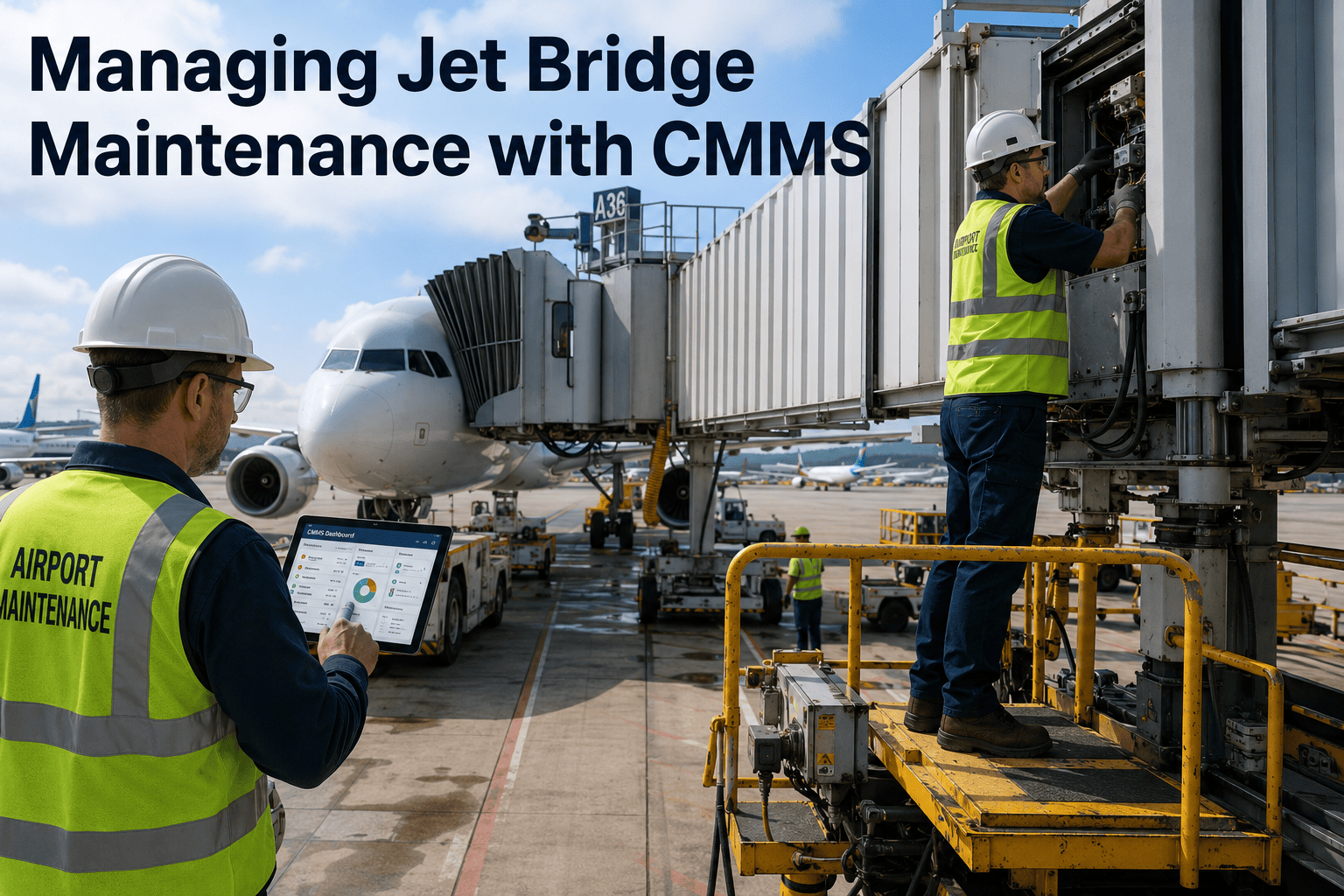
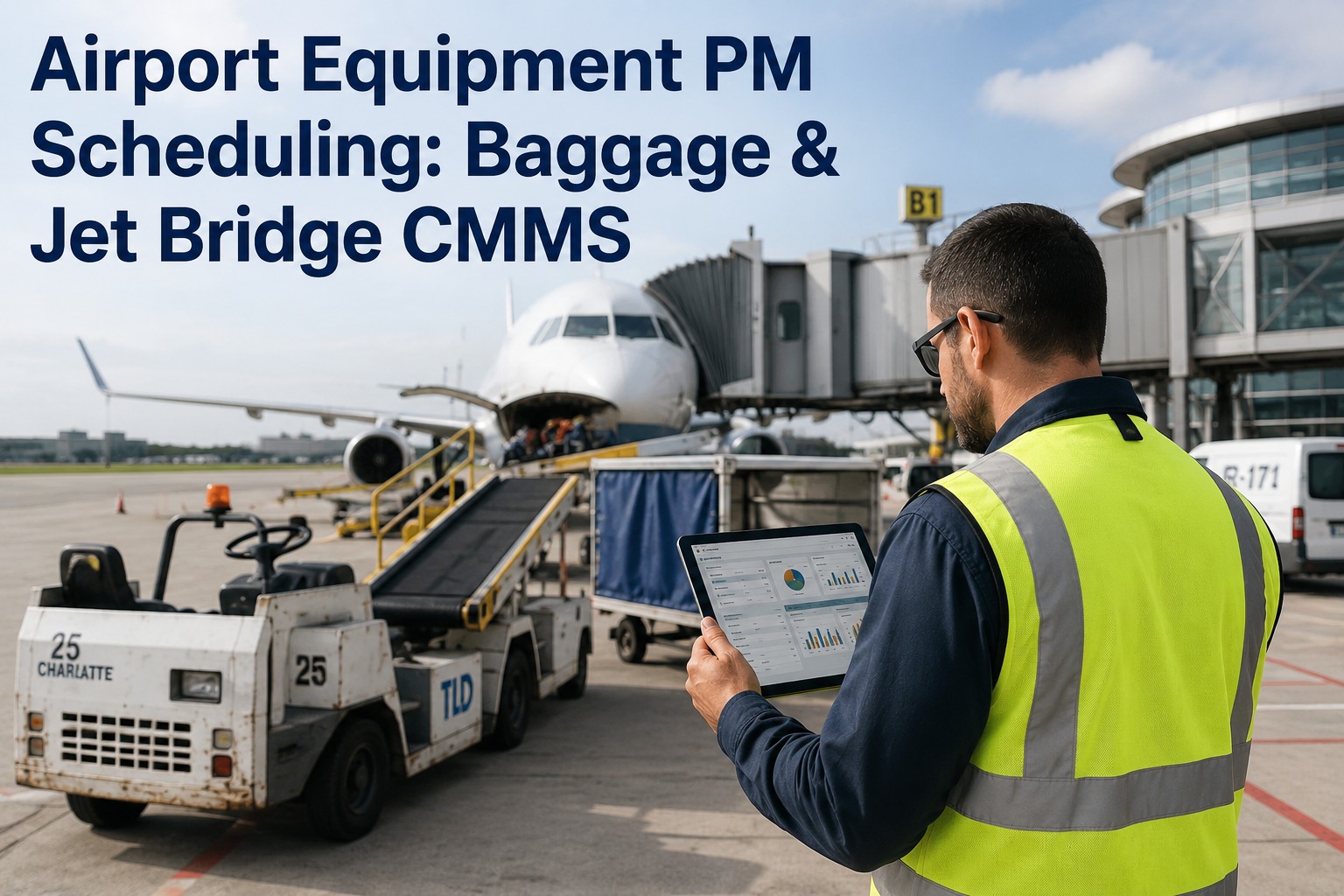
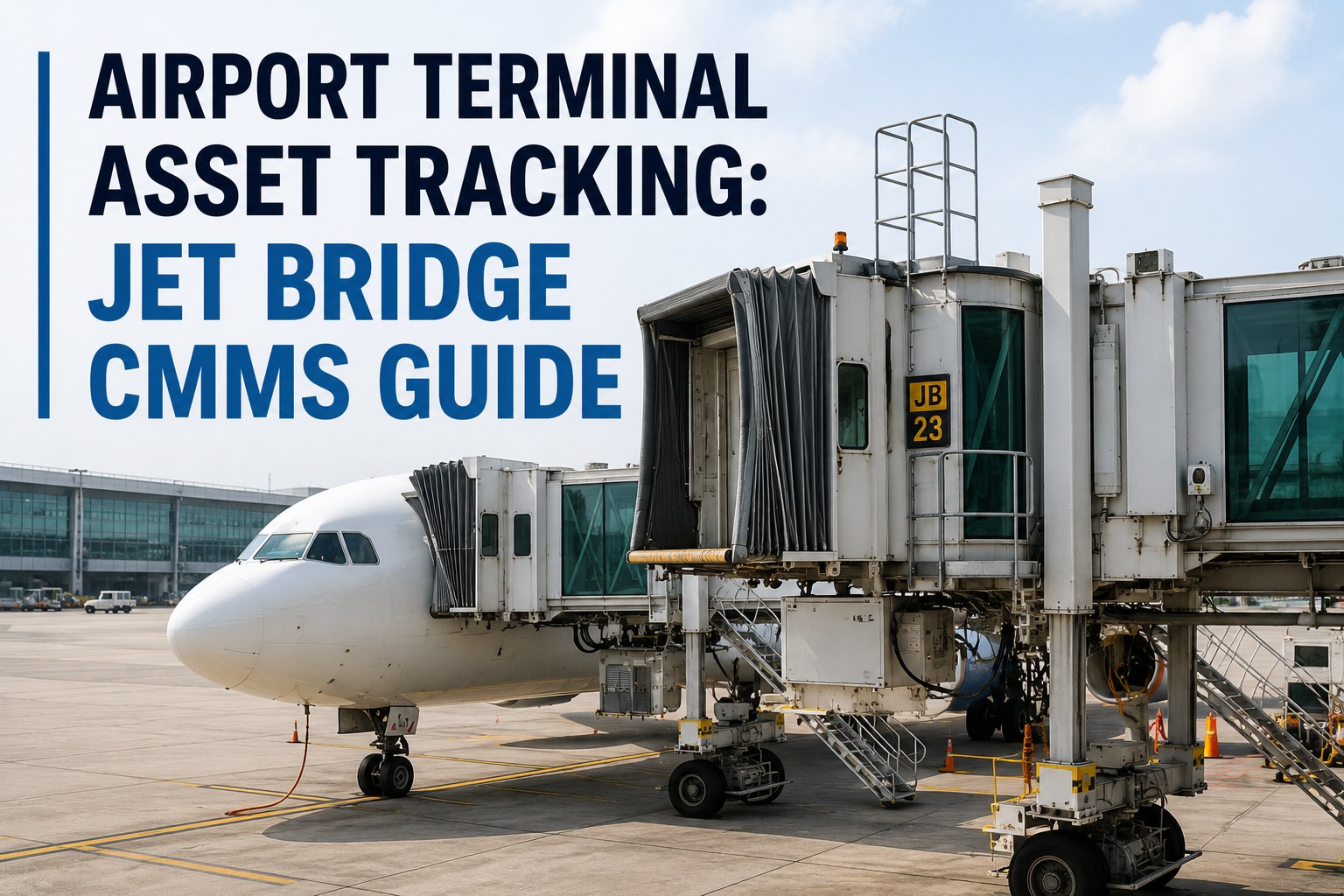
A jet bridge that fails to dock is an airline's worst gate-side surprise. Aircraft delay costs average roughly $100 per minute at U.S. airports, and a single passenger boarding bridge (PBB) outage cascades fast — gate reassignments, missed connections, crew time-out risk, and passenger frustration that lights up social media in minutes. PBBs are also among the most heavily cycled assets at any airport: thousands of extend-retract movements per year, exposed to jet blast, de-icing chemicals, coastal salt, and temperature extremes. Many bridges in service today are well past their 10–15-year refurbishment window with deferred maintenance backlogs that quietly compound. The fix is not more reactive callouts — it is a structured CMMS that brings every PBB component into a single asset registry, schedules preventive work around traffic patterns, automates inspections, captures compliance against FAA AC 150/5220-21C, and forecasts refurbishment CapEx years in advance. Book a demo to see how OxMaint runs PBB fleets across multi-terminal airports.
Stop letting jet bridge failures decide your gate availability. Run every PBB on a structured CMMS your team executes from a phone.
Average aircraft delay cost at U.S. airports — gate equipment failures compound fast across schedules.
20–25 yrs
PBB Service Life
Typical PBB service life with structured maintenance — many bridges now past midlife with deferred work.
3×
Reactive Cost Multiplier
Reactive PBB breakdowns can triple the typical $15–25K annual maintenance cost per bridge.
40–60%
Refurbishment Savings
Mid-life refurbishment costs 40–60% less than full PBB replacement when condition data drives the timing.
Why Jet Bridge Maintenance is Uniquely Difficult
A PBB is not one asset. It is a tightly integrated system of mechanical, hydraulic, electrical, structural, and HVAC subsystems — each with its own failure modes, PM intervals, and compliance overlays — operating in one of the harshest environments any commercial asset sees. Every cycle exposes the bridge to vibration, weather, jet blast, and chemical attack from de-icing fluid. Compounding this, PBBs sit on the critical operational path: a single failure idles a gate, displaces aircraft, and triggers airline penalties.
Generic CMMS platforms treat the PBB as one line item. Aviation-grade platforms break it into the actual subsystems your technicians service — drive units, lift columns, rotunda mechanism, canopy seals, auto-leveler, control panels, HVAC, and structural elements — so PM, condition data, and lifecycle costs roll up to the right place. Start a free trial and import your PBB asset hierarchy into OxMaint within hours.
Anatomy of a PBB: The Eight Subsystems Your CMMS Must Manage
Each subsystem has its own PM cadence, failure signatures, and inspection checklist. Treating them as separate maintainable components is the foundation of a working PBB program.
01
Drive & Wheel Bogey
Drive motors, wheels, steering linkages — wear from thousands of cycles plus apron contamination. Monthly lubrication, quarterly alignment.
02
Lift Column & Hydraulics
Hydraulic cylinders, pumps, hoses, accumulators. Leak risk from temperature cycling. Quarterly fluid sampling, annual seal inspection.
The pivot point connecting bridge to terminal. Bearing wear, slewing-ring lubrication, structural fatigue around welds — annual NDE recommended.
05
Cabin & Auto-Leveler
Aircraft-side cab, bumper, auto-leveler sensors and actuators. Sensor calibration is critical — misalignment risks aircraft door damage.
06
Canopy & Closure Seal
The bellows interface with the aircraft. Wear and weathering create leaks, drafts, and IAQ issues. Visual inspection every cycle, replacement on condition.
07
Electrical & Controls
Festoon or e-chain cable management, control panels, PLCs, drive electronics. Festoon entanglement is a documented downtime driver.
08
Cab HVAC & PCA / GPU
Cabin conditioning, pre-conditioned air units, ground power. Filter cycles, refrigerant checks, electrical safety inspections — separate PM trees.
A jet bridge runs thousands of dock cycles every year. Without condition data, you cannot tell which one is six months from a costly gate closure.
The Five Warning Signs Your PBBs Need Attention
Industry research on PBB reliability identifies five recurring degradation signatures that every CMMS-driven program should track and trigger work orders against.
Movement Irregularities
Vibration, slower docking cycles, alignment drift — almost always precursors to drive, hydraulic, or column failure.
Structural Degradation
Rust, corrosion pitting, fatigue cracks around welds and lifting columns — driven by humidity, salt air, jet blast, and de-icing chemicals.
Safety System Faults
Auto-leveler errors, bumper alarms, emergency-stop test failures — any of these grounds a bridge until reset and root-cause cleared.
Rising Downtime Frequency
More callouts month over month, longer MTTR. The asset is telling you its PM intervals or refurbishment plan no longer match its actual condition.
Operational Mismatch
Bridges asked to handle aircraft outside original design — extra weight, longer reach, wider doors — accelerate fatigue across motors, sensors, and structure.
Cable & Festoon Tangling
Free-hanging cables catching wind, snagging during retraction. A documented driver of unscheduled downtime and costly repairs.
The contrast in workflow is sharp. Below is how the same operational event — an auto-leveler sensor drifting out of calibration — is handled under each model.
What is the typical lifespan of a passenger boarding bridge?
A well-maintained PBB has a service life of 20–25 years, with some bridges operating beyond 30 years under structured care. Refurbishment at the 10–15 year mark — typically 40–60% less than full replacement — extends the lifecycle and lets airports upgrade outdated control systems and weatherproofing. Condition data, not age, is the right driver for refurb timing.
What compliance standards apply to PBB maintenance?
In the United States, FAA Advisory Circular 150/5220-21C provides performance and design guidance for PBBs. OSHA workplace-safety rules apply to maintenance work. ICAO standards cover international operations, and OEM service bulletins specify inspection cadence per model. OxMaint stores templates aligned to all of these.
How does OxMaint handle multiple PBB models from different OEMs?
PBBs from JBT, Oshkosh AeroTech, ThyssenKrupp, ShinMaywa, CIMC-TianDa and others all live in the same asset hierarchy. OEM-specific PM templates, parts lists, and service bulletins are loaded per asset, so a tech servicing any bridge gets the right procedure on their mobile device.
How fast can OxMaint go live on a PBB fleet?
Initial go-live for a single terminal's PBB fleet — asset registry, OEM PM templates, mobile checklists, compliance vault — typically takes 1–2 weeks. Sensor and SCADA integration layers in over 30–60 days. Most airports begin seeing measurable PM compliance gains inside the first 60 days post go-live.
Ready to End Reactive PBB Operations?
Stop Letting Jet Bridges Decide Your Gate Schedule.
OxMaint runs every passenger boarding bridge as a tracked, structured asset — eight subsystems, OEM-aligned PM templates, mobile checklists, automated work orders, and rolling refurbishment forecasts in a single CMMS your team can deploy this month.