MRO warehouse management is the discipline that decides whether parts availability stays high and lean or collapses into low availability and bloated inventory — and in aviation, where an AOG (aircraft on ground) can cost $10,000 to $150,000 per hour, the warehouse is either a competitive advantage or a silent bottleneck. A disorganized MRO parts warehouse delays every job that needs a part: technicians wait, aircraft sit, and procurement over-orders "just in case," inflating carrying costs by 20–30% annually. This guide breaks down how to run an aviation MRO warehouse for maximum parts availability, accuracy, and fast technician access — covering warehouse design, bin management, cycle counting, kitting for scheduled work, and the metrics that separate world-class storerooms from chaotic ones. If you're ready to replace spreadsheets and tribal knowledge with a system built for aviation maintenance, Start Free Trial and see how OxMaint keeps parts moving to the hangar without inventory sprawl.
Is your parts warehouse grounding aircraft — or keeping them flying?
A single missing $40 seal can hold a $90M aircraft on the ground. Aviation MRO warehouse management done right delivers 98%+ parts availability, 99.5% inventory accuracy, and technician pick times under 5 minutes — without doubling your stock.
What poor MRO warehouse management actually costs aviation operations
Industry benchmarks show that maintenance technicians spend 15–25% of their shift searching for parts, tools, or information — and in an MRO storeroom without bin discipline, that number climbs past 30%. Meanwhile, inventory carrying costs (capital, storage, insurance, obsolescence) run 18–30% of inventory value per year, meaning a $2M aircraft parts warehouse can quietly burn $400K–$600K annually just to exist. Here's where the money leaks:
AOG & delay events
A narrowbody AOG averages $10K–$20K per hour; widebody and cargo disruptions can exceed $150K per hour once passenger rebooking, crew, and slot penalties stack up. One "stockout on a $12 fitting" incident can erase a year of warehouse savings.
Ghost & duplicate stock
Without cycle counting, MRO inventory warehouses drift to 60–80% record accuracy. Buyers re-order parts already on the shelf, and 8–12% of SKUs become dead stock — rotables and life-limited parts expiring before they're ever installed.
Wrench-time erosion
Best-in-class hangars target 60%+ wrench time. Every 10-minute parts hunt per task, across 40 tasks a day, costs ~6.7 technician-hours daily — over 1,600 lost hours a year per 10-tech team, roughly $120K in fully-loaded labor.
How to design an aircraft parts warehouse for speed and accuracy
Warehouse design determines 70% of picking efficiency before a single process is written. The goal of MRO warehouse operations design is simple: the 20% of SKUs that drive 80% of picks should be within arm's reach of the issue counter, and every part should have exactly one home. Apply these five design rules:
Zone by velocity, not by part number
Class A items (top 10–20% of annual picks — filters, seals, lamps, brake components, common hardware) go in golden-zone shelving at the counter. Class B in mid-aisles. Class C and slow-moving rotables go to high-bay or mezzanine storage. Re-run the ABC analysis quarterly; demand shifts with fleet mix and season.
One SKU, one bin, one barcode
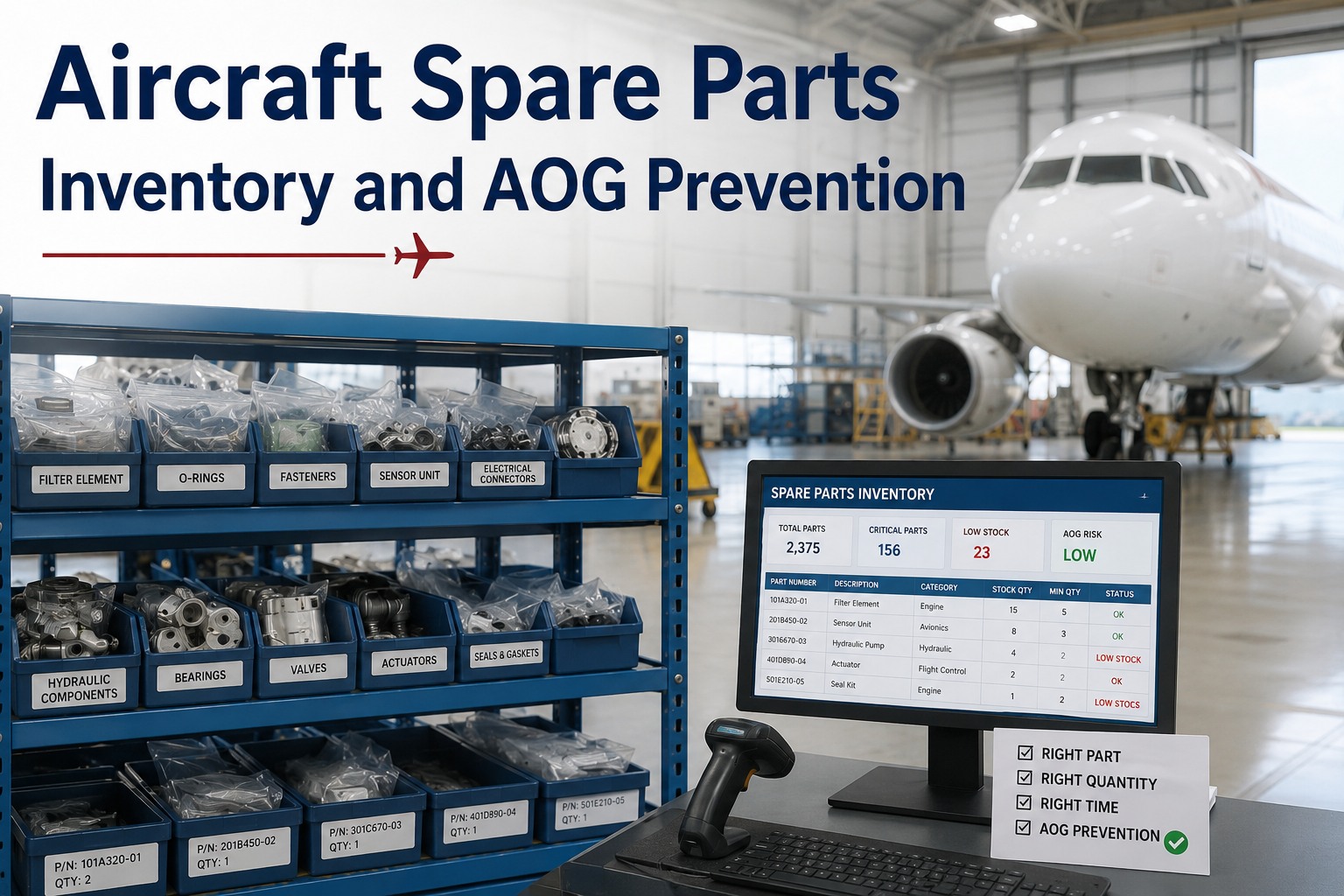
Every location gets a scannable address (Zone-Aisle-Bay-Level, e.g. A-03-B2-L1) and every bin holds exactly one part number. Mixed bins are the #1 cause of mis-picks and phantom stockouts in aviation parts warehouses. Barcode or QR scanning at issue and receipt drives record accuracy above 99%.
Segregate controlled categories
Avionics and static-sensitive components need ESD-safe zones; life-limited and shelf-life parts (O-rings, sealants, batteries, life vests) need date-controlled storage with FEFO (first-expired, first-out) picking; hazmat (oils, paints, oxygen bottles) needs compliant segregation per IATA DGR and local fire code.
Physically separate quarantine & serviceable stock
Unserviceable cores, parts awaiting inspection, and units pending 8130-3/EASA Form 1 paperwork must live in a locked quarantine area — never on serviceable shelves. One unairworthy part issued by mistake is a reportable event and a safety risk.
Design a one-way flow: receive → inspect → store → kit → issue
Receiving and shipping should never cross. Parts enter at receiving, pass incoming inspection (documentation, condition, traceability), get put away within 24 hours, and leave via the kitting/issue counter. Crossed flows cause lost receipts and "received but never shelved" black holes.
Cycle counting: the 99.5% accuracy habit for MRO storeroom management
Annual wall-to-wall physical inventories are a relic — they shut the storeroom for days and only tell you the damage after it's done. World-class MRO warehouse operations replace them with perpetual cycle counting: counting a small slice of inventory every day, weighted by value and velocity. Target 99.5% bin-level accuracy; anything below 95% means your min/max and reorder data is fiction.
| ABC Class | Count Frequency | % of SKUs | Counts per Day (2,000-SKU store) | Accuracy Target |
|---|---|---|---|---|
| A — high velocity / high value | Monthly (12×/yr) | ~15% | ~13 | 99.5%+ |
| B — moderate | Quarterly (4×/yr) | ~30% | ~10 | 99% |
| C — slow / low value | Annually (1×/yr) | ~55% | ~5 | 98% |
Rule of thumb: ~28 counts per day, 20–30 minutes of one storekeeper's time, keeps a 2,000-SKU aviation MRO warehouse audit-ready year-round — no shutdown, no year-end scramble, and discrepancies investigated within 48 hours while the trail is still warm.
Kitting: how MRO warehouses feed the hangar without technician downtime
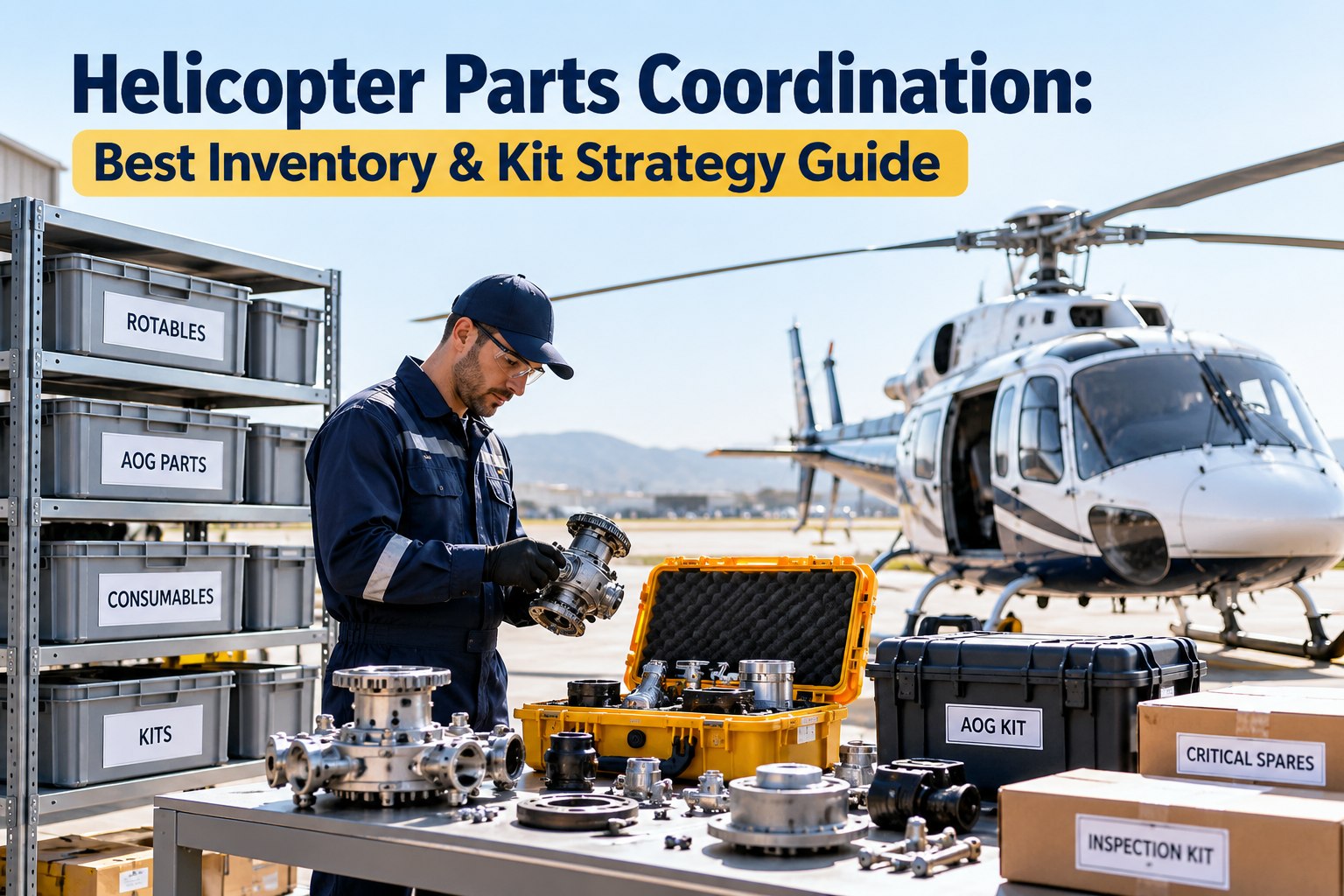
Kitting — pre-staging every part, consumable, and hardware item for a scheduled check or work order before the aircraft arrives — is the single highest-leverage practice in MRO warehouse management. Hangars that kit scheduled work report 20–35% faster check turnaround because technicians never leave the aircraft to hunt parts. A C-check that needs 3,000+ line items simply cannot run on ad-hoc counter issues.
Explode the work package BOM
Pull the bill of materials for every task card in the check. The CMMS flags what's on hand, what's short, and what's shelf-life constrained. Shortages go to procurement immediately — 14 days covers most AOG-priced expedites.
Pick & stage kits by task or zone
Build kits into labeled carts or tote bins — one per task card, zone, or day of the check. Scan every item out of stock and into the kit so inventory records stay live. Shelf-life items are verified FEFO at this stage.
Verify completeness & deliver to the dock
Run a 100% kit audit against the BOM. A 98% complete kit still grounds the job for the missing 2%. Deliver staged kits to the hangar dock the night before input.
Return, reconcile & restock
Unused parts are scanned back into stock within 24 hours of check close-out — not left on carts where they become unrecorded "bench stock." Actual consumption feeds back into min/max settings for the next check.
What disciplined MRO warehouse availability looks like in numbers
Consider a regional MRO running 3 hangar lines, ~4,500 SKUs, and $1.8M in parts inventory. Before tightening warehouse discipline, they ran 82% record accuracy, 91% fill rate, and technicians averaged 22 minutes per parts request. Twelve months after implementing bin management, cycle counting, and kitting:
The kicker: total inventory value dropped 11% while availability rose — proof that parts availability and lean inventory are not enemies. Accuracy, not volume, is what keeps aircraft moving.
Run your MRO parts warehouse from one AI-powered platform
Spreadsheets and standalone inventory tools can't connect the warehouse to the hangar. OxMaint is an AI-powered CMMS + EAM platform that ties spare-parts inventory directly to work orders, preventive maintenance schedules, and asset histories — so the right part is reserved, kitted, and tracked without manual chasing.
Real-time bin-level inventory
Track every SKU by bin location with barcode/QR scanning on mobile. Multi-warehouse support, min/max alerts, and automated reorder points push record accuracy toward 99.5% and cut stockouts by up to 40%.
Work-order-linked kitting
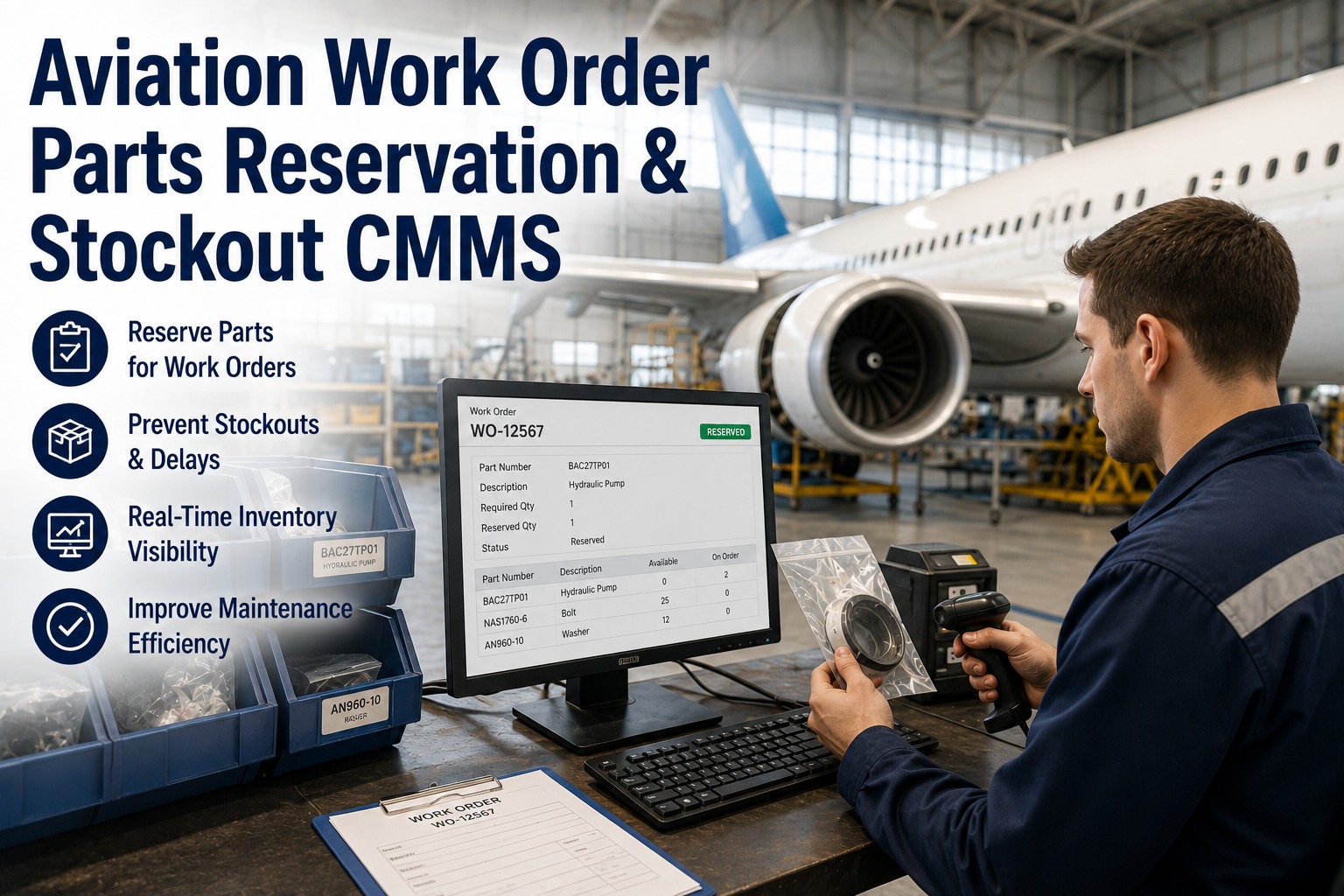
Parts are reserved against PM and work-order BOMs automatically, so kits are staged before the aircraft arrives. Teams report 20–30% faster job completion when technicians stop hunting and start wrenching.
Shelf-life & compliance tracking
Expiry alerts on life-limited and date-controlled parts, quarantine workflows, and full issue/return audit trails keep you aligned with FAA/EASA traceability expectations and ISO 55000 asset-management principles — audit-ready every day.
Inventory & availability analytics
Dashboards for fill rate, turns, dead stock, carrying cost, and consumption by aircraft or asset. AI-driven demand signals help you hold 10–20% less inventory while raising parts availability — lean and ready at once.
Watch OxMaint manage a live MRO warehouse in 30 minutes
Bring your toughest storeroom problem — stockouts, ghost inventory, kitting chaos — and we'll show you exactly how OxMaint solves it on your own asset data.
MRO warehouse management: frequently asked questions
What is MRO warehouse management?
MRO warehouse management is the discipline of storing, tracking, and issuing maintenance, repair, and operations parts so the right component is available at the right time — at the lowest sustainable inventory cost. In aviation it covers bin management, cycle counting, kitting, shelf-life control, quarantine of unserviceable parts, and traceability documentation.
What inventory accuracy should an aviation parts warehouse target?
Best-in-class aircraft parts warehouses hold 99.5%+ bin-level record accuracy, verified through perpetual cycle counting rather than annual wall-to-wall counts. Below 95%, your reorder points and min/max levels are unreliable, and stockouts plus duplicate purchasing become structural problems.
How does kitting improve MRO warehouse availability?
Kitting pre-stages every part for a scheduled check before the aircraft arrives, eliminating technician trips to the counter. MROs that kit scheduled work typically see 20–35% faster turnaround and far fewer mid-check AOG-style parts chases. OxMaint links parts directly to work-order BOMs so kits build themselves — Book a Demo to see it live.
How do you manage shelf-life and rotable parts in an MRO storeroom?
Store date-controlled items (sealants, O-rings, batteries) in segregated zones with FEFO picking and automated expiry alerts at 90/60/30 days. Rotables need serialized tracking through install, removal, repair, and return-to-service, with quarantine storage until airworthiness paperwork is complete. A CMMS with shelf-life fields and quarantine workflows automates nearly all of this.
Can software really reduce MRO inventory without hurting availability?
Yes — accuracy replaces volume. When records are 99%+ accurate and consumption data feeds reorder points, most operations can cut inventory value 10–20% while raising fill rates, because they stop over-buying "insurance" stock for parts they already own. Start Free Trial and OxMaint's analytics will show your dead stock and true demand within the first month.
Turn your MRO warehouse into an availability engine
Join maintenance teams using OxMaint to hit 99%+ inventory accuracy, kit every scheduled job, and keep aircraft — and technicians — moving.
Free 14-day trial · No credit card · Set up your first warehouse in under an hour