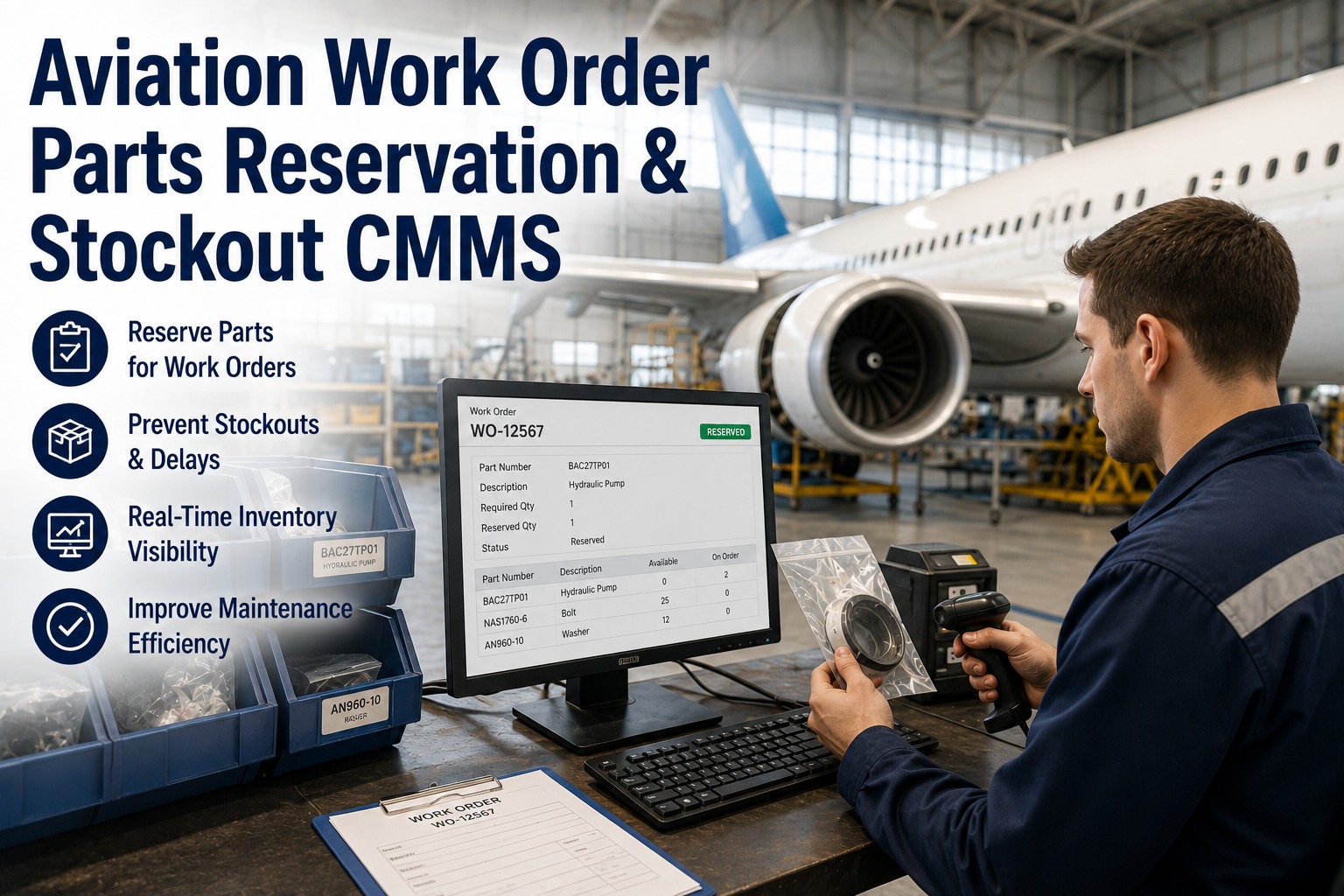
Parts stockouts at aviation MRO facilities rarely arrive unannounced — the signals show up in the CMMS days before the hangar floor feels them. A work order raised on Monday for a landing-gear overhaul usually reveals by Tuesday whether the seals, bearings, and hydraulic manifolds will actually be on the shelf when the aircraft rolls in. This guide breaks down how work order-driven parts reservation prevents stockouts, keeps the parts room ahead of the hangar, and avoids the inventory bloat that erodes margin. You can put the reservation logic described here into practice with a Start Free Trial of the platform and see the gap close inside one maintenance cycle.
What if every work order opened with confirmed parts on the shelf?
Most stockouts are visible in the CMMS 3–7 days before they hit the hangar floor. Reservation logic, kit builds, and lead-time alerts turn that early signal into action — so the aircraft arrives to a bench already staged, kitted, and ready.
What a missed reservation actually costs
A single unresolved stockout on a C-check line item averages 11.4 hours of schedule slippage and triggers a cascade of overnight overtime, expediting fees, and downstream slot conflicts.
A regional MRO operating 14 aircraft lines was spending roughly $312K per year on expedited parts and overnight technician overtime. After layering work order-driven reservation logic onto their CMMS, parts-related slippage dropped 61% inside two quarters — freeing $190K annually without adding a single SKU to the shelf. The inventory stayed flat; the visibility moved earlier.
From work order open to confirmed kit, in five moves
Each step below represents a control point where the CMMS either confirms availability or flags a gap — long before the aircraft is in the bay.
Work order raised and parts list inherited
The moment a work order is created, the CMMS pulls the required parts list from the task card, IPC reference, or kit template. Every line item is stamped with its reservation status before any technician sees the job.
Live availability check against on-hand stock
The system runs a real-time availability check across all stocking locations — main stores, rotable pool, line stores, and vendor-consigned bins. Unreserved on-hand quantity is compared against the work order demand in seconds.
Soft reservation and lead-time alert generation
Available units are soft-reserved against the work order. Any shortfalls trigger a lead-time alert — ranked by criticality — showing the gap, the supplier lead time, and the latest acceptable receipt date to preserve the scheduled start.
Alternate part linkage and substitution rules
Where the primary part is short, the CMMS evaluates approved alternates, interchangeable supersessions, and rotable exchange options. Substitutions are bounded by ATA-coded rules so only configuration-valid parts are proposed.
Kit build confirmation and hangar handoff
Once every line item is confirmed — on hand, reserved, or received — the kit is built, barcoded, and staged. The hangar receives a single staged kit with a green status, and the work order opens clean.
Keeping the parts room ahead without ballooning inventory
Reservation is not the same as overstocking. The discipline is to commit what is already on the shelf, surface what is missing early, and substitute intelligently — not to bury the gap under safety stock.
Kit templates tied to task cards
Every recurring inspection — 750-hour, 12-month, C-check — maps to a kit template. The CMMS builds the parts list from the task card, not from memory, so nothing is missed at kit assembly.
Lead-time alert thresholds
Each part carries a procurement lead time and a criticality code. Alerts fire when the gap between demand date and lead-time receipt date crosses a red threshold — typically 5 days for rotables, 2 days for consumables.
Alternate part linkage
Approved supersessions and interchangeables are stored as a linked graph. When the primary is short, the system proposes the next valid alternate — filtered by aircraft configuration, ATA chapter, and airworthiness directive compliance.
Reservation visibility dashboard
A single board shows every open work order color-coded by reservation health: green for fully reserved, amber for partial, red for open gaps. Planners triage red before the gap becomes an AOG.
The reservation checklist every planner should own
Run this checklist against every work order at least 5 days before scheduled start. Each item is a gate — if it fails, the work order does not go green.
Demand confirmed
Parts list inherited from task card or kit template. Quantities match the work scope, including split-bay allowances and contingency spares for hidden damage.
Availability checked
Live on-hand verified across all stocking locations, including rotable pool and vendor-consigned stock. Unreserved quantity meets demand with no double-counting.
Shortfalls alerted
Every gap has a generated alert with supplier lead time, latest receipt date, and criticality code. No shortfall is left without an owner and a recovery action.
Alternates evaluated
Approved alternates and supersessions reviewed for each short part. Substitution proposed only where configuration and airworthiness rules permit, with traceability retained.
Kit staged and barcoded
Kit physically built, sealed, and barcoded to the work order. Staged location recorded in CMMS. Hangar receives a single green-status handoff, not a shopping list.
Sign-off and audit trail
Reservation status signed off by stores supervisor. Full audit trail — who reserved, when, against which work order — retained for regulator review and internal QC.
What changes when reservation logic runs the parts room
The shift is not more inventory — it is earlier visibility. The table below maps the typical before-and-after across the parts workflow.
| Workflow dimension | Without reservation logic | With work order-driven reservation |
|---|---|---|
| Stockout discovery | At job kickoff, on the hangar floor | 3–7 days before start, inside the CMMS |
| Parts list accuracy | Manual, memory-based, frequently incomplete | Inherited from task card or kit template |
| Lead-time visibility | Unknown until the part is needed | Threshold alert with latest receipt date |
| Alternate part usage | Ad-hoc, often undocumented | Configuration-filtered, traceable substitution |
| Overtime exposure | 23% of OT traced to parts unavailability | 61% reduction in parts-related slippage |
| Inventory level | Inflated by safety-stock reaction to stockouts | Flat or reduced — visibility replaces buffer |
Stop discovering stockouts on the hangar floor.
Put work order-driven reservation logic in front of every job and give your parts room a 7-day head start on the hangar.
Parts reservation & stockout prevention, answered
How early does the CMMS flag a potential stockout?
Most stockouts are visible 3 to 7 days before scheduled start, depending on whether the parts list is tied to a task card or kit template. The moment a work order is raised, the system runs an availability check and generates lead-time alerts for any shortfalls — giving planners a workable window to expedite, substitute, or reschedule before the aircraft is in the bay.
Does reservation logic increase inventory levels?
No. The opposite is typical. Shops that implement reservation usually hold inventory flat or reduce it, because early visibility replaces the safety-stock buffer they previously kept to absorb surprise stockouts. You can see this pattern in your own data with a Start Free Trial — the dashboard tracks reserved vs unreserved on-hand separately so the effect is visible inside one cycle.
How are alternate parts handled without breaking airworthiness?
Alternates are stored as a linked graph of approved supersessions and interchangeables, filtered by aircraft configuration, ATA chapter, and applicable airworthiness directives. The CMMS only proposes a substitution where the configuration rules permit it, and every substitution is logged with full traceability for audit and regulator review.
What is the difference between soft and hard reservation?
A soft reservation commits on-hand quantity to a work order but can be reassigned if a higher-priority job demands it. A hard reservation locks the quantity irrevocably — typically once the kit is built and staged. Soft reservation runs at work order creation; hard reservation runs at kit confirmation, usually 24 to 48 hours before start.
Can reservation logic work with rotables and exchange pools?
Yes. Rotable pool availability, vendor exchange lead times, and core-return obligations are all treated as supply sources inside the availability check. When a primary rotable is short, the system evaluates the exchange pool as an alternate source and flags any core-return commitments that would be affected. To see this mapped to your own rotable inventory, Book a Demo and we will walk through the configuration.
Give your parts room a 7-day head start on the hangar.
Reservation logic, kit builds, lead-time alerts, and alternate part linkage — live in your CMMS inside one maintenance cycle.
Free 14-day trial · No credit card