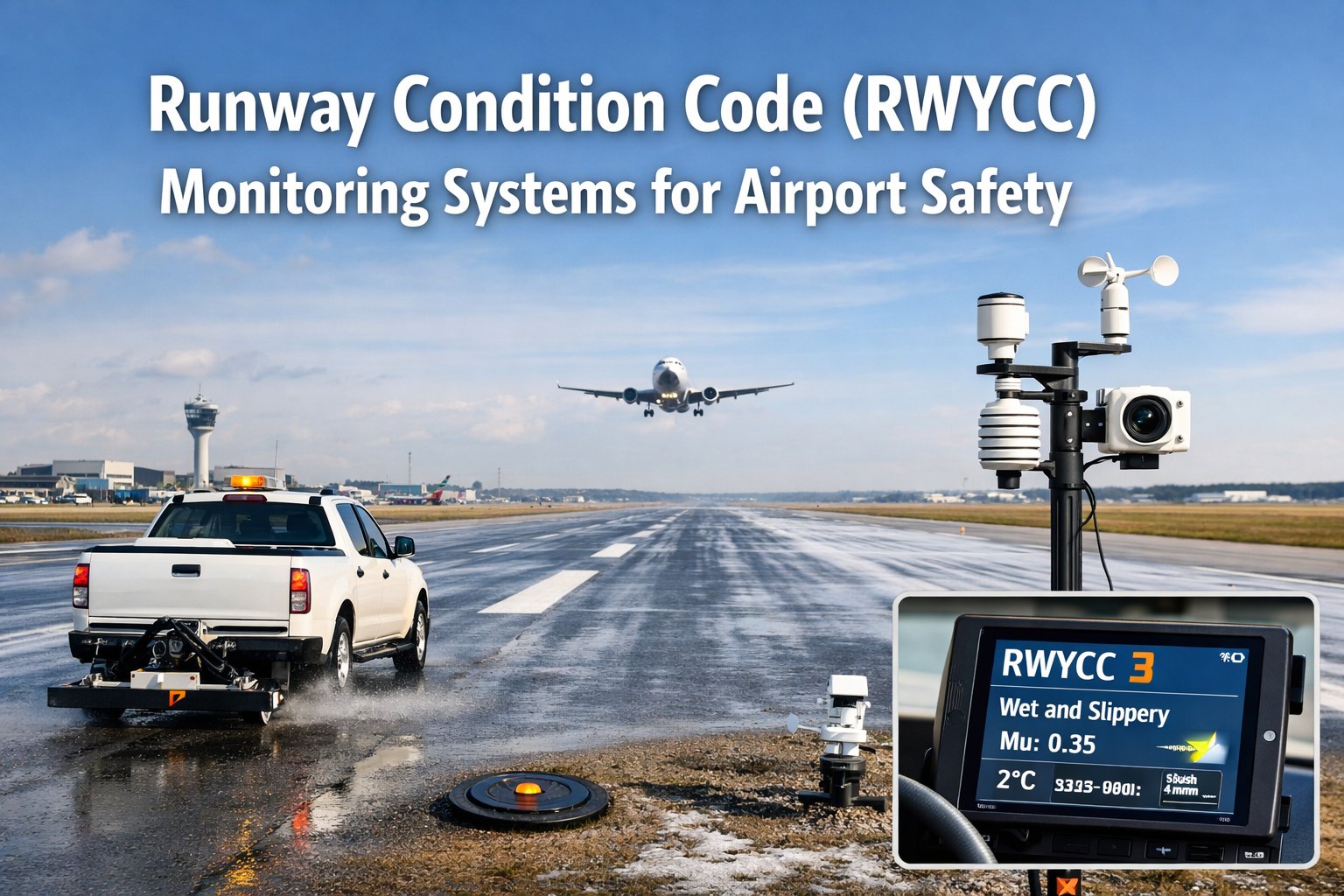
A single bolt left on a runway costs the aviation industry $4 billion annually. One inch of undetected ice causes a 10-minute delay that cascades through global flight networks. Your manual inspections catch 23% of debris—automated IoT sensors catch 100%. The difference between proactive monitoring and reactive crisis management is measured in lives, dollars, and operational chaos. Stop gambling with runway safety—deploy intelligent sensors that monitor pavement temperature, detect moisture before ice forms, and identify foreign objects smaller than a golf ball in any weather condition. Schedule a consultation
Deploy real-time pavement temperature sensors, automated moisture detection, and AI-powered foreign object debris systems that keep your runways safe 24/7—in any weather condition.
The Hidden Cost of Unmonitored Runways
Every minute of runway downtime, every undetected hazard, every delayed flight compounds into billions in losses annually.
Engine damage, punctured tires, aircraft out of service time—Boeing estimates direct repair costs alone at $4B yearly
Including flight delays, cancellations, lost revenue, passenger compensation—FAA estimates true costs up to $22.7B
Each minute of delay costs airlines $62.55 in crew salaries, fuel, and operational costs—compounding across networks
On average, 12.8 FOD incidents occur per 10,000 aircraft movements—at $26 direct cost per flight
⚫ The Air France Concorde Disaster
On July 25, 2000, a single piece of titanium debris on a runway at a major international airport caused the catastrophic crash of Air France Flight 4590, killing 113 people. The debris—part of a thrust reverser from a previous aircraft—punctured a tire, rupturing a fuel tank and igniting a fire. This tragedy transformed global FOD awareness and prevention standards.
Why Manual Inspections Fail
❌ Manual Visual Inspection
- Only 4 inspections per day (ICAO minimum)
- 23.6% of FOD detected by visual/vehicle inspection
- Cannot operate in low visibility conditions
- Human fatigue reduces detection accuracy
- Requires runway closure for inspection
- Cannot detect subsurface conditions
- Weather-dependent effectiveness
- High time and labor costs
✅ Automated IoT Monitoring
- 1,000+ inspections per day (continuous)
- 76.4% of FOD detected by automated systems
- Operates in zero visibility conditions
- Consistent 24/7 detection accuracy
- No runway closure required
- Monitors pavement health in real-time
- All-weather operation guaranteed
- Lower total cost of ownership
Comprehensive Runway Monitoring Solutions
A complete sensor ecosystem for every runway hazard—from microscopic debris to invisible ice formation.
Pavement Temperature Sensors
Embedded sensors measure surface and subsurface temperatures to predict ice formation hours before it occurs. Critical for proactive de-icing decisions.
- Predict icing conditions 2-4 hours in advance
- Optimize de-icing chemical application timing
- Reduce unnecessary chemical usage by 30%
- Withstand aircraft loads without damage
Moisture & Ice Detection
Active and passive sensors detect water film height, freezing point, ice percentage, and friction coefficient—determining exact runway surface state.
- Distinguish dry/damp/wet/ice/snow/slush
- Measure de-icing chemical concentration
- Independent freezing point detection
- Support RCAM condition reporting
FOD Detection Radar
Millimeter-wave radar systems continuously scan runways to detect, locate, and classify foreign objects as small as a bolt—in any weather condition.
- Detect metal, plastic, rubber, glass, organic
- AI-powered false alarm elimination
- Laser-guided personnel dispatch
- Zero-visibility operation capability
Atmospheric Sensors
Environmental monitoring stations track air temperature, dew point, humidity, wind, visibility, and precipitation—correlating with surface conditions.
- Correlate atmospheric and surface conditions
- Support Weather Support to Deicing (WSDDM)
- Enable proactive winter operations planning
- Integrate with existing AWOS systems
Pavement Health Monitoring
MEMS and fiber optic sensors embedded in pavement monitor strain, stress, deflection, and structural integrity—detecting cracks before they become hazards.
- Detect ASR (alkali-silica reaction) early
- Predict pavement blowup conditions
- Monitor thermal expansion stress
- Reduce unplanned runway closures
Mobile Assessment Systems
Vehicle-mounted sensors for dynamic runway condition assessment—creating real-time friction maps and condition reports during operations.
- Generate RCAM/SNOWTAM reports automatically
- Thermal mapping for targeted treatment
- Wireless data transfer to operations center
- Complement fixed sensor network
Advanced FOD Detection Technology
Millimeter-wave radar combined with AI delivers 100% runway inspection for every flight—not just 1% with manual checks.
How It Works
Continuous Scanning
76-96 GHz millimeter-wave radar continuously scans the full runway width, detecting objects with radar cross-section as low as -20 dBsm
AI Classification
Advanced algorithms distinguish FOD from background clutter, pavement features, and false alarms—eliminating 99% of false positives
Visual Verification
High-definition day/night cameras automatically cue to detection location, providing visual confirmation before dispatching personnel
Guided Removal
Laser beam guidance directs ground crew directly to exact FOD location—minimizing runway closure time and maximizing safety
Detectable Objects
FAA Standard: Reference metal cylinder 38mm diameter × 31mm height detectable at 1,000m range
Winter Operations Excellence
Predictive ice detection and intelligent de-icing reduce runway closures, chemical usage, and weather delays.
❄️ The Winter Challenge
IoT-Enabled Solution
-
2-4 Hour Advance WarningPredict ice formation before it occurs using subsurface temperature trends
-
30% Chemical ReductionApply de-icers only when and where needed based on sensor data
-
Real-Time Friction MonitoringKnow exact runway surface state without closing for inspection
-
Automated SNOWTAM GenerationCreate condition reports automatically from sensor data
-
Targeted TreatmentThermal mapping identifies specific areas requiring de-icing
-
Level 7 Wind ResistanceFiber optic sensors operate in severe weather
Sensor Placement Strategy
FAA Recommended Placement
- Minimum 3 sensors per runway for basic condition monitoring
- Touchdown and rollout zones require highest sensor density
- Light-colored pavement (concrete) freezes before dark pavement
- Pavement crown differences affect ice formation—account for drainage
- FOD radar units every 1,000m for full coverage with redundancy
- Atmospheric sensors at runway threshold and midpoint
System Integration Architecture
Sensor Layer
Communication Layer
Processing Layer
Output Layer
Proven Airport Deployments
No significant FOD-related emergencies since Tarsier system installation. Supporting 80+ million passengers with 1,000 automated inspections daily vs. 4 manual inspections.
5 sensor clusters on Runway 17L-35R plus 3 on taxiways. Active sensors measure freezing point of precipitation mixed with de-icers—not just surface temperature.
Between Jan 2019-2020, 33,140 items detected: 25,316 by FOD detection system, 7,824 by visual inspection. System validates threats before dispatching crews.
Return on Investment
Cost-Benefit Analysis
Annual Savings
Transform Your Runway Safety Operations
OxMaint integrates with runway condition monitoring systems to provide unified maintenance management, automated alerts, and compliance reporting for your airfield operations.
Frequently Asked Questions
How do embedded pavement sensors withstand aircraft loads?
Modern embedded sensors use flush-mount designs that sit level with the pavement surface. The sensor housing is engineered to distribute loads across the surrounding pavement, and vehicles (including aircraft) can drive directly over them without causing damage. Some sensors use two-part housings that allow maintenance access without disturbing the pavement.
Can FOD radar systems operate in heavy rain, fog, or snow?
Yes, millimeter-wave radar is specifically chosen for FOD detection because it operates effectively in zero-visibility conditions. Unlike camera-based systems, radar penetrates fog, rain, and snow. Advanced systems like Tarsier and FODetect guarantee operation in all weather conditions, including high temperatures, sandstorms, and frequent fog.
What's the minimum detectable object size for FOD radar?
FAA-certified systems can detect objects equivalent to a metal cylinder 38mm in diameter and 31mm high (roughly the size of a large bolt) at distances up to 1,000 meters. The Tarsier system achieves 100% detection at 3,168 feet, exceeding human visual inspection capabilities significantly.
How do ice detection sensors work with different de-icing chemicals?
Active sensors measure the actual freezing point of the surface liquid—regardless of which de-icing chemical is used (sodium chloride, potassium acetate, formates, etc.). This is critical because airports use different chemicals than road salt, with freezing points as low as -60°C depending on concentration.
Do runway sensors require runway closure for installation?
Embedded sensors typically require brief runway closure during installation—often scheduled during overnight hours or maintenance windows. However, once installed, the sensors operate continuously without requiring additional closures. Some mobile and non-invasive sensors can be deployed without any runway closure.
How do these systems integrate with existing airport operations centers?
Modern runway monitoring systems provide standard data interfaces (Ethernet, serial, API) that integrate with existing Airport Operations Centers, AWOS/ASOS systems, and maintenance management platforms. Data can be displayed on existing monitoring screens, and alerts can be routed through established notification systems. OxMaint provides pre-built integrations for seamless connectivity.