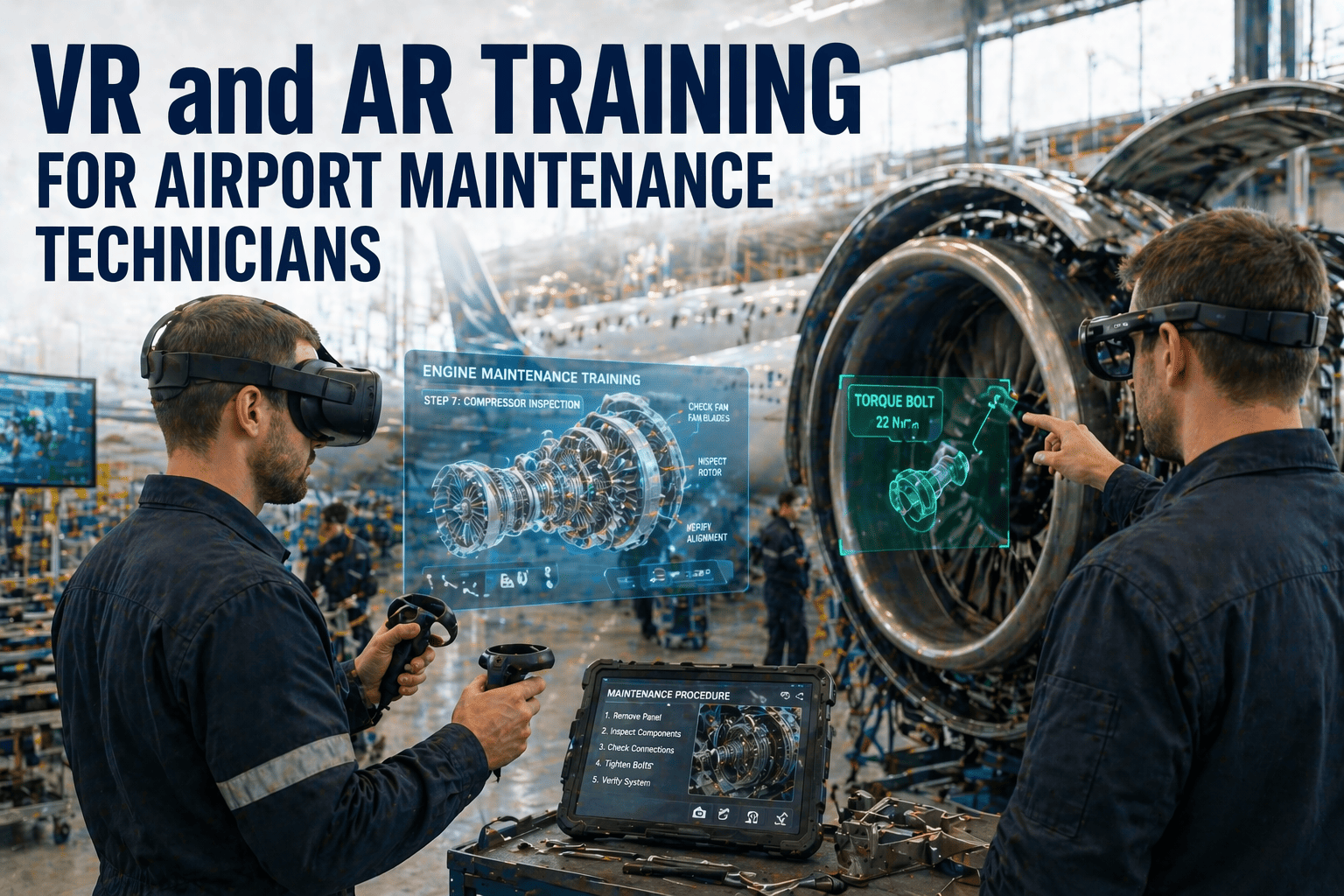
Aviation maintenance is one of the most precision-critical disciplines in any industry — a single miswired circuit or overlooked torque spec can cascade into catastrophic failure at 35,000 feet. Yet most MRO organisations still train their technicians the same way they did twenty years ago: dense manuals, classroom theory, and learning-by-doing on live aircraft. Virtual reality changes this equation entirely. VR-based training environments let technicians rehearse complex procedures, navigate failure scenarios, and build muscle memory in zero-risk simulations before they ever touch a real airframe. The result is measurable: fewer errors, faster certification, and stronger retention across every skill level. Organisations using Oxmaint to connect VR training outcomes with live maintenance operations are seeing the full picture — from first simulation to signed work order — in one unified platform. If that sounds like what your MRO operation needs, start a free trial today or book a demo to see how it works in practice.
80%
of aviation accidents attributed to human error
ICAO Safety Report
43%
reduction in maintenance errors with VR simulation
Boeing MRO Training Study
$83B+
global MRO market size by 2026
IATA MRO Forecast
40%
faster technician onboarding with immersive training
Aviation Week Workforce Survey
Ready to Eliminate Training Gaps Before They Become Errors?
Oxmaint connects your VR training programme directly to maintenance scheduling, work order assignment, and competency records — so your operation only deploys technicians with verified, current skills.
What Is VR Training in Aviation Maintenance?
Virtual reality training in aviation maintenance uses immersive, headset-based simulation environments to replicate real aircraft systems, components, and repair scenarios with high fidelity. Technicians interact with virtual engines, avionics bays, landing gear assemblies, and hydraulic systems using hand controllers that mimic actual tooling. Unlike classroom instruction, VR training activates procedural memory — the same neural pathways engaged during physical task execution — which is why retention rates in VR-trained cohorts run 3x higher than traditional video-based instruction. The technology is particularly powerful for fault diagnosis training, where technicians must identify failures without prior warning, and for low-frequency, high-consequence procedures that rarely occur on live aircraft but demand perfection when they do. To see how Oxmaint links simulation outcomes to your CMMS, start a free trial or book a demo with our team.
Immersive simulation that replicates real aircraft systems for skills-based maintenance training
70%
of standard MRO procedures are fully replicable in VR environments
3x
higher knowledge retention vs traditional training methods at 30-day recall
The Four Pillars of VR-Enabled MRO Technician Development
Effective VR training in aviation maintenance is not a single event — it is a structured progression from system familiarity to independently assessed competency. Organisations that see the strongest error-reduction results build their VR programmes around four sequential stages, each building on the last. Oxmaint's competency tracking module records progress at every stage, creating a living qualification record that feeds directly into work order assignment logic. Start a free trial to see how qualification data flows into your maintenance scheduling, or book a demo for a walkthrough of the full workflow.
01
System Familiarisation
Technicians explore full-scale virtual aircraft systems — engines, avionics bays, landing gear — at their own pace. They identify components, access panels, and safety zones before any procedural instruction begins. This stage reduces cognitive overload during subsequent hands-on training by up to 35%.
02
Guided Procedure Rehearsal
Step-by-step task walkthroughs with real-time haptic and visual feedback. Technicians repeat procedures until accuracy thresholds are met — typically 95% before advancement. AMM references are overlaid in the VR environment, reinforcing documentation habits in context rather than as a separate study activity.
03
Fault Scenario Simulation
Unannounced failure injections test diagnostic reasoning under time pressure. Technicians encounter hydraulic leaks, avionics faults, and structural anomalies in randomised sequences. This stage is impossible to replicate safely on live aircraft — VR is the only environment where fault training at scale is both safe and cost-effective.
04
Assessed Competency Sign-Off
Proctored VR assessments with objective scoring replace subjective supervisor observations. Pass/fail results, error timestamps, and procedure deviations are logged automatically. These records integrate directly into Oxmaint's competency registry — feeding task assignment, regulatory reporting, and training expiry management.
Where Traditional MRO Training Is Failing Aviation Operations
Legacy training approaches were built around a world with plenty of time, abundant senior mentors, and stable aircraft fleets. None of those assumptions hold today. Technician shortages are projected to reach 174,000 globally by 2032 according to Boeing's Pilot and Technician Outlook, while fleet complexity continues to rise. The gap between what traditional training delivers and what modern MRO operations require is widening every year. Start a free trial to see how Oxmaint closes that gap, or book a demo and bring your training coordinator.
Repetition Gap
Insufficient Hands-On Repetition
Live aircraft availability limits practice to 2-4 repetitions per procedure. VR-based training requires 8-12 repetitions to reach retention thresholds. The gap directly contributes to the 43% of maintenance errors traced back to insufficient procedural practice.
Evidence Gap
No Objective Competency Evidence
Sign-off records are typically a supervisor signature — not performance data. When an incident occurs, there is no audit trail showing what the technician actually practised, how many attempts it took, or where errors occurred during training.
Retention Gap
Rapid Knowledge Decay
Studies show technicians retain only 20% of classroom-based training at the 30-day mark. For low-frequency procedures performed once or twice per year, this means every execution is effectively the first — creating consistent error risk regardless of training history.
Fault Gap
Zero Fault Diagnosis Training
Traditional programmes teach technicians to execute correct procedures on functioning systems. They provide almost no structured training for identifying faults on degraded or damaged components — the exact skill needed when an unscheduled maintenance event occurs mid-operation.
Integration Gap
Disconnected Training Records
Training data lives in HR systems. Work orders live in the CMMS. Competency records live in spreadsheets. No system connects them, so a technician can be assigned a task they are no longer current on — and no automated check exists to catch it before the job is released.
Speed Gap
Slow New-Hire Onboarding
Type-rating onboarding for a new aircraft variant takes 6-9 months under traditional mentorship models. With senior technician time scarce, new hires spend significant periods shadowing rather than building independent competency — delaying the ROI on every hire by an average of 40%.
How Oxmaint Connects VR Training Data to Live Maintenance Operations
VR training platforms generate rich competency data — but without integration into your CMMS, that data never reaches the decisions that matter: who gets assigned to this work order, whose qualification expires next month, which crew is ready for unscheduled AOG response. Oxmaint bridges that gap. Every VR assessment score, training completion, and skill expiry date flows into a living competency registry that directly influences how work is scheduled, assigned, and signed off. Start a free trial and connect your training data to real operations, or book a demo to see the integration in action.
Competency Layer
Living Competency Registry
Every VR training result, assessment score, and skill sign-off populates a real-time technician competency profile. No manual data entry. The registry updates automatically and feeds every downstream decision in the platform.
Assignment Control
Qualification-Gated Work Assignment
Work orders requiring specific skill levels or certifications are automatically matched to qualified technicians only. If a technician's VR assessment score falls below threshold or a certification has lapsed, they are excluded from assignment pools for that task type.
Proactive Alerts
Skill Expiry and Recurrency Alerts
Configurable alerts notify supervisors and training coordinators 30, 60, and 90 days before any technician qualification expires. Recurrency training can be triggered directly from the alert — VR session assigned, scheduled, and tracked without leaving the platform.
Audit Trail
Digital Signature Traceability
Every completed work order links to the technician's active qualification record at the time of sign-off. Auditors see not just who signed the work order, but what they trained on, when, and at what assessment score — all in one tamper-proof record chain.
Gap Analysis
Competency Gap Reporting
Portfolio-level reports surface training gaps by task type, aircraft variant, and team. Maintenance managers can see exactly which skills are undertrained across their workforce before those gaps translate into errors on the hangar floor.
Mobile Verification
On-Site Qualification Verification
Supervisors verify technician qualification status from the mobile app before releasing any safety-critical task — no system access required from a desktop. Real-time qualification data follows every technician to every station, line, or remote site.
Performance History
Human Performance History Tracking
VR assessment trends, rework rates, near-miss reports, and task completion history are aggregated into a single technician performance timeline. Supervisors identify high-risk patterns — repeat errors, declining scores, high rework rates — before they reach incident level.
IoT Integration
Sensor-Triggered Training Flags
When IoT-connected assets report anomalies or new fault signatures, Oxmaint can automatically flag training requirements for the affected system. If a fleet update introduces a new failure mode, the platform identifies which technicians lack current training on that system and queues VR sessions accordingly.
Traditional MRO Training vs VR-Enabled Training with Oxmaint
The performance gap between conventional maintenance training and a VR-integrated approach becomes clear when you compare the two against the metrics that matter most to MRO directors: error rates, regulatory readiness, and workforce throughput. The table below reflects documented outcomes from aviation MRO organisations that have integrated simulation-based training with digital maintenance management. Start a free trial and benchmark your operation, or book a demo to walk through the numbers with our team.
| Training Dimension |
Traditional MRO Training |
VR-Enabled Training + Oxmaint |
| Procedure Repetition |
2-4 live aircraft repetitions per procedure |
Unlimited VR repetitions; advancement gated by accuracy score |
| Competency Evidence |
Supervisor signature only — no performance data |
Scored assessment with error timestamps and procedure deviations logged |
| CMMS Integration |
Training data siloed in HR or LMS — no CMMS connection |
Qualification data feeds directly into work order assignment and sign-off |
| Fault Scenario Training |
Minimal — unsafe to practice fault conditions on live aircraft |
Unlimited randomised fault injections across all systems at zero risk |
| Retention at 30 Days |
20% knowledge retention typical |
65-75% retention with spaced VR repetition protocols |
| Regulatory Traceability |
Paper logbooks and manual records — audit-intensive |
Automatic digital trail linked to every work order and sign-off event |
| Skill Expiry Management |
Manual tracking — expiry often missed until audit |
Automated 30/60/90-day alerts with VR recurrency session queuing |
| New-Hire Onboarding |
6-9 months to independent task qualification |
40% faster to first solo qualification with structured VR progression |
The Documented Impact
The business case for VR-integrated maintenance training is now supported by outcome data from commercial and military MRO operations across multiple aircraft types and maintenance categories. The metrics below reflect reported results from MRO organisations that have moved from traditional training to simulation-based programmes supported by digital competency management platforms. Start a free trial and begin tracking your own outcomes, or book a demo to see how the ROI model maps to your operation.
43%
Fewer Maintenance Errors
Average reduction in procedural errors when technicians complete structured VR training before live task authorisation
40%
Faster Time to Eligibility
New technicians reach independent task qualification 40% faster compared to mentorship-only onboarding programmes
3x
Higher Skill Retention
30-day knowledge retention rates 3x higher in VR-trained cohorts versus video-based instruction across complex procedures
28%
Reduction in Rework
Maintenance rework events drop by an average of 28% within six months of implementing VR-based pre-authorisation training
Frequently Asked Questions
How does Oxmaint receive data from VR training platforms?
Oxmaint integrates with major aviation VR training systems via API and xAPI (Tin Can) data standards. When a technician completes a VR assessment, the outcome — score, pass/fail, skill category, timestamp — is automatically pushed to their Oxmaint competency profile. No manual data transfer or HR system middleware is required. The integration is configurable per training provider, and Oxmaint's open API allows custom integrations for platforms not yet in the standard library. To see which VR platforms are currently supported natively,
book a demo or
start a free trial and the team will walk you through setup.
Can VR training records satisfy EASA Part 145 or FAA Part 145 documentation requirements?
VR training records stored in Oxmaint are maintained as audit-ready documentation with full digital traceability. Each record includes technician identity verification, task scope, assessment method, score, date, and the authorising supervisor's digital signature. Oxmaint's records chain links VR training completions directly to work order sign-offs, creating an unbroken documentation trail that satisfies performance evidence requirements referenced in EASA Part 145.A.30 and FAA Part 145.163. Final regulatory determination rests with your Accountable Manager and applicable authority.
Book a demo to review the compliance documentation framework in detail.
What happens when a technician's VR qualification expires in Oxmaint?
Oxmaint tracks every qualification with a configurable expiry period set by your training coordinator or quality manager. As the expiry date approaches, the platform sends automated alerts to the technician and their supervisor at 90, 60, and 30 days. If the qualification expires without recurrency training completed, Oxmaint automatically removes that technician from eligible assignment pools for work orders requiring that skill — no manual intervention needed. A VR recurrency session can be triggered directly from the expiry alert, queued, and tracked through to completion and re-qualification.
Start a free trial to configure your qualification expiry framework.
How quickly can a multi-base MRO operation deploy Oxmaint's VR training integration?
Most multi-site MRO operations are fully live within 4-6 weeks. Weeks one and two cover technician data migration, skill category configuration, and asset hierarchy setup. Weeks three and four establish VR platform API connections and work order assignment logic. Weeks five and six activate expiry alerting, competency gap reporting, and supervisor dashboards across all sites. Because Oxmaint is cloud-native and mobile-first, there is no on-site infrastructure to deploy — each site goes live independently without disrupting active operations at other bases.
Book a demo to map out your specific deployment timeline.
Stop Training in Silos. Start Building a Verified Workforce.
Every VR simulation hour your technicians complete should be making your operation safer, faster, and more audit-ready. Oxmaint ensures it does — by connecting training outcomes to work assignment, qualification tracking, and regulatory documentation in one unified platform. Whether you are running a single MRO base or a global portfolio of maintenance stations, Oxmaint gives you real-time visibility into who is qualified, who is expiring, and who is ready to fly.