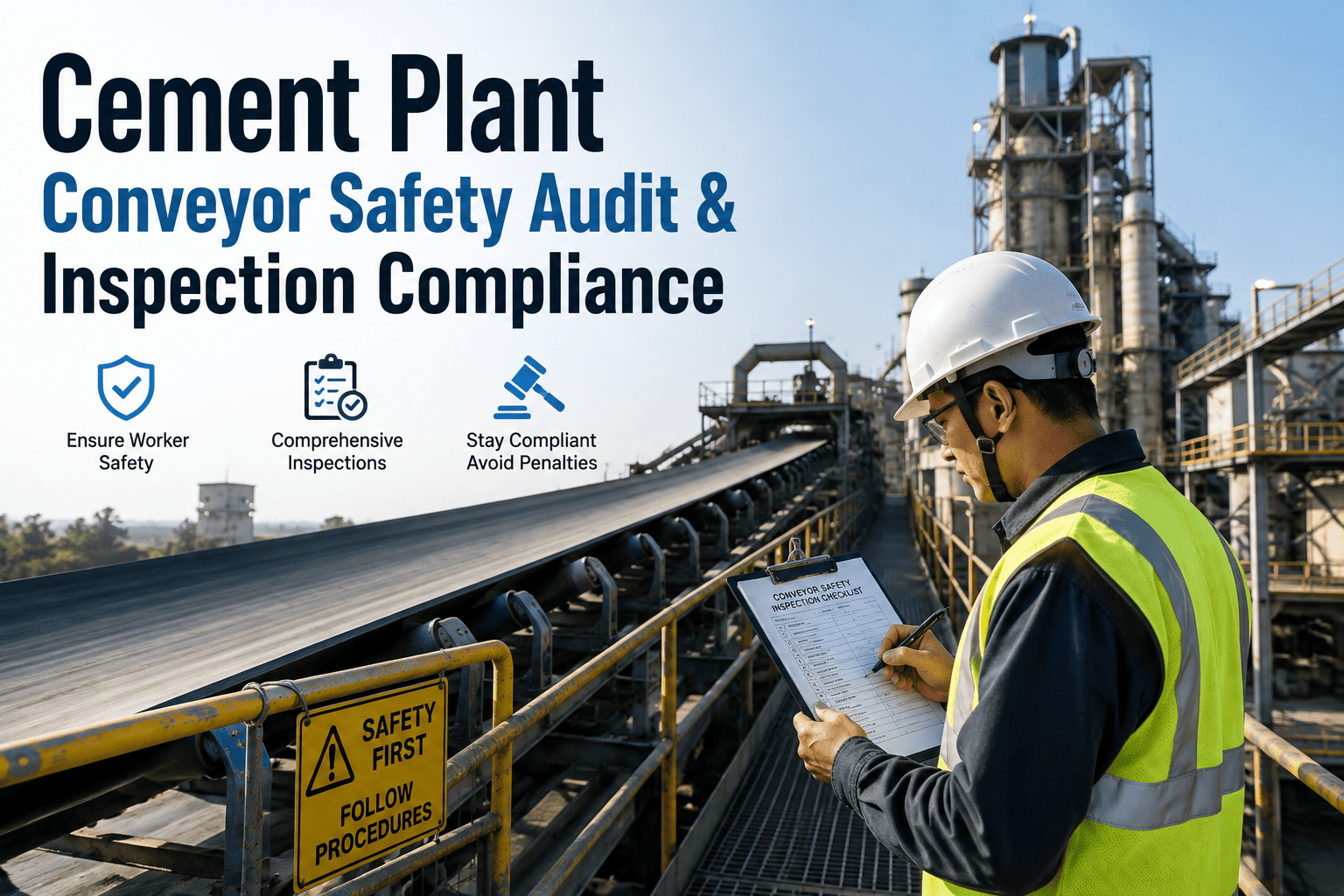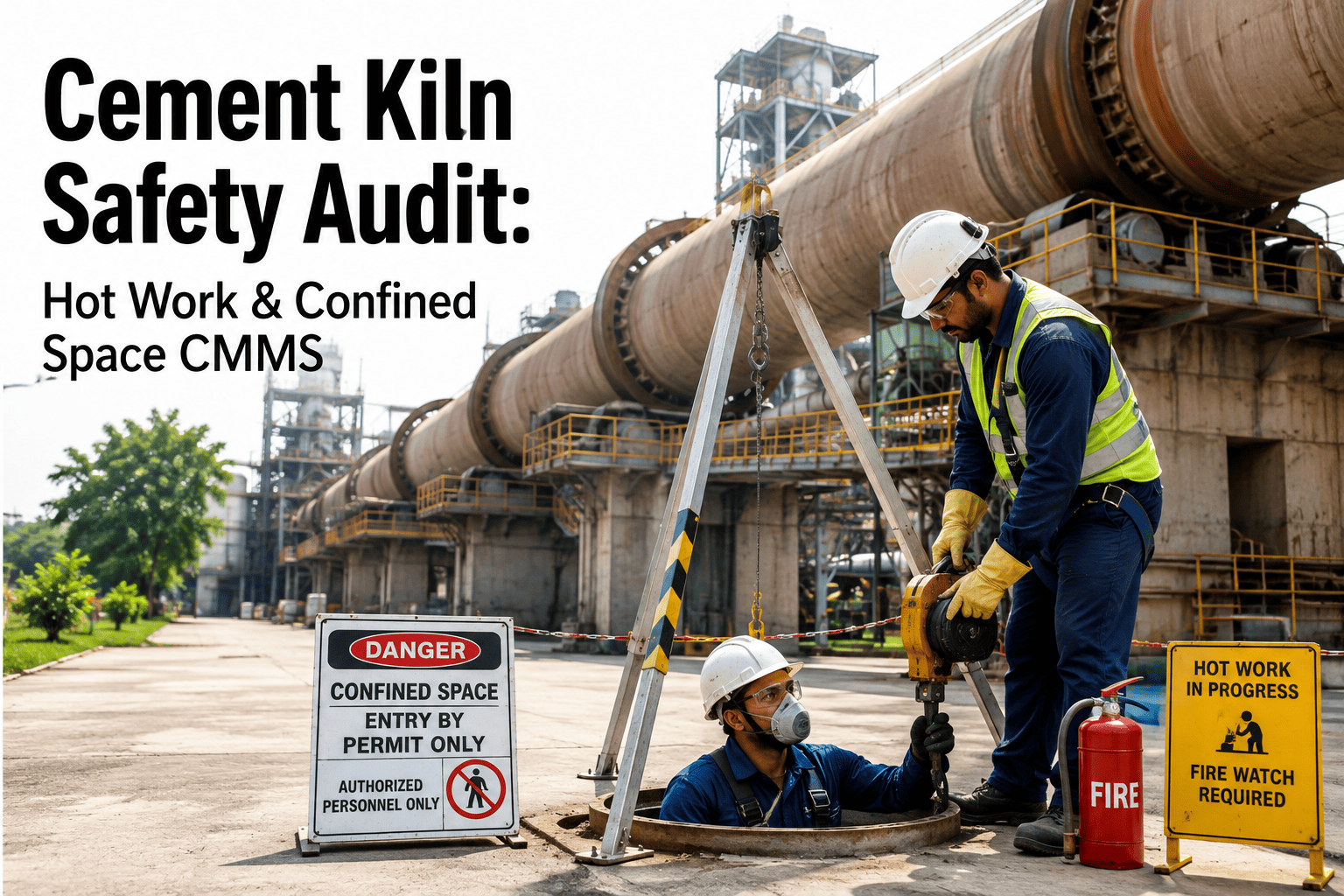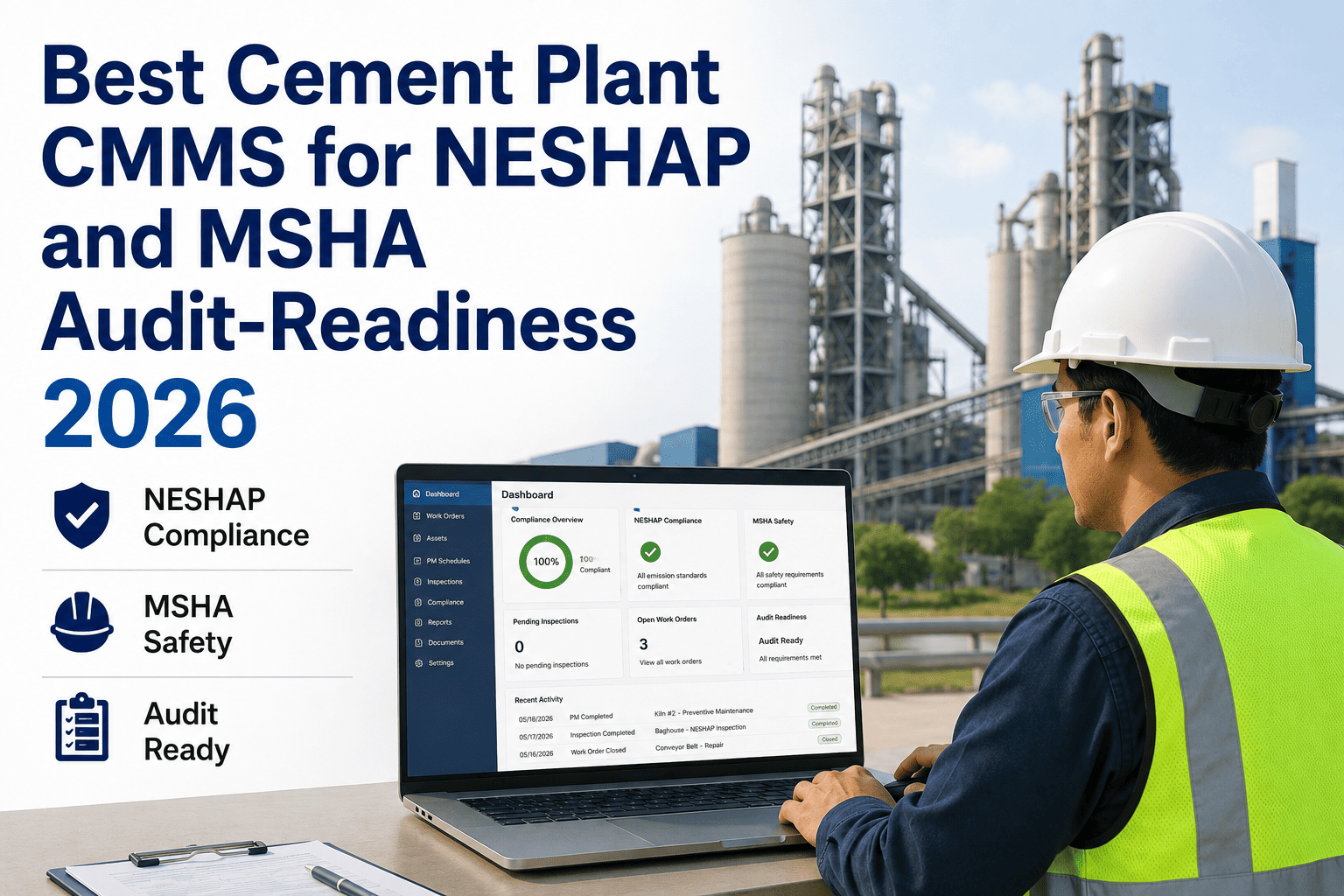
Cement manufacturing remains one of the most heavily audited industrial sectors, with OSHA, MSHA, and internal compliance teams all scrutinizing kiln operations, dust handling, and maintenance workflows under tightening 2026 expectations. A single failed audit can trigger six-figure penalties, mandatory shutdowns, and reputational damage that lingers for quarters. Building a defensible, always-audit-ready posture requires more than spreadsheets — it demands structured documentation, permit-to-work discipline, and corrective action tracking that holds up under regulator scrutiny. The guide below breaks down audit categories, documentation requirements, and the CMMS-driven compliance program that keeps cement plants audit-ready year-round. Start Free Trial to operationalize every checkpoint immediately.
Is your cement plant audit-defensible across every regulator in 2026?
OSHA, MSHA, and internal auditors all expect documented evidence of permit-to-work discipline, kiln safety controls, and dust explosion prevention — not verbal assurances. A structured CMMS turns scattered compliance into a single, defensible record.
Four audit regimes govern a cement plant — each demands different evidence
A mid-size cement plant running two kilns typically faces 14–18 formal inspections per year across federal, state, and internal frameworks. Each regime examines overlapping but distinct control areas, and missing documentation for any one of them can escalate a routine visit into a citation.
Federal workplace safety — 29 CFR 1910
Covers process safety management for pyroprocessing, lockout/tagout on crushers and mills, respirable crystalline silica (PEL 50 µg/m³), and confined space entry in silos and preheater towers. Inspectors request 5-year exposure records and LOTO procedure versions.
Mine Safety & Health — quarry operations
Applies to limestone quarries feeding the plant. Part 56 requires documented workplace examinations, highwall stability assessments, and equipment guarding logs. Non-compliance fines start at $272 per non-serious violation and exceed $75K for flagrant violations.
NESHAP & particulate compliance
Portland cement NESHAP (40 CFR 63 Subpart LLL) limits PM emissions to 0.04 lb/ton of clinker and mandates continuous opacity monitoring. Audit trails must show calibration records, baghouse inspection logs, and bypass stack incident reports for 5 years.
Corporate EHS & insurance audits
Carrier-mandated audits evaluate property loss exposure, combustible dust (NFPA 654), and mechanical integrity programs. Insurance premium reductions of 8–15% are tied to documented CMMS-based preventive maintenance and corrective action closure rates above 90%.
The 12 records that decide whether an audit passes or fails
When an inspector arrives, the first 90 minutes are spent requesting documentation. Plants that cannot produce these 12 record types within minutes — not days — face expanded scope, sampling, and referral for follow-up enforcement.
- Hot work permits with authorized-issuer signatures and fire-watch logs
- Confined space entry permits for silo, preheater, and kiln access
- Excavation permits identifying underground utilities near conveyors
- LOTO procedures with annual review sign-offs for every energy source
- Crane and lifting-equipment inspection certificates (annual third-party)
- Pressure vessel and safety relief valve test records per API 510/570
- PHM/PHA revalidation records (every 5 years per OSHA PSM)
- Management of Change (MOC) logs for equipment and procedure changes
- Pre-startup safety review (PSSR) sign-offs for kiln restarts after outages
- Silica exposure monitoring data and 8-hour TWA calculations
- Respiratory protection fit-test records (annual, OSHA 1910.134)
- Hearing conservation audiograms for areas exceeding 85 dBA
A 6-step workflow that converts audit findings into closed, verified actions
Industry benchmark data shows that 41% of cement plant audit findings are reopened on subsequent inspections because corrective actions were marked "complete" without verification evidence. The workflow below — built around CMMS-enforced closure rules — drives reopen rates below 6%.
Log finding with severity, regulator citation, and root cause code
Each finding enters the CMMS as a linked work order tagged with the originating audit ID, CFR citation, and a root-cause category (equipment, procedure, training, or design). Timestamp and inspector name auto-attach.
Assign owner and due date based on severity matrix
Serious findings (imminent danger) carry 15-day deadlines; other-than-serious 60 days; recordkeeping 90 days. The CMMS blocks overdue reassignment without EHS manager override, creating an auditable escalation trail.
Execute corrective action with photo and sign-off evidence
Technicians attach before/after photos, updated procedure PDFs, and training completion records directly to the work order. GPS timestamps on mobile submissions confirm on-site execution.
Independent verification by a different team member
A second qualified inspector — not the person who closed the action — signs off in the CMMS. This four-eyes principle is what auditors look for and is the single biggest factor in preventing finding reopenings.
Trend analysis across audits to surface systemic gaps
Quarterly CMMS reports group findings by root cause, area, and equipment type. When three or more findings share a root cause within 12 months, the system auto-triggers a Management of Change review.
Archive complete record package for 5-year retention
Closed findings bundle into a tamper-evident archive with original finding, corrective work order, evidence files, and verifier sign-off. Exportable as a single PDF for OSHA or MSHA inspector review on demand.
A 1.8MTPA plant cut audit findings by 73% in one audit cycle
Consider a 1.8 million ton-per-year cement plant in the Midwest running two dry-process kilns, 14 silos, and a limestone quarry. After a 2024 OSHA inspection produced 23 citations and $187,000 in penalties — plus a MSHA Part 56 referral — the plant deployed a CMMS-driven safety compliance program across maintenance and EHS teams within 90 days.
| Audit Dimension | Before CMMS (2024) | After CMMS (2025) |
|---|---|---|
| Permit-to-work documentation | Paper permits, 38% missing on re-inspection | Digital permits with mandatory field completion |
| LOTO procedure currency | 14 of 62 procedures past annual review date | Auto-escalation at 330 days; 100% current |
| Silica exposure records | Spreadsheet, gaps of 4–6 months between samplings | Scheduled sampling, alerts at 60-day intervals |
| Corrective action reopen rate | 41% reopened on next audit cycle | 6% reopen rate with verifier sign-off enforced |
| Inspector response time | 3–5 business days to assemble records | Under 2 hours via CMMS audit-export module |
Where cement plant audits find the most serious violations
Three operational zones consistently produce the highest-severity audit findings in cement plants: the pyroprocessing line, bulk material handling and dust collection, and confined space entry into silos and storage domes. Targeted CMMS controls in these areas yield the strongest audit defense per dollar invested.
Kiln & preheater safety
Coating ring formation, refractory failure, and fuel system leaks drive 28% of serious pyroprocessing incidents. CMMS-enforced inspection rounds on refractory thickness (ultrasonic at 90-day intervals), burner pipe alignment, and fuel gas leak detection create the documentation trail auditors expect.
Dust explosion prevention
Coal and petcoke grinding circuits carry the highest combustible dust risk. NFPA 654 compliance requires documented housekeeping schedules, layer depth measurements (action level 3.2 mm), and explosion vent inspection on baghouses. CMMS triggers cleaning work orders when dust accumulation thresholds are logged.
Silo & confined space entry
Silo entry for debridging and cleaning accounts for 19% of cement industry confined space fatalities. CMMS-enforced permits require atmospheric testing (O₂ 19.5–23.5%, LEL below 10%), rescue team standby confirmation, and continuous ventilation monitoring before entry authorization is issued.
Mobile equipment & traffic
Quarry haul trucks, front-end loaders, and plant vehicles contribute to 22% of MSHA-reportable cement-sector injuries. CMMS tracks pre-shift inspection forms, backup alarm tests, and brake system service intervals — producing the documentation MSHA inspectors request under Part 56.14100.
Make your next audit the easiest one your plant has faced
Deploy a CMMS-built safety compliance program in under 14 days and walk into your next OSHA, MSHA, or internal audit with every permit, LOTO procedure, and corrective action organized and exportable.
Cement plant safety audit & CMMS compliance — answered
How often should a cement plant conduct internal safety audits?
Internal audits should run monthly in high-risk zones (kiln, silos, coal grinding), quarterly across the full plant, and annually as a comprehensive cross-functional review. OSHA and MSHA do not mandate internal audit frequency, but insurers and ISO 45001 certification bodies expect at least quarterly documented self-assessments with tracked corrective actions.
What records must be retained and for how long under OSHA and MSHA rules?
OSHA requires silica exposure records for 30 years (1910.1053), LOTO procedure retention for as long as the equipment is in service, and injury/illness logs (300, 300A, 301) for 5 years. MSHA requires workplace examination records for 1 year (Part 56.18002), but most cement plants retain them for 5 years to align with OSHA expectations. A CMMS automates retention schedules and prevents premature deletion. Book a Demo to see retention workflows configured for your plant.
Does a CMMS replace the need for a dedicated EHS team in a cement plant?
No. A CMMS systematizes what EHS professionals design — it enforces permit-to-work steps, tracks corrective actions, and generates audit-ready documentation. Plants using a CMMS typically reallocate 40–60% of EHS administrative time to higher-value field work like behavior-based safety observations and root-cause training.
What is the single most common audit finding in cement plants?
Expired or undocumented lockout/tagout procedures top the list, followed by missing confined space entry permits and inadequate respirable crystalline silica monitoring data. OSHA citation data from 2022–2024 shows LOTO-related citations in cement plants averaged $4,200 per violation, with repeat violations reaching $62,500 each under the 2024 penalty structure.
How long does it take to deploy a CMMS for safety compliance in a cement plant?
A focused deployment targeting permit-to-work, LOTO, corrective actions, and audit documentation takes 10–14 days for a plant with 200–500 assets. Full enterprise rollout including quarry equipment integration and silo confined space permit automation typically reaches 30–45 days. Start Free Trial to begin configuration on day one.
Every day without a CMMS is a day of audit exposure
Join cement plants that have cut findings by 70%+, reduced penalty exposure by tens of thousands of dollars, and turned compliance from a scramble into a routine. Deploy OxMaint in under two weeks and walk into your next inspection with confidence.
Free 14-day trial · No credit card