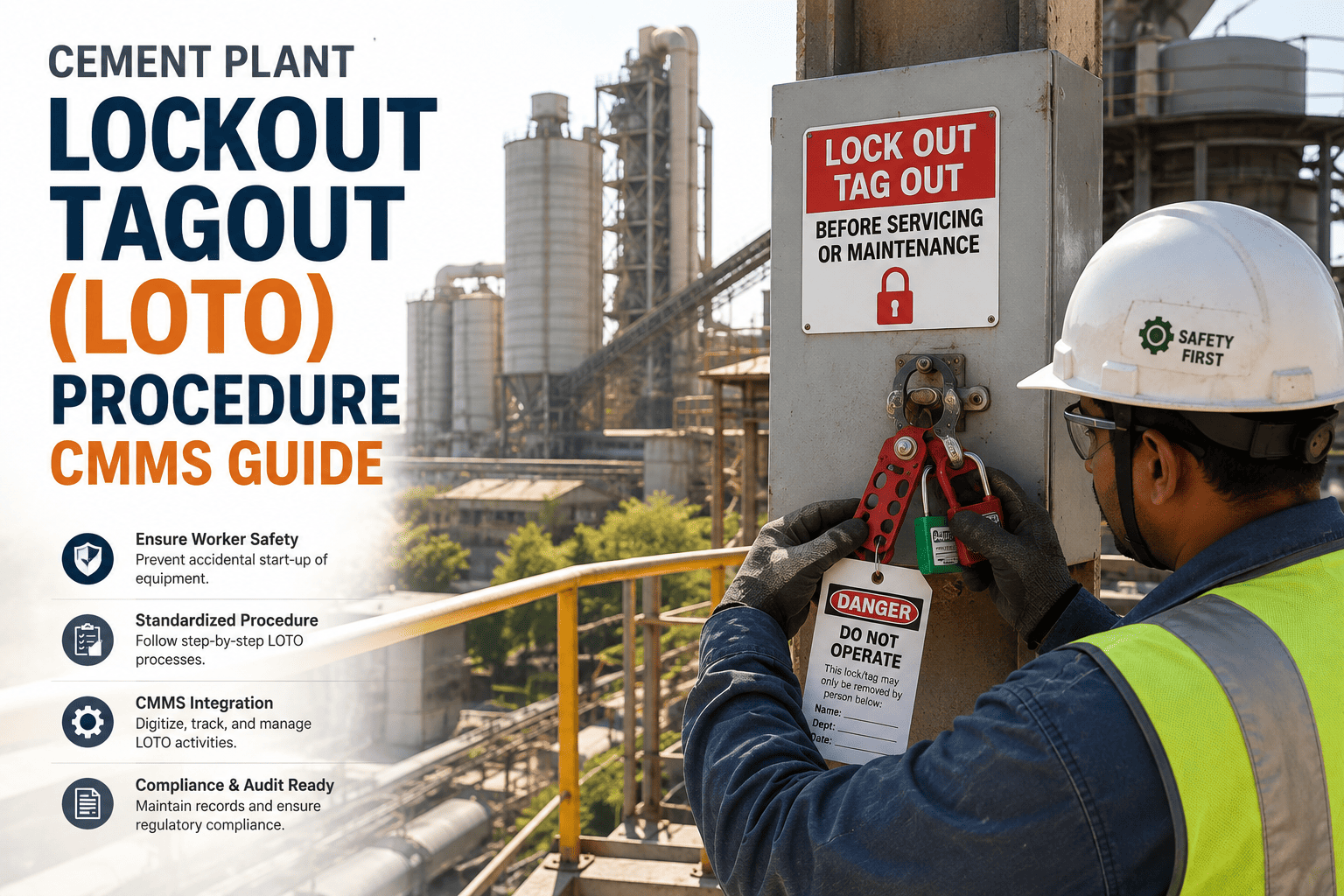
In a cement plant, a stored-energy surprise can come from almost anywhere: a kiln drive that turns under its own unbalanced load, a mill motor with residual rotation, an air cannon on a preheater cyclone, or a silo of material that decides to move. Lockout tagout is the control that keeps maintenance crews safe from all of them, but it only works when isolation points, devices and verification steps are inspected as carefully as the equipment itself. This checklist helps safety and maintenance teams audit LOTO practice across the cement process and record each result in cement plant CMMS software so gaps are closed instead of rediscovered.
Safety & Compliance · Cement Plant LOTO
Cement Plant Lockout Tagout Inspection Checklist
Structured field checks, condition indicators and escalation criteria for auditing energy control on kilns, mills, conveyors, silos and dust collection, so every isolation is verified before hands go near the equipment.
8Inspection Categories
36Check Points
6Frequency Levels
1Prepare
2Shut down
3Isolate
4Lock and tag
5Release stored energy
6Verify zero energy
Cement Plant LOTO Inspection Checklist by Category
Use this checklist for supervisor field audits, shift spot checks and the periodic review of every machine-specific procedure. Tick each item and escalate any exception using the severity bands below.
SEvery shiftWWeeklyMMonthlyQQuarterlyAAnnual or outageEEach job or event
01Quick Field Verification Card
The correct machine-specific procedure is open at the point of use and its revision matches the asset as installed.EEach job · Authorized person
The number of locks on the isolation points matches the number of energy sources listed on the procedure.EEach job · Authorized person
Every worker exposed to the equipment has a personal lock on the isolation point or on the group lock box.EEach job · Job lead
Stored energy is confirmed released: gauges read zero, raised parts are blocked and rotation is restrained.EEach job · Authorized person
A try-start was performed, the result recorded, and the controls returned to the off position.EEach job · Authorized person
Linked permits for confined space, hot work or work at height are in place and their expiry times checked.EEach job · Permit issuer
02Procedures and Authorization
A machine-specific energy control procedure exists for the equipment, lists every energy source and isolation point, and is available at the point of use.EEach audit · Safety officer
Procedure revision matches the equipment as installed, including any modification, bypass or added drive since the last review.EEach audit · Maintenance engineer
Workers performing lockout are listed as authorized, with training records current and refresher dates visible.QQuarterly · Safety officer
Work permits reference the lockout, and confined space or work at height permits are linked where the job requires both.EEach job · Permit issuer
03Locks, Tags and Devices
Locks are individually keyed, identifiable by owner, and not duplicated. Tags show name, date and reason in a format that survives dust and moisture.WWeekly · Supervisor
Lockout stations are stocked with hasps, valve covers, breaker lockouts and tags, and damaged or corroded devices are removed from service.WWeekly · Area owner
Disconnects, breakers and valves have legible labels matching the procedure, and high-voltage switchgear access follows electrical safety rules.MMonthly · Electrical lead
Lockout boxes and group lock boards are in place and in use for multi-person jobs such as mill relining and kiln shell work.EEach job · Job lead
04Isolation and Stored Energy
Electrical isolation is at the motor control centre or switchgear, not at a local stop button, and the isolator position is confirmed before locking.EEach job · Authorized person
Compressed air supply to air cannons, pulse valves and pneumatic gates is isolated, bled down and verified at a gauge or bleed point.EEach job · Authorized person
Hydraulic circuits and accumulators are depressurized, and raised or loaded components are lowered or mechanically blocked.EEach job · Authorized person
Rotating equipment such as mill, kiln and fan rotors is confirmed stationary and secured against turning by gravity, draft or load.EEach job · Authorized person
Material supply is stopped and bulk material is accounted for, with hung-up or bridged material treated as stored energy before anyone enters or clears.EEach job · Area supervisor
05Area-Specific Field Checks
Kiln and preheater: auxiliary drive isolated, kiln mechanically secured, cyclone blockage clearing planned with air cannons locked out and personnel kept clear of discharge paths.EEach job · Kiln supervisor
Mills and crushers: main and inching drives locked, lubrication and hydraulic units isolated, and any feed gates closed and locked before entry.EEach job · Mill supervisor
Conveyors and elevators: take-up tension released or secured, anti-rollback devices checked, and pull cords or trip switches included in the isolation scope.EEach job · Area supervisor
Silos and hoppers: discharge gates and aeration locked, entry covered by a separate confined space permit, and atmosphere and engulfment risk assessed.EEach job · Permit issuer
Dust collectors and fans: fan isolated and prevented from windmilling, pulse air and screw conveyors locked, and rotary valves secured before bag or hopper work.EEach job · Area supervisor
06Group Lockout and Contractors
Every person exposed to the equipment, employee or contractor, has applied a personal lock, and the group lock owner is named on the permit.EEach job · Job lead
Contractors received the site procedure, tag rules and emergency contacts before work, and their lock ownership is recorded.EEach contract · Contract owner
Shift handover transfers locks through a documented step, and no lock is removed by anyone other than its owner without the approved removal process.EEach shift · Shift supervisor
07Restoration, Verification and Periodic Audit
Tools and materials removed, guards refitted, and all personnel accounted for and clear of the machine before locks are removed.EEach job · Authorized person
Affected workers are informed before re-energizing, and the first start is observed with the area clear.EEach job · Area supervisor
Periodic inspection of each machine-specific procedure is completed at least annually, with an observer other than the person using the procedure and findings documented.AAnnual · Safety officer
Near misses and procedure deviations feed the corrective action list with owners and due dates, and closure is verified in the field.MMonthly · Safety committee
08Audit Sign-Off and Records
Audit date, area, equipment, auditor and observed workers are recorded in the audit record.EEach audit · Auditor
Photos of locks, tags and gauge readings are attached as evidence.EEach audit · Auditor
Each finding is classified using the escalation bands, with an owner and due date assigned.EEach audit · Safety officer
Training and procedure review gaps are raised as corrective actions and not left as verbal feedback.EEach audit · Safety officer
The auditor and area supervisor have both signed the completed checklist.EEach audit · Area supervisor
Make Every Isolation Audit Traceable
Run LOTO field audits on mobile in Oxmaint, attach photos of locks and gauge readings, and turn each failed item into a corrective work order with an owner and a due date.
The Six-Step Isolation Sequence the Inspection Follows
Inspectors observe each step on live jobs and compare it with the written procedure.
1Prepare and notifyThe authorized person reviews the machine-specific procedure, identifies every energy source and informs operations and affected workers before any shutdown starts.
2Shut down normallyEquipment is stopped using the normal sequence, which matters in cement because feeding material into a stopped mill or kiln creates new hazards.
3Isolate energy sourcesBreakers, disconnects, valves and gates are operated to separate the machine from electrical, pneumatic, hydraulic and material supply.
4Apply locks and tagsEach authorized worker applies a personal lock and tag showing name, date and reason. Tags alone are not treated as equal to locks where locking is possible.
5Release or restrain stored energyCapacitors, springs, air receivers, hydraulic accumulators, raised components and loaded belts are discharged, blocked or secured.
6Verify zero energyStart controls are tested, voltage is checked where required, and gauges are read to confirm that the machine cannot move or release energy.
Energy Sources LOTO Must Cover in a Cement Plant
Cement process equipment combines heavy rotating mass, high-voltage supply, compressed air, hydraulics and bulk material. The table lists what an inspector should look for in each area.
Where LOTO Programs Break Down on Site
Most incidents involving energy control do not come from missing procedures. They come from small departures that become habit. The comparison shows what inspectors should challenge.
Common gap found in audits
Verified practice
Operator stop button or control-room interlock treated as isolation
Energy isolating device physically locked and tagged at the source
Generic procedure shared across different machines
Machine-specific procedure listing every energy source and isolation point
Compressed air and hydraulics left pressurized after power is removed
Stored energy bled, blocked or restrained, then confirmed at gauges
Verification skipped because the job is quick
Try-start test performed by the authorized person before work begins
Contractor locks missing from group lockout
Every worker and contractor places a personal lock on the group device
Locks left on across shift change with no handover note
Documented handover with locks transferred only through a controlled process
Cement-Specific Hazards Inspectors Should Challenge
Generic LOTO audits miss hazards that are unique to clinker and cement production. These questions help inspectors probe beyond the lock itself.
Can the kiln or mill still turn?Heavy rotating mass can move from uneven load or draft even with power removed. Ask how rotation is physically prevented.
Is material itself treated as energy?Hung-up clinker, raw meal or coal can release without warning. Ask how clearing tasks are isolated and who stays clear of discharge paths.
Are air cannons and pulse headers bled down?Trapped compressed air is a frequent surprise. Ask where pressure is verified and who confirms it.
Does isolation cover heat and dust?Hot surfaces, dust-laden atmospheres and confined spaces need their own permits alongside the lock.
Escalation Criteria for LOTO Findings
Findings should trigger the same response regardless of who finds them. Adapt the severity bands to your site rules.
Compliance and Records Behind the Checklist
Confirm which rules govern your site, since cement operations may fall under OSHA general industry rules, MSHA requirements or national equivalents. Typical elements are consistent across them.
Written energy control programA documented program with machine-specific procedures, as described in OSHA 29 CFR 1910.147 for general industry sites.
Authorized and affected worker trainingTraining matched to each role, with retraining after procedure changes or observed deviations.
Periodic inspectionsReview of each procedure at least annually, documented with the equipment, date, inspector and employees involved.
Management system alignmentRecords that support an ISO 45001 style safety management system, including corrective action tracking and audit evidence.
How the LOTO Workflow Runs in Oxmaint
Oxmaint maintenance management software connects energy control to the work that triggers it.
Asset-linked proceduresAttach each machine-specific procedure to the asset record so crews open the right version from the work order.
Work orders with isolation stepsInclude lockout tasks and verification as mandatory steps before maintenance tasks can be completed.
Mobile field auditsSupervisors complete the checklist on a phone, attach photos and capture signatures for audit records.
Scheduled periodic reviewsAnnual procedure reviews and training refreshers are generated as recurring preventive tasks with reminders.
Corrective action trackingFailed audit items become work orders with owners, so closure is visible and not left in an email.
Reports and dashboardsAudit pass rates, overdue reviews and repeat findings by area guide where to focus safety effort.
KPIs for LOTO Performance
Pair leading indicators with incident data so the program is judged on prevention, not only on injuries.
Frequently Asked Questions
Why is LOTO harder in a cement plant than in a typical factory?
Cement plants combine large rotating mass, bulk material that can shift, compressed air cannons and many dust-heavy interfaces. Isolation scope is broader and easier to miss.
How often should LOTO procedures be inspected?
Energy control procedures should be inspected at least annually under OSHA 1910.147, and sooner after incidents or equipment changes. Confirm local rules.
Is a tag enough if locking is possible?
No. Where a device can be locked, a lock should be used, with a tag showing who applied it and why.
Can a cement plant CMMS manage LOTO records?
Yes. A cement plant CMMS can link procedures to assets, store audits and track actions. Book a demo to see the workflow.
What should happen when a lock is found unattended?
Treat the equipment as locked out, trace the owner through the documented process, and never cut the lock without approval. Get started to track these events.
Close the Gaps Before the Next Shutdown
Bring LOTO procedures, field audits, training dates and corrective actions into one cement plant maintenance system, and give every shutdown a verified record.