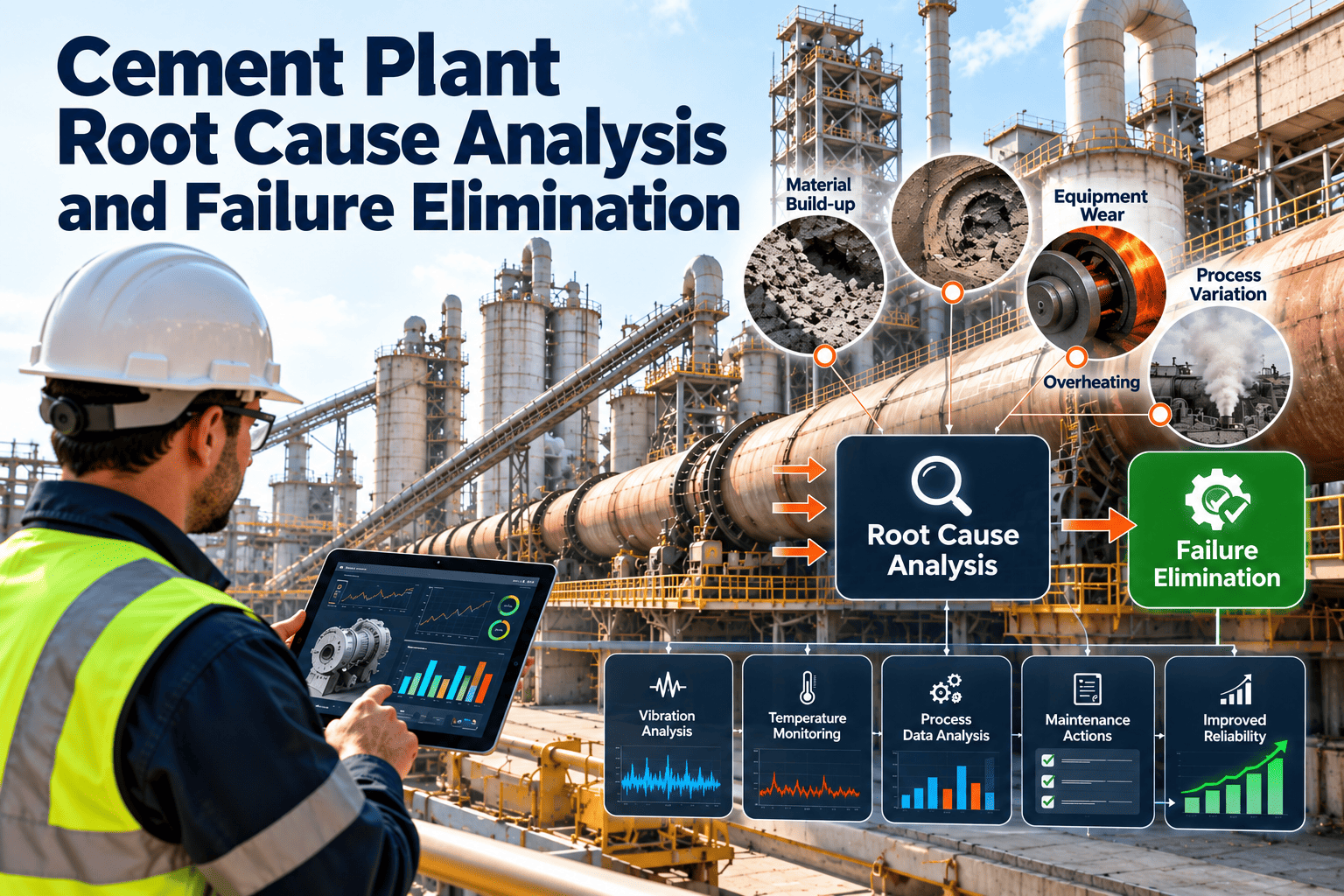
A kiln trips at 3 AM for the third time in ninety days, and the maintenance team replaces the same bearing for the third time, because nobody has connected this failure to the previous two. Across documented failure events at cement plants, repeat failures with an unidentified or uncorrected root cause routinely account for more than a third of total downtime, even when every individual repair was carried out correctly. The problem is rarely a lack of effort — it is that DCS history, maintenance work orders, and production logs sit in three different systems that nobody has time to cross-reference at 3 AM. AI root cause analysis closes that gap by reading all three at once, surfacing the pattern in seconds instead of leaving it buried until the fourth trip. Sign up to see how Oxmaint connects sensor history, work orders, and failure patterns into one root cause view.
AI Root Cause Analysis for Cement Downtime: Stop Fixing the Same Failure Three Times
Oxmaint connects sensor history, work order records, and downtime events automatically, surfacing the probable root cause and the open corrective action gap in seconds instead of days.
A Third of Your Downtime May Already Be Preventable
Research analysing thousands of documented failure events across cement plants shows the same pattern again and again: mechanical systems dominate failure causes, and a large share of those failures are repeats of something the plant already paid to fix once.
From Failure Event to Closed Corrective Action
Stop Letting the Same Failure Repeat Because Nobody Had Time to Cross-Reference the Data
Oxmaint's AI RCA engine reads sensor history, work orders, and failure patterns together — turning every significant failure into a closed corrective action instead of a recurring repair.
Four Capabilities Behind Automated Root Cause Analysis
Oxmaint continuously compares new failure events against historical patterns, flagging recurring signatures across shifts, seasons, and asset clusters that a manual review would likely miss.
High-cost or repeat failures require a structured 5-Why investigation before the work order can close, ensuring no significant event escapes a real root cause review.
Every identified corrective action is tracked as an open item with an owner and a due date, and stays open until the system confirms the failure has not recurred.
Every completed RCA becomes searchable institutional knowledge, so the next technician who sees a similar fault finds the proven fix in minutes, not after rediscovering it themselves.
Where Most Repeat Failures Actually Originate
Documented failure data across cement plants consistently points to the same equipment categories as the largest source of unplanned downtime — and the same handful of root causes behind most of those events.
| Failure Category | Share of Downtime | Common Root Cause | Typical Corrective Action |
|---|---|---|---|
| Bearing Failures | High | Lubrication contamination or misalignment | Revised lubrication PM and alignment check |
| Gearbox Failures | High | Overloading or oil analysis gap | Load review and oil sampling interval change |
| Conveyor Components | Moderate | Idler wear or belt tracking drift | Idler replacement schedule and tracking adjustment |
| Electrical Trips | Moderate | Loose connection or thermal hot spot | Torque verification and thermal imaging round |
| Instrumentation Faults | Lower | Calibration drift or sensor fouling | Calibration interval review and cleaning PM |
AI Root Cause Analysis for Cement Plants — Common Questions
Oxmaint cross-references sensor trends, work order history, and production context around the failure window, then compares the resulting pattern against prior failure events on the same or similar assets. The system proposes the most probable root cause and the contributing factor chain, which the maintenance team then confirms through a structured 5-Why review. This combination of automated pattern matching and human verification keeps the output reliable rather than a black-box guess. Book a demo to see a real failure pattern analysed live.
Plants configure their own trigger thresholds, but the most common rules are downtime exceeding a set duration, repeat failures on the same asset within a defined window, safety-related incidents, and repair costs above a chosen amount. Once a triggering event occurs, Oxmaint opens the RCA workflow automatically rather than waiting for someone to remember to start one. This ensures no significant failure escapes formal investigation simply because the team was busy. Sign up to configure your own RCA trigger thresholds.
No, Oxmaint embeds the 5-Why methodology directly into the work order workflow rather than replacing it, giving your reliability team a structured digital template instead of a spreadsheet or paper form. The AI pattern detection simply does the data-gathering legwork beforehand, so the team starts the 5-Why with relevant evidence already assembled. Fishbone diagrams and other structured methods can still be attached as supporting documentation. Start a free trial to see the 5-Why template inside a real work order.
Oxmaint can begin surfacing patterns from the moment historical work order and sensor data is imported, since pattern detection compares against past events rather than requiring months of new data collection. That said, accuracy improves as more failure events are logged and corrective actions are verified over time. Most plants see clearly useful pattern flags within the first few weeks of go-live, even on assets with only a year or two of digitised history. Book a demo to see what your existing history could already reveal.
Yes. When a root cause investigation points to an interval that is too long, a missing inspection step, or a lubrication frequency that does not match actual wear data, the recommended PM change can be pushed directly into the asset's maintenance schedule from inside the RCA record. This keeps the corrective action from becoming a one-time fix that quietly drifts back to the old schedule months later. Sign up to link your RCA findings to live PM schedules.
Make This the Last Time This Bearing, Gearbox, or Drive Fails for the Same Reason.
Oxmaint's AI root cause analysis connects sensor history, work orders, and failure patterns into one view — so every significant failure becomes a closed corrective action instead of a recurring line item on next month's maintenance budget.