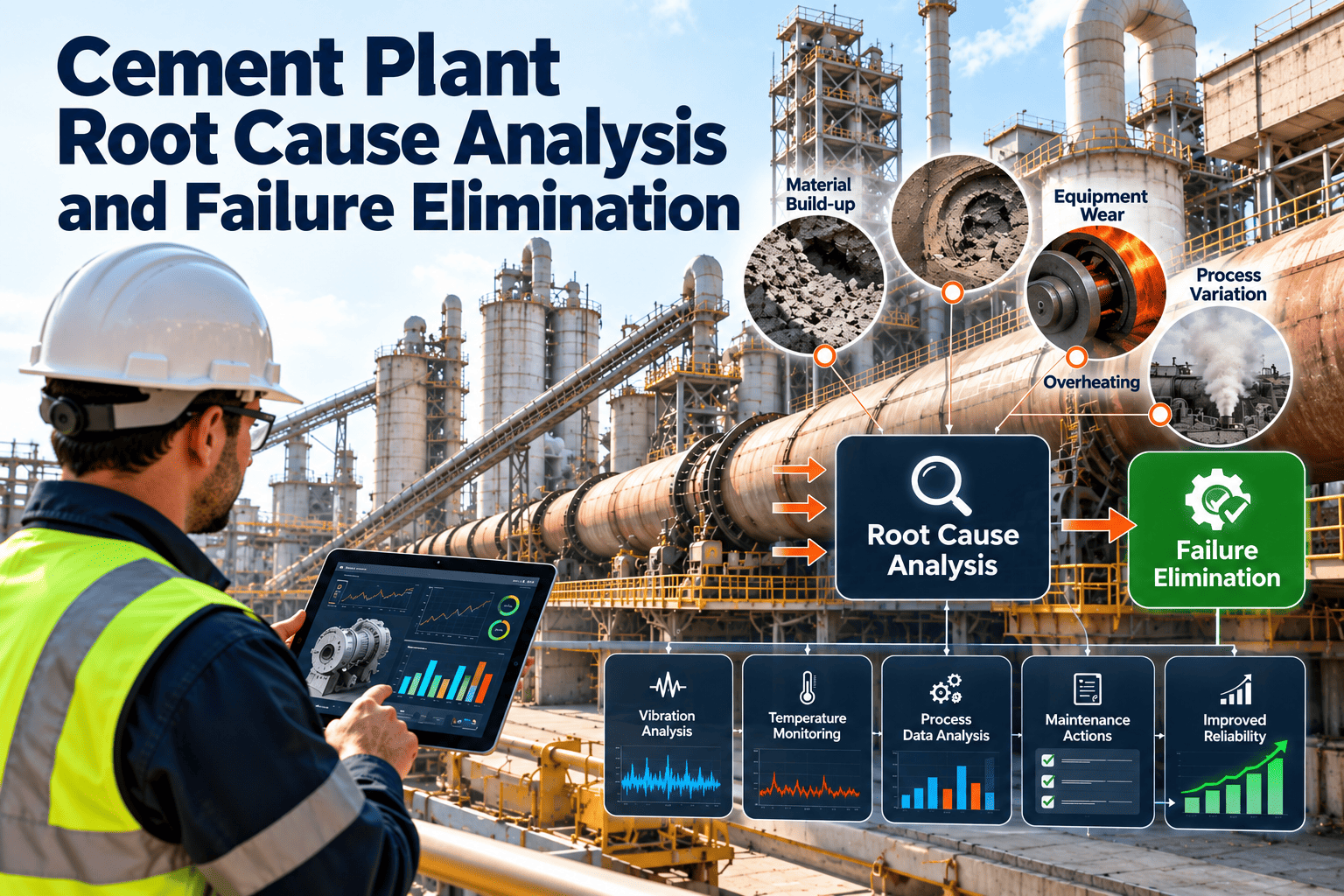
Cement plants lose 18 to 22% of production time to equipment failures, and 73% are repeat events from unresolved root causes. A repeated rotary kiln bearing failure costs $180,000 to $280,000 per event. Plants with CMMS-integrated RCA reduce recurring failures by 58% within 18 months. Book a demo to see how Oxmaint embeds 5-Why, fishbone, and FMEA templates into work orders and links every finding to the asset record.
RCA Compliance Frameworks for Cement Plants by Region
Failure investigation requirements vary by region. Oxmaint generates audit-ready RCA documentation across all frameworks below without manual report assembly.
| Region | Key Regulatory Frameworks | Oxmaint Coverage |
|---|---|---|
| USA | OSHA 29 CFR 1910.119 PSM, EPA RMP failure analysis, MSHA 30 CFR Part 50 | RCA templates per failure class, corrective action tracking, investigation records |
| UAE | OSHAD-SF incident investigation, Civil Defence post-incident analysis, SASO documentation | Digital investigation workflows, multi-site dashboards, corrective action records |
| India | Factories Act 1948 Section 88, DGMS kiln failure investigation, CPCB incident reporting | Failure records linked to asset history, statutory templates, corrective action tracking |
| Germany | BetrSichV Article 14 obligations, DIN EN 13306 documentation, TUV failure records | Investigation docs per DIN EN 13306, condition archiving per failure event |
| UK | RIDDOR 2013 reportable investigation, PUWER 1998 equipment analysis, HSE cement guidance | RIDDOR-aligned records, work order failure classification, action exports |
| Canada | CSA Z1000 reliability maintenance, Provincial OHS Acts investigation, ACGIH guidelines | Multi-site RCA dashboards, corrective action audit trails, closure tracking |
Connect Your Failure History to Structured RCA
Oxmaint embeds 5-Why, fishbone, and FMEA templates directly into failure work orders, linking every finding to the asset record with photo documentation and corrective action tracking. Book a demo to see RCA workflows built from your failure history.
What Is Root Cause Analysis for Cement Plant Failures?
RCA identifies physical, human, and systemic causes behind kiln, mill, and cooler failures. Without it, 67% of plants repeat the same failure modes within 18 months. Book a demo to see how Oxmaint structures investigation from capture through corrective action closure.
Structured Failure Investigation
Systematic process identifying physical, human, and latent causes behind every failure event. Converts a reactive repair into a documented investigation preventing the same failure on the next kiln campaign.
Failure Mode Classification
Categorising events by mode and severity. Enables Pareto analysis identifying the 20% of failure modes driving 80% of unplanned downtime so effort focuses where returns are greatest.
CMMS Failure History Integration
Linking RCA findings to the specific asset record. History builds per asset class so patterns across kiln bearings, mill liners, and girth gear assemblies become visible without cross-referencing paper records.
Corrective Action Management
Tracking every finding to verified implementation with named owner, deadline, and evidence. Without structured tracking, 54% of recommendations are abandoned within 6 months.
Four RCA Failures Costing Cement Plants Every Year
No Structured Investigation After Failures
Without embedded RCA, teams restore equipment and move on. Root causes stay verbal. The same kiln bearing or ball mill gearbox fails again within 6 to 14 months with no record of the first event.
Failure History Scattered Across Records
Failure data is split across paper logs, SAP work orders, and verbal handovers. Pattern analysis is impossible and every investigation starts without context from previous events on the same equipment.
RCA Findings Never Trigger PM Updates
Even when RCA is completed, findings rarely update PM intervals in the CMMS. The corrective action stays on a whiteboard and never reaches the trigger parameters that would prevent recurrence.
No Cross-Plant Pattern Visibility
Multi-site groups experience identical girth gear and preheater dip tube failures at different plants. Without cross-site analytics, the solution from Plant A never reaches Plant B in time, costing $180,000 to $280,000.
How Oxmaint Structures Cement Plant Root Cause Analysis
Oxmaint connects failure capture, RCA templates, corrective action tracking, and PM updates into a single work order workflow. Book a demo to walk through the RCA workflow against your plant's failure modes.
Four RCA Methods Pre-Configured in Oxmaint
All four include cement-specific templates with asset failure history auto-populated at launch. Book a demo to see each configured for your equipment.
Oxmaint RCA Platform Modules for Cement Plant Reliability
Book a demo to walk through each module against your plant failure history.
Reactive Failure Response versus Oxmaint Structured RCA
Read the maintenance KPIs guide to see how RCA improvements feed into MTBF and kiln availability metrics.
| Performance Factor | With Oxmaint | Without Oxmaint |
|---|---|---|
| Kiln Bearing Recurrence | 71% recurrence reduction. Lubrication adjusted to revolution-count trigger. PM updated with temperature baseline check. | 67% of bearing failures recur within 18 months. Investigation verbal only. Root cause never reaches PM schedule. |
| Girth Gear Degradation | Fault tree identifies alignment deviation. Quarterly PM added. Zero deterioration at 30-month inspection. | Attributed to age only. Same failure repeats on the replacement gear within 30 months. |
| Ball Mill Liner Wear | Oversize feed identified as wear accelerator. Crusher spec tightened. Liner life extends 60% to 94% rated. Annual saving $240,000. | Liners replaced at 60% rated life with no investigation. Cost $120,000 to $180,000 per event. |
| Preheater Refractory Failure | FMEA finds inspection interval insufficient. Frequency increased. Failure rate reduced 63% over following two campaigns. | Emergency reline costs $85,000 to $320,000. No interval analysis. Pattern repeats in following campaign. |
| Corrective Action Closure | 89% closure within 90 days. Named owner accountability. PM changes required as closure evidence. | 54% of recommendations abandoned within 6 months. Email-thread tracking with no enforcement. |
| PM Schedule Updates | Interval gaps route to PM review automatically. Revolution-count triggers replace calendar dates. PM compliance reaches 84%. | Intervals set at commissioning, rarely changed. Calendar schedules unchanged even after failures. PM compliance averages 31%. |
Every Failure Should Make the Next Campaign More Reliable
With Oxmaint, every kiln stop becomes a structured investigation linked to the asset record and fed back into the PM schedule. Book a demo and see how your failure history becomes a reliability improvement engine.
RCA Programme Performance: Benchmarks at 18 Months
RCA ROI: Results at a Glance
Frequently Asked Questions: RCA for Cement Plant Failures
QWhy is structured RCA necessary in cement plant maintenance?
QWhich RCA method works best for cement equipment failures?
QWhich compliance frameworks require failure investigation at cement plants globally?
QHow does CMMS failure history improve RCA investigation quality?
QHow quickly can an RCA programme be deployed at a cement plant?
QWhat is the financial return on RCA investment in cement manufacturing?
Continue Reading: Cement Plant Maintenance and Reliability Resources
Cement Plant Annual Shutdown Planning with CMMS
CMMS-driven shutdown planning reduces outage duration by 41% and keeps scope overruns below 12% at integrated cement plants.
Click Here to Read MoreCement Plant Contractor Management for Shutdowns
Digital work packages eliminate the 28% of overrun hours caused by contractor interface failures during planned cement plant outages.
Click Here to Read MoreCement Plant Maintenance KPIs: MTBF, OEE and Availability
RCA improvements feed directly into MTBF and kiln availability. CMMS-tracked KPIs become leading signals that predict shutdown scope and anchor capital decisions.
Click Here to Read MoreKiln Shutdown Checklist: Cooldown and Restart Procedures
RCA findings feed into cooldown and restart checklist updates that prevent the same failure modes during the next campaign startup.
Click Here to Read MoreStart Eliminating Repeat Failures at Your Cement Plant
Oxmaint RCA templates deploy within 30 days, connected to your failure history and PM schedules from day one. No heavy configuration, no data migration, no shutdown required. Book a 30-minute demo and see structured RCA running against your plant failure data.